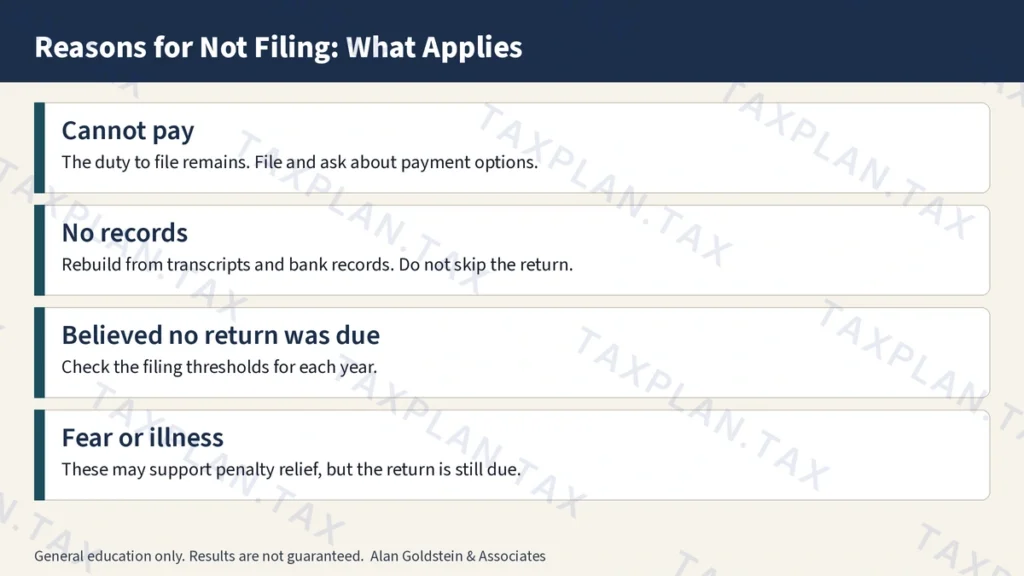


Common reasons for not filing federal tax returns include inability to pay, fear, missing records, a belief that no return is due, and serious life events. People don’t file for many human reasons. Most of these reasons are understandable. However, few of them stop the filing duty, and the cost of waiting usually grows each month. This guide explains each reason, what the IRS and the courts say about it, and what you can do next as of late 2026.
Key Takeaways
- Inability to pay does not excuse failing to file, and the IRS tells taxpayers to file all returns that are due even if they cannot pay in full.
- Missing records, serious illness, and disasters may support penalty relief, but you must show ordinary care and prudence.
- Relying on a preparer or another person generally does not qualify as reasonable cause.
- Willful failure to file can be a crime, and courts treat the filing duty as clear.
- Whatever the reason, filing the missing returns is usually the first step toward resolution. No outcome is guaranteed.
What are the most common reasons for not filing federal tax returns?
The reasons commonly include inability to pay, fear or overwhelm, lost records, a mistaken belief that no return is needed, illness or family crises, reliance on someone else, and tax protest beliefs. The IRS does not publish a ranked list, so these are the situations that come up most often in practice.
The problem is not small. The IRS projects that the nonfiling part of the gross tax gap, meaning tax not paid on time by those who do not file on time, was $63 billion for tax year 2022 (IRS: The tax gap). That figure is a projection, not a count of people. It does show that late and missing returns are a significant compliance issue.
What if you can’t afford to pay?
File anyway. The IRS says to file all tax returns that are due, whether or not you can pay in full (IRS: Filing past due tax returns).
Filing matters because the penalties differ. Under IRC §6651, the failure-to-file penalty is 5% of unpaid tax per month, up to 25%. The failure-to-pay penalty is 0.5% per month, also up to 25%. Skipping the return therefore usually costs more than filing and paying slowly. The IRS also offers payment options, including a short extension to pay, an installment agreement, and an offer in compromise. Our guide to installment agreements for unfiled returns explains how that works.
What if you are afraid of the IRS or feel overwhelmed?
Avoidance tends to make the problem larger. Filing is the step that lets you start resolving it.
If you do nothing, the IRS may file a substitute return that might not give you credit for deductions you could claim (IRS: Filing past due tax returns). Help exists. The IRS says you may qualify for Volunteer Income Tax Assistance (VITA) or Tax Counseling for the Elderly (TCE) if you struggle to prepare a return. Low Income Taxpayer Clinics can also represent eligible low-income taxpayers in disputes with the IRS. A qualified professional can handle contact with the IRS for you.
What if you lost your records?
Lost records do not erase the duty to file, but you can rebuild many numbers. IRS transcripts show information returns that payers filed.
The IRS says the wage and income transcript is available for the current and nine prior tax years. It also lists “inability to get records” as an example that may support reasonable cause (IRS: Penalty relief for reasonable cause). That relief depends on your showing ordinary care. For freelancers, see our guide to unfiled tax returns for independent contractors.
What if you thought you didn’t need to file, or expected a refund?
Check the filing rules for each year. The requirement depends on income, filing status, age, and other facts, and self-employed people have a lower trigger.
For 2025, a single filer under 65 generally must file with gross income of $15,750 or more. You must also file if you had over $400 in net earnings from self-employment, and the IRS lists other situations that require a return (IRS: Check if you need to file a tax return). If you expected a refund, the timing rule is strict. You generally must claim it within three years of the return due date, or you risk losing it. If you owe no tax, the failure-to-file penalty is generally zero, because it is based on unpaid tax. For more, see our guide to whether you owe taxes on unfiled returns if you are due a refund.
What if illness, a death, or a disaster got in the way?
These events may support penalty relief. The IRS lists fires, natural disasters, and the death, serious illness, or unavoidable absence of the taxpayer or an immediate family member as examples (IRS: Penalty relief for reasonable cause).
The Supreme Court has recognized this principle. In United States v. Boyle (1985), it noted that the IRS exempts late filings when delay results from illness and other factors largely beyond the taxpayer’s control. It also said a disability alone could well be an acceptable excuse for a late filing (469 U.S. at 248). The Court framed that point as outside the question it decided. For refunds, IRC §6511(h) suspends the refund time limits while an individual is financially disabled, as the statute defines that term.
What if you relied on a spouse, preparer, or employer?
Reliance on someone else generally does not excuse a late return. The IRS says you are responsible for compliance even if another person handles your taxes.
The IRS lists reliance on a tax professional and lack of knowledge among the reasons that generally do not qualify (IRS: Penalty relief for reasonable cause). Boyle reached the same result for an executor who relied on a lawyer to file an estate tax return. The Court said the lawyer’s role did not relieve the executor of the duty to comply, and that reliance “cannot function as a substitute for compliance with an unambiguous statute” (469 U.S. at 250–51).
What about tax protest beliefs?
Do not rely on them. The IRS describes common frivolous arguments and warns that taxpayers may not rely on them to avoid or evade federal tax (IRS: The truth about frivolous tax arguments).
Courts have rejected the idea that a privilege objection lets you skip the return. In United States v. Sullivan (1927), the Supreme Court said a person could raise a Fifth Amendment objection to particular answers on the return, but could not on that account refuse to make any return at all (274 U.S. at 263). Willfulness is the key issue in criminal cases, as the next section explains.
Do any of these reasons excuse failing to file?
Some may support penalty relief, but none removes the duty to file. Relief depends on the facts, and the IRS decides each case on its merits.
The IRS says reasonable cause is determined case by case on all the facts and circumstances. The table summarizes how the IRS page treats each common reason:
| Reason | How the IRS treats it for penalty relief |
|---|---|
| Lack of funds | Not reasonable cause by itself for failing to pay; other facts may matter |
| Inability to get records | Listed as a valid example, with ordinary care shown |
| Serious illness, death, or unavoidable absence | Listed as a valid example |
| Fires, natural disasters, civil disturbances | Listed as valid examples |
| Reliance on a tax professional | Generally does not qualify |
| Lack of knowledge of the rules | Generally does not qualify |
| Fear or avoidance | Not listed; judged on all facts and circumstances |
Even if a reason qualifies, relief applies to penalties, not to the tax or the filing duty itself. Tax and interest remain.
What happens if you don’t file, whatever the reason?
Penalties, interest, and enforcement can grow. The IRS may also file a substitute return and start collection.
- Penalties. The failure-to-file penalty is 5% per month up to 25%. If a return is more than 60 days late, the minimum is the smaller of $525 (for 2025 returns due in 2026) or 100% of the tax due (IRS: Failure to file penalty).
- Interest. The underpayment rate is 7% for October through December 2026 and 8% from January 1, 2027 (IR-2026-144).
- No time limit. If you file no return, the IRS may assess tax at any time under IRC §6501(c)(3).
- Criminal exposure. Willful failure to file is a misdemeanor under IRC §7203.
The Supreme Court defines willfulness in this area as a voluntary, intentional violation of a known legal duty (Cheek v. United States, 498 U.S. at 201). In Spies v. United States (1943), the Court described willful but passive neglect of the statutory duty as the lesser offense, separate from the felony of willfully attempting to evade tax (317 U.S. at 499). Most late filers face civil outcomes, but that is no guarantee. See our guide to what happens if you don’t file.
How can you fix the problem, whatever the reason?
Gather your IRS records, file the missing returns, and then address any balance. Each step reduces risk.
- Get transcripts. Use Get Transcript to see what the IRS has for each year.
- File the returns. Our guide to filing past-due federal tax returns explains the steps.
- Handle the balance. Consider a payment plan, an offer in compromise, or penalty relief, as our posts on offers in compromise and currently not collectible status describe.
- Stay current. File and pay on time going forward.
If you have missed several years, read our guide on what to do if you haven’t filed in 5 years.
Frequently Asked Questions
Is not being able to pay a valid reason to skip filing?
No. The IRS says to file all returns that are due even if you cannot pay in full. Filing limits the larger failure-to-file penalty.
Can fear of the IRS be reasonable cause?
The IRS does not list fear as an example. Reasonable cause is judged on all facts and circumstances, so a qualified professional should review your situation.
What if I thought I owed nothing or was due a refund?
You may still have had to file. If you owed nothing, the failure-to-file penalty is generally zero, but a refund must be claimed within three years of the due date.
Does relying on my accountant excuse a missed return?
Generally not. The IRS says reliance on a tax professional usually does not qualify as reasonable cause, and Boyle reached the same result for a lawyer.
Can illness excuse missed returns?
It may support penalty relief if you show ordinary care. The IRS lists serious illness as an example, and the facts and timing matter.
Can I go to jail for not filing?
Willful failure to file is a misdemeanor, but most late filers face civil penalties instead. Willfulness is the key question, so get advice if you have concerns.
Where can I get free help?
The IRS lists VITA and TCE for preparation help and Low Income Taxpayer Clinics for eligible disputes. Eligibility rules apply.
Conclusion
People skip filing for many human reasons, and most of them are fixable. Whatever your reason, the practical answer is usually the same: get your records, file the missing returns, and address any balance. Results depend on your facts, and no outcome is guaranteed.
Alan Goldstein, MBA, IRS Enrolled Agent, at Alan Goldstein & Associates in Coral Gables, Florida, can review your unfiled returns and your IRS resolution options in a confidential consultation. We do not guarantee any particular result.
Cases Cited
Each case below was checked against the page-numbered text of the official U.S. Reports opinion. Pinpoint pages were confirmed on the cited pages.
- United States v. Boyle, 469 U.S. 241, 248, 250–51 (1985) (U.S. Supreme Court). Cited for the points that IRS practice exempts late filings caused by illness and other factors beyond the taxpayer’s control (at 248, the Court said a disability alone could well be an acceptable excuse, but that question was not before it), and that reliance on an agent does not relieve the taxpayer of the duty to file (at 250–51). Opinion text (GovInfo).
- United States v. Sullivan, 274 U.S. 259, 263 (1927) (U.S. Supreme Court). Cited for the point that a Fifth Amendment objection could be raised as to particular answers on the return but did not justify refusing to make any return. Opinion text (GovInfo).
- Cheek v. United States, 498 U.S. 192, 201 (1991) (U.S. Supreme Court). Cited for the definition of willfulness in criminal tax cases as a voluntary, intentional violation of a known legal duty. Opinion text (GovInfo).
- Spies v. United States, 317 U.S. 492, 499 (1943) (U.S. Supreme Court). Cited for the point that willful but passive neglect of the statutory duty is the lesser offense, while a willful and positive attempt to evade tax is the felony. Opinion text (GovInfo).
Sources
- IRS: The tax gap (projections for tax year 2022)
- IRS: Filing past due tax returns
- IRC §6651, Failure to file tax return or to pay tax
- IRS: Low Income Taxpayer Clinics
- IRS: Transcript types for individuals and ways to order them
- IRS: Penalty relief for reasonable cause
- IRS: Check if you need to file a tax return
- IRC §6511, Limitations on credit or refund (see §6511(h), financial disability)
- IRS: The truth about frivolous tax arguments
- IRS: Failure to file penalty (minimum penalty table)
- IRS: IR-2026-144, Interest rates increase for the first quarter of 2027
- IRC §6501, Limitations on assessment and collection
- IRC §7203, Willful failure to file return, supply information, or pay tax
- IRS: Get Transcript
- United States v. Boyle, 469 U.S. 241, 248, 250–51 (1985) (official U.S. Reports, GovInfo)
- United States v. Sullivan, 274 U.S. 259, 263 (1927) (official U.S. Reports, GovInfo)
- Cheek v. United States, 498 U.S. 192, 201 (1991) (official U.S. Reports, GovInfo)
- Spies v. United States, 317 U.S. 492, 499 (1943) (official U.S. Reports, GovInfo)
This article is provided for general educational purposes and does not constitute individualized tax, legal, or accounting advice. Tax consequences depend on the taxpayer’s specific facts and applicable law.
