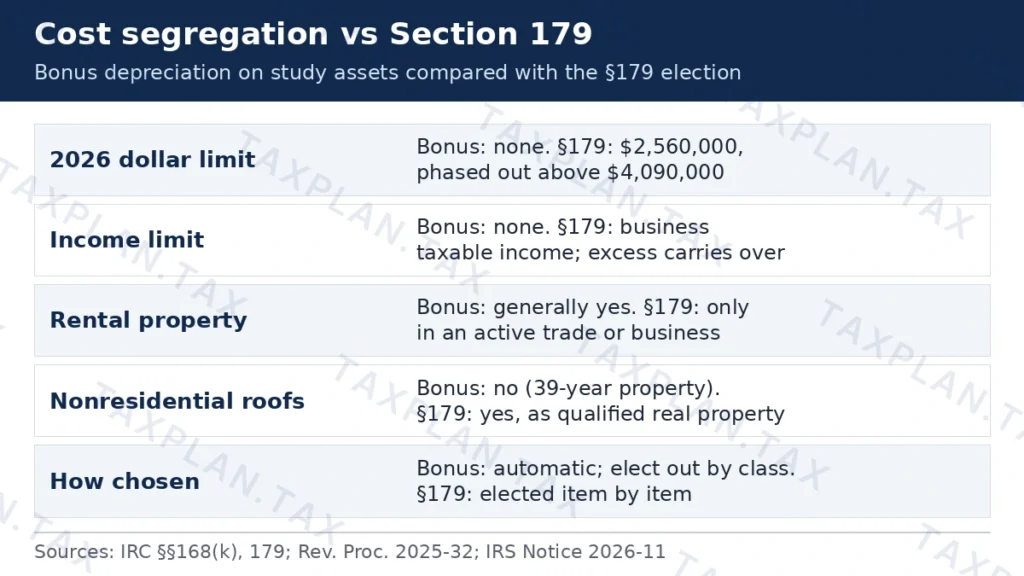


Cost segregation vs Section 179 is not really an either-or choice, because the two tools do different jobs. A cost segregation study is an engineering-based analysis that sorts a building’s cost into shorter recovery classes. By contrast, IRC §179 is an election to expense the cost of certain business property in the year you place it in service. In practice, a study often identifies the property that bonus depreciation or §179 can then deduct.
In fact, the main differences are limits. For tax years beginning in 2026, Rev. Proc. 2025-32 caps §179 at $2,560,000, with a phase-out above $4,090,000. Also, §179 cannot exceed taxable income from the active conduct of a trade or business. Bonus depreciation has no dollar cap or income limit, and it is now 100% for qualified property acquired after January 19, 2025. Therefore, bonus usually handles assets found in a study. However, §179 still matters for roofs and certain HVAC, fire protection, and security improvements that bonus cannot reach.
Key Takeaways
- Cost segregation classifies property; §179 is an election to expense it.
- For 2026, the §179 limit is $2,560,000, reduced dollar for dollar above $4,090,000 of §179 property.
- Section 179 cannot exceed business taxable income, but the excess carries forward.
- By contrast, bonus depreciation is 100% for qualified property acquired after January 19, 2025, with no income limit.
- Still, Section 179 can expense qualifying roofs, HVAC, fire protection, and security systems on nonresidential buildings.
- Most passive rental owners cannot use §179, but they can use cost segregation and bonus depreciation.
Introduction and Background: What Is Cost Segregation vs Section 179?
Direct answer: Cost segregation decides how fast property depreciates; §179 lets you expense certain property at once.
Under IRC §168, a nonresidential building is generally recovered over 39 years. Similarly, residential rental property uses 27.5 years. However, many parts of a building are really personal property or land improvements. Accordingly, a cost segregation study identifies those parts and assigns them 5-, 7-, or 15-year lives. Also, the IRS describes study methods in its Cost Segregation Audit Techniques Guide (Publication 5653).
Section 179, meanwhile, is not a classification tool. Instead, it is an election. Specifically, it lets a business deduct the cost of qualifying property immediately, within annual limits. Public Law 119-21, §70306, raised the base limit to $2,500,000 and the phase-out threshold to $4,000,000 for tax years beginning after 2024. After 2025, both amounts are indexed for inflation.
So the real comparison is between two ways to deduct short-life property: §179 and bonus depreciation with cost segregation. For a broader view of the timing benefit, see cost segregation vs standard depreciation.
How Does Cost Segregation vs Section 179 Work in Practice?
Direct answer: A study identifies eligible assets, and then you choose §179, bonus, or regular MACRS for each class or item.
Step 1: Cost segregation classifies the property before any Section 179 choice
First, the study separates items such as carpet, millwork, dedicated electrical, and paving from the building shell. Notably, the legal basis comes from cases applying the old investment tax credit rules. In Hospital Corp. of America v. Commissioner, 109 T.C. 21, 55 (1997), the Tax Court held that those rules apply under MACRS.
Step 2: Section 179 comes first
Next, if you elect §179, it applies before bonus depreciation. IRS Publication 946 explains that the special allowance is taken after any §179 deduction and before regular MACRS depreciation. You make the §179 election item by item on Form 4562, Part I.
Step 3: Bonus depreciation applies by class
Then bonus depreciation applies automatically to qualified property. Qualified property generally includes MACRS property with a recovery period of 20 years or less. If you do not want bonus, §168(k)(7) lets you elect out, but only for an entire class for the year.
Step 4: Regular MACRS covers the rest
Finally, any remaining basis is depreciated under MACRS. For example, the building shell stays on its 27.5-year or 39-year schedule.
Key Differences in Cost Segregation vs Section 179
Direct answer: The table compares bonus depreciation on study-identified assets with the §179 election.
| Feature | Cost segregation with bonus | Section 179 |
|---|---|---|
| What it is | Study plus automatic first-year allowance | Elective expensing |
| 2026 dollar limit | None | $2,560,000, phased out above $4,090,000 |
| Income limit | None; can create a loss | Business taxable income; excess carries forward |
| Eligible property | Generally recovery period of 20 years or less | §1245 property and qualified real property |
| Investment rentals | Generally allowed | Requires active trade or business |
| How chosen | Automatic; elect out by class | Elected item by item |
| Sale of property | §1245 recapture | §1245 recapture |
What Are the Benefits of Each Approach?
Direct answer: Bonus is broader and simpler; §179 is more flexible and reaches some building improvements.
Benefits of cost segregation with bonus depreciation
- No income limit. Unlike §179, bonus can create or increase a loss, subject to the passive and excess business loss rules.
- No dollar cap. As a result, large acquisitions are not limited by the §179 phase-out.
- Works for rentals. Investors who hold rental property for income can generally claim bonus depreciation.
- Covers land improvements. In addition, 15-year property such as paving and fencing qualifies.
Benefits of Section 179
- Item-by-item control. For instance, you can choose specific assets and even part of an asset’s cost.
- Qualified real property. Under §179(e), you can expense qualified improvement property and certain later improvements to nonresidential buildings. For example, these include roofs, HVAC, fire protection and alarm systems, and security systems.
- Revocable choices. Also, §179(c)(2) allows you to revoke an election for specific property, though a revocation is final.
- Fills gaps. For example, §179 can help when property does not qualify for 100% bonus.
Legal and Regulatory Considerations for Cost Segregation vs Section 179
Direct answer: Section 179 has strict business-use, income, and property tests; bonus has its own acquisition-date rules.
The active trade or business requirement
Section 179 property must be acquired by purchase for use in the active conduct of a trade or business. Under Treas. Reg. §1.179-2(c)(6), “trade or business” has the same meaning as in §162. Thus, property held merely for the production of income does not qualify. Moreover, a taxpayer generally must meaningfully participate in management or operations.
The Supreme Court described a trade or business in Commissioner v. Groetzinger, 480 U.S. 23, 35 (1987). In particular, the Court said the taxpayer must be involved with continuity and regularity, with a primary purpose of income or profit. As a result, a passive investor in a net-leased building usually cannot claim §179.
Lessor and residential limits
In addition, §179(d)(5) generally bars noncorporate lessors from §179 on leased property unless specific tests are met. Also, qualified real property under §179(e)(2) covers only improvements to nonresidential real property. So apartment owners generally cannot use §179 for roofs or HVAC.
Dollar limits and the income limit
For tax years beginning in 2026, Rev. Proc. 2025-32 sets the limit at $2,560,000, reduced above $4,090,000. Also, under §179(b)(3), the deduction cannot exceed business taxable income. However, the disallowed amount carries forward. For partnerships and S corporations, §179(d)(8) applies the limits at both the entity and owner levels.
Bonus depreciation after Public Law 119-21
Public Law 119-21, §70301, amended §168(k). IRS Notice 2026-11 explains that 100% bonus depreciation now applies permanently to qualified property acquired after January 19, 2025. However, property acquired before January 20, 2025, and placed in service in 2025 generally gets 40%. See our article on permanent 100% bonus depreciation for details.
Recapture
Under §1245(a)(2)(C), a §179 deduction is treated like amortization for recapture. So gain on a later sale is ordinary income to the extent of those deductions. In addition, §179(d)(10) requires recapture if the property stops being used predominantly in a trade or business.
What counts as personal property?
In Whiteco Industries, Inc. v. Commissioner, 65 T.C. 664, 672-673 (1975), the Tax Court listed questions about whether property is movable and permanent. Those questions still guide which components a study can reclassify. Our guide to 5-, 7-, and 15-year property gives examples.
Practical Examples of Cost Segregation vs Section 179
Direct answer: These illustrative examples show when bonus wins, when §179 is needed, and how the phase-out works.
Example 1: The income limit (illustrative)
For this example, assume a distribution company buys and occupies a warehouse in February 2026. It acquired the property after January 19, 2025. Its study identifies $300,000 of 5- and 7-year personal property. Also assume the company’s business taxable income for §179 purposes is $250,000.
| Item (illustrative) | Elect §179 | Use 100% bonus |
|---|---|---|
| Personal property identified by the study | $300,000 | $300,000 |
| Deduction in 2026 | $250,000 | $300,000 |
| Carryforward to 2027 | $50,000 | $0 |
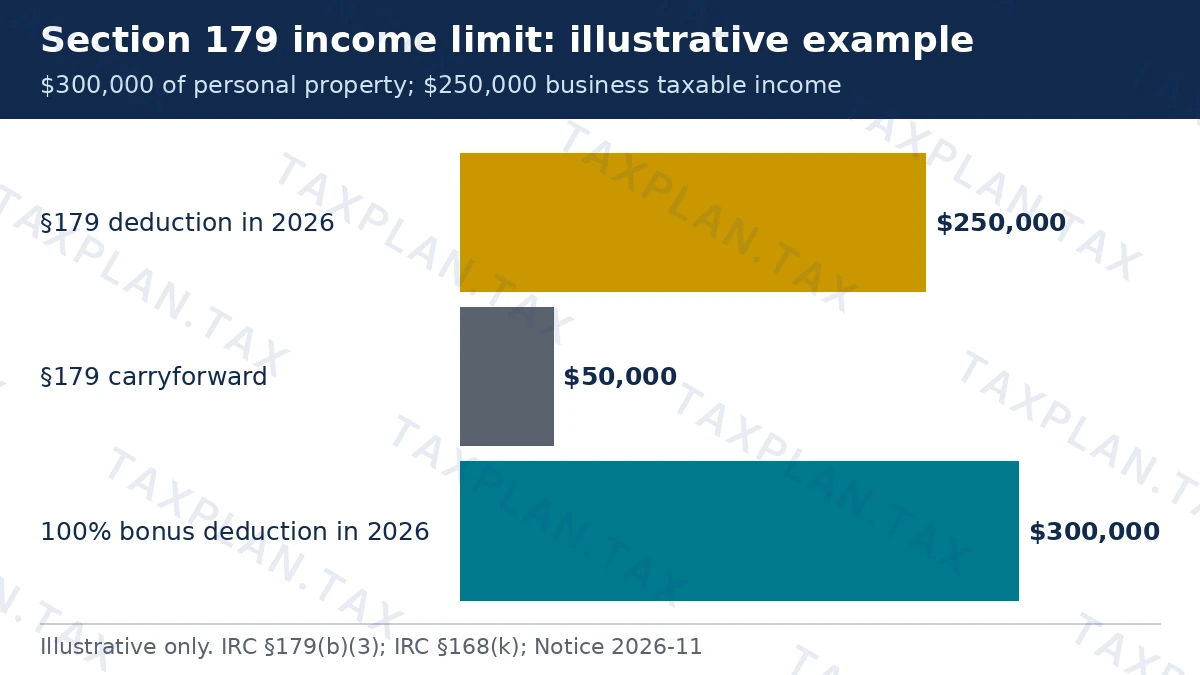
In this case, bonus produces the larger current deduction. Still, any resulting loss must clear the passive and excess business loss rules.
Example 2: A roof replacement (illustrative)
Next, assume the company replaces the warehouse roof in May 2027 for $180,000. A roof is not interior work, so it is not qualified improvement property. As a result, the roof is 39-year property and does not qualify for bonus. Regular depreciation in year one would be $2,889, using the May rate of 1.605% from Publication 946, Table A-7a.
However, a roof on a nonresidential building is qualified real property under §179(e)(2). So the company could elect to expense the full $180,000, if it has enough business income and room under the limits.
Example 3: The phase-out (illustrative)
Now assume a larger company places $4,500,000 of §179 property in service in 2026. Consequently, its limit falls by the $410,000 excess over $4,090,000. Therefore, the maximum §179 deduction is $2,150,000. Bonus depreciation can still cover qualified property beyond that amount.
Example 4: A passive investor (illustrative)
Finally, assume an individual owns a building net-leased to a national tenant. The tenant handles maintenance, and the owner simply collects rent. In that case, the owner likely holds the property for the production of income rather than an active trade or business. Therefore, §179 is generally unavailable, and the noncorporate lessor rule could also apply. Even so, a cost segregation study and 100% bonus depreciation remain available for qualified property. The resulting loss, however, is generally passive under §469.
Common Mistakes in Cost Segregation vs Section 179 Planning
Direct answer: Most errors come from using §179 where it does not apply or ignoring its limits.
- Claiming §179 on a passive rental. In general, property held for the production of income does not qualify.
- Ignoring the income limit. A §179 deduction cannot create a business loss; the excess carries forward.
- Expensing apartment roofs. Qualified real property under §179(e)(2) covers nonresidential buildings only.
- Forgetting the lessor rule. Likewise, noncorporate lessors face §179(d)(5).
- Assuming bonus covers roofs. A new roof on a nonresidential building is generally 39-year property, not QIP, so bonus does not apply.
- Skipping documentation. Publication 5653 cautions examiners about studies without support.
- Missing a study on the first return. You can often catch up through Rev. Proc. 2025-23 and Form 3115.
Frequently Asked Questions
Can I use cost segregation and Section 179 together?
Yes. A study identifies short-life property. Then you may elect §179 on eligible items and let bonus cover the rest.
Which is better in 2026: cost segregation or Section 179?
Usually, cost segregation with 100% bonus covers more property with fewer limits. However, §179 can still expense qualifying roofs, HVAC, fire protection, and security systems on nonresidential buildings.
Can rental owners use Section 179, or only cost segregation?
Only if the rental is an active trade or business and the lessor rules are met. Otherwise, the owner can still use cost segregation and bonus depreciation.
Does Section 179 apply to the building shell after cost segregation?
No. The building shell is not §179 property. However, qualified real property, such as qualified improvement property, can be.
Is the cost segregation vs Section 179 decision permanent?
Not entirely. You can revoke a §179 election for specific property, but the revocation is final. By contrast, revoking an election out of bonus generally requires IRS consent.
What is the Section 179 limit for 2026?
It is $2,560,000, reduced dollar for dollar once §179 property placed in service exceeds $4,090,000. Rev. Proc. 2025-32 sets these amounts.
Do cost segregation and Section 179 both trigger recapture?
Yes. On a sale, both §179 and bonus deductions on §1245 property are generally recaptured as ordinary income.
Conclusion: Choosing Between Cost Segregation and Section 179
Cost segregation vs Section 179 is best seen as a sequence, not a contest. First, the study finds short-life property. Then, bonus depreciation usually deducts it with no dollar or income limit. Meanwhile, §179 remains useful for nonresidential roofs, HVAC, and other qualified real property.
Alan Goldstein, EA, of Emunah Cost Segregation, helps business owners and CPAs coordinate studies, bonus depreciation, and §179 elections. Contact Emunah Cost Segregation in Coral Gables, Florida, to request a feasibility review.
Cases Cited
- Hospital Corp. of America v. Commissioner, 109 T.C. 21, 55 (1997) (United States Tax Court). Pinpoint verified against the reporter-paginated opinion text. Opinion
- Whiteco Industries, Inc. v. Commissioner, 65 T.C. 664, 672-673 (1975) (United States Tax Court). Pinpoint verified against the reporter-paginated opinion text. Opinion
- Commissioner v. Groetzinger, 480 U.S. 23, 35 (1987) (Supreme Court of the United States). Pinpoint verified against the reporter-paginated opinion text. Opinion
Sources and Authorities
- 26 U.S.C. §179: https://www.law.cornell.edu/uscode/text/26/179
- 26 U.S.C. §168: https://www.law.cornell.edu/uscode/text/26/168
- 26 U.S.C. §1245: https://www.law.cornell.edu/uscode/text/26/1245
- Public Law 119-21 (H.R. 1, 119th Congress), §§70301 and 70306: https://www.congress.gov/bill/119th-congress/house-bill/1
- IRS Notice 2026-11: https://www.irs.gov/pub/irs-drop/n-26-11.pdf
- Rev. Proc. 2025-32, section 4.24: https://www.irs.gov/pub/irs-drop/rp-25-32.pdf
- Rev. Proc. 2025-23, section 6.01: https://www.irs.gov/pub/irs-drop/rp-25-23.pdf
- Treas. Reg. §1.179-2: https://www.ecfr.gov/current/title-26/section-1.179-2
- Instructions for Form 4562 (2025): https://www.irs.gov/instructions/i4562
- IRS Publication 946, How To Depreciate Property (2025), Table A-7a: https://www.irs.gov/pub/irs-pdf/p946.pdf
- IRS Publication 5653, Cost Segregation Audit Techniques Guide: https://www.irs.gov/pub/irs-pdf/p5653.pdf
- About Form 3115: https://www.irs.gov/forms-pubs/about-form-3115
- Court opinions: see Cases Cited above.
This article is provided for general educational purposes and does not constitute individualized tax, legal, or accounting advice. Tax consequences depend on the taxpayer’s specific facts and applicable law.
