

Cost segregation for short-term rentals can turn an Airbnb or VRBO property into a large first-year deduction, and the tax rules for short stays make that deduction more usable than it is for most rentals. A study moves furnishings, finishes, and site work out of the building’s long recovery period and into 5-, 7-, and 15-year classes. Then, for property acquired after January 19, 2025, 100% bonus depreciation lets you deduct those components in year one.
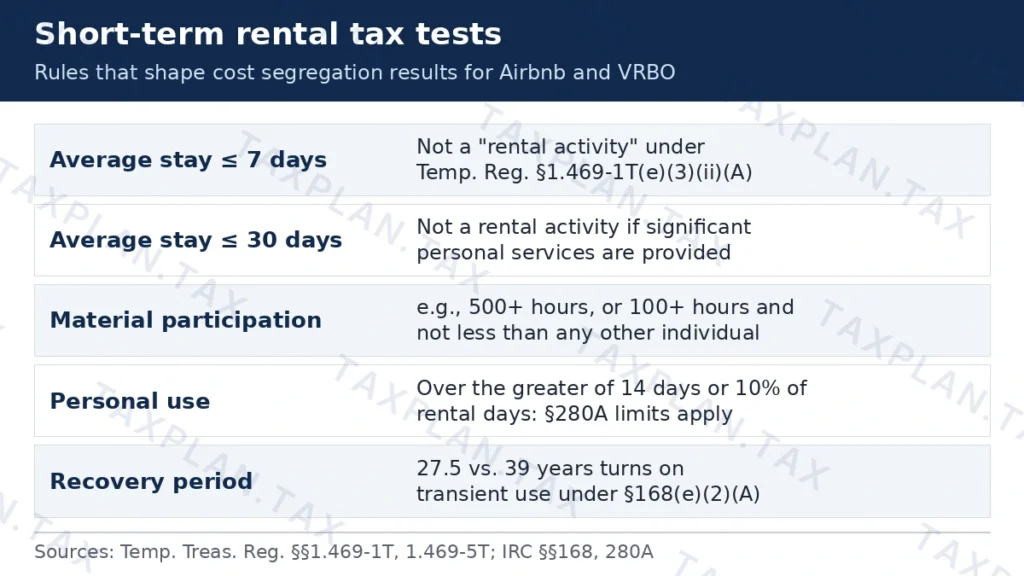
However, the key difference is the passive loss rules. Under Temp. Treas. Reg. §1.469-1T(e)(3)(ii)(A), an activity is not a “rental activity” if the average customer stay is seven days or less. Therefore, if you also materially participate, the loss is generally nonpassive. As a result, it can offset wages or business income, subject to the excess business loss limit. However, personal use, weak hour logs, and the recovery period question can all reduce the benefit.
Key Takeaways
- A study reclassifies parts of a short-term rental into 5-, 7-, and 15-year property.
- Qualified property acquired after January 19, 2025, can get 100% bonus depreciation.
- An average stay of seven days or less means the activity is not a rental activity under the passive rules.
- You must still materially participate for the loss to be nonpassive.
- Still, heavy personal use can limit deductions under §280A.
- Whether the building is 27.5-year or 39-year property depends on the facts.
Introduction and Background: Why Cost Segregation for Short-Term Rentals Gets Attention
Direct answer: Short stays change how the passive loss rules apply, so accelerated depreciation can be more valuable.
Ordinarily, IRC §469(c)(2) treats rental activities as passive, whether or not the owner works in them. Consequently, most landlords with full-time jobs cannot use rental losses against salary. In general, the main exceptions are the $25,000 allowance for active participation and real estate professional status.
Short-term rentals, however, often fall outside that framework. The temporary regulations list several exceptions to the definition of a rental activity. For example, the best known is the seven-day average stay test. Another applies when the average stay is 30 days or less and the owner provides significant personal services.
Meanwhile, a cost segregation study increases early depreciation. As a result, combining the two ideas explains the strong interest in cost segregation for short-term rentals. For long-term rentals, see our guide to residential rental cost segregation.
How Does Cost Segregation for Short-Term Rentals Work?
Direct answer: You classify the property, compute the average stay, test material participation, and then claim depreciation.
Step 1: Commission the study
First, an engineer or qualified specialist reviews the closing statement, plans, and photos. Then the study assigns costs to recovery classes under IRC §168. Also, the IRS Cost Segregation Audit Techniques Guide describes acceptable methods and documentation.
Step 2: Identify short-life components
Typical short-term rental components include furniture, appliances, carpeting, decorative lighting, and some cabinetry. In addition, outdoor work such as fencing, paving, and landscaping is often 15-year land improvement property. IRS Publication 946 lists appliances, carpets, and furniture used in residential rental real estate as 5-year property. For more detail, see our overview of 5-, 7-, and 15-year property.
Step 3: Compute the average period of customer use
Next, divide the total days in all rental periods by the number of rentals during the year. IRS Publication 925 explains this calculation. Then, if the result is seven days or less, the activity is not a rental activity for passive loss purposes.
Step 4: Test material participation
Then check the seven tests in Temp. Treas. Reg. §1.469-5T(a). Owners of short-term rentals most often rely on three of them:
- More than 500 hours of participation during the year.
- Participation that is substantially all of the participation by all individuals.
- More than 100 hours, and not less than any other individual, including cleaners and managers.
Step 5: Report the results
Finally, report the income and depreciation on the correct schedule. According to IRS Publication 527, owners who provide substantial services, such as regular cleaning or maid service, report on Schedule C. Otherwise, the activity is generally reported on Schedule E.
What Are the Benefits of Cost Segregation for Short-Term Rentals?
Direct answer: Larger early deductions, possible use against nonpassive income, and better cash flow in the early years.
- Front-loaded deductions. With 100% bonus depreciation, reclassified components are deductible in the year the property is placed in service.
- Nonpassive treatment. If the seven-day test and a material participation test are met, losses can generally offset wages and business income.
- No real estate professional requirement. Because the activity is not a rental activity, the §469(c)(7) hour tests generally are not needed.
- Furnishings count. Short-term rentals are usually furnished, so they often hold more personal property than unfurnished rentals.
- Catch-up options. Also, owners who skipped a study can often claim missed depreciation later through an accounting method change.
Legal and Regulatory Considerations for Short-Term Rental Cost Segregation
Direct answer: Classification law, bonus rules, passive loss regulations, personal use limits, and loss caps all apply.
What separates personal property from the building?
In general, the courts use the investment tax credit tests. In Hospital Corp. of America v. Commissioner, 109 T.C. 21, 55 (1997), the Tax Court held that those tests decide whether property is tangible personal property under MACRS. In addition, Whiteco Industries, Inc. v. Commissioner, 65 T.C. 664, 672-673 (1975), lists questions about mobility and permanence. For example, the court asked whether the property can be moved and whether it was designed to stay in place.
Bonus depreciation after Public Law 119-21
Public Law 119-21, §70301, amended §168(k). Notice 2026-11 explains that 100% bonus depreciation now applies permanently to qualified property acquired after January 19, 2025. By contrast, property acquired before January 20, 2025, and placed in service in 2025 generally gets 40%. Notice 2026-11 is interim guidance, so proposed regulations may follow.
Is a short-term rental 27.5-year or 39-year property?
Unfortunately, this question has no single answer. Under §168(e)(2)(A), residential rental property must earn at least 80% of gross rents from dwelling units. However, a “dwelling unit” excludes a unit in a hotel, motel, or other establishment where more than half the units are used on a transient basis.
The Code does not define “transient” for this purpose. A related lodging regulation, Treas. Reg. §1.48-1(h)(2)(ii), treats accommodations as transient if the rental period is normally less than 30 days. For that reason, many advisors treat buildings rented mostly to short-stay guests as 39-year nonresidential real property. Because no rule squarely addresses a single vacation home, document your position with your tax advisor.
Material participation must be real
Above all, hours must reflect work you actually performed. In Moss v. Commissioner, 135 T.C. 365, 370 (2010), the Tax Court refused to count “on call” hours toward the 750-hour real estate professional test. That case involved §469(c)(7), but the lesson carries over. Therefore, keep a contemporaneous log of guest communication, cleaning, repairs, and bookkeeping.
Personal use and §280A
Under §280A(d)(1), you use a dwelling unit as a residence if personal days exceed the greater of 14 days or 10% of fair rental days. If that happens, §280A(c)(5) generally limits rental deductions to rental income. Moreover, if you rent a residence for fewer than 15 days, §280A(g) excludes the income and disallows the rental deductions.
Excess business loss limit
Even nonpassive losses face §461(l). For 2026, Rev. Proc. 2025-32 sets the threshold at $256,000, or $512,000 for joint filers. Then any excess carries forward as a net operating loss.
Practical Examples of Cost Segregation for Short-Term Rentals
Direct answer: These illustrative examples show how a study changes year-one depreciation and how the passive tests work.
Example 1: A beach house bought in June 2026 (illustrative)
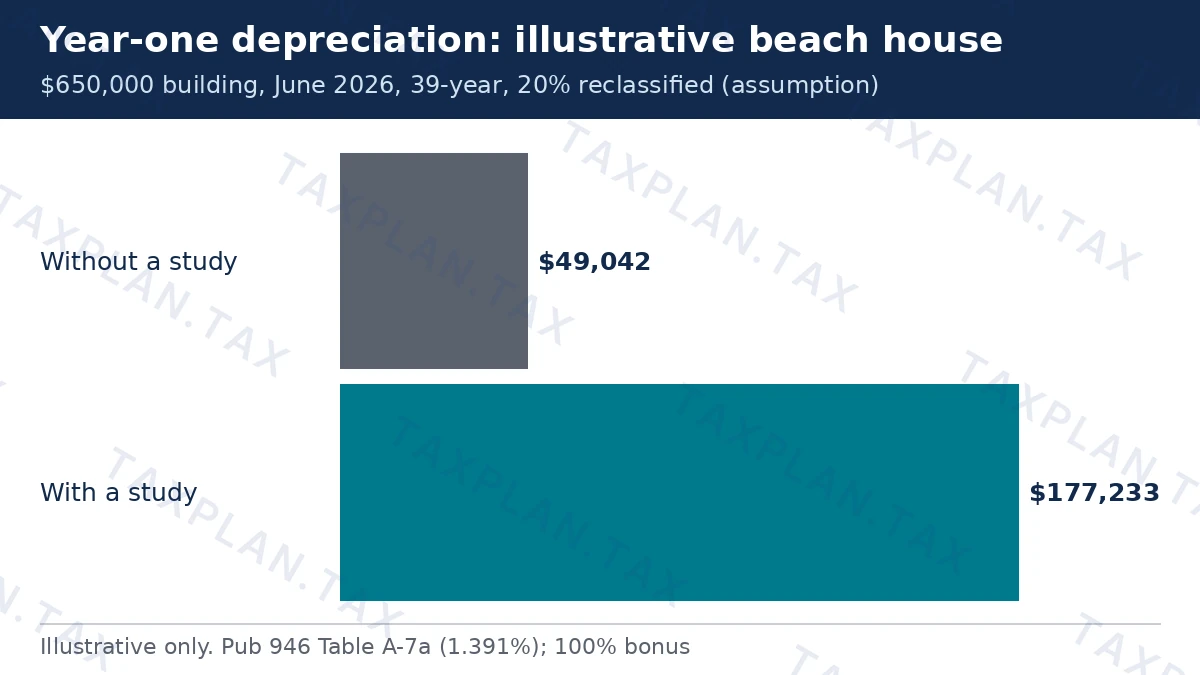
For this example, assume an owner buys a furnished beach house for $900,000 and places it in service in June 2026. Assume $250,000 is land and $650,000 is building. The owner also spends $40,000 on new furniture. Finally, assume the study reclassifies 20% of the building, or $130,000, into 5-, 7-, and 15-year property. Again, these figures are assumptions, not typical results.
The table assumes 39-year treatment and the June rate of 1.391% from Publication 946, Table A-7a. If the building were 27.5-year property instead, the June rate would be 1.970% from Table A-6.
| Item (illustrative) | Without study | With study |
|---|---|---|
| Building basis left at 39 years | $650,000 | $520,000 |
| Year-one building depreciation (1.391%) | $9,042 | $7,233 |
| Bonus on reclassified components | $0 | $130,000 |
| Bonus on new furniture | $40,000 | $40,000 |
| Total year-one depreciation | $49,042 | $177,233 |
Example 2: Applying the passive tests (illustrative)
Next, assume the house had 60 stays totaling 240 nights. The average stay is therefore 4.0 days, which is seven days or less. The owner logged 140 hours, while the cleaner worked 110 hours. Because the owner exceeded 100 hours and worked more than any other individual, the third test is met.
Assume rental income of $80,000 and operating expenses of $35,000. With the study, the loss is $132,233. That loss is generally nonpassive and falls below the $512,000 joint-return threshold. So the owners may use it against wages. At an assumed 35% marginal rate, the federal tax benefit would be about $46,282.
Example 3: When the plan fails (illustrative)
Now change one fact. For instance, suppose a full-service manager spends 300 hours on the property. In that case, the owner’s 140 hours no longer meet the third test. Unless another test applies, the loss is passive. Also, because the activity is not a rental real estate activity, the $25,000 allowance in §469(i) generally does not help.
Common Mistakes With Cost Segregation for Short-Term Rentals
Direct answer: Most errors involve the passive tests, personal use, and unsupported classifications.
- Counting hours you cannot prove. Hours you did not actually work do not count, as Moss shows.
- Ignoring the manager’s hours. For example, a busy manager or cleaner can defeat the 100-hour test.
- Miscounting the average stay. Use the Publication 925 formula, not a guess from the booking calendar.
- Too many personal days. Family use can trigger the §280A limits.
- Assuming 27.5 years automatically. The transient-use rules may point to 39 years.
- Using a percentage shortcut. Publication 5653 cautions against studies without supporting documentation.
- Forgetting recapture. On a sale, depreciation on §1245 property is generally ordinary income under §1245.
- Missing the first-year return. If you file without a study, Rev. Proc. 2025-23 lists automatic changes made on Form 3115.
Frequently Asked Questions
Does cost segregation for short-term rentals require real estate professional status?
Generally, no. If the average stay is seven days or less, the activity is not a rental activity. Instead, you need material participation in that activity.
Is cost segregation for short-term rentals worth it on a small condo?
It depends on basis, furnishings, your tax bracket, and the study fee. Compare the fee with the modeled benefit first. Our article on cost segregation for single-family rentals covers smaller properties.
How do I calculate the average stay?
Divide the total number of days in all rental periods by the number of separate rentals. Publication 925 describes this formula.
Do personal days hurt short-term rental cost segregation results?
They can. If personal days exceed the greater of 14 days or 10% of fair rental days, §280A generally limits deductions to rental income.
What if the average stay is between 8 and 30 days?
Then a different exception may apply. It requires significant personal services provided by or for the owner. Otherwise, the activity is generally a rental activity.
Can I do cost segregation for short-term rentals bought in earlier years?
Often, yes. A look-back study can claim missed depreciation through Form 3115. However, the bonus rate depends on when you acquired the property.
Does a hotel-style operation change anything?
Possibly. If you provide substantial services, Publication 527 says to report on Schedule C. Our article on cost segregation for hotels covers larger lodging properties.
Conclusion: Is Cost Segregation for Short-Term Rentals Right for You?
Cost segregation for short-term rentals can create large early deductions. Moreover, the seven-day rule and material participation can make those deductions usable against other income. Still, the benefit depends on careful records, limited personal use, and a well-documented study.
Alan Goldstein, EA, of Emunah Cost Segregation, helps Airbnb and VRBO owners and their CPAs evaluate studies and passive loss planning. Contact Emunah Cost Segregation in Coral Gables, Florida, to request a feasibility review.
Cases Cited
- Hospital Corp. of America v. Commissioner, 109 T.C. 21, 55 (1997) (United States Tax Court). Pinpoint verified against the reporter-paginated opinion text. Opinion
- Whiteco Industries, Inc. v. Commissioner, 65 T.C. 664, 672-673 (1975) (United States Tax Court). Pinpoint verified against the reporter-paginated opinion text. Opinion
- Moss v. Commissioner, 135 T.C. 365, 370 (2010) (United States Tax Court). Pinpoint verified against the reporter-paginated opinion text. Opinion
Sources and Authorities
- 26 U.S.C. §168: https://www.law.cornell.edu/uscode/text/26/168
- 26 U.S.C. §469: https://www.law.cornell.edu/uscode/text/26/469
- 26 U.S.C. §280A: https://www.law.cornell.edu/uscode/text/26/280A
- 26 U.S.C. §1245: https://www.law.cornell.edu/uscode/text/26/1245
- Public Law 119-21 (H.R. 1, 119th Congress), §70301: https://www.congress.gov/bill/119th-congress/house-bill/1
- IRS Notice 2026-11: https://www.irs.gov/pub/irs-drop/n-26-11.pdf
- Rev. Proc. 2025-32, section 4.31: https://www.irs.gov/pub/irs-drop/rp-25-32.pdf
- Rev. Proc. 2025-23, section 6.01: https://www.irs.gov/pub/irs-drop/rp-25-23.pdf
- Temp. Treas. Reg. §1.469-1T(e)(3): https://www.ecfr.gov/current/title-26/section-1.469-1T
- Temp. Treas. Reg. §1.469-5T: https://www.ecfr.gov/current/title-26/section-1.469-5T
- Treas. Reg. §1.48-1(h): https://www.ecfr.gov/current/title-26/section-1.48-1
- IRS Publication 925, Passive Activity and At-Risk Rules: https://www.irs.gov/pub/irs-pdf/p925.pdf
- IRS Publication 527, Residential Rental Property: https://www.irs.gov/pub/irs-pdf/p527.pdf
- IRS Publication 946, How To Depreciate Property (2025), Tables A-6 and A-7a: https://www.irs.gov/pub/irs-pdf/p946.pdf
- IRS Publication 5653, Cost Segregation Audit Techniques Guide: https://www.irs.gov/pub/irs-pdf/p5653.pdf
- About Form 3115: https://www.irs.gov/forms-pubs/about-form-3115
- Court opinions: see Cases Cited above.
This article is provided for general educational purposes and does not constitute individualized tax, legal, or accounting advice. Tax consequences depend on the taxpayer’s specific facts and applicable law.
