

Residential rental cost segregation is an engineering-based review that splits a rental building’s cost into 5-year, 15-year, and 27.5-year property. Without a study, owners usually depreciate the whole building over 27.5 years. With one, appliances, removable carpet, and many site improvements move into shorter classes. Those shorter-lived parts can also qualify for bonus depreciation. For property acquired after January 19, 2025, the bonus rate is 100% under IRS Notice 2026-11.
However, the building shell, roof, central HVAC, and kitchen cabinets generally stay in the 27.5-year class. The IRS says so in its Cost Segregation Audit Techniques Guide, Chapter 7.H. In addition, passive loss rules can limit when you use the larger deduction. So the real value depends on the building, the purchase date, and your tax profile. This guide explains each piece of residential rental cost segregation with primary sources. It covers the 80% test, the IRS matrix, bonus timing, passive limits, recapture, and two worked examples.
Key Takeaways
- A building is residential rental property if at least 80% of its gross rent comes from dwelling units, under IRC §168(e)(2)(A).
- The building itself is 27.5-year property, while appliances, removable carpet, and furniture are 5-year property.
- Fences, sidewalks, parking areas, and landscaping are usually 15-year land improvements.
- The IRS publishes a residential rental matrix in Chapter 7.H of its audit guide, which a good study should follow.
- Passive activity rules under IRC §469 can delay the benefit for many owners.
- Depreciation on 5- and 15-year parts can be recaptured as ordinary income when you sell.
What Is Residential Rental Cost Segregation?
Direct answer: Residential rental cost segregation is a study that identifies parts of an apartment building or rental home that have shorter tax lives than the building. Then it assigns each part to its correct class.
Depreciation lets you recover the cost of business property over time. Under IRC §168(c), residential rental property has a 27.5-year recovery period. In contrast, nonresidential real property uses 39 years. Both classes use the straight-line method and the mid-month convention.
A building is not one asset for tax purposes, though. It holds many components. Some are structural, such as walls and roofs. Others serve tenants directly, such as a refrigerator or a dishwasher. Therefore, residential rental cost segregation separates the two groups and documents why each part belongs where it does. For a basic overview of studies in general, see What Is a Cost Segregation Study and How Does It Work?
What counts as residential rental property?
The 80% test decides the class. Specifically, IRC §168(e)(2)(A) defines residential rental property as a building where 80% or more of gross rental income comes from dwelling units. A dwelling unit is a house or apartment used for living accommodations.
However, the statute excludes units in a hotel, motel, or other establishment where more than half the units are used on a transient basis. Also, if you live in part of the building, the rental value of your unit counts in the gross rent. As a result, a mixed-use building with ground-floor shops can fail the test. In that case, the building is 39-year property instead.
How Does Residential Rental Cost Segregation Work?
Direct answer: A specialist reviews the building, its records, and its costs. Next, the specialist assigns each component to a tax class using the code, regulations, and IRS asset classes.
The process usually follows the same steps. First, the team gathers the closing statement, appraisal, drawings, and any construction costs. Second, it inspects the property. Third, it removes the land value, since land is never depreciable. Finally, it allocates the building basis among the classes and documents each decision. Good residential rental cost segregation work ties every line item to evidence.
For a full walk-through, read Cost Segregation Study Process: Step-by-Step Breakdown.
Which components usually move to shorter lives?
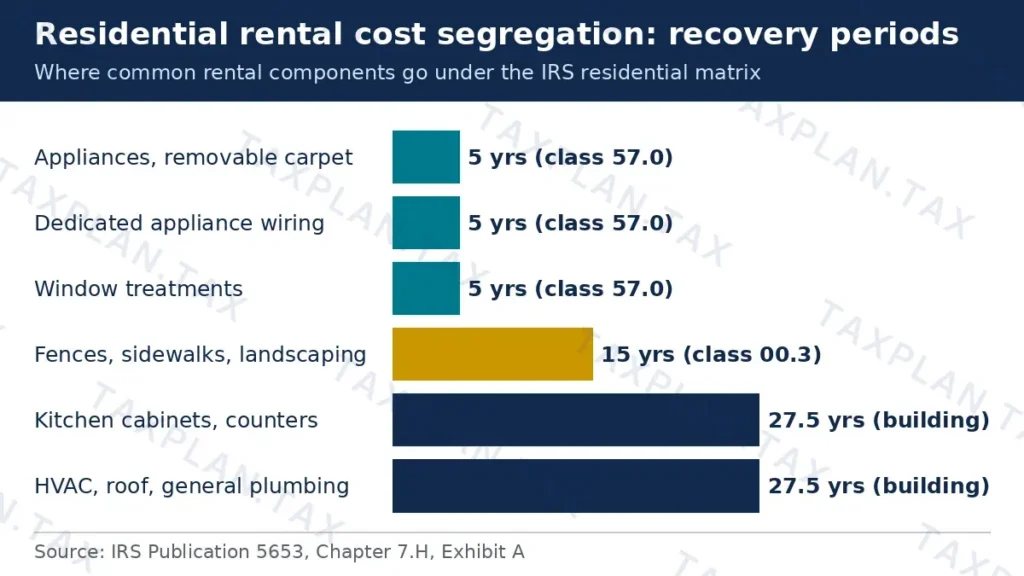
The IRS residential rental matrix in Publication 5653, Chapter 7.H, Exhibit A gives clear direction. For example, it treats the following as §1245 property in asset class 57.0, with a 5-year life:
- Kitchen appliances, such as ranges, refrigerators, and dishwashers
- Electrical outlets and wiring dedicated to specific appliances
- Water or gas hook-ups that serve specific appliances
- Floor coverings installed with strippable adhesive or tack strips
- Window treatments, strippable wallpaper, and decorative light fixtures
- Furniture in furnished units and in pool or exercise areas
Similarly, the matrix places sidewalks, curbs, fencing, site lighting, and landscaping in asset class 00.3. That class carries a 15-year life. Outdoor pools and athletic courts built on land fall there too. In residential rental cost segregation, these site items often add meaningful value.
Which components stay in the 27.5-year class?
Many items that seem like “finishes” remain building property. Notably, the matrix lists kitchen cabinets, counters, and sinks as §1250 property with a 27.5-year life. Likewise, central HVAC, general plumbing, general wiring, roofs, ceilings, doors, windows, and stairs stay in the building class. Permanently glued flooring also stays.
In addition, a rental office or clubhouse building is a separate case. The matrix treats it as nonresidential real property with a 39-year life. Therefore, residential rental cost segregation can involve three building-related lives, not two.
What Are the Benefits of Residential Rental Cost Segregation?
Direct answer: The main benefit is timing. You take deductions years earlier, which can lower current tax and free up cash for other uses.
A study does not create new depreciation. Instead, residential rental cost segregation moves deductions forward. Even so, earlier deductions have real value because money today is worth more than money later. For a deeper look at the cash-flow effect, see How Cost Segregation Accelerates Depreciation and Boosts Cash Flow.
How does bonus depreciation change the math?
Bonus depreciation applies only to property with a recovery period of 20 years or less. So the 27.5-year building never qualifies. However, the 5-year and 15-year parts found in residential rental cost segregation can qualify.
Public Law 119-21, enacted July 4, 2025, restored a permanent 100% rate. It applies to qualified property acquired after January 19, 2025. In contrast, property acquired under a written binding contract signed before January 20, 2025 follows the old phase-down schedule. Under that schedule, the rate is 40% for property placed in service in 2025 and 20% in 2026. Notice 2026-11 explains how the IRS applies these dates. Also, used property can qualify if you never used it before, under Treas. Reg. §1.168(k)-2.
Can you apply it to a building you already own?
Yes. A look-back study can cover a rental you placed in service in an earlier year. In that case, you generally file Form 3115 for an automatic accounting method change. Then you claim the missed depreciation as a §481(a) adjustment in the current year. Rev. Proc. 2025-23 lists the current automatic change procedures. However, bonus eligibility still depends on the original acquisition and placed-in-service dates.
What Legal Rules Govern Residential Rental Cost Segregation?
Direct answer: The Internal Revenue Code, Treasury regulations, IRS asset classes, and two key Tax Court cases set the rules.
- IRC §168: sets the 27.5-year life, the 80% test, the mid-month convention, and bonus depreciation in §168(k).
- Treas. Reg. §1.48-1: defines tangible personal property and structural components.
- Rev. Proc. 87-56: sets asset classes 57.0 and 00.3, as reproduced in Publication 946, Appendix B.
- Publication 527: lists 5-year appliances, carpets, and rental furniture, plus 15-year fences, roads, and shrubbery.
- Publication 5653: the IRS audit guide, including the residential rental matrix.
Two court cases also shape residential rental cost segregation. In Hospital Corporation of America v. Commissioner, 109 T.C. 21 (1997), the Tax Court held that the former investment tax credit rules still decide what counts as §1245 property. Meanwhile, Whiteco Industries, Inc. v. Commissioner, 65 T.C. 664 (1975), set out factors for deciding whether an item is inherently permanent. The audit guide summarizes both cases.
How do the passive loss rules affect rental owners?
Rental activities are generally passive under IRC §469. As a result, a rental loss can usually offset only passive income. However, there are three important exceptions:
- The $25,000 allowance. Owners who actively participate can deduct up to $25,000 of rental losses against other income. That amount phases out by 50% of modified AGI above $100,000, so it is gone at $150,000.
- Real estate professionals. Under §469(c)(7), a taxpayer who spends more than half of working time and more than 750 hours in real property businesses, and materially participates, can avoid the passive rule for rentals.
- Short-term rentals. According to Publication 925, an activity is not a rental activity if the average customer stay is 7 days or less. Then the material participation tests apply instead.
Disallowed losses are not lost. Instead, they carry forward and are generally freed up when you dispose of the activity in a taxable transaction.
What happens when you sell?
Residential rental cost segregation also affects the sale. Under IRC §1245, gain on 5- and 15-year personal property is ordinary income up to the depreciation taken. In contrast, straight-line depreciation on the building is “unrecaptured §1250 gain.” Under IRC §1(h), that gain faces a maximum 25% rate. Therefore, residential rental cost segregation is a deferral strategy, and you should plan for the exit.
What Does Residential Rental Cost Segregation Look Like in Practice?
Direct answer: The example below shows how a study changes first-year depreciation for a 10-unit building. All amounts are illustrative assumptions, not typical results.
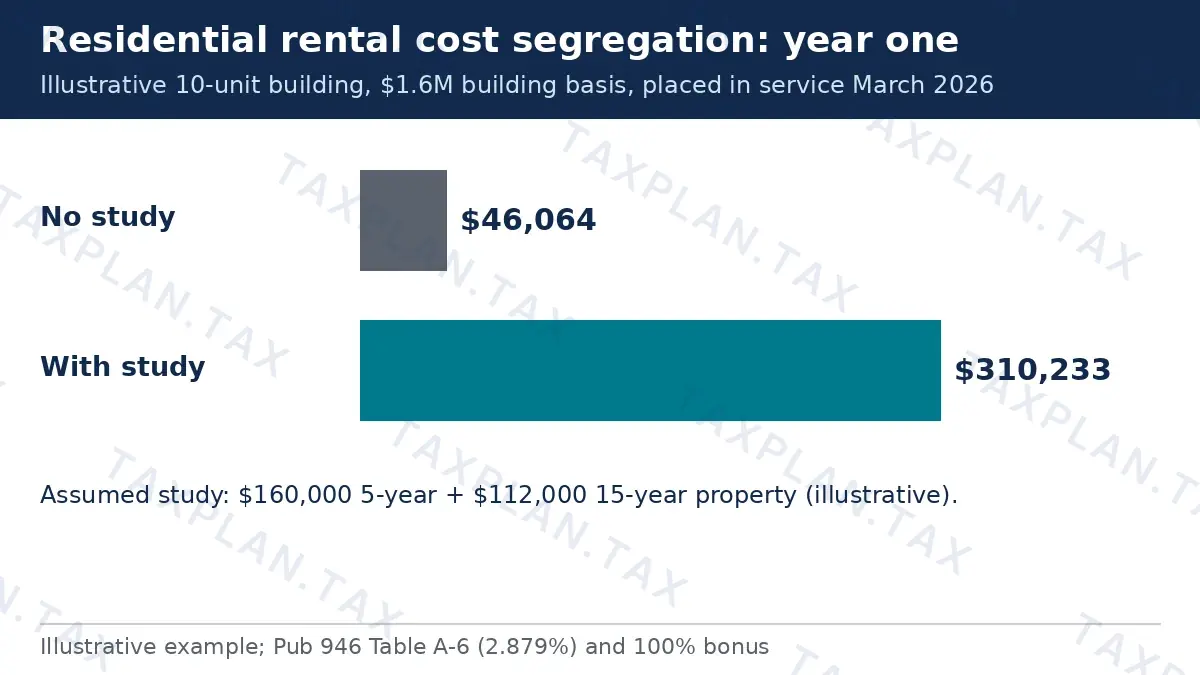
Assume an investor buys a 10-unit apartment building for $2,000,000 in 2026. The purchase contract is signed after January 19, 2025. Land is worth $400,000, so the building basis is $1,600,000. The building is placed in service in March 2026.
| Class (illustrative study) | Basis | Share | Year-one depreciation |
|---|---|---|---|
| 5-year personal property (class 57.0) | $160,000 | 10% | $160,000 (100% bonus) |
| 15-year land improvements (class 00.3) | $112,000 | 7% | $112,000 (100% bonus) |
| 27.5-year building | $1,328,000 | 83% | $38,233 |
| Total | $1,600,000 | 100% | $310,233 |
The 27.5-year figure uses the March rate of 2.879% from Publication 946, Table A-6. So $1,328,000 times 2.879% equals $38,233.
Without a study, the full $1,600,000 would sit in the 27.5-year class. First-year depreciation would then be $46,064. As a result, the study adds about $264,169 of first-year depreciation in this example.
Next, consider the tax effect. If the owner qualifies as a real estate professional and is in the 37% bracket, the extra deduction could reduce federal tax by roughly $97,743. However, if the owner has no passive income and earns too much for the $25,000 allowance, most of the loss would be suspended. In that case, the benefit arrives later.
Example 2: A rental with a retail ground floor
Now assume a building earns $500,000 of gross rent. Apartments produce $380,000, and two ground-floor shops produce $120,000. Dwelling units therefore produce 76% of the rent. Because 76% is below 80%, the building is nonresidential real property with a 39-year life. A study would still separate the shorter-lived parts. Even so, the building portion would use 39 years, not 27.5.
What Are Common Residential Rental Cost Segregation Mistakes?
Direct answer: Most problems come from wrong classifications, weak support, or ignoring the passive loss and recapture rules.
- Treating kitchen cabinets as 5-year property. The IRS residential matrix lists them as 27.5-year property.
- Calling central HVAC personal property. Building HVAC is a structural component under Treas. Reg. §1.48-1(e)(2).
- Using a flat percentage. The audit guide warns against studies built on rules of thumb rather than facts.
- Overstating the building share. Land value must be removed first, and a weak allocation invites adjustment.
- Skipping the 80% test. Mixed-use buildings may be 39-year property.
- Ignoring §469. A large loss you cannot use this year may not help much now.
- Forgetting the binding contract date. A contract signed before January 20, 2025 limits the bonus rate.
In addition, some states do not follow federal bonus depreciation, which can change state-level results from residential rental cost segregation. So check state rules before you rely on a projection.
Frequently Asked Questions
Is residential rental cost segregation worth it for small buildings?
It can be, but the fee matters more on small properties. Therefore, compare the quoted fee with the projected tax effect you can actually use. Our guide When Is a Cost Segregation Study Worth It? covers the break-even analysis.
Are appliances in a rental 5-year property?
Yes. Publication 527, Table 2-1 lists appliances, carpets, and furniture used in rental property as 5-year property.
Can a short-term rental use residential rental cost segregation?
A study can still help. However, a property used mainly for short stays may not meet the dwelling unit definition in §168(e)(2)(A). In that case, the building could be 39-year property. Have your advisor review the facts first.
Does residential rental cost segregation increase audit risk?
No published IRS rule says that. Still, the IRS has a detailed audit guide for these studies. So a study should be well supported and follow the IRS residential matrix.
What if I bought my rental years ago?
You can usually do a look-back study. Then you claim the missed depreciation with Form 3115 and a §481(a) adjustment, without amending prior returns.
Can I use qualified improvement property rules for apartments?
No. Under IRC §168(e)(6), qualified improvement property covers interior improvements to nonresidential real property only.
Does recapture cancel the benefit?
Not necessarily. Recapture can reduce the benefit, but the deferral still has time value. Also, if you hold the property until death, the heirs generally receive a basis equal to fair market value under IRC §1014. Planning for the exit is essential.
Conclusion: Is Residential Rental Cost Segregation Right for You?
To sum up, residential rental cost segregation moves appliances, removable flooring, and site work out of the 27.5-year class. For property acquired after January 19, 2025, those parts can get 100% bonus depreciation. However, the passive loss rules, recapture, and the 80% test all shape the real result. Therefore, the right answer depends on your building and your tax profile.
Emunah Cost Segregation can help you decide. Alan Goldstein, EA, reviews your rental property, purchase records, and tax situation before any study begins. Then he tells you plainly whether a study makes sense. Contact Emunah Cost Segregation in Coral Gables, Florida, to request a review. To estimate the dollar effect first, read How Much Can You Save with a Cost Segregation Study?
Sources and Authorities
- 26 U.S.C. §168 (MACRS, §168(c) recovery periods, §168(e)(2) and (e)(6) definitions, §168(k) bonus): https://www.law.cornell.edu/uscode/text/26/168
- 26 U.S.C. §469 (passive activity losses): https://www.law.cornell.edu/uscode/text/26/469
- 26 U.S.C. §1245: https://www.law.cornell.edu/uscode/text/26/1245
- 26 U.S.C. §1 (including §1(h) rates on unrecaptured §1250 gain): https://www.law.cornell.edu/uscode/text/26/1
- Public Law 119-21 (H.R. 1, 119th Congress): https://www.congress.gov/bill/119th-congress/house-bill/1
- IRS Notice 2026-11: https://www.irs.gov/pub/irs-drop/n-26-11.pdf
- Treas. Reg. §1.48-1: https://www.ecfr.gov/current/title-26/section-1.48-1
- Treas. Reg. §1.168(k)-2: https://www.ecfr.gov/current/title-26/section-1.168(k)-2
- IRS Publication 527, Residential Rental Property (2025): https://www.irs.gov/pub/irs-pdf/p527.pdf
- IRS Publication 925, Passive Activity and At-Risk Rules (2025): https://www.irs.gov/pub/irs-pdf/p925.pdf
- IRS Publication 946, including Table A-6 and Appendix B: https://www.irs.gov/pub/irs-pdf/p946.pdf
- IRS Publication 5653, Cost Segregation Audit Techniques Guide, Chapter 7.H: https://www.irs.gov/pub/irs-pdf/p5653.pdf
- About Form 3115: https://www.irs.gov/forms-pubs/about-form-3115
- 26 U.S.C. §1014: https://www.law.cornell.edu/uscode/text/26/1014
- Rev. Proc. 2025-23: https://www.irs.gov/pub/irs-drop/rp-25-23.pdf
- Hospital Corporation of America v. Commissioner, 109 T.C. 21 (1997), and Whiteco Industries, Inc. v. Commissioner, 65 T.C. 664 (1975), as discussed in IRS Publication 5653.
This article is provided for general educational purposes and does not constitute individualized tax, legal, or accounting advice. Tax consequences depend on the taxpayer’s specific facts and applicable law.
