

Cost segregation for single-family rentals separates a rental home’s cost into 5-year, 15-year, and 27.5-year property, so part of the cost is deducted much sooner. Without it, owners usually depreciate the whole house over 27.5 years. A study pulls out items such as appliances, removable carpet, window treatments, fences, and driveways. IRS Publication 527 lists many of these as 5-year or 15-year property. If you acquired the home after January 19, 2025, those parts can also get 100% bonus depreciation under IRS Notice 2026-11.
However, single-family homes are smaller than apartment complexes. So the dollar benefit is smaller, and the study fee matters more. In addition, the passive loss rules often delay the benefit for higher-income owners. This guide explains how cost segregation for single-family rentals works, when it helps, and when it may not. It uses primary IRS sources and a worked example. It also shows how income limits can delay the benefit of cost segregation for single-family rentals.
Key Takeaways
- A rental house is residential rental property with a 27.5-year recovery period under IRC §168(c).
- Appliances, carpets, and furniture used in a rental are 5-year property, according to Publication 527, Table 2-1.
- Fences, roads, and shrubbery are 15-year property, while the house and its structural parts are 27.5-year property.
- Land is never depreciable, so the land allocation directly affects every result.
- The $25,000 rental loss allowance phases out between $100,000 and $150,000 of modified AGI under IRC §469(i).
- Personal use of a vacation home can limit deductions under IRC §280A.
What Is Cost Segregation for Single-Family Rentals?
Direct answer: Cost segregation for single-family rentals is a cost allocation study for rental houses. It identifies components with shorter tax lives than the house and assigns each to the correct class.
Depreciation lets rental owners recover the cost of the building over time. Under IRC §168, a rental house uses the 27.5-year straight-line method with a mid-month convention. However, a house contains parts with shorter lives. For example, a refrigerator wears out long before the foundation does. Therefore, the tax law gives those parts shorter recovery periods, and cost segregation for single-family rentals puts that rule to work.
A study does not add new deductions. Instead, it changes when you take them. For the basics, see What Is a Cost Segregation Study and How Does It Work?
Which parts of a rental house can move to shorter lives?
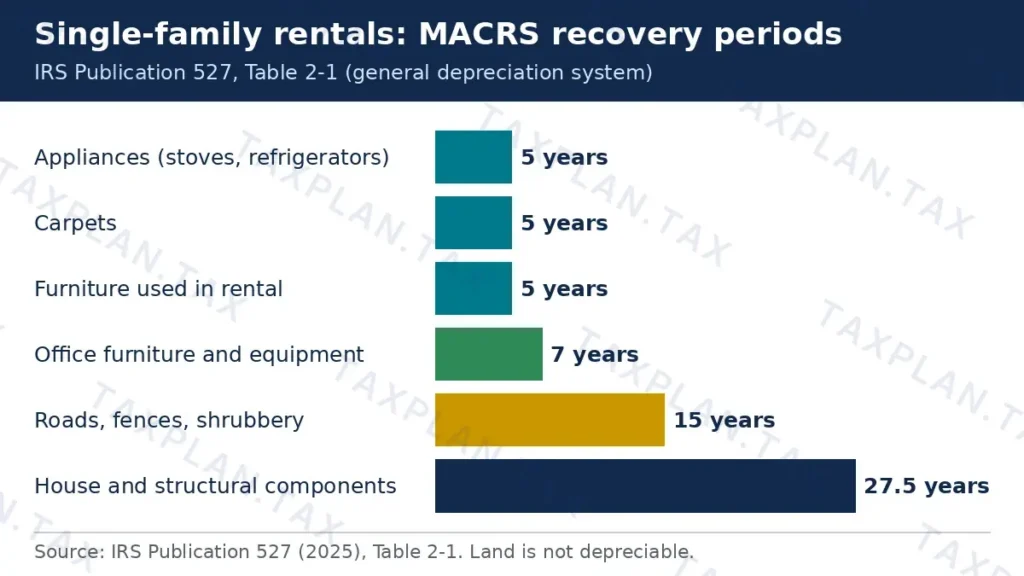
Publication 527, Table 2-1 gives a clear list for rental activities. It shows these recovery periods under the general depreciation system:
| Property in a rental activity | GDS recovery period |
|---|---|
| Appliances, such as stoves and refrigerators | 5 years |
| Carpets | 5 years |
| Furniture used in rental property | 5 years |
| Office furniture and equipment | 7 years |
| Roads, fences, and shrubbery | 15 years |
| The building and structural components, such as furnaces and water pipes | 27.5 years |
In addition, the IRS residential matrix in Publication 5653, Chapter 7.H adds detail. For instance, it treats electrical and plumbing lines dedicated to appliances as 5-year property. It also treats window treatments and readily removable flooring as 5-year property. However, it keeps kitchen cabinets, counters, central HVAC, and roofs in the 27.5-year class.
How Does Cost Segregation for Single-Family Rentals Work?
Direct answer: You start with the purchase price, remove the land value, and then allocate the building basis among the classes with documented support.
First, the land must come out, because cost segregation for single-family rentals starts from the building basis only. Publication 527 says to divide cost between land and building based on their relative fair market values. However, if you aren’t certain of those values, you can use the assessed values for real estate tax purposes. Next, the specialist reviews the house, photos, closing documents, and any renovation invoices. Then the specialist prices each short-lived component and assigns its class. Finally, the report explains each allocation.
For a step-by-step view, read Cost Segregation Study Process: Step-by-Step Breakdown.
Can you study several rental homes at once?
Many investors own several houses. Each house is a separate building with its own basis and placed-in-service date. So cost segregation for single-family rentals still needs property-level facts. However, similar homes may share data sources, which can make a portfolio review more efficient. Ask the provider how it supports each home.
What Are the Benefits of Cost Segregation for Single-Family Rentals?
Direct answer: The benefit is earlier depreciation. With 100% bonus depreciation, the 5- and 15-year parts of a recently acquired home can be deducted in year one.
Public Law 119-21, enacted July 4, 2025, restored 100% bonus depreciation permanently. It applies to qualified property acquired after January 19, 2025. Bonus covers property with a recovery period of 20 years or less. So the 27.5-year house itself does not qualify. Even so, cost segregation for single-family rentals can unlock bonus on the shorter-lived parts.
However, a written binding contract signed before January 20, 2025 changes the answer. In that case, the old phase-down rates apply: 40% for 2025 and 20% for 2026. Also, used property can qualify for bonus if you did not use it before, under Treas. Reg. §1.168(k)-2. That matters because most rental homes are bought used.
What Tax Rules Limit Cost Segregation for Single-Family Rentals?
Direct answer: The passive loss rules, the vacation home rules, and depreciation recapture can all limit or delay the benefit.
How do the passive loss rules apply?
Rental activities are generally passive under IRC §469. As a result, rental losses usually offset only passive income. However, §469(i) allows owners who actively participate to deduct up to $25,000 of rental losses against other income. That allowance shrinks by 50% of modified AGI over $100,000. So it disappears at $150,000. Publication 925 explains these rules in detail.
In addition, real estate professionals under §469(c)(7) can avoid the passive rule if they materially participate. That status requires more than half of working time and more than 750 hours in real property businesses. Unused losses are not lost, though. Instead, they carry forward. That timing should shape any plan for cost segregation for single-family rentals.
What about short-term rentals?
According to Publication 925, an activity is not a rental activity if the average customer stay is 7 days or less. Then the material participation tests apply instead. So an owner who materially participates in a short-term rental may treat its losses as nonpassive.
However, short stays raise a second question. The statute excludes units in an establishment where more than half the units are used on a transient basis from the dwelling unit definition. Therefore, before relying on cost segregation for single-family rentals used as vacation stays, ask whether the home is 27.5-year or 39-year property.
How do vacation home rules apply?
Personal use can change everything. Under IRC §280A, a home is treated as a residence if your personal use exceeds the greater of 14 days or 10% of the days it is rented at fair rental. In that case, deductions are generally limited to rental income. Publication 527, Chapter 5, explains the rules.
What happens when you sell?
Under IRC §1245, gain on 5- and 15-year property is ordinary income up to the depreciation taken. Meanwhile, building depreciation can create unrecaptured §1250 gain, taxed at up to 25% under IRC §1(h). So cost segregation for single-family rentals defers tax rather than eliminating it.
What Does Cost Segregation for Single-Family Rentals Look Like in Practice?
Direct answer: The example below shows one rental house and how the passive rules change the result. All amounts are illustrative assumptions, not typical results.
Assume an investor buys a rental house for $450,000 in 2026. The property tax bill shows a land value of $60,000 and an improvement value of $240,000. So land is 20% of the assessed total. Applying that ratio, land is $90,000 and the house is $360,000. The home is placed in service in June 2026.
| Class (illustrative study) | Basis | Year-one depreciation |
|---|---|---|
| 5-year: appliances, removable carpet, window treatments, dedicated circuits | $36,000 | $36,000 (100% bonus) |
| 15-year: fence, driveway, landscaping | $21,600 | $21,600 (100% bonus) |
| 27.5-year: house and structural components | $302,400 | $5,957 |
| Total | $360,000 | $63,557 |
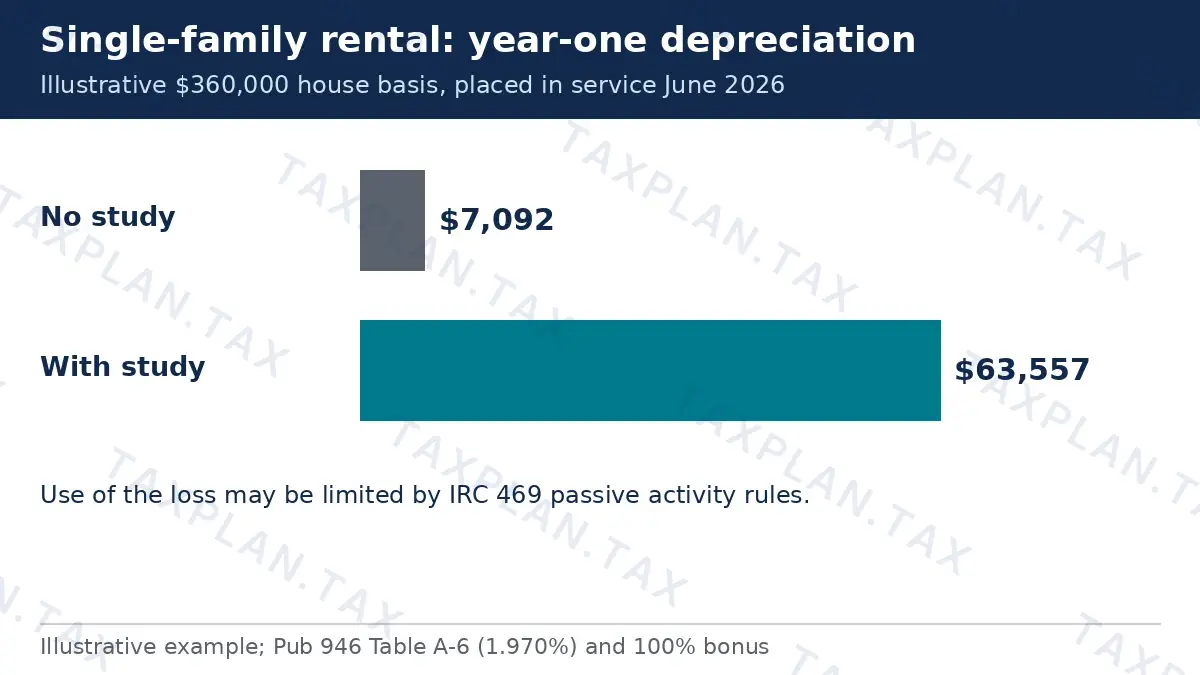
The 27.5-year amount uses the June rate of 1.970% from Publication 946, Table A-6. Without a study, the full $360,000 at 1.970% gives $7,092. Therefore, the study adds about $56,465 of first-year depreciation in this example.
How much of that loss can the owner use?
Next, assume rent is $30,000 and cash expenses are $14,000. Income before depreciation is $16,000. With the study, the rental shows a loss of $47,557. Now the owner’s income decides the result:
- Modified AGI of $90,000: the owner can deduct $25,000, and $22,557 carries forward.
- Modified AGI of $130,000: the allowance drops by $15,000 to $10,000, and $37,557 carries forward.
- Modified AGI of $150,000 or more: no allowance remains, so the whole loss carries forward unless the owner has passive income.
These figures assume active participation and no other passive activities. In other words, cost segregation for single-family rentals helps most when the owner can actually use the loss.
What Are Common Mistakes With Cost Segregation for Single-Family Rentals?
Direct answer: The biggest mistakes involve land value, misclassified finishes, and projections that ignore the passive rules.
- Skipping the land allocation. Land is not depreciable, so a missing or inflated building share overstates every deduction.
- Treating kitchen cabinets as 5-year property. The IRS residential matrix lists them as 27.5-year property.
- Calling glued-down flooring removable. Only readily removable floor covering is 5-year property in the matrix.
- Studying a flip. A house held for resale is inventory and is not depreciable.
- Ignoring the fee. On a small house, the fee can absorb much of the time value of the deduction.
- Forgetting personal use. Family stays can trigger the §280A limits.
Also, some states do not follow federal bonus depreciation. So review the state return as well when you model cost segregation for single-family rentals.
Frequently Asked Questions
Is cost segregation for single-family rentals worth the cost?
It depends on the basis, the purchase date, and whether you can use the loss. Compare the quoted fee with the tax value you expect to use. Our article When Is a Cost Segregation Study Worth It? walks through the analysis.
Can I do my own study on a rental house?
You can classify items yourself, such as appliances you buy. However, the IRS audit guide favors detailed, well-documented studies. A weak allocation is easier for an examiner to adjust.
Does cost segregation for single-family rentals work on homes I already own?
Yes. A look-back study can catch up missed depreciation through Form 3115 and a §481(a) adjustment. The automatic change procedures are in Rev. Proc. 2025-23.
What if I replace appliances later?
New appliances are separate 5-year property. In addition, you may be able to recognize a loss on the remaining basis of the old ones as a disposition under Treas. Reg. §1.168(i)-8.
Does a new roof qualify for bonus depreciation?
Generally, no. Publication 527 says a new roof uses the same recovery period as the building. For a rental house, that is 27.5 years.
Do short-term rental owners get a different result?
Possibly. The 7-day rule can change passive treatment, and transient use may affect the building’s class. Have your advisor review the facts.
Conclusion: Should You Use Cost Segregation for Single-Family Rentals?
To sum up, cost segregation for single-family rentals can move appliances, removable finishes, and site work into 5- and 15-year classes. For homes acquired after January 19, 2025, those parts can get 100% bonus depreciation. However, the smaller basis, the study fee, and the passive loss rules all affect the real value. Therefore, run the numbers with your own income and portfolio in mind.
Emunah Cost Segregation can help you make that decision. Alan Goldstein, EA, reviews your rental homes, closing documents, and tax picture before any study begins. Then he tells you plainly whether a study makes sense. Contact Emunah Cost Segregation in Coral Gables, Florida, to request a review. To estimate potential savings first, read How Much Can You Save with a Cost Segregation Study?
Sources and Authorities
- 26 U.S.C. §168 (including §168(c), §168(e)(2), and §168(k)): https://www.law.cornell.edu/uscode/text/26/168
- 26 U.S.C. §469 (including §469(c)(7) and §469(i)): https://www.law.cornell.edu/uscode/text/26/469
- 26 U.S.C. §280A: https://www.law.cornell.edu/uscode/text/26/280A
- 26 U.S.C. §1245: https://www.law.cornell.edu/uscode/text/26/1245
- 26 U.S.C. §1 (including §1(h)): https://www.law.cornell.edu/uscode/text/26/1
- Public Law 119-21 (H.R. 1, 119th Congress): https://www.congress.gov/bill/119th-congress/house-bill/1
- IRS Notice 2026-11: https://www.irs.gov/pub/irs-drop/n-26-11.pdf
- Treas. Reg. §1.168(k)-2: https://www.ecfr.gov/current/title-26/section-1.168(k)-2
- Treas. Reg. §1.168(i)-8: https://www.ecfr.gov/current/title-26/section-1.168(i)-8
- IRS Publication 527, Residential Rental Property (2025), including Table 2-1 and Chapter 5: https://www.irs.gov/pub/irs-pdf/p527.pdf
- IRS Publication 925 (2025): https://www.irs.gov/pub/irs-pdf/p925.pdf
- IRS Publication 946, Table A-6: https://www.irs.gov/pub/irs-pdf/p946.pdf
- IRS Publication 5653, Cost Segregation Audit Techniques Guide, Chapter 7.H: https://www.irs.gov/pub/irs-pdf/p5653.pdf
- About Form 3115: https://www.irs.gov/forms-pubs/about-form-3115
- Rev. Proc. 2025-23: https://www.irs.gov/pub/irs-drop/rp-25-23.pdf
This article is provided for general educational purposes and does not constitute individualized tax, legal, or accounting advice. Tax consequences depend on the taxpayer’s specific facts and applicable law.
