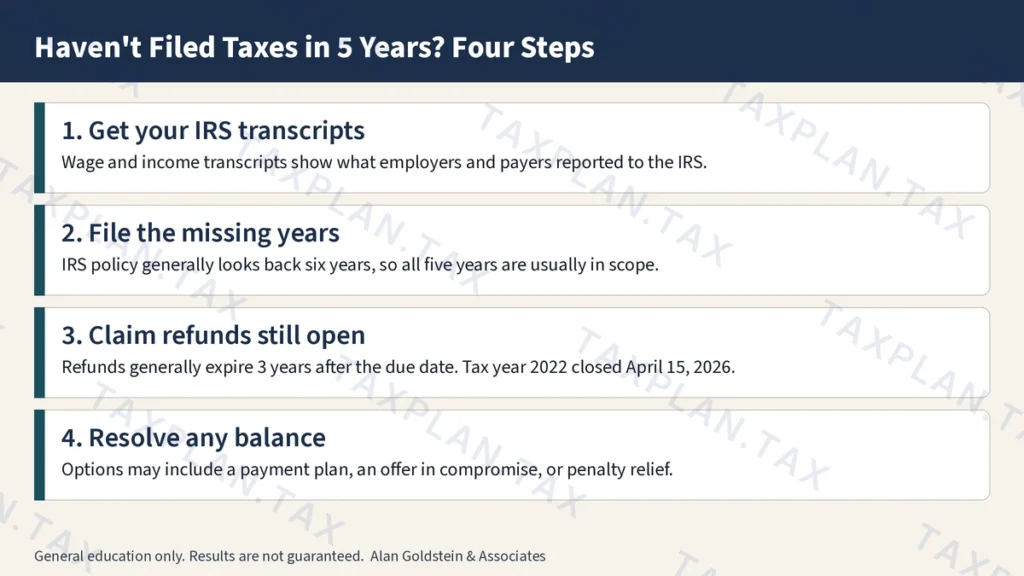


If you haven’t filed taxes in 5 years, the best next step is usually to file the missing returns as soon as you can. Start by getting your IRS transcripts. Then file each required year, claim any refunds that are still open, and deal with any balance. Penalties and interest may already apply to unpaid tax, but filing can stop the failure-to-file penalty from growing on a year. This guide walks through each step as of late 2026.
Key Takeaways
- IRS policy generally looks back six years, so all five missing years are usually in scope.
- Refunds generally expire about 3 years after the due date. The window for tax year 2022 closed April 15, 2026.
- The minimum failure-to-file penalty differs by year, from $435 to $525 for these five years.
- When no return was filed, the IRS can assess the tax at any time for that year.
- Payment plans, offers in compromise, and penalty relief may be available after you file. None is guaranteed.
What should you do first if you haven’t filed taxes in 5 years?
Get your IRS records first. Your wage and income transcripts show what employers, banks, and other payers reported for each year.
You can request transcripts through Get Transcript. The IRS explains the different transcript types on its transcript types page. Also order account transcripts. They show whether the IRS already assessed tax for any year, for example through a substitute return.
Next, gather your own records. These include bank statements, Forms 1099 and W-2, and records of business expenses. Transcripts may not show every type of income, so your records fill the gaps.
Which years do you need to file?
Usually all five. IRS policy generally enforces filing for up to six years, so a five-year gap typically falls entirely within it.
The Internal Revenue Manual (IRM 4.12.1) says the enforcement period under Policy Statement P-5-133 is not to be more than six years. However, it also allows longer or shorter periods based on the facts. Meanwhile, the IRS advises taxpayers to file all tax returns that are due, whether or not they can pay in full (IRS: Filing past due tax returns). For more on the policy, read how far back the IRS requires unfiled tax returns.
Is there a legal time limit on unfiled years?
No. Under IRC §6501(c)(3), the IRS may assess tax “at any time” if no return was filed. Once you file, the normal three-year assessment period generally begins. After assessment, the IRS generally has 10 years to collect under IRC §6502.
Can you still get refunds after 5 years of not filing?
Only for the years still inside the refund window. In general, you have three years to file and claim a refund. After that, the IRS says the money becomes the property of the U.S. Treasury.
The IRS set April 15, 2026 as the deadline for most 2022 refund claims (IRS: Tax year 2022 refund deadline). As of November 2026, the table below shows the general status for the five most recent years:
| Tax year | Refund window (general rule, as of November 2026) |
|---|---|
| 2021 | Closed |
| 2022 | Closed April 15, 2026, per the IRS |
| 2023 | Open; generally ends April 15, 2027 (statute-based estimate) |
| 2024 | Open |
| 2025 | Open |
These rules come from IRC §6511 and §6513. Exceptions can extend the window, so confirm the date for your situation. Even for a closed refund year, you still must file if you were required to. Also, the IRS may hold or offset refunds for open years. See our guide to the refund deadline for unfiled federal tax returns.
What penalties apply after 5 years of unfiled returns?
If you owe tax for a year, failure-to-file and failure-to-pay penalties usually apply, plus interest. If you owe nothing, the failure-to-file penalty is generally zero.
Under IRC §6651, the failure-to-file penalty is 5% of unpaid tax per month, up to 25%. So for a year more than five months late, that penalty has usually reached its cap. The failure-to-pay penalty then keeps adding 0.5% per month, up to its own 25% limit. When both apply in a month, §6651(c)(1) reduces the failure-to-file penalty by the failure-to-pay amount.
What is the minimum penalty for each year?
If a return is more than 60 days late, a minimum penalty applies. It is the smaller of the amount below or 100% of the unpaid tax (IRS: Failure to file penalty). The IRS ties the amount to the return’s original due date:
| Tax year (return due in) | Minimum failure-to-file penalty |
|---|---|
| 2021 (due in 2022) | $435 |
| 2022 (due in 2023) | $450 |
| 2023 (due in 2024) | $485 |
| 2024 (due in 2025) | $510 |
| 2025 (due in 2026) | $525 |
Interest also compounds daily on unpaid tax and penalties. The underpayment rate is 7% for October through December 2026 (IRS: Quarterly interest rates). It rises to 8% for the quarter beginning January 1, 2027 (IR-2026-144).
What if the IRS already filed returns for you?
Then you can usually still file your own returns for those years. The IRS says it will generally adjust your account to reflect the correct figures.
The IRS prepares these returns under IRC §6020(b). They are called substitute for returns (SFRs). An SFR might not give you credit for deductions you may be entitled to receive. Before the assessment, the IRS sends a Notice of Deficiency CP3219N. You then have 90 days to file your own return or petition the Tax Court. To learn more, read what a substitute for return is.
Could 5 years of unfiled returns lead to criminal charges?
It is possible but uncommon. The key question is willfulness, and most late filers face civil penalties instead.
Under IRC §7203, willful failure to file is a misdemeanor. In Cheek v. United States (1991), the Supreme Court said willfulness means a “voluntary, intentional violation of a known legal duty” (498 U.S. at 201). If you have unreported income from illegal sources, hidden accounts, or other serious issues, talk to a qualified professional first. The IRS also runs a Criminal Investigation Voluntary Disclosure Practice for certain taxpayers with potential criminal exposure.
How can you resolve a balance after filing?
File first, then choose a payment or relief option that fits your finances. Most IRS collection options require you to be current on filing.
- Installment agreement. A monthly payment plan. See how to request an installment agreement for unfiled returns.
- Offer in compromise. A settlement for less than the full amount, if you qualify. See our offer in compromise guide.
- Currently not collectible status. A temporary pause for hardship. See CNC status with unfiled returns.
Can penalties be removed after five years?
Possibly, but relief is not automatic. First Time Abate requires three prior years of timely compliance, so it rarely helps when five years are missing (IRS: Administrative penalty relief). Reasonable cause relief may apply if events beyond your control prevented filing (IRS: Penalty relief for reasonable cause). However, in United States v. Boyle (1985), the Supreme Court held that relying on an agent to file “cannot function as a substitute for compliance with an unambiguous statute” (469 U.S. at 251).
Frequently Asked Questions
Do I have to file all five years at once?
Not necessarily on the same day. However, the IRS generally expects every required year to be filed, and most collection options require full filing compliance.
Will the IRS go back further than five years?
It can. Policy generally limits enforcement to six years, but the IRM allows longer periods based on the facts. Legally, unfiled years have no assessment deadline.
Can I still get my 2022 refund?
Generally, no. The IRS set April 15, 2026 as the deadline for most 2022 refund claims, unless an exception applies.
What if I can’t pay what I owe?
File anyway. Filing stops the failure-to-file penalty from growing, and you can then request a payment plan or other option.
Will filing late returns trigger an audit?
Filing late does not by itself mean an audit. The IRS reviews returns based on its own criteria, and outcomes vary.
What if I don’t have my old records?
Start with IRS wage and income transcripts. Then rebuild missing items from bank statements and other third-party records.
What if I also had a business?
You may have business returns to file too, such as payroll or partnership returns. See our guide for small business owners.
Conclusion
If you haven’t filed taxes in 5 years, the problem is serious but usually manageable. Get your transcripts, file every required year, claim the refunds that are still open, and then address any balance. Acting before the IRS does gives you more control over the figures and the options.
Alan Goldstein, MBA, IRS Enrolled Agent, of Alan Goldstein & Associates in Coral Gables, Florida, helps people catch up after years of unfiled returns. We can obtain your IRS records, prepare the missing returns, and evaluate payment and penalty relief options. Every case depends on its facts, and we cannot guarantee any outcome. To request a confidential review, visit our Tax Resolution Services page.
Cases Cited
Sources and Authorities
- IRS: Get Transcript
- IRS: Transcript types for individuals and ways to order them
- IRM 4.12.1, Nonfiled Returns (Enforcement Period, P-5-133)
- IRS: Filing past due tax returns
- IRC §6501, Limitations on assessment and collection
- IRC §6502, Collection after assessment
- IRS: Time is running out to claim refunds for tax year 2022 (April 15, 2026 deadline)
- IRC §6511, Limitations on credit or refund
- IRC §6513, Time return deemed filed and tax considered paid
- IRC §6651, Failure to file tax return or to pay tax
- IRS: Failure to file penalty (minimum penalty table)
- IRS: Quarterly interest rates
- IRS: IR-2026-144, Interest rates increase for the first quarter of 2027
- IRC §6020, Returns prepared for or executed by Secretary
- IRC §7203, Willful failure to file return, supply information, or pay tax
- Cheek v. United States, 498 U.S. 192, 201 (1991) (official U.S. Reports, Library of Congress)
- IRS: Criminal Investigation Voluntary Disclosure Practice
- IRS: Penalty relief due to First Time Abate or other administrative waiver
- IRS: Penalty relief for reasonable cause
- United States v. Boyle, 469 U.S. 241, 251 (1985) (official U.S. Reports, Library of Congress)
This article is provided for general educational purposes and does not constitute individualized tax, legal, or accounting advice. Tax consequences depend on the taxpayer’s specific facts and applicable law.
