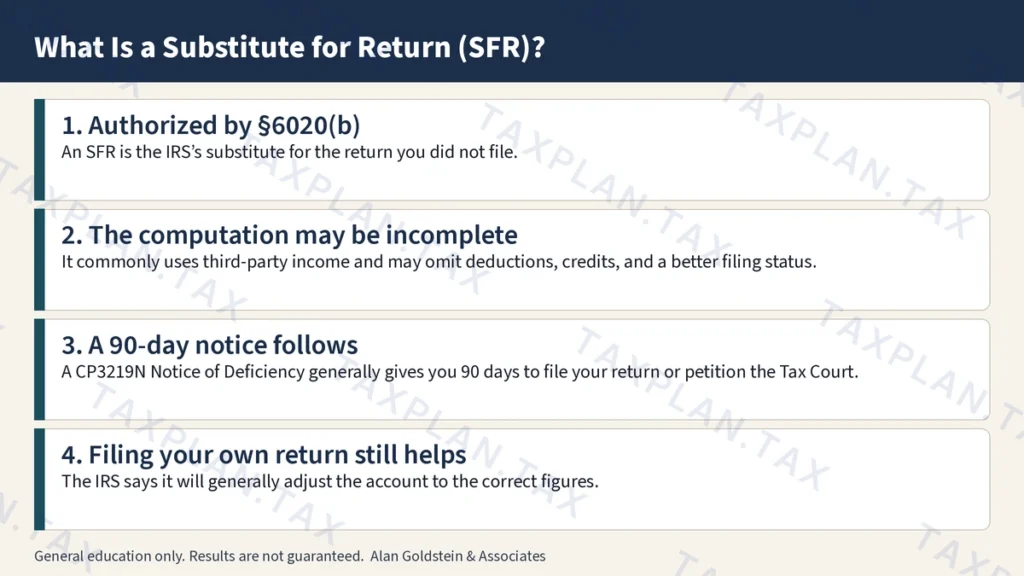


A substitute for return, or SFR, is a return the IRS prepares when you do not file a required return, using information the agency already has. Internal Revenue Code (IRC) §6020(b) provides that if a person fails to make a required return, the Secretary shall make a return from the Secretary’s own knowledge and from information that can be obtained, and that a return so made and subscribed is prima facie good and sufficient for all legal purposes. In practice, the IRS typically builds the SFR from Forms W-2, 1099, and other information returns. The agency states that this return might not give you credit for deductions and exemptions you may be entitled to receive. It generally sends a Notice of Deficiency, CP3219N (a 90-day letter), proposing an assessment. You then have 90 days (150 days if the notice is addressed to a person outside the United States) to file your own return or petition the Tax Court. If you do neither, the IRS may assess the proposed tax and begin collection, including liens and levies. The IRS states that you should still file your own signed return, and that it will generally adjust the account to the correct figures.
Key Takeaways
- An SFR is the IRS’s substitute for the return you did not file. It is authorized by §6020(b) and, once properly made and subscribed, is prima facie good and sufficient for all legal purposes.
- The computation is often incomplete in the taxpayer’s favor. It commonly uses third-party reported income and may omit itemized deductions, credits, and a more favorable filing status.
- The IRS generally issues a CP3219N Notice of Deficiency and gives you 90 days to file your own return or petition the Tax Court. The IRS states that you cannot request an extension to file after that notice.
- If you do not respond, the proposed tax can be assessed and collected. Collection can include a notice of federal tax lien under §6321 and a levy under §6331.
- Filing your own return after an SFR is not futile. The IRS says it will generally adjust the account to reflect the correct figures.
- An SFR assessment starts the ordinary 10-year collection period under §6502. It does not replace the value of filing an accurate original return.
Introduction and Background
The income tax system is built on self-assessment: you file a return, report income, claim the deductions and credits the law allows, and pay any balance. When you do not file, the IRS is not required to wait indefinitely. Section 6020(b) gives the Secretary the authority to make a return from available information so that tax can be determined and assessed.
That authority is why an unfiled year does not simply go away. The IRS already receives wage and income reports from employers, brokers, banks, and other payers. Those reports are often enough to prepare a proposed tax computation, especially for a wage earner or a recipient of Forms 1099. What they are usually not enough to do is reconstruct your filing status, dependents, adjustments, itemized deductions, business expenses, or credits. The resulting SFR can overstate the tax compared with a complete Form 1040.
Understanding what an SFR is—and what it is not—helps you read the notices that precede it and decide how to respond. A companion article addresses the risks of an SFR and the steps to take after you receive one. This article explains the legal mechanism, the typical process, and the effect on your account.
How It Works
How the IRS builds the substitute return
The IRS’s past-due returns page describes the sequence in operational terms. If you fail to file, the IRS may file a substitute return for you. That return might not give you credit for deductions and exemptions you may be entitled to receive. The agency will send a Notice of Deficiency CP3219N proposing a tax assessment. You have 90 days to file your past-due tax return or to petition the Tax Court. If you do neither, the IRS will proceed with the proposed assessment. If any of the income listed is incorrect, the IRS says to contact the agency, contact the payer for a corrected Form W-2 or 1099, and attach the corrected forms when you send your completed return.
IRM 4.12.1 distinguishes a few related concepts. Section 6020(a) allows the Secretary to prepare a return that the taxpayer then signs, which may be received as the taxpayer’s return. Section 6020(b) applies when the taxpayer does not file, or files a false or fraudulent return, and the Secretary makes a return from the Secretary’s own knowledge and from information that can be obtained. The IRM states that an SFR, in and of itself, does not constitute a return under §6020(b) until additional certification steps are completed, including, where applicable, Form 13496, IRC Section 6020(b) Certification. Those internal steps matter for whether certain penalties, including the failure-to-pay penalty, can be asserted on the SFR. They do not require you to wait for the IRS to finish its paperwork before you file your own return.
What happens after the notice of deficiency
The CP3219N is a statutory notice of deficiency. The 90-day period (150 days if the notice is addressed to a person outside the United States) is the period in which you may petition the Tax Court without first paying the proposed tax. The IRS also states that you may file your past-due return during that period, and that you cannot request an extension to file after receiving CP3219N. If you do nothing, the IRS may assess the proposed tax. Once the tax is assessed and remains unpaid, collection can include a levy on wages or a bank account or the filing of a notice of federal tax lien. Repeated failure to file, the IRS warns, can lead to additional enforcement, including additional penalties and criminal prosecution.
Account transcripts will often show an SFR posting and later assessments, penalties, and interest. If you need income information to prepare your own return, the IRS points taxpayers to Form 4506-T (wage and income transcripts) and to Get Transcript.
Benefits and Opportunities
- You can still file your own return. An SFR does not permanently lock in the IRS’s figures. The IRS states that it will generally adjust the account to the correct figures when you file.
- Your return can reduce the tax base. Filing status, the standard or itemized deduction, adjustments, business expenses, and credits can change the tax, which can also change penalties computed on unpaid tax and the balance that collection can pursue.
- You can correct third-party reports. If a W-2 or 1099 is wrong, the IRS’s process is to obtain a correction and to attach it to your return, and to contact the IRS at the number it publishes for that purpose (866-681-4271 on the past-due returns page).
- A timely response preserves Tax Court access. A petition filed within the 90-day period allows the Tax Court to review the proposed deficiency before you have to pay it. Missing that period changes the path to later review.
Legal and Regulatory Considerations
Section 6020(b)(1) directs the Secretary to make a return if a required return is not filed, or if a false or fraudulent return is made, from the Secretary’s own knowledge and from information obtained through testimony or otherwise. Section 6020(b)(2) provides that any return so made and subscribed by the Secretary shall be prima facie good and sufficient for all legal purposes. That is the statutory foundation for treating a certified SFR as a return that will support an assessment after the deficiency procedures of the Code are followed.
The deficiency process is what produces the CP3219N. Until the tax is assessed, the 10-year collection period in §6502 generally has not started. After assessment, that period generally runs from the assessment date. The assessment limitation period in §6501 is a separate clock; if you never filed, §6501(c)(3) already allowed assessment at any time. The SFR is the mechanism the IRS uses to turn that open period into an actual assessment.
Civil penalties under §6651 can still apply. The failure-to-file penalty is computed on the net unpaid tax and can include the inflation-adjusted minimum if an income tax return is more than 60 days late. For due dates after December 31, 2025, that minimum is $525, or 100% of the tax required to be shown, whichever is less. The failure-to-pay penalty may depend in part on whether the SFR has been certified in the manner the IRM requires for §6651(g). Interest under §§6621 and 6622 compounds daily; for October 1 through December 31, 2026, the underpayment rate for individuals is 7% per year. Willful failure to file can also be a misdemeanor under §7203.
Practical Examples
The following examples are illustrative. They show how an SFR can differ from a taxpayer-prepared return. They do not determine any actual tax.
| Item | Typical SFR posture (illustrative) | Taxpayer-prepared Form 1040 (illustrative) |
|---|---|---|
| Income | Amounts reported on Forms W-2 and 1099 that the IRS has received | The same third-party amounts, plus any unreported income, minus corrections supported by payer statements |
| Filing status and dependents | Often a default status that may not reflect a joint return or dependents | The status and dependents the taxpayer is entitled to claim, with required support |
| Deductions and adjustments | Often omitted or limited, because the IRS may not have those facts | Standard or itemized deduction, IRA or other adjustments, and allowable business expenses |
| Credits | Often omitted, including refundable credits that must be claimed on a filed return | Credits for which the taxpayer qualifies, subject to §6511 if a refund is involved |
| Resulting tax and collection | A proposed tax that may be higher, followed by assessment and collection if there is no timely response | A corrected tax that the IRS states it will generally use to adjust the account |
Illustrative numbers. Suppose third-party reports show $80,000 of wages and $6,000 of withholding, and the SFR proposes tax of $12,000 on a default filing status with no additional deductions or credits, leaving an $6,000 unpaid tax before penalties and interest. If a complete Form 1040, using the correct status and allowable deductions and credits, shows tax of $7,200, the unpaid tax after withholding would be $1,200, not $6,000. Penalties and interest computed on the lower unpaid tax would also be lower. The example is simplified and labeled as illustrative; the actual computation depends on the year, the facts, and the law in effect for that year. It is the kind of difference the IRS is pointing to when it says an SFR might not give you credit for deductions and exemptions you may be entitled to receive.
Common Mistakes and Risks
- Treating the SFR as the final tax bill before the notice period ends. The CP3219N is a proposed assessment. The 90-day period is the time to file or petition.
- Assuming you cannot file once the IRS has “already filed for you.” The IRS says you should still file your own return.
- Ignoring incorrect income on the SFR. The remedy is a corrected payer statement and your own return, not silence.
- Missing the 90-day period and then facing assessment and collection on inflated figures. After assessment, the collection path is harder, even if you later file.
- Confusing an SFR with a filed return for refund purposes. A refund of withholding or credits generally still requires a timely claim under §6511 on a return you file.
- Overlooking related entity or employment returns. An SFR process for Form 1040 does not automatically resolve unfiled employment, partnership, or S corporation returns.
Frequently Asked Questions
Is a substitute for return the same as my Form 1040?
No. It is the IRS’s return, prepared from available information, and it may omit deductions, credits, and filing-status facts that would appear on a complete Form 1040 you sign.
Does an SFR satisfy my filing requirement?
A certified §6020(b) return is prima facie good and sufficient for legal purposes, including assessment. It is still in your interest to file your own return so that the account reflects the correct figures, as the IRS itself states.
Will I get a refund from an SFR?
An SFR is typically used to propose a tax assessment, not to claim your credits or a refund. If you are due a refund, you generally must file your own return in time under §6511.
What is a CP3219N?
It is the Notice of Deficiency, also called a 90-day letter, that the IRS says it will send when it proposes to assess tax on a substitute return. It starts a short period to file your return or petition the Tax Court.
Can I get more time after I receive the CP3219N?
The IRS states that you cannot request an extension to file after receiving that notice. The statutory period to petition the Tax Court is also strict.
What if the income on the SFR is wrong?
Contact the IRS at the number on the past-due returns page or on your notice, contact the payer for a corrected form, and attach the corrected forms to your completed return.
Does an SFR start penalties and interest?
Penalties under §6651 and interest under §§6621 and 6622 can apply to a non-filed year whether or not an SFR has posted, and they can be computed on the assessed tax after an SFR. Filing your own return can change the tax base.
What should I do first if I learn an SFR has been prepared?
Get the notice and any account transcripts, calendar the 90-day date if a CP3219N was issued, gather wage and income transcripts, and prepare a complete, signed original return. If the period to petition the Tax Court is running, get professional advice promptly.
Conclusion
A substitute for return is the IRS’s statutory tool for turning an unfiled year into a proposed, and then an assessed, tax liability. It is built from the information the agency already has, and it often omits the deductions and credits that would appear on a return you prepare. The notice of deficiency that accompanies it has a short response period. Filing your own return, and doing so on time, is how you put the correct figures on the account and limit what can be assessed and collected.
If the IRS has prepared, or may prepare, a substitute for return on an unfiled year, Alan Goldstein & Associates can help. Alan Goldstein, MBA, IRS Enrolled Agent, works with individuals, business owners, and their tax advisors to prepare original returns, review SFR notices, and address the tax, penalties, and collection issues that follow. Contact Alan Goldstein & Associates in Coral Gables, Florida, for a confidential review.
Sources and Authorities
- 26 U.S.C. §6020: https://www.law.cornell.edu/uscode/text/26/6020
- IRS, Filing past due tax returns (SFR and CP3219N process): https://www.irs.gov/businesses/small-businesses-self-employed/filing-past-due-tax-returns
- IRM 4.12.1, Nonfiled Returns (SFR and §6020(b) certification): https://www.irs.gov/irm/part4/irm_04-012-001
- 26 U.S.C. §§6501 and 6502: https://www.law.cornell.edu/uscode/text/26/6501
- 26 U.S.C. §§6321 and 6331: https://www.law.cornell.edu/uscode/text/26/6321
- 26 U.S.C. §6651: https://www.law.cornell.edu/uscode/text/26/6651
- IRS, Failure to file penalty: https://www.irs.gov/payments/failure-to-file-penalty
- IRS, Quarterly interest rates: https://www.irs.gov/payments/quarterly-interest-rates
- IRS, Get Transcript: https://www.irs.gov/individuals/get-transcript
This article is provided for general educational purposes and does not constitute individualized tax, legal, or accounting advice. Tax consequences depend on the taxpayer’s specific facts and applicable law.
