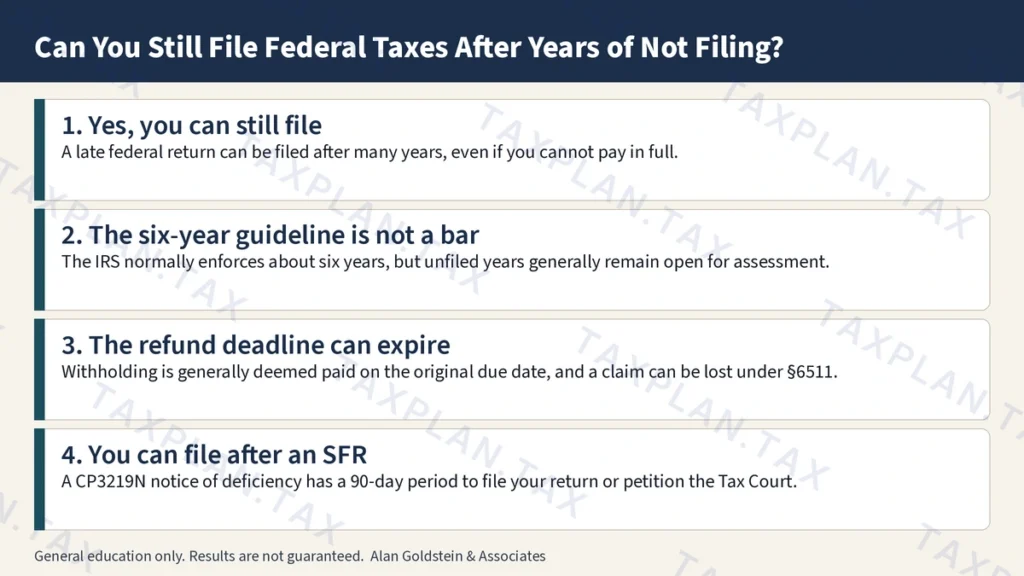


Yes. You can still file a required federal tax return after years of not filing, and the IRS tells taxpayers to file all returns that are due, whether or not they can pay in full. There is no rule that a return becomes legally unfileable merely because it is one, five, or ten years late. The IRS will accept a delinquent return, and Internal Revenue Manual 5.1.11 states that a taxpayer may file for all open periods regardless of the age of the delinquency. What does change with time is the cost and the remaining options. Failure-to-file and failure-to-pay penalties under Internal Revenue Code (IRC) §6651, plus daily compounded interest, can add to any unpaid tax. A refund of withholding or estimated tax can be lost if you wait too long under §6511. The assessment limitation period in §6501 generally does not start until a valid return is filed, so delay does not close a balance-due year. If the IRS has already prepared a substitute for return, you can still file your own return, and the IRS states that it will generally adjust the account to the correct figures.
Key Takeaways
- A late federal return can be filed after many years. The IRS’s published instruction is to file every return that is due, even if you cannot pay the tax in full.
- The IRS will normally enforce delinquency procedures for about six years under Policy Statement 5-133, but you may file older years, and an unfiled year generally remains open for assessment under §6501.
- The real time bar for many people is the refund deadline, not a ban on late filing. Withholding is generally deemed paid on the original due date, and a claim can be lost under §6511.
- You can file after the IRS has prepared a substitute for return. A CP3219N notice of deficiency has a 90-day period to file your return or petition the Tax Court.
- Penalties and interest continue until the return is filed and the tax is paid, subject to the statutory caps and to any available relief. For returns due after December 31, 2025, the minimum failure-to-file penalty can be as high as $525, limited to 100% of the tax required to be shown.
- If you are concerned that the non-filing was willful or that a criminal investigation may be involved, get professional advice before you file or contact the IRS.
Introduction and Background
People stay in non-filer status for years because they assume it is too late, too expensive, or too complicated to come forward. The law does not treat a late return as a nullity. A signed, complete return for a prior year is still a return. What the delay changes is the penalty computation, the interest, the refund period, and, if the IRS has already acted, the collection posture of the account.
The IRS’s past-due returns page is consistent with that view: file now, file even if you cannot pay, and file the same way and to the same location as an on-time return, or to the address on any notice. The same page warns that a substitute return may omit deductions and credits, that refunds can be lost, and that processing a complete past-due return takes about six weeks. Those are operational facts, not a closed door.
The question is therefore not whether you are allowed to file after a long delay. You are. The question is how to file so that you protect any remaining refund, place accurate figures on the account, stop the failure-to-file penalty from continuing, and open payment and relief options.
How It Works
What you can still do after years of silence
You can determine, year by year, whether a return was required. You can request wage and income transcripts and account transcripts through Get Transcript or Form 4506-T. You can complete the prior-year form under the law in effect for that year and file it electronically if the year is still accepted for e-file, or on paper if it is not. The IRS has stated, on its CP515 notice page, that it accepts returns electronically for the two most recent prior years through a provider that offers that service. Older years are generally paper-filed. If you have a notice, you file to the notice address and include any requested form, such as Form 15103.
You can also file years the IRS is not currently asking for. Policy Statement 5-133, as applied in IRM 4.12.1 and IRM 5.1.11, normally limits enforcement to six years, with manager approval to do more or less. The IRM states that the taxpayer may file for all open periods regardless of the age of the delinquency, and that manager approval is not required for those voluntary filings. That is often the right step for a refund year that is still timely, or for a complete filing history.
What time does take away
Time does not bar the filing itself, but it can bar a refund. Under §6511 and the deemed-paid rule in §6513, a refund of withholding or estimated tax may be untimely if the return is filed more than three years after the original due date, taking into account the lookback rules, including any filing-extension period that is part of the lookback. The IRS states this in plain language on the past-due returns page and applies the same concern to credits such as the earned income credit.
Time also increases cost on a balance-due year. The failure-to-file penalty generally accrues at 5% of unpaid tax per month, or part of a month, up to 25%, reduced by the failure-to-pay amount when both apply, so the combined monthly charge is 5% for those months. The failure-to-pay penalty can continue after filing, up to 25%. Interest compounds daily. For October 1 through December 31, 2026, the underpayment rate for individuals is 7% per year. If the IRS has already assessed a substitute for return, collection tools under §§6321 and 6331 can already be in motion, and the 10-year collection period in §6502 generally runs from that assessment.
Benefits and Opportunities
- You can still claim what an SFR omits. Filing status, dependents, deductions, and credits belong on your signed return. The IRS states that it will generally adjust an SFR account to the correct figures.
- You may still capture a refund. If the §6511 period has not expired, a late return is how you claim it. That is often the most time-sensitive reason to file after a long gap.
- You start the ordinary assessment period. A valid, nonfraudulent return generally begins the three-year period in §6501. An unfiled year does not start that clock.
- You become eligible for ordinary collection alternatives. Installment agreements and offers in compromise generally require required returns to be on file. The IRS also describes a short-term 60- to 120-day payment option, with no user fee, through the Online Payment Agreement application or by calling 800-829-1040.
- Penalty relief may still be available. Reasonable cause, and in some cases first-time abatement, are requested after the return is filed, with supporting facts. They are not a reason to delay the filing itself.
Legal and Regulatory Considerations
The Code does not impose a latest date after which a required return may no longer be filed. The failure-to-file penalty in §6651(a)(1) is computed from the due date determined with regard to extensions, and it caps at 25% (or 75% if the failure is fraudulent under §6651(f)). It does not convert a late return into a return that cannot be filed. Section 6020(b) authorizes the IRS to make a substitute return if you do not file, and a return so made and subscribed is prima facie good and sufficient for all legal purposes. That authority is a consequence of not filing, not a prohibition on later filing your own return. The IRS’s past-due returns page states that it is still in your interest to file your own return after an SFR.
Section 6501(c)(3) allows assessment at any time if no return has been filed. Filing is therefore still legally meaningful after many years: it is how you report the correct tax, and it is how the ordinary assessment period begins. Section 6502’s 10-year collection period is measured from assessment, which may already have occurred on an SFR, or which may occur when your late return is processed.
Refund timing remains the principal statutory deadline that can truly run out on the taxpayer. Section 6511, together with §6513, can bar recovery of withholding that was deemed paid years earlier. Filing after that deadline can still be necessary if a return was required; it simply may not produce the refund the taxpayer expected.
Willful failure to file a required return can be a misdemeanor under §7203. Most long-term non-filer cases are handled with civil penalties and collection, but willfulness is a facts-and-circumstances question. A person who is concerned about criminal exposure should obtain professional advice before making statements to the IRS or filing.
Practical Examples
The following examples are illustrative. Interest is not computed to the penny.
| Situation | Can you still file? | What time may have changed |
|---|---|---|
| Five unfiled years, no IRS notice yet | Yes. File each required year on the prior-year form | Failure-to-file penalties may already have reached the 25% cap on older unpaid years; refund years may be approaching the §6511 deadline |
| Ten unfiled years, some older than the normal six-year enforcement period | Yes, including the older years if you choose to file them | The IRS may not currently be pursuing every year, but assessment on an unfiled year remains open, and some refunds may already be barred |
| An SFR has been proposed in a CP3219N | Yes, and the 90-day period to file or petition the Tax Court is short | The IRS states that you cannot request a filing extension after this notice |
| A year with withholding and an apparent refund, four years after the original due date | You can still file if a return was required | The refund itself may be time-barred under §6511 even though the return can be filed |
Illustrative cost of further delay. Suppose a year due after December 31, 2025, has $5,000 of unpaid tax and is already more than five months late, so the failure-to-file penalty has reached its cap (22.5% after the failure-to-pay offset, or $1,125). Filing today does not remove that cap amount automatically, but it stops any remaining confusion about whether the cap has been reached and leaves the failure-to-pay penalty, currently 0.5% per month up to 25%, plus daily interest at the applicable quarterly rates (7% per year during the fourth quarter of 2026), as the continuing charges. Waiting another year does not make the return unfileable; it adds more failure-to-pay penalty and interest.
Common Mistakes and Risks
- Assuming it is “too late” to file. Late is not the same as barred, except for many refund claims.
- Waiting until you can pay the entire balance. The IRS instructs you to file anyway and then request a short-term payment or an installment agreement.
- Filing only recent years and leaving an older refund year until last. The refund year is the one that can expire.
- Ignoring a notice of deficiency because the years “are old.” The 90-day period is not extended by the age of the tax year.
- Using the current-year form for a year that is many years old. Use the prior-year form and the law in effect for that year, unless official IRS instructions say otherwise.
- Coming forward in a potentially criminal case without advice. Civil late filing is ordinary; willful conduct is not a do-it-yourself problem.
Frequently Asked Questions
Is there a last year I am allowed to file?
There is no general last date after which a required federal income tax return cannot be filed. The deadlines that do expire are mainly refund claims under §6511 and, after an assessment, the collection period under §6502.
Will the IRS still accept a return from 10 years ago?
Yes, the IRS accepts delinquent returns, and the IRM states that you may file for all open periods regardless of age. Whether the IRS would have pursued that year on its own is a separate, policy-level question.
Can I e-file a return that is many years late?
The IRS has stated that it accepts electronic filing for the two most recent prior years, through a provider that offers the service. Older years are generally filed on paper.
If I am due a refund, is it too late after several years?
It may be. You generally must file within the §6511 period, and withholding is usually deemed paid on the original due date. File a still-timely refund year first, and do not assume a refund is available simply because you never received it.
What if the IRS already filed a substitute return?
You can still file your own return. The IRS says it will generally adjust the account to the correct figures. If you have a CP3219N, watch the 90-day period.
Do I have to file years in which I earned too little to be required to file?
If no return was required, the correct response to an inquiry may be an explanation, with facts, rather than a return. If a return was required, or if you need to file to claim a refund, you should file.
Will filing after many years trigger a criminal case?
A civil late filing, by itself, is a common way to become compliant. Willful failure to file can be a crime under §7203. If you have reason to worry about willfulness or a current investigation, get advice before you contact the IRS.
How long will the IRS take to process a return filed years late?
The IRS states that it takes approximately six weeks to process an accurately completed past-due return. If a notice is outstanding, send a copy to the notice address as well.
Conclusion
You can still file federal tax returns after years of not filing. The IRS accepts delinquent returns, and the Code does not close the door on a late filing the way it can close the door on a late refund claim. What you should not do is wait for a perfect moment or a perfect set of records while penalties, interest, and refund deadlines continue to run, or while a substitute for return moves toward assessment and collection. File the required years, pay what you can, and then address the balance and any penalty relief.
If you have gone years without filing federal returns and want to come into compliance, Alan Goldstein & Associates can help. Alan Goldstein, MBA, IRS Enrolled Agent, works with individuals, business owners, and their tax advisors to prepare delinquent returns, protect timely refunds, and respond to IRS notices. Contact Alan Goldstein & Associates in Coral Gables, Florida, for a confidential review.
Sources and Authorities
- IRS, Filing past due tax returns: https://www.irs.gov/businesses/small-businesses-self-employed/filing-past-due-tax-returns
- IRS, Understanding your CP515 notice: https://www.irs.gov/individuals/understanding-your-cp515-notice
- IRM 5.1.11, Delinquent Return Investigations: https://www.irs.gov/irm/part5/irm_05-001-011r
- IRM 4.12.1, Nonfiled Returns: https://www.irs.gov/irm/part4/irm_04-012-001
- 26 U.S.C. §§6501, 6511, and 6513: https://www.law.cornell.edu/uscode/text/26/6501
- 26 U.S.C. §§6020 and 6651: https://www.law.cornell.edu/uscode/text/26/6020
- IRS, Failure to file penalty: https://www.irs.gov/payments/failure-to-file-penalty
- IRS, Quarterly interest rates: https://www.irs.gov/payments/quarterly-interest-rates
- IRS, Get Transcript: https://www.irs.gov/individuals/get-transcript
- IRS, Online payment agreement: https://www.irs.gov/payments/online-payment-agreement-application
This article is provided for general educational purposes and does not constitute individualized tax, legal, or accounting advice. Tax consequences depend on the taxpayer’s specific facts and applicable law.
