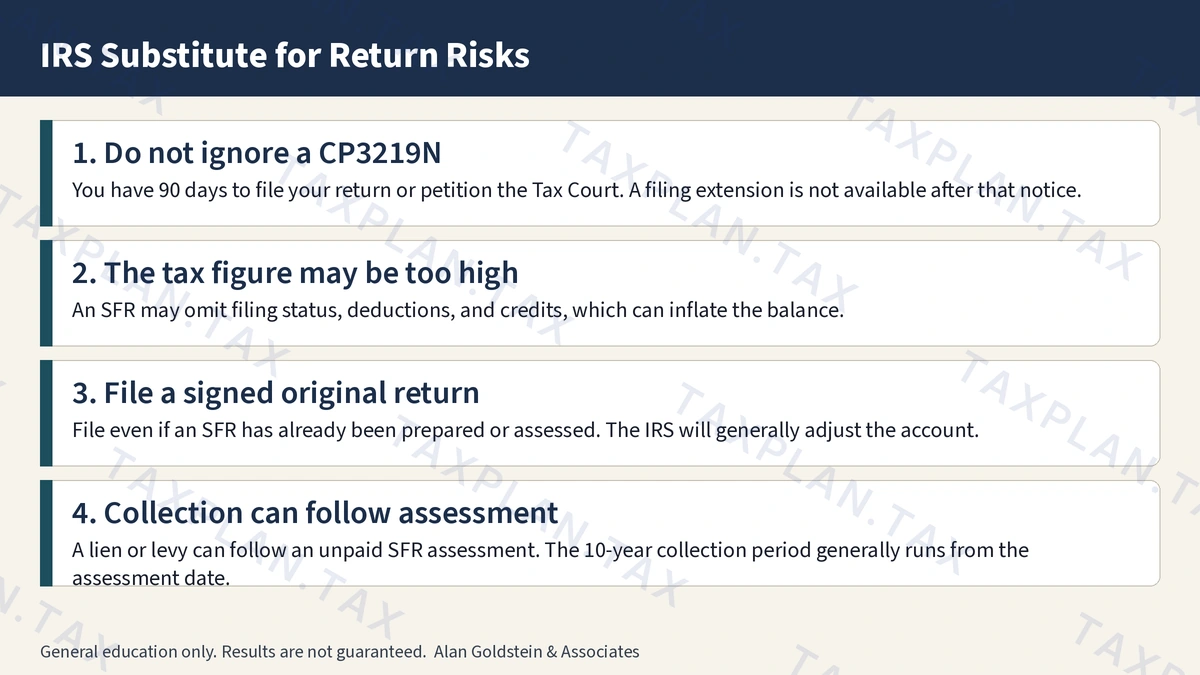

The principal risks of an IRS substitute for return are an overstated tax, a short deadline to respond, and collection that can begin once the proposed tax is assessed. The Internal Revenue Service may prepare an SFR under Internal Revenue Code (IRC) §6020(b) from Forms W-2, 1099, and other information it already has. The agency states that this return might not give you credit for deductions and exemptions you may be entitled to receive. It generally sends a Notice of Deficiency, CP3219N, and gives you 90 days (150 days if the notice is addressed to a person outside the United States) to file your own return or petition the U.S. Tax Court. The IRS also states that you cannot request an extension to file after that notice. If you do neither, the IRS may assess the proposed tax and pursue collection, including a federal tax lien under §6321 and a levy on wages or a bank account under §6331. The correct response, in a typical civil case, is to file a complete, signed original return with supporting records, and to calendar the 90-day date. The IRS states that it will generally adjust the account to the correct figures.
Key Takeaways
- Do not ignore a CP3219N. The 90-day period to file your return or petition the Tax Court is short, and the IRS states that a filing extension is not available after that notice.
- The largest practical risk is often the tax computation itself. An SFR may omit filing status, deductions, and credits, which can inflate the unpaid tax, the penalties, and the collectible balance.
- File a signed original return even if an SFR has already been prepared or assessed. The IRS says it will generally adjust the account to the correct figures.
- If the income listed is wrong, contact the payer for a corrected Form W-2 or 1099, attach the correction to your return, and contact the IRS as its past-due returns page instructs.
- Once the tax is assessed, collection risk increases. A notice of lien or a levy can follow an unpaid SFR assessment, and the 10-year collection period in §6502 generally runs from the assessment date.
- If the period to petition the Tax Court is still open, or if you are concerned about fraud or a criminal investigation, get professional advice promptly rather than missing the deadline.
Introduction and Background
An SFR is not merely a reminder that you forgot to file. It is the IRS’s path to a statutory notice of deficiency and, if you do not act, to an assessment that can be collected. The legal authority is §6020(b): the Secretary may make a return from available information, and a return so made and subscribed is prima facie good and sufficient for all legal purposes. The operational description is on the IRS past-due returns page, including the CP3219N, the 90-day period, and the instruction to file your own return anyway.
The risks are therefore both computational and procedural. Computationally, the SFR may be a worse picture of your tax than a complete Form 1040. Procedurally, the notice period is short, the collection tools after assessment are powerful, and delay can also forfeit a refund under §6511. The response is correspondingly practical: identify the notice, protect the deadline, assemble transcripts and records, and file an accurate original return to the address the IRS has given you.
How It Works
Identify the notice and the deadline
The key notice is the CP3219N Notice of Deficiency, which the IRS also calls a 90-day letter. Read the tax year, the proposed tax, and the date of the notice. The period to petition the Tax Court is generally 90 days from the date the notice is issued (150 days if it is addressed to a person outside the United States). That period is statutory and is not extended by a request for more time to file, according to the IRS. If you received only an earlier delinquency notice, such as a CP515, CP59, or CP516, you should still file, and you should use the address and any Form 15103 instructions on that notice, but those notices are not the same as a notice of deficiency.
Get an account transcript and a wage and income transcript for the year. The account transcript will show whether an SFR has posted and whether an assessment has already been made. The wage and income transcript shows the third-party reports the IRS is likely using.
Prepare and file your own return
Complete the prior-year Form 1040 (or other required form) under the law in effect for that year. Reconcile income to the transcripts. Claim the filing status, dependents, deductions, and credits you are entitled to claim. If a payer report is wrong, obtain a corrected statement and attach it. Sign and date the return. The IRS says to file a past-due return the same way and to the same location as an on-time return, unless a notice provides a different address. After a CP3219N, follow the notice, and do not assume you can obtain a filing extension.
If the 90-day period is still running and you dispute the proposed deficiency, you may also petition the Tax Court. Filing a return and petitioning the Tax Court are not the same act, and the better path depends on the facts, including whether the return will resolve the deficiency and how much time remains. Professional advice is important when the Tax Court deadline is close, when the income figures are disputed, or when more than one year is in SFR status.
If the tax has already been assessed
If the 90-day period has passed and the IRS has assessed the SFR tax, you should still file your own return. The IRS states that it will generally adjust the account to the correct figures. An assessed, unpaid liability can already be in collection. Filing does not automatically release a levy or a notice of lien. After the correct tax is determined, you may need a payment arrangement or another collection alternative to stop enforced collection. Pay what you can, and use the IRS’s short-term payment or installment-agreement procedures if you cannot pay in full.
Benefits and Opportunities
- A lower, correct tax can shrink everything downstream. Penalties under §6651 and interest are computed on unpaid tax. Reducing an inflated SFR tax reduces the base.
- A timely petition preserves prepayment review. The Tax Court can review a deficiency before you pay it, but only if the petition is timely.
- Filing keeps refund rights in view. If withholding or credits produce an overpayment, a timely return under §6511 is how you claim it. An SFR is not a reliable vehicle for that claim.
- Collection alternatives become available once required returns are in. Installment agreements and offers in compromise generally require current filing. Resolving the SFR with your own return is often a step toward those options.
Legal and Regulatory Considerations
Section 6020(b) supplies the IRS’s authority to make the return and treats a properly subscribed SFR as prima facie good and sufficient for all legal purposes. The deficiency procedures that precede assessment, including the notice of deficiency, are how the taxpayer is given a prepayment forum in the Tax Court. Missing that notice period does not make the tax legally unchallengeable in every setting, but it does change the forum and the collection posture. After assessment, §6502 generally allows collection for 10 years from the assessment date, subject to suspensions and extensions.
IRM 4.12.1 describes internal SFR certification, including Form 13496, and notes that an SFR, in and of itself, does not constitute a return under §6020(b) until those steps are completed, a point that can matter for the failure-to-pay penalty under the IRM’s discussion of §6651(g). Taxpayers should not wait for that internal certification before filing their own return. The IRS’s public instruction is to file.
Liens and levies rest on §6321 and §6331 after the tax has been assessed, notice and demand have been made, and the tax remains unpaid. The failure-to-file and failure-to-pay penalties in §6651, and interest under §§6621 and 6622, can add to the balance. For income tax returns more than 60 days late, the minimum failure-to-file penalty is the lesser of the IRS-published amount or 100% of the tax required to be shown; for due dates after December 31, 2025, that amount is $525. For October 1 through December 31, 2026, the underpayment interest rate for individuals is 7% per year, compounded daily. Willful failure to file can be a misdemeanor under §7203; a case with possible criminal exposure should not be handled as a routine SFR response without advice.
Practical Examples
The following examples are illustrative and describe a response path, not a guaranteed outcome.
| Where the case stands | Primary risk | Immediate response |
|---|---|---|
| Delinquency notice only (for example, CP515); no CP3219N yet | The case can proceed to an SFR and a notice of deficiency if you do not file | File the prior-year return and Form 15103, if required, to the notice address |
| CP3219N received; 90 days still running | Assessment of an inflated tax if you miss the period | Calendar the date; prepare and file a complete original return; consider a Tax Court petition if the deficiency will be disputed and time is short |
| Income on the SFR is wrong | Tax computed on inflated or misattributed income | Obtain a corrected W-2 or 1099, attach it, and contact the IRS as instructed on the past-due returns page or the notice |
| SFR tax already assessed; collection letter or levy notice received | Lien, levy, or wage garnishment on an unpaid assessment | File your own return so the tax can be adjusted; then address collection with payment or a collection alternative. Filing alone may not stop a levy already in motion |
| Multiple SFR years, or possible fraud concerns | Missed deadlines, inconsistent figures, or statements that affect a more serious investigation | Get professional advice before filing or calling the IRS, and do not let a 90-day date pass while you decide |
Illustrative computation risk. If an SFR proposes $10,000 of unpaid tax and the correct unpaid tax on a complete Form 1040 would have been $3,000, the failure-to-file penalty, the failure-to-pay penalty, and daily interest all have a larger base until the account is adjusted. Filing the correct return is what gives the IRS the figures it says it will generally use. The example is simplified; actual amounts depend on the year and the facts.
Common Mistakes and Risks
- Setting the notice aside because you plan to “deal with it later.” The 90-day period does not pause for that plan, and the IRS states that you cannot obtain a filing extension after a CP3219N.
- Calling to discuss the facts at length while the Tax Court deadline runs, and never filing the return or a petition. A conversation is not a substitute for a timely filing or a timely petition.
- Filing a current-year form, or an incomplete return, and assuming the SFR will be reversed automatically. Use the prior-year form, sign it, and include the required schedules.
- Paying the SFR balance in full without checking whether your own return would show a lower tax. Payment stops collection, but it may pay more than is legally due if the SFR omitted deductions and credits.
- Assuming a later refund will clean up an SFR year. The IRS may hold refunds when other years are unfiled, and a refund claim is subject to §6511.
- Missing related unfiled years. Resolving one SFR year does not resolve other missing years that can lead to the same process.
Frequently Asked Questions
What is the first thing I should do when I receive an SFR notice?
Read the notice, identify the tax year, and calendar the 90-day date if it is a CP3219N. Then gather transcripts and prepare your own return. If the deadline is close, get professional help immediately.
Should I petition the Tax Court or just file the return?
If your complete return will correct the proposed tax and you can file it in time, filing the return is the IRS’s published path, and the agency says it will generally adjust the account. A Tax Court petition is the way to obtain prepayment review if you dispute the deficiency and need that forum. The two can both be time-sensitive. The right choice depends on the facts and on how many days remain.
What if I already missed the 90-day period?
File your own return anyway. The IRS states that it will generally adjust the account to the correct figures. Also address any collection notices, because an assessment may already have been made.
Will filing my return stop a levy?
Not automatically. A levy is a collection tool used after assessment, notice, and demand. You may need a payment arrangement or another collection alternative after the correct tax is determined. Do not assume that mailing the return, by itself, releases a levy.
Where do I send the return?
To the address on the notice if you have one; otherwise to the same location you would use for an on-time return. Keep a complete copy and proof of filing.
How long will the IRS take to adjust the account?
The IRS states that it takes approximately six weeks to process an accurately completed past-due return. If you have a notice, send a copy to the notice address as well, and allow time for the account to catch up.
What if I cannot pay the corrected balance?
File anyway. Pay what you can, then request a short-term payment or an installment agreement, or evaluate whether you qualify for another collection alternative.
Can an SFR affect my refunds in later years?
Yes. An assessed SFR balance can be collected from later refunds, and the IRS also holds refunds when records show other income tax returns are past due, until it receives those returns or an acceptable reason for not filing.
Conclusion
The risks of an IRS substitute for return are concrete: a tax computation that may omit your deductions and credits, a 90-day notice that does not wait, and collection tools that become available after assessment. The response is equally concrete. Calendar the deadline, gather transcripts, file a complete original return, correct any bad payer reports, and then address the remaining balance and any levy or lien. Waiting for the SFR to “work itself out” is how those risks mature.
If you have received an SFR notice, or you need to replace an IRS substitute return with your own, Alan Goldstein & Associates can help. Alan Goldstein, MBA, IRS Enrolled Agent, works with individuals, business owners, and their tax advisors to prepare original returns, protect notice deadlines, and resolve the tax, penalties, and collection issues that follow an SFR. Contact Alan Goldstein & Associates in Coral Gables, Florida, for a confidential review.
Sources and Authorities
- IRS, Filing past due tax returns: https://www.irs.gov/businesses/small-businesses-self-employed/filing-past-due-tax-returns
- 26 U.S.C. §6020: https://www.law.cornell.edu/uscode/text/26/6020
- IRM 4.12.1, Nonfiled Returns: https://www.irs.gov/irm/part4/irm_04-012-001
- IRS, Understanding your CP515 notice: https://www.irs.gov/individuals/understanding-your-cp515-notice
- 26 U.S.C. §§6321, 6331, 6501, and 6502: lien, levy, assessment limitations
- 26 U.S.C. §6651: https://www.law.cornell.edu/uscode/text/26/6651
- IRS, Failure to file penalty: https://www.irs.gov/payments/failure-to-file-penalty
- IRS, Quarterly interest rates: https://www.irs.gov/payments/quarterly-interest-rates
- IRS, Get Transcript: https://www.irs.gov/individuals/get-transcript
- IRS, Online payment agreement: https://www.irs.gov/payments/online-payment-agreement-application
This article is provided for general educational purposes and does not constitute individualized tax, legal, or accounting advice. Tax consequences depend on the taxpayer’s specific facts and applicable law.
