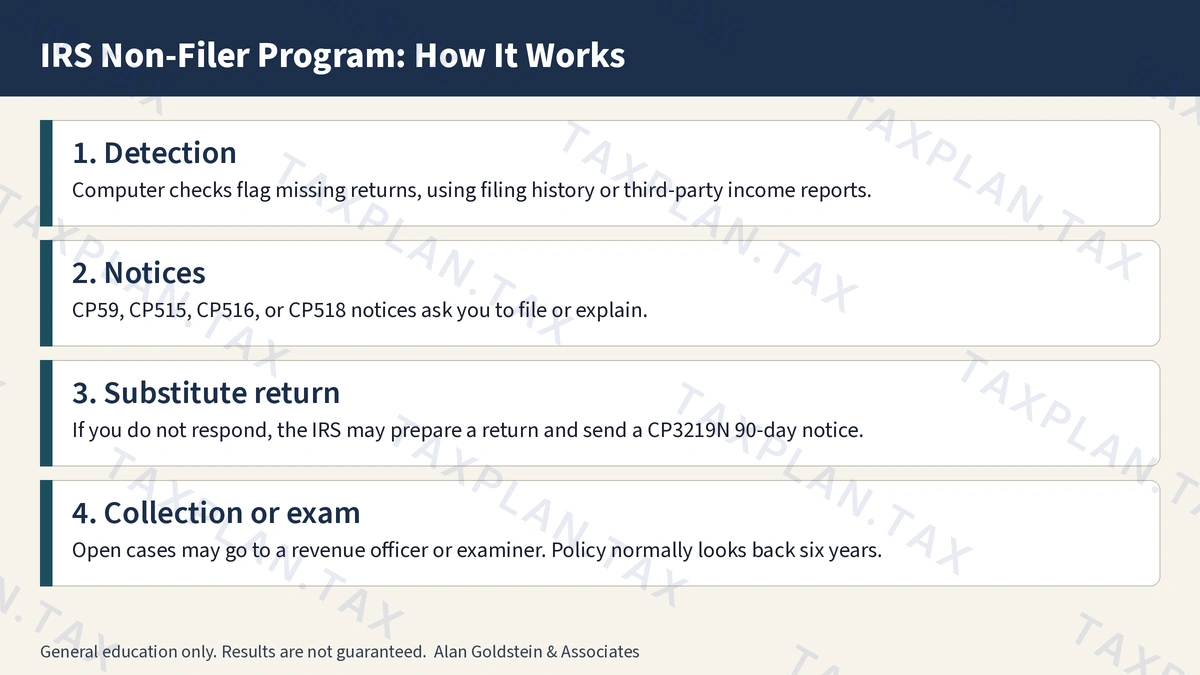

The IRS non-filer program is the set of IRS compliance efforts that identify people who did not file required returns and push them to file. It is not one program that you apply to or join. Instead, several IRS functions work together. They send notices, create substitute returns, and assign cases for collection or examination. This guide explains how the IRS non-filer program works, what each stage means, and how to respond.
Key Takeaways
- The IRS uses several programs against non-filers, including the Return Delinquency Program and the Automated Substitute for Return (ASFR) program.
- Most cases start with a computer match and one or two notices, such as CP59, CP515, CP516, or CP518.
- If you do not respond, the IRS may prepare a substitute return and send a 90-day notice (CP3219N).
- IRS policy normally enforces filing for no more than six years, but there is no assessment deadline when no return was filed.
- Filing accurate returns usually ends the non-filer case, but any tax, penalties, and interest still come due.
What is the IRS non-filer program?
It is an umbrella for IRS efforts to secure delinquent returns. The IRS Manual says the goal is full compliance, including full payment of the tax shown on the delinquent return.
The Internal Revenue Manual (IRM) is the IRS’s internal operating guide. Its field examination section describes achieving full compliance as the goal of the Nonfiler Program (IRM 4.12.1.1.1). A nonfiler is a person or business that did not file a required return by the due date, including extensions.
Is there one official program name?
No. The IRS uses several names for related work. The IRM calls the collection side the Return Delinquency Program and describes ASFR as a nonfiler program.
The Return Delinquency Program (IRM 5.1.11.2) creates delinquent return cases when a return is not filed by the program completion date. Meanwhile, the ASFR program (IRM 5.18.1.2) secures returns or assesses tax based on information reported by third parties. A substitute for return (SFR) is a return the IRS prepares for you under IRC §6020(b).
How does the IRS identify non-filers?
It uses computer checks against its Master File records. The checks look for people who filed last year but not this year, and for people with third-party income reports but no return.
According to the IRM (5.1.11.2.1), the Case Creation Nonfiler Identification Program (CCNIP) identifies individuals in two groups. The first group filed a return the previous year but not the current one. The second group has Information Returns Program documents, such as Forms W-2 and 1099, but no return. The individual checks that use those documents generally run about 10 months after the return due date.
Business checks work differently. The IRM says business delinquency checks run 16 weeks after the due date of each return and tax period. For a broader look at detection, see our guide to what a substitute for return is and how it affects you.
What notices does the IRS send non-filers?
Most individuals first receive a reminder notice. The IRM says nonfilers generally receive one or two notices about the delinquent return before a case is assigned.
The table below summarizes the individual notices, based on the IRS pages for each notice.
| Notice | What the IRS says |
|---|---|
| CP59 | No record that you filed your prior year personal return. File it or explain why you do not need to file. |
| CP515 | Reminder that no prior-year returns are on file. |
| CP516 | Second reminder after a previous notice. |
| CP518 | Final reminder. The IRS may determine your tax for you if it hears nothing. |
| CP3219N | Notice of Deficiency (90-day letter) with tax computed from reported income. |
These notices ask you to file the return or to explain on Form 15103 why you do not have to file. The IRS also says it accepts e-filed returns for the two most recent prior years, if you find a provider that offers that service.
What happens if you ignore the notices?
The IRS opens a delinquency investigation and assigns it for action. That may lead to a substitute return, a collection contact, or an examination.
The IRM explains that the system creates a delinquent return (Del Ret) module when a taxpayer does not resolve the delinquency during the notice process. It also says the investigator must look at all unresolved prior periods, meaning the past six, and later periods. The goal is full filing and paying compliance (IRM 5.1.11.2.2). A taxpayer delinquency investigation (TDI) is the case the IRS opens for an unfiled return.
How does the ASFR program work?
ASFR either gets your return or computes your tax from third-party income data. It then sends notices and may assess the result.
The IRM (5.18.1.2) says ASFR determines tax by securing valid returns, or by computing tax, penalties, and interest from reported information. ASFR issues statutory notices of deficiency under IRC §6212. Under IRC §6020(b)(2), a return the IRS makes is prima facie good and sufficient for legal purposes. However, the IRS warns that its return might not give you credit for deductions and exemptions you may be entitled to claim.
When do revenue officers and examiners get involved?
They get involved when the case is more complex or the amount is larger. The IRM assigns different delinquent return work to Field Collection and Field Examination.
Revenue officers work delinquent return investigations under IRM 5.1.11. Field examiners handle nonfiled returns under IRM 4.12.1. Both aim to bring the taxpayer into compliance. A revenue officer may also set a firm date for filing. The IRM says a failure to file by that date is treated as a refusal to file under IRC §7203.
How far back does the non-filer program reach?
IRS policy normally enforces filing for not more than six years. However, that is a policy, not a legal time limit.
Policy Statement 5-133 (IRM 1.2.1.6.18) says enforcement normally covers six years or less. It also says enforcement beyond six years needs prior managerial approval. Factors include prior noncompliance, effect on voluntary compliance, anticipated revenue, and collectibility.
The law is different. Under IRC §6501(c)(3), tax may be assessed at any time if no return was filed. Our article on how far back the IRS requires unfiled tax returns covers this in more detail.
Is the non-filer program a criminal matter?
Usually no. Most cases are civil and end when the returns are filed and the balance is resolved. However, willful failure to file can be a crime.
IRC §7203 makes willful failure to file a misdemeanor. In United States v. Bishop (1973), the Supreme Court said willfulness generally means a voluntary, intentional violation of a known legal duty. In Spies v. United States (1943), the Court separated that passive offense from the felony of willfully attempting to evade tax, which needs an affirmative act.
The IRM also instructs collection employees not to solicit delinquent returns when a failure to file appears willful or fraud is indicated. They suspend compliance activity and report the facts for fraud review (IRM 5.1.11.7). That rule is one reason to speak with a qualified representative before responding if the facts are sensitive.
What does the program require from you?
It requires you to file every return that is due and address the balance. The IRS advises filing all due returns, whether or not you can pay in full.
When a delinquent return is secured, the IRM tells revenue officers to advise the taxpayer that all tax, penalty, and interest is immediately due (IRM 5.1.11.6). If you cannot pay, the IRS says you may request more time, an installment agreement, or an offer in compromise. See our guides on an installment agreement for unfiled returns and an offer in compromise for unfiled returns.
How can you resolve a non-filer case?
File accurate returns for the required years, then deal with any balance. The steps below are a general path, not advice for your facts.
- Read each notice and note its response date. A CP3219N deadline cannot be extended, according to the IRS.
- Get your IRS transcripts to see what the IRS already has on file.
- Gather records for income and deductions the transcripts do not show.
- Prepare and file each missing return. Our guide to filing past-due federal tax returns explains the process.
- Pay what you can and request a payment option for the rest.
- Ask about penalty relief, such as first-time abatement or reasonable cause, where the facts fit.
Frequently Asked Questions
Can I join the IRS non-filer program voluntarily?
No. It is an enforcement process, not an application program. You can simply file your overdue returns at any time. The IRS says to file them the same way you would file an on-time return, unless a notice says to send them elsewhere.
Does the IRS always file a substitute return?
No. The IRS may file one under §6020(b), but it often sends notices first and sometimes closes cases with no further action. The decision depends on the facts and on IRS enforcement priorities under Policy Statement 5-133.
What if I received a CP59 and I do not need to file?
Explain that to the IRS. The notice says to file your return or explain why you do not need to file, and it points to Form 15103 for disputes. Keep proof of your income level and filing status.
Will filing stop the penalties?
Filing stops the failure-to-file penalty from growing for that year. However, penalties and interest already charged remain unless the IRS removes them. Interest on unpaid tax continues until you pay.
What is the minimum failure-to-file penalty now?
For Form 1040 and 1120 returns due after December 31, 2025, the IRS lists a $525 minimum for returns more than 60 days late, or 100% of the tax if less. Earlier years have lower minimums, such as $435 for returns due from 2020 to 2022 (IRS failure to file penalty).
What interest rate applies to unpaid tax?
The underpayment rate is 7% for the fourth quarter of 2026. The IRS announced it will rise to 8% for the first quarter of 2027, compounded daily (IR-2026-144).
Can the IRS go back more than six years?
Yes, in some cases. Six years is a normal enforcement practice, not a limit. Managerial approval is needed to go beyond it, and no assessment deadline applies when no return was filed.
Should I hire a representative?
It can help, especially with several unfiled years or a revenue officer assignment. A representative with a Form 2848 can speak with the IRS for you. Results still depend on the facts.
Conclusion
The IRS non-filer program is a layered process of matching, notices, substitute returns, and collection. It usually ends when you file accurate returns and resolve what you owe. Delay tends to make each stage harder to manage.
Alan Goldstein, MBA, IRS Enrolled Agent, of Alan Goldstein & Associates in Coral Gables, Florida, helps taxpayers respond to non-filer notices and catch up on past-due returns. We can pull your transcripts, prepare the returns, and review payment and relief options. We cannot guarantee any outcome. To request a confidential review of your unfiled returns and IRS collection options, visit our Tax Resolution Services page.
Cases Cited
- Spies v. United States, 317 U.S. 492, 498–499 (1943)
- United States v. Bishop, 412 U.S. 346, 360 (1973)
Sources
- IRS: IRM 4.12.1, Nonfiled Returns
- IRS: IRM 5.1.11, Delinquent Return Investigations
- IRS: IRM 5.18.1, Automated Substitute for Return (ASFR) Program
- IRS: IRM 1.2.1, Servicewide Policy Statements (Policy Statement 5-133)
- IRS: Filing past due tax returns
- IRS: Understanding your CP59 notice
- IRS: Understanding your CP515 notice
- IRS: Understanding your CP516 notice
- IRS: Understanding your CP518 notice
- IRS: Understanding your CP3219N notice
- IRC §6020, Returns prepared for or executed by Secretary
- IRC §6501, Limitations on assessment and collection
- IRC §7203, Willful failure to file return, supply information, or pay tax
- IRS: Failure to file penalty
- IRS: IR-2026-144, Interest rates increase for the first quarter of 2027
- Spies v. United States, 317 U.S. 492, 498–499 (1943) (official U.S. Reports, Library of Congress)
- United States v. Bishop, 412 U.S. 346, 360 (1973) (official U.S. Reports, Library of Congress)
This article is provided for general educational purposes and does not constitute individualized tax, legal, or accounting advice. Tax consequences depend on the taxpayer’s specific facts and applicable law.
