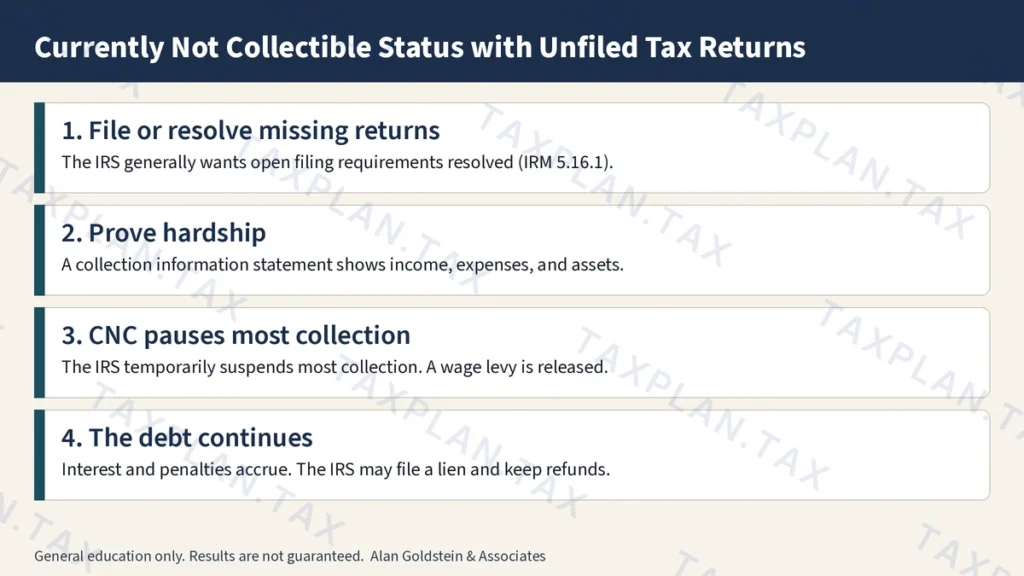


Currently not collectible status with unfiled tax returns is possible in limited hardship cases, but it is not the normal path. The IRS manual says open filing requirements must generally be resolved before an account goes into CNC status. However, it also allows a hardship closing when the IRS can verify your finances, even if some returns are still missing. In practice, filing first usually makes a hardship request stronger. This article explains how CNC works, what the IRS checks, and what stays at risk while returns remain unfiled.
Key Takeaways
- Currently not collectible (CNC) status means the IRS has temporarily paused most collection because you cannot pay.
- The debt is not forgiven, and penalties and interest keep growing.
- The IRS generally wants all open filing requirements resolved before it reports an account CNC.
- Even so, the IRS manual allows hardship CNC with unfiled returns if it can verify your financial statement.
- While you are in CNC, the IRS may file a lien, keep your refunds, and review your finances again later.
What is currently not collectible status?
Currently not collectible status is an IRS account status for people who cannot pay their tax debt because of financial hardship. In this status, the IRS temporarily suspends most collection activity.
The IRS describes three core points (IRS: Temporarily delay the collection process). First, it has paused most collection activities. Second, you still owe the full amount, so nothing is forgiven or canceled. Third, penalties and interest continue until you pay the balance in full.
That last point matters. For example, the IRS underpayment interest rate for individuals is 7% per year, compounded daily, for October through December 2026 (IRS: Quarterly interest rates). So a balance in CNC status generally grows over time.
What does “economic hardship” mean here?
Economic hardship generally means you cannot pay reasonable basic living expenses. The Treasury regulation on levy releases uses that standard for individual taxpayers (Treas. Reg. §301.6343-1(b)(4)).
The IRS manual on CNC accounts says its hardship procedures rest in part on that regulation (IRM 5.16.1). In other words, the question is not whether paying is unpleasant. Instead, it is whether paying would leave you unable to cover basic needs.
Can you get currently not collectible status with unfiled tax returns?
Sometimes, but filing first is the safer route. The IRS manual says open filing requirements must generally be resolved when an account is reported CNC. It also gives revenue officers room to approve hardship CNC when they can verify your financial statement.
What is the general rule in the IRS manual?
The general rule favors filing compliance. According to IRM 5.16.1, all open filing requirements, called Delinquent Return (Del Ret) modules, must generally be resolved and closed when the IRS reports an account CNC. The manual also tells employees to run a compliance check when they contact the taxpayer.
A compliance check is the IRS review of whether you have filed every required return and paid current taxes. The delinquent return procedures in IRM 5.1.11 explain how the IRS secures missing returns. Because of this, a CNC request with gaps in your filing history may trigger a request for those returns first.
When does the manual allow hardship CNC despite unfiled returns?
The hardship section of IRM 5.16.1 says an account may be reported CNC hardship if the IRS can verify your collection information statement, even if there are unfiled returns. That is the key exception.
However, the same section adds a condition. If the IRS needs an unfiled return to confirm your income, expenses, or assets, it may hold the balance until it gets the return. Meanwhile, the manual says the IRS should not issue levies on those balances if its other income and asset checks appear to confirm hardship.
Can the IRS close an unfiled year without a return?
Yes, in some cases. The manual says an open delinquent return module may close as little or no tax due, or as income below the filing requirement, if the facts support it.
This ties to IRS Policy Statement 5-133, which sets the normal enforcement period for delinquent returns. The examination manual explains that enforcement is normally not more than six years, with exceptions (IRM 4.12.1). Still, this is an IRS decision. You should not assume a year will close without a return.
Why does filing your returns first usually help?
Filing first usually helps because the IRS bases a hardship decision on verified income, expenses, and assets. Your own returns give it that proof. They can also replace higher balances from IRS-prepared returns.
If you do not file, the IRS may prepare a substitute for return (SFR) under IRC §6020(b). An SFR is a return the IRS prepares from information it already has. The IRS warns that an SFR might not give you credit for deductions and exemptions you may be entitled to (IRS: Filing past due tax returns).
So the balance placed in CNC may be larger than the tax you truly owe. Filing your own return may lower it. Our guide on what a substitute for return is explains that process in more detail.
What happens to the failure-to-file penalty?
The failure-to-file penalty keeps applying to a late return that shows tax due. Under IRC §6651(a)(1), it is generally 5% of the unpaid tax for each month or part of a month, up to 25%.
In addition, a minimum penalty applies when a return is more than 60 days late. For returns due after December 31, 2025, the IRS lists a minimum of $525 or 100% of the unpaid tax, whichever is less (IRS: Failure to file penalty). CNC status does not stop these amounts.
How does the IRS decide whether you qualify for CNC?
The IRS reviews your financial information, usually on a collection information statement. It then compares your income with allowable living expenses and looks at equity in your assets.
Which forms might the IRS ask for?
The IRS says you may need one of these forms (IRS):
- Form 433-F, Collection Information Statement.
- Form 433-A, for wage earners and self-employed individuals.
- Form 433-B, for businesses.
The IRS may also ask for documents that verify your income, monthly living expenses, bank accounts, and property. Also, the IRS manual treats a collection information statement as current if it is less than twelve months old, subject to exceptions (IRM 5.16.1).
How are living expenses measured?
The IRS uses national and local expense standards when it reviews your budget. These are the Collection Financial Standards, which cover items such as food, housing, utilities, transportation, and health care.
If your allowable expenses equal or exceed your income, and you have little equity in assets, CNC may fit. On the other hand, if you can pay something each month, the IRS may suggest a payment plan instead.
What happens while your account is CNC?
Most collection stops, but the account stays open. The IRS may review your finances later, file a lien, and keep your future refunds.
The IRS lists what may occur while you are in CNC status (IRS):
- It may review your financial situation later.
- It may resume collection if your ability to pay improves.
- It may file a Notice of Federal Tax Lien.
- It may apply your federal tax refund to your tax debt.
Will the IRS file a tax lien?
It may. The IRS manual says a Notice of Federal Tax Lien should generally be filed on CNC accounts when the total unpaid assessments equal or exceed $10,000, subject to listed exceptions (IRM 5.16.1). The lien itself arises under IRC §6321. See our article on unfiled tax returns and IRS tax liens for more.
Does CNC release a wage levy?
Generally, yes. IRC §6343(e) requires the IRS to release a levy on wages once it agrees with the taxpayer that the tax is currently not collectible. In addition, the IRS manual tells employees to release wage levies before closing an account as hardship CNC.
What about passport certification?
The IRS says it will not certify a seriously delinquent tax debt to the State Department for a taxpayer whose account is CNC due to hardship (IRS: Passport revocation or denial). The IRS manual adds that if a certified taxpayer later goes into hardship CNC, the IRS will reverse the certification within 30 days.
What risks remain if returns stay unfiled during CNC?
Unfiled returns stay a problem even while collection pauses. The IRS can still pursue the returns, assess tax, and keep refunds. Also, a willful failure to file can carry criminal exposure in serious cases.
First, the assessment period stays open. Under IRC §6501(c)(3), if no return is filed, the IRS may assess tax at any time. Second, the IRS says it holds income tax refunds when its records show one or more past-due returns (IRS).
Third, IRC §7203 makes a willful failure to file a misdemeanor. Most delinquent filers resolve matters civilly. Even so, the statute shows why the IRS treats filing as a basic duty.
Can new balances end your CNC status?
They can. For hardship accounts, the IRS manual describes a systemic reactivation process tied to an increase in your reported income above a set amount. If later returns show higher income, the IRS may resume collection. If you fail to file or pay new taxes, the IRS may also revisit the account.
How do you request CNC status?
You can call the IRS at 800-829-1040 or use the phone number on your bill or notice. Before you call, gather financial records and, ideally, file your missing returns.
A practical sequence often looks like this:
- Order your wage and income transcripts through Get Transcript.
- Prepare and file each missing return. Our guide to filing past-due federal tax returns walks through the steps.
- Complete the collection information statement the IRS requests.
- Collect proof of income, expenses, bank balances, and assets.
- Contact the IRS and request a temporary delay of collection.
The IRS decides whether to grant CNC. So a complete, consistent file matters more than any single argument.
Is CNC better than a payment plan or an offer?
It depends on your finances. CNC fits when you cannot pay anything toward the debt now. A payment plan fits when you can pay over time. An offer in compromise may fit when you can never pay the full amount.
The IRS says that if you do not qualify for CNC, you may qualify for a payment plan or an offer in compromise. Each of these generally requires filing compliance. See our articles on installment agreements for unfiled returns and the offer in compromise for unfiled federal tax returns.
Also keep the collection period in mind. Under IRC §6502, the IRS generally has 10 years after assessment to collect by levy or court action. Because a late return or SFR starts that clock later, the timing of each year’s assessment affects your options.
Frequently Asked Questions
Does CNC status erase my tax debt?
No. The IRS says you still owe the full amount. CNC only pauses most collection activity while you face hardship.
Do penalties and interest stop during CNC?
No. The IRS says penalties and interest continue to accrue until you pay the balance in full.
Can I stay in CNC if I never file my missing returns?
That is risky. The IRS manual generally expects open filing requirements to be resolved. Although it allows hardship CNC with unfiled returns in some cases, the IRS may still pursue those returns or prepare substitute returns.
How long does CNC status last?
There is no fixed period. The IRS says it may review your financial condition periodically to decide whether you can pay.
Will the IRS keep my tax refund while I am in CNC?
Yes, generally. The IRS says it will apply any federal tax refund to your unpaid tax debt. It also holds refunds when past-due returns are missing.
Can the IRS file a lien even if my account is CNC?
Yes. The IRS says it may file a Notice of Federal Tax Lien to protect the government’s interest. The manual generally calls for one when unpaid assessments reach $10,000 or more.
Who decides whether I qualify for CNC?
The IRS decides. It reviews your financial statement and documents. A representative can help you present accurate information, but no one can promise approval.
Does CNC stop the IRS from preparing a substitute return?
No. CNC concerns collection of assessed balances. Meanwhile, the IRS can still address unfiled years, including through a substitute for return under IRC §6020(b).
Conclusion
Currently not collectible status can give real breathing room when you cannot cover basic living expenses. However, it does not erase the debt, and unfiled returns can complicate the request. The IRS generally wants missing returns filed or resolved, and it may hold balances until it can verify your finances.
If you have unfiled returns and cannot pay, Alan Goldstein, MBA, IRS Enrolled Agent, of Alan Goldstein & Associates in Coral Gables, Florida, can review your filing history and financial picture. We can help you file what is required and evaluate CNC, payment plans, and other IRS resolution options. Every case depends on its facts, and we cannot guarantee any IRS outcome. To request a confidential review, visit our Tax Resolution Services page.
Sources and Authorities
- IRS: Temporarily delay the collection process (CNC)
- IRM 5.16.1, Currently Not Collectible
- IRM 5.1.11, Delinquent Return Investigations
- IRM 4.12.1, Nonfiled Returns (Policy Statement 5-133)
- Treas. Reg. §301.6343-1, Requirement to release levy
- IRS: Quarterly interest rates
- IRS: Failure to file penalty
- IRC §6651, Failure to file or pay
- IRC §6020, Returns prepared by the Secretary
- IRS: Filing past due tax returns
- IRS Form 433-F
- IRS Form 433-A
- IRS Form 433-B
- IRS: Collection Financial Standards
- IRC §6321, Lien for taxes
- IRC §6343, Release of levy
- IRS: Revocation or denial of passport for certain unpaid taxes
- IRC §6501, Limitations on assessment
- IRC §7203, Willful failure to file
- IRC §6502, Collection after assessment
- IRS: Get Transcript
This article is provided for general educational purposes and does not constitute individualized tax, legal, or accounting advice. Tax consequences depend on the taxpayer’s specific facts and applicable law.
