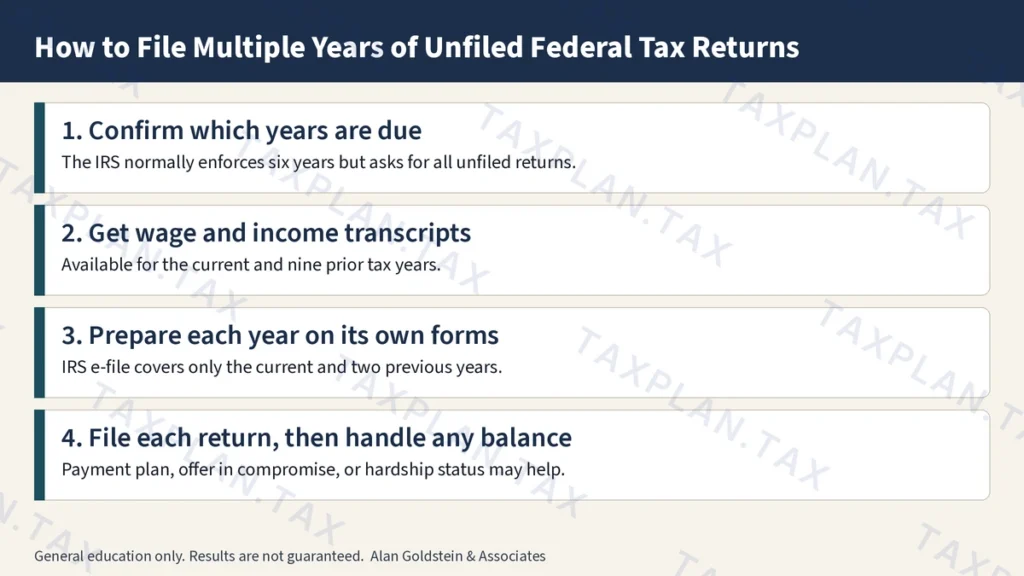


To file multiple years of unfiled federal tax returns, rebuild each year’s income records, prepare every return on that year’s forms, and file each one as a separate return. Then address any balance with payment or a resolution plan. The IRS tells taxpayers to file all returns that are due, whether or not they can pay in full. This guide walks through each step for multiple years of unfiled federal tax returns, from transcripts to penalties.
Key Takeaways
- File every return that is due, even if you cannot pay the full balance now.
- The IRS normally enforces six years of delinquent returns, but it asks for all unfiled returns.
- Wage and income transcripts are generally available for the current and nine prior tax years.
- Prepare each year on that year’s forms. IRS e-file covers only the current and two previous years.
- Refunds are generally lost if you do not file within 3 years of the return due date.
- Penalties and interest apply to years with a balance, but relief may be available in some cases.
How do you file multiple years of unfiled federal tax returns?
You file them one year at a time, using the correct forms for each year. Then you send each return to the right IRS address and deal with any tax due.
The IRS says to file your past-due return the same way, and to the same location, as an on-time return. However, if you received a notice, send the return to the address on that notice (IRS: Filing past due tax returns).
A typical catch-up project follows five stages:
- Confirm which years you must file.
- Gather income records for each year.
- Prepare each return on that year’s forms.
- File each return and keep proof of filing.
- Resolve any balance due.
How many years of unfiled returns should you file?
The IRS normally enforces filing for the most recent six years. However, it asks for all unfiled returns, and you may file older years too.
The IRS delinquent return procedures say enforcement of filing requirements will normally be pursued for a six-year period. The same section tells employees to always request all non-fraudulent unfiled returns. It adds that the taxpayer may file for all open periods regardless of age (IRM 5.1.11).
This six-year practice comes from Policy Statement 5-133. The IRS examination manual explains that enforcement may run longer or shorter based on facts such as prior noncompliance or income from illegal sources (IRM 4.12.1). For a full discussion, see our article on how far back the IRS requires unfiled tax returns.
Do you have to file years when your income was low?
Only if you had a filing requirement. Whether you must file depends on your income, filing status, age, and other factors. The IRS offers an online tool to check: Do I need to file a tax return?
Even so, filing may still help in a low-income year. For example, you may be due a refund of withholding or a refundable credit. That refund has a deadline, as explained below.
How do you get income records for past years?
Start with IRS wage and income transcripts, then fill gaps with your own records. Transcripts show what payers reported, but they may not show everything.
What does a wage and income transcript show?
A wage and income transcript lists data from information returns the IRS received, such as Forms W-2, 1098, 1099, and 5498. The IRS says this transcript is available for the current and nine prior tax years (IRS: Transcript types).
You can request transcripts online through Get Transcript. Alternatively, you can file Form 4506-T and check the box on line 8, as the IRS suggests. Keep in mind that the transcript only shows documents filed with the IRS. So it may not reflect every form issued to you.
What if you were self-employed?
Self-employed people usually need more than transcripts. A transcript may show Form 1099 income, but it will not show your business expenses. Therefore, you will need bank statements, invoices, receipts, and mileage logs to support deductions.
This matters because filing also affects Social Security. The IRS notes that if you are self-employed and do not file, your self-employment income will not be reported to the Social Security Administration. As a result, you may not receive credits toward retirement or disability benefits (IRS).
Which forms do you use for each year?
Use the forms and instructions for the specific tax year you are filing. Tax law, brackets, and form lines change from year to year.
The IRS posts earlier versions of forms and instructions on its prior year forms page. If you use software, make sure it is the version for that tax year.
Can you e-file older returns?
Only recent years. The IRS e-file handbook says filing individual returns through IRS e-file is limited to returns with due dates in the current year and two previous years (IRS Publication 1345). Older years generally need to go on paper.
Because paper returns take longer, plan for processing time. The IRS says it takes about 6 weeks to process an accurately completed past-due return.
In what order should you prepare the returns?
In practice, prepare the years in chronological order, oldest first. Many tax items carry forward from one year to the next. Then prioritize filing the years with the most urgent deadlines.
Carryforwards are the main reason for chronological preparation. For example, a capital loss carryover, a net operating loss, or depreciation on business property can affect later years. If you prepare a later year first, you may need to redo it.
Which years are most urgent?
Three situations often call for quick action:
- A notice with a deadline. If you received Notice CP3219N, a 90-day letter, the IRS says you have 90 days to file your return or petition the Tax Court. After that, it may proceed with its proposed assessment.
- A refund about to expire. The IRS says you must file within 3 years of the return due date to claim a refund of withholding or estimated taxes.
- Active collection. If the IRS has assessed tax from a substitute return, filing your own return may reduce that balance.
What if the IRS already prepared a return for you?
You should still file your own return. When you do not file, the IRS may prepare a substitute for return (SFR) under IRC §6020(b). The IRS says an SFR might not give you credit for deductions and exemptions, and that it is in your best interest to file your own return. It will generally adjust your account to reflect the correct figures.
Our article on IRS substitute for return risks covers how to respond.
How should you file and track each return?
Treat each year as a separate filing. Each return needs its own signature, its own attachments, and its own proof of filing.
A few practical habits help:
- Attach the Forms W-2 and other documents each year’s instructions require.
- Use the address on any IRS notice for that year.
- Keep a copy of every return and proof of mailing.
- Make a simple log showing each year, the date filed, and the result.
After you file, watch your mail. The IRS may send notices that adjust a return, assess penalties, or request more information.
What penalties and interest apply when you file several years late?
Years with tax due usually carry a failure-to-file penalty, a failure-to-pay penalty, and interest. Years with a refund generally do not carry a failure-to-file penalty, since it applies to unpaid tax.
How large is the failure-to-file penalty?
The penalty is generally 5% of the unpaid tax for each month or part of a month the return is late, up to 25% (IRC §6651(a)(1)). The IRS computes it on the tax required to be shown, less tax paid on time and refundable credits (IRS: Failure to file penalty).
In addition, a minimum penalty applies when a return is more than 60 days late. It is the lesser of a set dollar amount or 100% of the unpaid tax. The IRS lists these amounts for Forms 1040 and 1120:
| Return due date (without extension) | Minimum penalty |
|---|---|
| After 12/31/2025 | $525 |
| 01/01/2025 to 12/31/2025 | $510 |
| 01/01/2024 to 12/31/2024 | $485 |
| 01/01/2023 to 12/31/2023 | $450 |
What about late payment and interest?
The failure-to-pay penalty generally runs at 0.5% of the unpaid tax per month, up to 25% (IRS: Failure to pay penalty). When both penalties apply for the same month, IRC §6651(c) reduces the failure-to-file penalty by the failure-to-pay amount.
Interest also accrues. For October through December 2026, the IRS underpayment rate for individuals is 7% per year, compounded daily (IRS: Quarterly interest rates). Rates change quarterly, so check the current table.
Can penalties be reduced?
Sometimes. The IRS may remove penalties for reasonable cause. It also offers administrative relief for taxpayers with a clean compliance history (IRS: Administrative penalty relief).
The IRS says First Time Abate applies to taxpayers with three years of timely compliance history. It is transitioning to a new Automatic Exemption from Penalty starting in summer 2026. Because both depend on a clean prior three years, a person with several consecutive missed years may qualify, if at all, only for the earliest year. Reasonable cause is a separate route, and the IRS decides each request.
What if you cannot pay what you owe?
File anyway, then choose a payment option. Filing limits the failure-to-file penalty, and the IRS has several ways to handle a balance you cannot pay at once.
The IRS says you may request an additional 60 to 120 days to pay in full, with no user fee. If you need longer, you can request an installment agreement, or you may qualify for an offer in compromise (IRS). See our guides on installment agreements for unfiled returns and stopping IRS collections on unfiled tax returns.
Should you worry about criminal exposure?
Most people who catch up on late returns resolve the matter civilly. Still, willful failure to file is a crime, so unusual facts deserve professional advice before you file.
IRC §7203 makes a willful failure to file a misdemeanor. If your situation involves large unreported income, foreign accounts, or concealment, talk with a qualified representative first. Our article comparing voluntary disclosure and streamlined filing discusses options for more serious noncompliance.
Frequently Asked Questions
Can I file all my late returns at the same time?
Yes. Each year is a separate return, but you can send them in the same period. If notices list different addresses, follow each notice.
Do I need to file more than six years of returns?
The IRS normally enforces six years. However, it asks for all unfiled returns, and it may enforce a longer period based on the facts. A representative can help you decide.
Can I e-file a return from four years ago?
Generally, no. IRS e-file for individuals covers returns due in the current year and the two previous years. Older returns generally go on paper.
What if I do not have my old W-2s or 1099s?
Request a wage and income transcript. It covers the current and nine prior tax years. You can also ask the employer or payer for copies.
Will I get refunds for all the years I file?
Not necessarily. Refunds of withholding and estimated tax are generally lost if you do not file within 3 years of the return due date. In addition, the IRS may apply refunds to balances you owe.
Should I wait until I can pay before filing?
No. The IRS tells taxpayers to file all returns that are due, regardless of whether they can pay in full. Waiting usually lets the failure-to-file penalty grow.
How long will the IRS take to process my late returns?
The IRS says about 6 weeks for an accurately completed past-due return. Paper returns and returns with issues may take longer.
Does filing late returns start any IRS deadlines?
Yes. Under IRC §6501, filing generally starts the IRS’s assessment period for that year. If you never file, the IRS may assess at any time.
Conclusion
Filing multiple years of unfiled federal tax returns is a project, not a single form. Confirm which years you must file, rebuild each year’s income, and prepare each return on the right forms. Then file, track each return, and address any balance through payment or a resolution plan.
Alan Goldstein, MBA, IRS Enrolled Agent, of Alan Goldstein & Associates in Coral Gables, Florida, helps individuals and business owners get current with the IRS. We can review your transcripts, prepare your past-due returns, and explain your options for any balance. Results depend on your facts, and we do not guarantee outcomes. To request a confidential review, visit our Tax Resolution Services page.
Sources and Authorities
- IRS: Filing past due tax returns
- IRM 5.1.11, Delinquent Return Investigations
- IRM 4.12.1, Nonfiled Returns (Policy Statement 5-133)
- IRS Interactive Tax Assistant: Do I need to file a tax return?
- IRS: Transcript types for individuals and ways to order them
- IRS: Get Transcript
- IRS: About Form 4506-T
- IRS: Prior year forms and instructions
- IRS Publication 1345, Handbook for Authorized IRS e-file Providers
- IRC §6020, Returns prepared by the Secretary
- IRC §6651, Failure to file or pay
- IRS: Failure to file penalty
- IRS: Failure to pay penalty
- IRS: Quarterly interest rates
- IRS: Administrative penalty relief
- IRC §7203, Willful failure to file
- IRC §6501, Limitations on assessment
This article is provided for general educational purposes and does not constitute individualized tax, legal, or accounting advice. Tax consequences depend on the taxpayer’s specific facts and applicable law.
