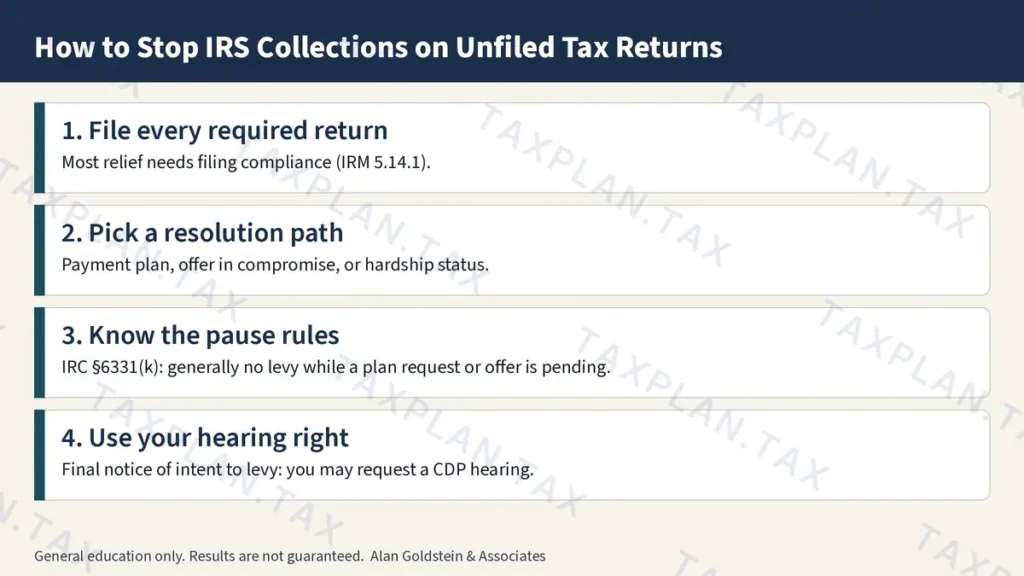


To stop IRS collections on unfiled tax returns, you generally need to file every missing return and then work with the IRS on a resolution. Filing does not erase a tax bill. However, filing is usually the first step toward a payment plan, an offer in compromise, or a temporary hold on collection. This article explains how to stop IRS collections on unfiled tax returns, which options exist, and what limits apply.
Key Takeaways
- The IRS generally needs an assessment (a recorded tax bill) before it can levy or file a lien. A substitute for return (SFR) can create that assessment.
- Most collection alternatives require filing compliance. That means you have filed all required returns.
- By law, the IRS generally cannot levy while a payment plan request or an offer in compromise is pending.
- A final notice of intent to levy gives you the right to request a collection due process (CDP) hearing.
- Currently not collectible (CNC) status delays collection for hardship. It does not cancel the debt.
- Interest and penalties can keep growing while you work out a plan.
What does IRS collection mean when you have unfiled tax returns?
IRS collection means the steps the IRS takes to get paid on a tax bill it has already recorded. With unfiled returns, the IRS often starts by trying to get the returns, not the payment.
Can the IRS collect tax before it assesses a balance?
Generally, no. The IRS says it usually levies only after it assesses the tax, sends a notice and demand for payment, and you neglect or refuse to pay (IRS: What is a levy?).
A truly unfiled return has no assessment yet. Even so, the IRS can still act. It may open a delinquent return investigation. It may also issue a summons to get the information it needs to prepare the missing returns (IRS: Enforced collection actions).
How does a substitute for return lead to collection?
If you do not file, the IRS may prepare a substitute return under IRC §6020(b). The IRS says that return may not include deductions you could claim. If you do not respond to the proposed assessment, the IRS may assess the tax. As the IRS explains, the resulting bill can trigger the collection process, including a levy or a Notice of Federal Tax Lien (IRS: Filing past due tax returns).
For more detail, see our article on what a substitute for return is and how it affects you.
Which collection notices follow an assessment?
After an assessment, the IRS typically sends a series of balance-due notices. Two matter most for stopping collection: the CP504 and the final notice of intent to levy.
The CP504 is a Notice of Intent to Levy under IRC §6331(d). It tells you the IRS can levy your income, bank accounts, and state refund if you do not pay. The LT11 or Letter 1058 is the Final Notice of Intent to Levy and Notice of Your Right to a Hearing (IRS: Understanding your LT11 or Letter 1058). The levy statute requires the IRS to give that notice at least 30 days before the first levy (IRC §6330).
How can you stop IRS collections on unfiled tax returns?
You can often pause collection by getting into filing compliance and then asking for a payment plan, an offer in compromise, hardship status, or a hearing. No step works for everyone, and the IRS decides each request on its facts.
Why should you file every missing return first?
You should file first because the IRS generally will not grant relief without filing compliance. The Internal Revenue Manual says that before granting an installment agreement, individuals must file all required returns (IRM 5.14.1). For an offer in compromise, the IRS lists filing all required tax returns as a basic eligibility rule (IRS: Offer in compromise).
Filing also stops some problems from growing. The IRS holds refunds while returns are past due. In addition, you risk losing a refund if you wait more than three years after the due date to claim it (IRS: Filing past due tax returns).
Our guide on how to file past-due federal tax returns walks through the filing steps.
Does a payment plan request stop a levy?
Often, yes, while the request is pending. Under IRC §6331(k)(2), the IRS may not levy while an installment agreement request is pending or while an agreement is in effect. The ban also covers 30 days after a rejection or termination. If you appeal within that window, it lasts while the appeal is pending.
However, the IRS treats a request as pending only if you meet the filing requirements. The Internal Revenue Manual tells employees not to treat a request as pending when required returns are unfiled (IRM 5.14.1).
Does an offer in compromise stop collection?
It can, once the IRS accepts the application for processing. Under IRC §6331(k)(1), the IRS generally may not levy while a processable offer is pending. The IRS says it suspends most collection activities and extends your collection period (IRS: Offer in compromise).
An offer needs a $205 application fee and a first payment, unless you meet low-income rules. The IRS also says it generally will not accept an offer if you can pay in full through a payment plan or asset equity.
What is currently not collectible status?
Currently not collectible (CNC) is an IRS status that temporarily suspends most collection when you cannot pay due to financial hardship. The IRS states that you still owe the full amount, and penalties and interest continue to accrue (IRS: Temporarily delay the collection process).
Unfiled returns complicate CNC. The Internal Revenue Manual says open delinquent return modules generally must be resolved before an account is reported CNC. It also notes that a hardship case may proceed with unfiled returns if the financial statement can be verified (IRM 5.16.1).
What is a collection due process hearing?
A collection due process (CDP) hearing is an independent review of a proposed levy. You request it using the instructions in your Final Notice of Intent to Levy, often on Form 12153. The notice sets your deadline, so read it closely.
At the hearing, you can propose alternatives such as an installment agreement. Under IRC §6330(c)(2), you may also challenge the underlying tax liability if you never received a notice of deficiency. That point can matter after an SFR assessment. Details appear in Publication 1660.
Can a levy be released for hardship?
Yes, in some cases. The IRS says a wage levy causing an immediate economic hardship must be released. A bank levy causing hardship may be released (IRS: What if a levy is causing a hardship?). The statute behind this is IRC §6343(a)(1)(D).
The IRS defines economic hardship as a levy that keeps you from meeting basic, reasonable living expenses. Expect to provide financial information. A release does not erase the balance.
What happens if you ignore IRS collection notices?
If you ignore the notices, the IRS can levy wages and bank accounts and can file a Notice of Federal Tax Lien. Costs also keep growing, so waiting rarely helps.
Interest on underpayments is 7% per year, compounded daily, for the quarter that began October 1, 2026 (IRS: Quarterly interest rates). Rates reset each quarter. In addition, the failure-to-pay penalty rises to 1% per month if you do not pay within 10 days after a notice of intent to levy (IRS: Failure to pay penalty).
The IRS also warns that a seriously delinquent tax debt can lead to passport certification under IRC §7345 (IRS: LT11 or Letter 1058). For liens, see our overview of federal tax liens. For levies, see our overview of IRS levies and wage garnishments.
What is a practical order of steps to stop collection?
Start by learning exactly what the IRS shows on your account, then file, then respond to each notice by its deadline. The order below is a general outline, not advice for your case.
- Read every notice. Note the notice type, the tax years, and the response date.
- Pull your IRS records. Use Get Transcript for account and wage data. Form 4506-T can also help with wage and income information.
- File each missing return. Send each return to the address on your notice if you received one.
- Pick a resolution path. Compare a payment plan, an offer, and hardship status against your facts.
- Calendar the hearing deadline. If you receive a Final Notice of Intent to Levy, decide quickly whether to request a CDP hearing.
- Consider representation. An authorized representative can use Form 2848 to speak with the IRS for you.
Frequently Asked Questions
Can you stop IRS collections without filing your unfiled returns?
Sometimes you can pause action briefly, such as by requesting a hearing on a levy notice. However, installment agreements and offers generally require filing compliance, so lasting relief usually needs filed returns.
Will the IRS stop collection once I file?
Not automatically. Filing lets you ask for options. If the IRS has already assessed tax, collection can continue until you resolve the balance or an exception applies.
Can the IRS levy my wages if I never filed?
The IRS generally needs an assessment first. If it assessed tax from a substitute return and sent the required notices, it may levy wages.
How long do I have to request a collection due process hearing?
Your Final Notice of Intent to Levy states the deadline. Because the notice controls, check it right away and request a hearing before that date.
Does a payment plan stop interest and penalties?
No. Interest continues to accrue. The failure-to-pay rate can drop to 0.25% per month during an approved plan, but only if you filed your return on time (IRC §6651(h)). That reduction generally does not help late filers.
Is currently not collectible status permanent?
No. The IRS may review your finances and resume collection if your ability to pay improves.
Can the IRS take my refund while I resolve unfiled returns?
Yes. The IRS holds refunds when returns are past due, and it may apply a refund to an unpaid balance.
Should I hire a professional?
Many people do, especially with several years of returns or a levy notice. A representative can review your transcripts, prepare the returns, and communicate with the IRS.
Conclusion
Stopping IRS collection starts with filing and then choosing the right resolution path. Deadlines on notices matter, and the best route depends on your income, assets, and the years involved. Nothing here guarantees a particular result, because the IRS decides each request.
If you have unfiled returns or IRS collection notices, I can review your situation. Contact Alan Goldstein, MBA, IRS Enrolled Agent, at Alan Goldstein & Associates in Coral Gables, Florida, for a confidential review of your unfiled returns and collection options. We do not guarantee outcomes, and every case depends on its facts.
Sources
- IRS: What is a levy?
- IRS: Enforced collection actions
- IRS: Filing past due tax returns
- IRS: Understanding your CP504 notice
- IRS: Understanding your LT11 notice or Letter 1058
- IRM 5.14.1, Securing Installment Agreements (Payment Plans)
- IRM 5.16.1, Currently Not Collectible
- IRS: Offer in compromise
- IRS: Temporarily delay the collection process
- IRS: What if a levy is causing a hardship?
- IRS Form 12153, Request for a Collection Due Process or Equivalent Hearing
- IRS Publication 1660, Collection Appeal Rights
- IRS: Quarterly interest rates
- IRS: Failure to pay penalty
- IRS: Get Transcript
- IRS: About Form 2848
- 26 U.S.C. §6020
- 26 U.S.C. §6330
- 26 U.S.C. §6331
- 26 U.S.C. §6343
- 26 U.S.C. §6651
- 26 U.S.C. §7345
This article is provided for general educational purposes and does not constitute individualized tax, legal, or accounting advice. Tax consequences depend on the taxpayer’s specific facts and applicable law.
