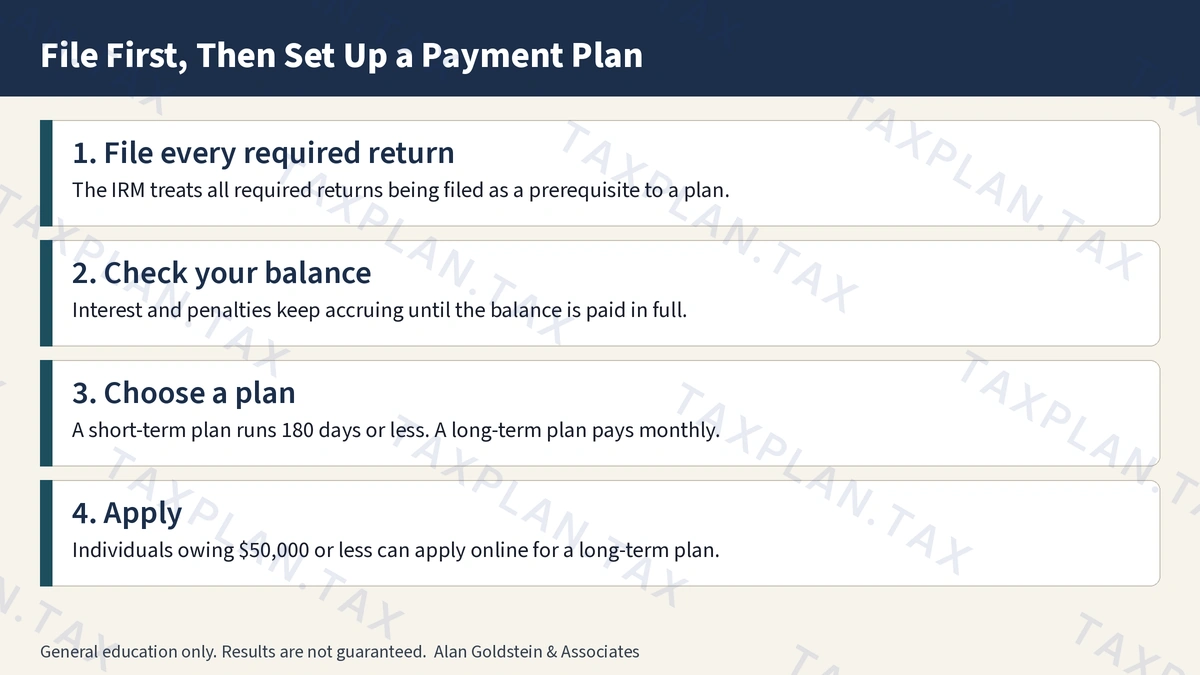

To file unfiled returns and set up a payment plan, file every required return first, then ask the IRS for a plan on the balance. The IRS generally will not approve a plan while required returns are missing. This guide gives you the order of steps, the plan types and fees that apply in 2026, and the costs that keep growing while you wait.
Key Takeaways
- Filing comes first. The IRS Internal Revenue Manual (IRM) treats all required returns being filed as a prerequisite to any payment plan.
- Short-term plans run 180 days or less. Long-term plans, also called installment agreements, pay monthly.
- Individuals may apply online for a long-term plan if they owe $50,000 or less and have filed all required returns.
- Interest and penalties keep accruing during a plan. The reduced late-payment rate applies only to people who filed on time.
- A payment plan does not erase the debt. Missing a payment or a new filing deadline can put it in default.
Why must you file the returns before asking for a payment plan?
The IRS treats filing compliance as a prerequisite. It defines that as all required returns being filed or on an approved extension. Without that, it cannot approve an agreement.
IRM 5.14.1.4.2 states the prerequisite directly. It also says that if taxpayers must file returns and have not, installment agreements cannot be granted or approved (IRM 5.14.1). The IRS payment plan page repeats the point for online long-term plans, which require that you have “filed all required returns.”
Moreover, the IRS can only know your balance after it processes your returns. A substitute for return (SFR) is a return the IRS prepares for you when you do not file. That return can overstate your tax. See our guide to what an SFR is. The Supreme Court has noted that an assessment is little more than the calculation or recording of a tax liability, after which administrative collection can begin (United States v. Galletti, 2004, 541 U.S. at 122).
What are the steps to file unfiled returns and set up a payment plan?
Gather records, file each year, check your balance, and then apply for a plan. Doing the steps in that order avoids rejections and wasted time.
- Collect your records. Request wage and income transcripts for each missing year. See our guide to transcripts for unfiled years.
- Check which years you must file. The IRS says to file all returns that are due, even if you cannot pay in full. Our article on how far back the IRS requires returns explains the six-year policy.
- File each return. Follow the IRS past-due return instructions. Our guide to filing multiple years covers the logistics.
- Review your balance. Check your online account or notices for tax, penalties, and interest.
- Pick a plan type. Choose among full payment, a short-term plan, or a long-term plan.
- Apply and set up payments. Apply online, by phone, or by mail.
Which payment plan options does the IRS offer in 2026?
The IRS lists full payment, a short-term plan of 180 days or less, and a long-term plan with monthly payments. Your balance and filing history decide which you can use.
The IRS payment plan page sets out these options. Individuals may apply online for a long-term plan if they owe $50,000 or less in combined tax, penalties, and interest and have filed all required returns. For a short-term plan, an individual may apply online if the combined balance is under $100,000. Businesses cannot apply online and should call 800-829-4933.
The IRS past-due returns page adds that you may request an additional 60 to 120 days to pay in full through the Online Payment Agreement application or by phone, with no user fee. If you apply by mail, you use Form 9465. Depending on its instructions, you may also need to attach a Form 433-F financial statement.
How much does a payment plan cost?
Costs depend on the plan type and how you apply. The IRS posts $0 setup fees for short-term plans and several fee levels for long-term plans.
According to the IRS page (updated March 3, 2026), the setup fees are:
- Short-term plan (180 days or less): $0 setup fee, online or by phone, mail, or in person.
- Long-term plan with direct debit: $29 online, or $107 by phone, mail, or in person.
- Long-term plan with other payment methods: $69 online, or $178 by phone, mail, or in person.
- Low-income taxpayers: setup fee waived for a direct debit plan. Otherwise the fee is $43, which may be reimbursed if certain conditions are met.
Moreover, interest and penalties keep accruing on the balance until you pay in full. Also, card payments carry processing fees that go to a payment processor. Confirm current fees on IRS.gov before applying, because they can change.
Do interest and penalties continue during a payment plan?
Yes. Interest and some penalties continue until the balance is paid in full. For late filers, the lower failure-to-pay rate generally does not apply.
The underpayment interest rate is 7% for the fourth quarter of 2026, according to the IRS quarterly rates page. The failure-to-pay penalty is 0.5% per month, up to 25%. The IRS says it drops to 0.25% per month during an approved plan only if you filed your return on time as an individual, as stated on the IRS failure-to-pay page and in IRC §6651(h). Because late filers did not file on time, that reduction generally does not apply to them.
The failure-to-file penalty adds more. It is 5% of the tax due for each month or part of a month, up to 25%. If both penalties apply in a month, the failure-to-file penalty drops to 4.5%. For returns due after December 31, 2025, the IRS lists a $525 minimum failure-to-file penalty, or 100% of the tax if less, once a return is more than 60 days late (IRS failure-to-file page). Our article on failure to file versus failure to pay explains how they interact.
What protection does a pending or approved plan give you?
With certain exceptions, the IRS is generally prohibited from levying while your request is pending. The collection clock also pauses during a pending request and certain related periods.
The IRS says the collection period is suspended while a request is pending. It adds 30 days if the IRS rejects the request or proposes to terminate the plan, plus any time an appeal of a rejection or termination is pending. Also, IRC §6343(a) requires the IRS to release a levy when you enter an installment agreement, unless the agreement says otherwise. Our article on installment agreements for unfiled returns covers the agreement itself in more depth.
However, protection is not unlimited. Interest and penalties continue, and a plan does not erase the debt. The IRS says to file all required returns on time and pay new taxes in full to avoid default. Your future refunds also go toward the debt until it is paid.
What if you cannot afford a payment plan?
You may have other options, such as a longer plan based on financial information, an offer in compromise, or currently not collectible status. Each has its own rules and none is guaranteed.
For example, IRM 5.14.1.4.1 describes a six-year rule. If you cannot pay immediately and do not qualify for a simple plan, you may qualify if you can stay current, pay the balance within six years and within the collection statute, and show reasonable expenses. That rule does not apply to businesses. For other paths, see our guides to offers in compromise and currently not collectible status.
Frequently Asked Questions
Can I set up a payment plan before filing my missing returns?
Generally no. The IRM states that if required returns are not filed, installment agreements cannot be granted or approved. File first, then apply.
Do I have to pay anything when I file?
You should pay what you can. The IRS says paying as much as you can limits interest and penalties. A plan covers the remainder.
How many years do I need to file?
That depends on your facts. IRS policy normally looks back six years, but exceptions exist. Our six-year guide explains the policy and its limits.
What is the difference between a short-term plan and an installment agreement?
A short-term plan allows up to 180 days to pay. An installment agreement, or long-term plan, spreads payments over a longer period. Fees differ, as shown above.
What if I owe more than $50,000?
You may not qualify to apply online. You can call, mail Form 9465, or provide financial information. The IRS may ask for Form 433-F.
Will a payment plan stop IRS levies?
Generally, the IRS cannot levy while a request is pending, with exceptions. It must release a levy if the agreement allows. Confirm the status in writing.
What happens if I miss a payment?
The plan can default, and the IRS may propose to terminate it. Contact the IRS quickly. You may be able to reinstate it, possibly for a fee.
Can a tax professional apply for me?
Yes, with a power of attorney on Form 2848. The IRS says not every authority level can represent you for payment plans, so check the form instructions.
Conclusion
To file unfiled returns and set up a payment plan, finish the returns first, confirm your balance, and then choose the plan type that fits. Acting early limits interest and penalties and keeps more options open.
Alan Goldstein, MBA, IRS Enrolled Agent, of Alan Goldstein & Associates in Coral Gables, Florida, helps taxpayers prepare past-due returns and evaluate payment options. We cannot guarantee any outcome. To request a confidential review, visit our Tax Resolution Services page.
Cases Cited
- United States v. Galletti, 541 U.S. 114, 122 (2004) (assessment is the calculation or recording of a tax liability; verified against the official U.S. Reports opinion)
Sources
- IRS: Payment plans and installment agreements
- IRS: Online payment agreement application
- IRM 5.14.1, Securing Installment Agreements (Payment Plans)
- IRS: Filing past due tax returns
- IRS Form 9465, Installment Agreement Request
- IRS: Quarterly interest rates
- IRS: Failure to pay penalty
- IRS: Failure to file penalty
- 26 U.S.C. §6651, Failure to file tax return or to pay tax
- 26 U.S.C. §6343, Authority to release levy and return property
- 26 U.S.C. §6159, Agreements for payment of tax liability in installments
- United States v. Galletti, 541 U.S. 114, 122 (2004) (official U.S. Reports, Library of Congress)
This article is provided for general educational purposes and does not constitute individualized tax, legal, or accounting advice. Tax consequences depend on the taxpayer’s specific facts and applicable law.
