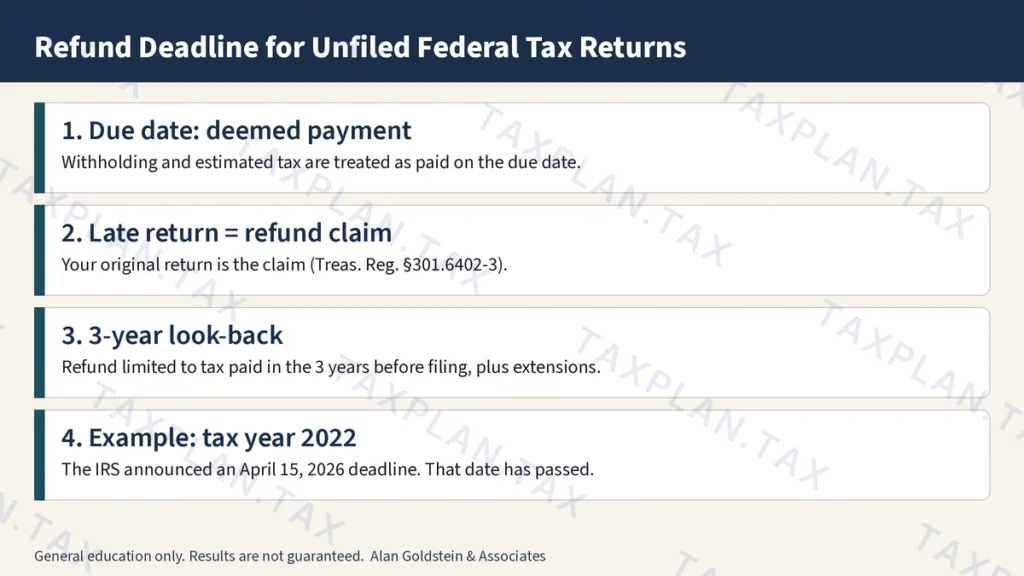


The refund deadline for unfiled federal tax returns is generally 3 years from the original due date of the return. That is the practical result for refunds of withholding and estimated tax. The law treats those payments as made on the due date, and it limits a refund to tax paid in the 3 years before you file. If you miss the window, the money generally stays with the U.S. Treasury. This article explains how the refund deadline for unfiled federal tax returns works, which years are still open, and which exceptions may give you more time.
Key Takeaways
- For an unfiled return, the late original return is your refund claim.
- Withholding and estimated tax are treated as paid on the return due date, usually April 15.
- So you generally must file within 3 years of that due date to recover them.
- The IRS said the deadline for 2022 refunds was April 15, 2026.
- Extensions, disasters, combat zone service, and financial disability may add time.
- The IRS may hold or offset a refund even when you file on time.
What is the refund deadline for unfiled federal tax returns?
In most cases, it is 3 years after the original due date. The IRS says that if you are due a refund for withholding or estimated taxes, you must file your return to claim it within 3 years of the return due date (IRS: Filing past due tax returns).
The same rule applies to refundable credits, such as the Earned Income Credit. The IRS calls the last date to claim a refund the Refund Statute Expiration Date (RSED) (IRS: Time you can claim a credit or refund).
Why is the late return itself the claim?
Because the regulation says so. A properly executed original income tax return is a claim for refund for the overpayment it shows (Treas. Reg. §301.6402-3(a)(5)). It counts as filed on the date the return is considered filed.
The same regulation adds a mailing rule. If the timely-mailing rules are met, the claim counts as filed on the postmark date. That is why proof of mailing matters near a deadline.
How does the 3-year look-back rule work?
The law sets two limits. First, you must file the claim in time. Second, the refund cannot exceed tax paid during a look-back period before the claim.
Under IRC §6511(a), you generally must file a refund claim within 3 years from when you filed the return or 2 years from when you paid the tax, whichever is later. For a late original return, the return and the claim arrive together, so the first limit is met.
The second limit is the one that matters. Under IRC §6511(b)(2)(A), the refund cannot exceed the tax paid within 3 years before the claim, plus any extension of time to file the return.
When are withholding and estimated tax treated as paid?
They are treated as paid on the return due date. IRC §6513(b) deems income tax withholding and estimated income tax paid on the fifteenth day of the fourth month after the tax year ends. For calendar-year individuals, that is April 15.
Put the two rules together. If you file more than 3 years after that April date, the withholding and estimated payments fall outside the look-back. As a result, they generally cannot be refunded.
Does an extension add time?
Yes, if you had one for that year. The look-back period is 3 years plus the period of any extension of time to file the return. The IRS page on claiming a credit or refund describes the same rule. So if you obtained a valid six-month extension, the look-back reaches back further.
What about payments made after the due date?
They may still be refundable. The look-back covers any tax paid within the 3 years before you file. For example, payments the IRS collected on a substitute-return balance within that window may qualify, even if older withholding does not. The IRS decides each claim on its facts.
Which tax years can still produce a refund?
Generally, only the three most recent filing seasons remain open for withholding refunds. Older years are generally closed unless an exception applies.
| Tax year | General refund deadline for withholding and estimated tax |
|---|---|
| 2022 | April 15, 2026, as the IRS announced. This deadline has passed. |
| 2023 | Generally April 15, 2027, three years after the April 15, 2024 due date. |
| 2024 and 2025 | Generally three years after each year’s original April due date. |
For 2022, the IRS said about 1.3 million people had unclaimed refunds totaling about $1.2 billion. It added that unclaimed refunds become the property of the U.S. Treasury after three years (IRS: IR-2026-37). The 2023 date above applies the same statutory rule. It is illustrative, so confirm it against current IRS guidance and your own facts.
What exceptions can extend the refund deadline?
Several exceptions can add time. The most common involve disasters, combat zone service, written agreements with the IRS, bad debts, and financial disability.
The IRS lists these exceptions on its refund timing page:
- Written agreement to extend assessment. The claim period runs through the agreement period plus 6 months, with limits.
- Presidentially declared disaster. You may have up to 1 more year.
- Combat zone or contingency operation. You may have additional time if you qualify.
- Bad debt or worthless security. You have 7 years from the return due date for that claim.
What is financial disability?
Financial disability can suspend the refund deadline. Under IRC §6511(h), the periods stop running while an individual is unable to manage financial affairs because of a medically determinable physical or mental impairment. The impairment must be expected to result in death or last at least 12 months.
However, the suspension does not apply while a spouse or another person is authorized to act for the individual in financial matters. The law also requires proof in the form the IRS requires. Because these claims depend on records, get professional help early.
What happens if you miss the refund deadline?
You generally lose the refund and cannot apply it to another year. The IRS may still want the return, however.
The IRS states that you cannot get a credit or refund if you do not file within the 3-year or 2-year periods, unless an exception applies. In addition, IRC §6402(a) allows the IRS to credit overpayments against other liabilities only within the applicable limitations period. So an expired overpayment generally cannot reduce a balance from a different year.
Even then, filing may help. For instance, your own return may replace a higher substitute-return assessment. Our article on the statute of limitations on unfiled federal tax returns explains how the refund, assessment, and collection periods interact.
Can the IRS hold or reduce a timely refund?
Yes. Filing on time protects your right to the refund, but it does not guarantee that you receive the full amount.
First, the IRS says it holds income tax refunds when its records show other past-due returns. It holds them until it gets the missing return or an acceptable explanation (IRS). Second, the IRS may apply the refund to other federal tax you owe. Third, the Treasury Offset Program may reduce it for child support and certain federal and state debts (IRS: Reduced refund).
Also, interest is limited. Under IRC §6611(b)(3), the IRS pays no interest for days before a late return is filed.
How do you meet the refund deadline?
File a complete original return for the year before the deadline, and keep proof of the filing date. Start early, because rebuilding old records takes time.
- Order your wage and income transcript through Get Transcript.
- Prepare the return on that year’s forms from the IRS prior year forms page.
- Sign the return and attach required Forms W-2 and other documents.
- File it, and keep proof of mailing or e-file acceptance.
- File any other missing years so the IRS does not hold the refund.
Keep e-file limits in mind. The IRS e-file handbook says individual e-file covers returns due in the current year and two previous years (IRS Publication 1345). For more on late filing, see our guide to filing past-due federal tax returns.
Frequently Asked Questions
Is the refund deadline 3 years from when I file or from the due date?
For an unfiled return, the practical answer is 3 years from the due date. The claim is timely when you file, but the look-back limits the refund to tax paid within 3 years before filing.
Can I still claim my 2022 refund?
Generally, no. The IRS said the 2022 deadline was April 15, 2026. An exception, such as a valid extension or disaster relief, may change that for some taxpayers.
What is the deadline for my 2023 refund?
Generally April 15, 2027, based on the April 15, 2024 due date. Confirm it against IRS guidance and your facts.
Does the refund deadline apply to the Earned Income Credit?
Yes. The IRS says the same 3-year rule applies to the right to claim credits such as the Earned Income Credit.
Does a postmark count as the filing date?
It can. The regulation treats the claim as filed on the postmark date if the timely-mailing requirements are met. Keep proof of mailing.
What if I was seriously ill and could not file?
Financial disability under IRC §6511(h) may suspend the deadline. The rules are strict, and the IRS requires proof.
Will I get interest on a late-filed refund?
Not for days before you file. IRC §6611(b)(3) bars interest for that period.
Conclusion
The refund deadline for unfiled federal tax returns is generally 3 years from the original due date. That result comes from the look-back rule in IRC §6511 and the deemed-payment rule in IRC §6513. Some exceptions may add time, but missing the window usually means the refund is gone. Even a timely refund may be held or offset if other years are unfiled.
Alan Goldstein, MBA, IRS Enrolled Agent, of Alan Goldstein & Associates in Coral Gables, Florida, can identify which of your unfiled years can still produce a refund. We can prepare those returns, address other missing years, and explain any balances. Every case depends on its facts, and we cannot guarantee a refund. To request a confidential review, visit our Tax Resolution Services page.
Sources and Authorities
- IRS: Filing past due tax returns
- IRS: Time you can claim a credit or refund
- Treas. Reg. §301.6402-3, Special rules applicable to income tax
- IRC §6511, Limitations on credit or refund
- IRC §6513, Time return deemed filed and tax considered paid
- IRS: IR-2026-37, Unclaimed refunds for tax year 2022
- IRC §6402, Authority to make credits or refunds
- IRS: Reduced refund
- IRC §6611, Interest on overpayments
- IRS: Get Transcript
- IRS: Prior year forms and instructions
- IRS Publication 1345, Handbook for Authorized IRS e-file Providers
This article is provided for general educational purposes and does not constitute individualized tax, legal, or accounting advice. Tax consequences depend on the taxpayer’s specific facts and applicable law.
