
You generally have 3 years from the original due date to claim a refund on an unfiled return. For most people, that means 3 years from the April filing deadline for that tax year. The late return itself is the claim, so you do not need a separate form. If you file after that point, the refund of withholding and estimated tax is usually lost. This guide explains how to claim a refund on an unfiled return, step by step, and what can delay or reduce the check.
Key Takeaways
- The window to claim a refund on an unfiled return is generally 3 years from the original due date.
- Your late original return is the refund claim. You do not file Form 1040-X for it.
- As of November 2026, tax years 2023, 2024, and 2025 generally remain open. Tax year 2022 closed on April 15, 2026.
- Paper returns take longer. The IRS says mailed refunds take 6 or more weeks after it receives the return.
- The IRS may hold the refund until other past-due returns arrive, and it may offset certain debts.
How long do you have to claim a refund on an unfiled return?
In most cases, you have 3 years from the return’s original due date. The IRS states that you must file within 3 years of the return due date to claim a refund of withholding or estimated tax (IRS: Filing past due tax returns).
The rule comes from two code sections. First, IRC §6511(b)(2)(A) limits a refund to tax paid within 3 years before the claim, plus any filing extension. Second, IRC §6513(b) treats withholding and estimated tax as paid on the return due date. Together, they set the practical deadline. We cover the statutory mechanics in more depth in our article on the refund deadline for unfiled federal tax returns.
What is a refund claim?
A refund claim is a filing that asks the IRS to return an overpayment. For an unfiled year, the original return serves as the claim. Under Treas. Reg. §301.6402-3(a)(5), a properly executed original income tax return is a claim for the overpayment it shows.
So you do not use Form 1040-X for a year you never filed. Instead, you file the original Form 1040 for that year. The IRS page on claiming a credit or refund lists the original return as one way to claim.
Does the same deadline apply to refundable credits?
Yes. The IRS says the same 3-year rule applies to the right to claim credits such as the Earned Income Credit. Therefore, an older year with a large credit can also expire. Check the date before you spend time on an old return.
Which unfiled years can still produce a refund in late 2026?
As of November 2026, tax years 2023, 2024, and 2025 generally remain open. Tax year 2022 closed on April 15, 2026, as the IRS announced.
| Tax year | Original due date | General end of the refund window |
|---|---|---|
| 2022 | April 18, 2023 | April 15, 2026 (IRS-announced). This window has closed. |
| 2023 | April 15, 2024 | Generally April 15, 2027 |
| 2024 | April 15, 2025 | Generally 3 years after the due date, adjusted for weekends and holidays |
| 2025 | April 15, 2026 | Generally 3 years after the due date, adjusted for weekends and holidays |
The 2022 date comes from the IRS itself. In its 2026 announcement, the IRS said about $1.2 billion in 2022 refunds was unclaimed and set an April 15, 2026 deadline (IRS: IR-2026-37). The later dates in the table apply the same statute. They are illustrative, so confirm them against current IRS guidance. In addition, IRC §7503 moves a deadline that falls on a weekend or legal holiday to the next business day.
Can an extension or an exception add time?
Sometimes. A valid filing extension for that year lengthens the look-back period. In addition, the IRS lists exceptions for disasters, combat zone service, written agreements, bad debts, and financial disability. Each exception has its own conditions, so do not assume one applies without checking the facts.
How do you claim a refund on an unfiled return, step by step?
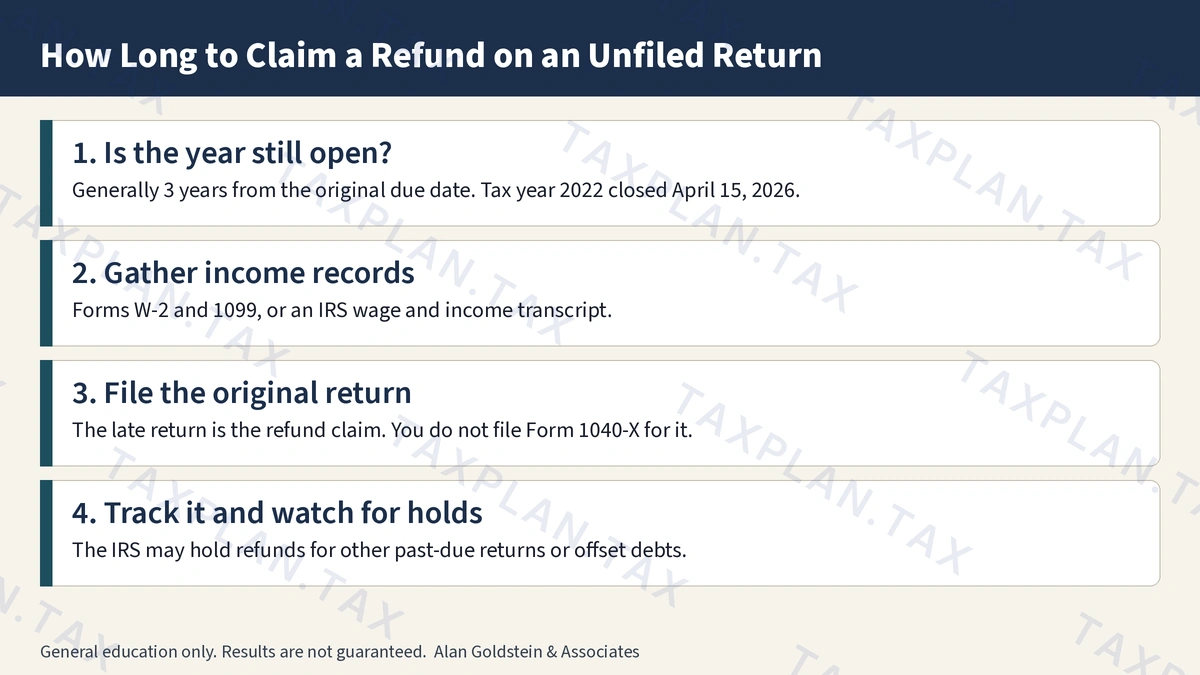
You claim it by filing a complete original return for that year before the window closes. The process has four practical steps.
Step 1: Is the tax year still open?
First, compare the year’s original due date with today’s date. If more than 3 years have passed, the refund is generally gone. However, the IRS may still want that return, so the year may still matter. For instance, the IRS holds refunds when its records show other past-due returns.
Step 2: Which income records do you need?
Next, collect your Forms W-2, 1099, and other income statements. If they are missing, request a wage and income transcript, which is an IRS record of information returns filed under your taxpayer number. You can get it online through IRS Get Transcript. The transcript also shows federal withholding, which drives the refund amount.
Step 3: Which forms should you use?
Then use the forms and instructions for the year you are filing. The IRS posts them on its prior-year forms page. Tax law changes every year, so current-year software or forms will not fit an older return.
Electronic filing has limits. The IRS e-file handbook says individual returns can be e-filed only for due dates in the current year and the two previous years (IRS Publication 1345). Older returns generally go on paper.
Step 4: How do you file and track the refund?
Finally, file the return and keep proof of the filing date. Near a deadline, proof matters. The regulation applies the timely-mailing rules, so a postmark can count as the filing date when those rules are met. Certified mail or an approved private delivery service may help you prove the date.
After that, track the refund with Where’s My Refund. The IRS says status appears 3 days after you e-file a prior-year return and 4 weeks after you file a paper return.
How long does a late-filed refund take to arrive?
Timing depends on how you file. The IRS says e-filed refunds typically take 3 weeks, while mailed returns take 6 or more weeks from the date it receives them.
Delays can happen if the return needs corrections or more review. Moreover, older paper returns may face extra review. Plan for a longer wait than the typical range, especially if you file several years at once.
Does the IRS pay interest on a late-filed refund?
Only in limited cases. Under IRC §6611(b)(3), no interest accrues for any day before a late return is filed. Also, under §6611(e), no interest is due if the IRS refunds the money within 45 days after a late return is filed. So you should not expect interest for the years the return sat unfiled.
What can delay or reduce a refund on an unfiled return?
Three issues come up often. The IRS may hold the refund for other missing returns, apply it to other tax debts, or send it to pay certain non-tax debts.
- Refund hold. The IRS says it holds refunds when one or more income tax returns are past due. It keeps the hold until it gets the return or an acceptable reason for not filing (IRS: Filing past due tax returns).
- Tax offset. The IRS may apply the refund to federal tax you owe for another year (IRS: Reduced refund).
- Debt offset. The Bureau of the Fiscal Service may reduce the refund for past-due child support, federal agency non-tax debts, and certain state debts. This system is the Treasury Offset Program (TOP).
Because of these rules, the refund you see on the return may not be the amount you receive. If you owe for other years, the refund may still help by lowering that balance. Our article on whether you owe taxes on unfiled returns in a refund year covers that question in more detail.
What happens if you miss the window?
You generally lose the refund, and the IRS will not apply it to another year. Under IRC §6402(a), the IRS may credit an overpayment against other liabilities only within the applicable limitations period.
Even so, filing the return may still be worthwhile. For example, if the IRS prepared a substitute return for that year, your own return may correct the tax it assessed. The IRS says it will generally adjust your account to reflect the correct figures when you file after a substitute return. A filed return also starts the assessment period under IRC §6501, which does not run while no return exists.
Frequently Asked Questions
Is the deadline 3 years from when I earned the income?
No. It generally runs from the return’s original due date, not the end of the tax year. For a calendar-year individual, that is usually April 15 of the following year, adjusted for weekends and holidays.
Do I need Form 1040-X to claim a refund for a year I never filed?
No. You file the original return for that year. The regulation treats a properly executed original return as the refund claim.
Can I still e-file an old return to get the refund faster?
Only for recent years. IRS e-file for individuals covers returns due in the current year and the two previous years. Older returns generally must be mailed.
Will the IRS release my refund if other years are still unfiled?
Perhaps not. The IRS says it holds refunds when its records show other past-due returns. It releases the hold after it gets those returns or an acceptable explanation.
Does a filing extension give me more time to claim the refund?
It can. The look-back period is 3 years plus any extension of time to file for that year. You need to have obtained the extension for the year in question.
Will I receive interest on a refund from a late return?
Usually little or none. No interest accrues before a late return is filed. In addition, no interest is due if the IRS pays within 45 days after you file.
Can someone else claim a refund for a deceased taxpayer’s unfiled year?
Generally, a personal representative can file the return. The same 3-year limit applies. Get professional help, because extra forms and proof of authority may be required.
Conclusion
You generally have 3 years from the original due date to claim a refund on an unfiled return. The original return is the claim, and it must arrive before the window closes. Holds, offsets, and paper processing can delay or reduce the refund. Acting early gives you the best chance to recover money that is still available.
Alan Goldstein, MBA, IRS Enrolled Agent, of Alan Goldstein & Associates in Coral Gables, Florida, can check which of your unfiled years remain open. We can prepare those returns and address other missing years that may trigger a refund hold. Every case depends on its facts, and we cannot guarantee a refund or its amount. To request a confidential review, visit our Tax Resolution Services page.
Sources and Authorities
- IRS: Filing past due tax returns
- IRS: Time you can claim a credit or refund
- IRC §6511, Limitations on credit or refund
- IRC §6513, Time return deemed filed and tax considered paid
- Treas. Reg. §301.6402-3, Special rules applicable to income tax
- IRS: IR-2026-37, 2022 unclaimed refunds and the April 15, 2026 deadline
- IRC §7503, Time for performance of acts where last day falls on Saturday, Sunday, or legal holiday
- IRS: Get Transcript
- IRS: Prior-year forms and instructions
- IRS Publication 1345, Handbook for Authorized IRS e-file Providers
- IRS: Where’s My Refund
- IRC §6611, Interest on overpayments
- IRS: Reduced refund
- IRC §6402, Authority to make credits or refunds
- IRC §6501, Limitations on assessment and collection
This article is provided for general educational purposes and does not constitute individualized tax, legal, or accounting advice. Tax consequences depend on the taxpayer’s specific facts and applicable law.
