

Cost segregation for retail properties splits a store or shopping center into building, personal property, and site improvement components, so part of the cost is deducted much sooner. A retail building is nonresidential real property, so its shell and building systems are depreciated over 39 years. However, retail sites usually include many shorter-lived assets. Examples are point-of-sale wiring, display fixtures, removable flooring, decorative lighting, signage, and large parking lots. The IRS even publishes a retail matrix in its Cost Segregation Audit Techniques Guide that shows how examiners view these items. In addition, interior store build-outs are often qualified improvement property under IRC §168(e)(6), with a 15-year life.
For property acquired after January 19, 2025, these 5-, 7-, and 15-year parts can generally get 100% bonus depreciation, as explained in IRS Notice 2026-11. This guide explains cost segregation for retail properties, the IRS retail matrix, tenant build-outs, and two worked examples, all tied to primary sources.
Key Takeaways
- Retail buildings are 39-year nonresidential real property under IRC §168(c).
- Assets used in retail trade fall in asset class 57.0, with a 5-year life, according to Publication 946, Table B-1.
- The IRS retail matrix in Publication 5653, Chapter 7.B, lists many store assets as 5-year property.
- Interior build-outs can be 15-year qualified improvement property, except enlargements, elevators, escalators, and internal structural framework.
- Parking lots, sidewalks, and landscaping are usually 15-year land improvements in asset class 00.3.
- Store space used for sales activities is excluded from the new §168(n) production property allowance.
What Is Cost Segregation for Retail Properties?
Direct answer: Cost segregation for retail properties is an engineering-based study that assigns each part of a retail property’s cost to its correct depreciation class. The goal is to find costs that do not belong in the 39-year building class.
Retail property includes freestanding stores, grocery stores, strip centers, neighborhood centers, and single-tenant net-lease buildings. Under IRC §168(e)(2)(B), these are nonresidential real property. As a result, the building and its structural components use 39-year straight-line depreciation with a mid-month convention.
However, not everything inside a store is a structural component. Treas. Reg. §1.48-1(c) lists refrigerators, grocery counters, display racks and shelves, and neon and other signs as examples of tangible personal property. Therefore, cost segregation for retail properties can move these items into shorter classes. For the basics, see What Is a Cost Segregation Study and How Does It Work?
Which asset class applies to retail personal property?
Asset class 57.0, Distributive Trades and Services, covers assets used in wholesale and retail trade. Publication 946 reproduces this class from Rev. Proc. 87-56 and assigns it a 5-year GDS recovery period. Office furniture is different, because it falls in class 00.11 with a 7-year life. Similarly, computers used in normal business records fall in class 00.12 with a 5-year life.
Also note who owns the property. When a landlord leases a store to a retailer, the asset class is determined as if the lessee owned the property. The audit guide explains this rule and cites Treas. Reg. §1.167(a)-11(e)(3)(iii).
How Does Cost Segregation for Retail Properties Work?
Direct answer: A study team gathers cost data and drawings, tours the store, removes land value, and classifies each component. Then it documents why each item belongs in its class.
For new construction, contractor pay applications and invoices give the strongest support. For an acquisition, the team usually starts with the purchase price, removes land, and then uses cost estimating to price each component. The IRS guide explains how examiners review these methods. So cost segregation for retail properties should follow a documented, engineering-based approach. To see each stage, read Cost Segregation Study Process: Step-by-Step Breakdown.
What does the IRS retail matrix say?
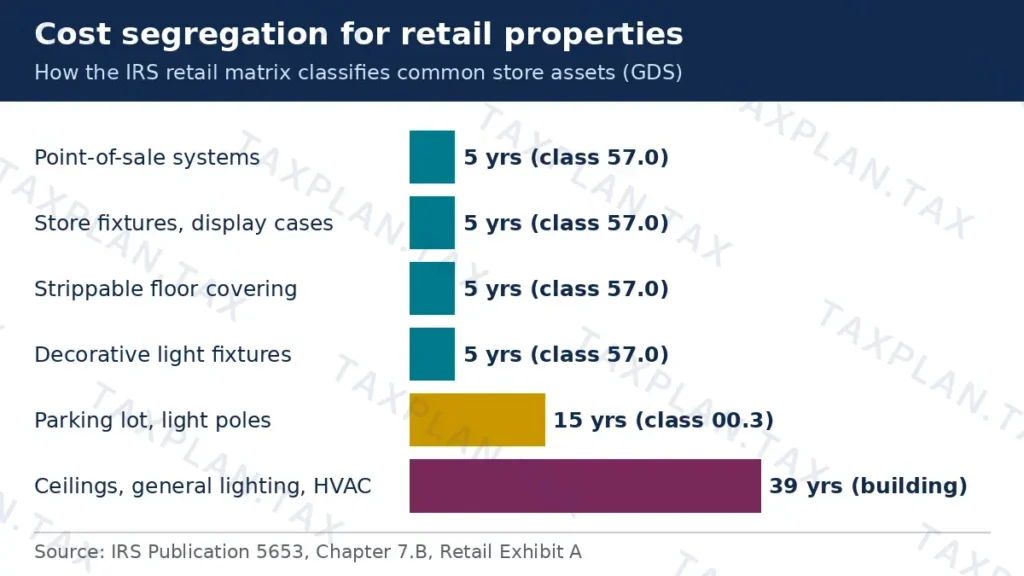
Chapter 7.B of Publication 5653 reproduces a 2004 field directive for the retail industry. Its Exhibit A recommends a category and GDS life for common store assets. If a taxpayer’s return matches the matrix, examiners are told not to adjust those items. However, the guide also says the matrix is not an official pronouncement and cannot be cited or relied upon as such.
Even so, the matrix is a useful map. For example, it lists these items as §1245 property in class 57.0 with a 5-year life:
- Point-of-sale systems, including registers and scanners.
- Retail store fixtures, such as back cases, islands, and display accessories.
- Floor covering installed with strippable adhesive.
- Decorative light fixtures that are not the store’s general lighting.
- Interior and exterior signs used for display or theme, but not exit or restroom signs.
- Refrigeration units and portable refrigerated structures.
- Special electrical connections and plumbing hook-ups that serve specific equipment.
In contrast, the matrix keeps ceilings, general lighting, general plumbing, central HVAC, roofs, doors, and permanently installed dock levelers in the 39-year building class. Light poles and grade-level parking are 15-year land improvements in class 00.3.
What about restaurants inside retail centers?
Many strip centers include restaurants. The retail directive itself says to use the restaurant directive for restaurants located within a retail store. That guidance appears in Chapter 7.C of the audit guide. Therefore, cost segregation for retail properties with food tenants should apply both matrices carefully.
What Are the Benefits of Cost Segregation for Retail Properties?
Direct answer: The main benefits are larger early deductions, faster recovery of tenant build-outs, and cleaner records for later renovations and dispositions.
How does bonus depreciation apply?
Public Law 119-21, enacted July 4, 2025, made 100% bonus depreciation permanent for qualified property acquired after January 19, 2025. Bonus applies to property with a recovery period of 20 years or less. So the 5-, 7-, and 15-year parts identified through cost segregation for retail properties can qualify. However, property acquired under a written binding contract signed before January 20, 2025 stays under the old phase-down, which is 20% for property placed in service in 2026. Also, used property can qualify under Treas. Reg. §1.168(k)-2 if you did not use it before.
Why are tenant build-outs so valuable?
Retail landlords and tenants remodel often. Under IRC §168(e)(6), qualified improvement property is an improvement to an interior portion of a nonresidential building, placed in service after the building was first placed in service. QIP is 15-year property under §168(e)(3)(E)(vii), so it can also qualify for bonus depreciation.
Before 2018, the law used separate categories such as qualified retail improvement property. The audit guide notes that, for property placed in service in tax years beginning after 2017, QIP took their place for §179 purposes. However, QIP still excludes enlargements, elevators and escalators, and the internal structural framework. In addition, IRC §179(f) lets eligible taxpayers expense QIP and certain roofs, HVAC, fire protection, alarm, and security systems on nonresidential buildings, subject to the §179 limits.
Can you write off old store improvements?
Often, yes. Under IRC §168(i)(8)(B), a lessor improvement for a tenant that is irrevocably disposed of or abandoned when the lease ends is treated as disposed of. In addition, a partial disposition election under Treas. Reg. §1.168(i)-8 can apply when you replace a roof or storefront. That regulation allows a cost segregation study as a reasonable way to find the retired basis.
What Legal Rules Govern Cost Segregation for Retail Properties?
Direct answer: The key authorities are IRC §168, IRC §179, the structural component regulations, Rev. Proc. 87-56 asset classes, and the IRS audit guide.
- IRC §168: recovery periods, QIP, lessor improvements, and bonus under §168(k).
- IRC §179: expensing, including qualified real property.
- Treas. Reg. §1.48-1: the line between personal property and structural components. It names stores as an example of a building.
- Rev. Proc. 87-56: asset classes 00.11, 00.12, 00.3, 57.0, and 57.1, as reproduced in Publication 946.
- Publication 5653: the audit guide, including the retail and restaurant matrices.
Two Tax Court cases discussed in the audit guide shape the analysis. In Hospital Corporation of America v. Commissioner, 109 T.C. 21 (1997), the court held that the former investment tax credit rules still decide §1245 status for cost recovery. Also, Whiteco Industries, Inc. v. Commissioner, 65 T.C. 664 (1975), set out factors for judging whether a property is inherently permanent.
Are gas stations and car washes different?
Yes. A retail motor fuels outlet is 15-year property under IRC §168(e)(3)(E)(iii). In addition, asset class 57.1 in Publication 946 covers service station buildings, car wash buildings, related land improvements, and billboards, with a 15-year life. So convenience stores with fuel sales need their own analysis.
What about recapture when you sell?
Gain on §1245 property is ordinary income up to the depreciation taken, under IRC §1245. Meanwhile, straight-line depreciation on the building creates unrecaptured §1250 gain, taxed at up to 25% under IRC §1(h). Therefore, cost segregation for retail properties should be planned with the expected holding period in mind.
What Does Cost Segregation for Retail Properties Look Like in Practice?
Direct answer: The two examples below show a strip center purchase and a store build-out. All amounts are illustrative assumptions, not typical or guaranteed results.
Example 1: Buying a neighborhood strip center
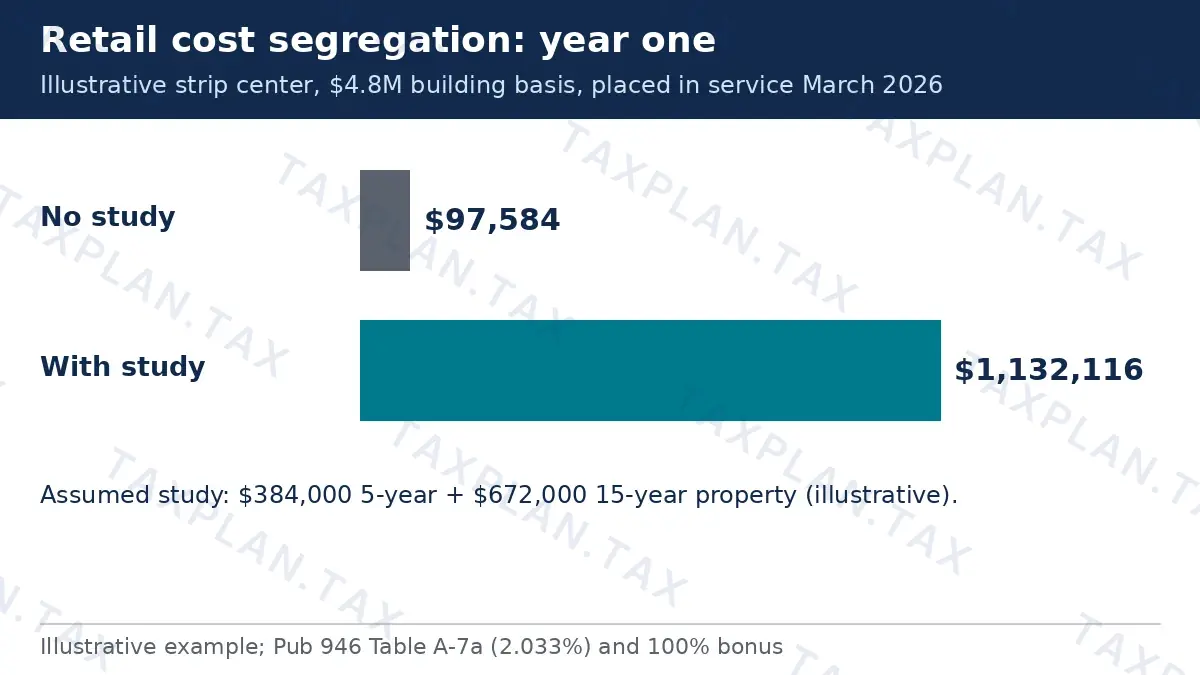
Assume an investor buys a neighborhood strip center for $6,000,000 under a 2026 contract. The land is worth $1,200,000, so the building basis is $4,800,000. The center is placed in service in March 2026.
| Class (illustrative study) | Basis | Year-one depreciation |
|---|---|---|
| 5-year retail personal property (class 57.0) | $384,000 | $384,000 (100% bonus) |
| 15-year parking, lighting, landscaping (class 00.3) | $672,000 | $672,000 (100% bonus) |
| 39-year building | $3,744,000 | $76,116 |
| Total | $4,800,000 | $1,132,116 |
The 39-year figure uses the March rate of 2.033% from Publication 946, Table A-7a. Without a study, $4,800,000 at 2.033% gives $97,584. So in this example, cost segregation for retail properties adds about $1,034,532 of first-year depreciation.
Example 2: A tenant build-out in an older store
Next, assume a landlord owns a store first placed in service in 2008. In 2026, the landlord spends $500,000 to prepare the space for a new tenant. The work includes $440,000 of new interior partitions, ceilings, lighting, and finishes. It also includes $60,000 to enlarge the building with a rear addition.
The $440,000 of interior work can be qualified improvement property. So it is 15-year property and may qualify for 100% bonus. In contrast, the $60,000 enlargement is excluded from QIP and is depreciated over 39 years. In addition, the landlord should check whether the old tenant’s improvements were abandoned, because their remaining basis may be deductible.
What Are Common Mistakes With Cost Segregation for Retail Properties?
Direct answer: Most errors come from overreaching on building systems, ignoring the retail matrix, or mishandling build-outs.
- Calling general lighting or central HVAC personal property. The retail matrix keeps both in the building class.
- Treating exit signs or restroom signs as 5-year signage. The matrix lists them as building components.
- Classifying an enlargement as QIP. The statute excludes enlargements of the building.
- Using the lease term to depreciate build-outs. Under §168(i)(8)(A), normal MACRS lives apply.
- Relying on a flat percentage. The audit guide favors detailed, fact-based studies.
- Ignoring state law. Some states do not follow federal bonus depreciation.
Also, keep the study and its workpapers. They support cost segregation for retail properties if the IRS examines the return. They also help with future dispositions.
Frequently Asked Questions
Is cost segregation for retail properties worth it for a small store?
It depends on the cost basis, tax bracket, and holding period. A small store may not justify a full study, while a center often does. Our guide When Is a Cost Segregation Study Worth It? walks through the analysis.
Can a net-lease landlord use cost segregation?
Yes. A landlord that owns the building can depreciate it and can use cost segregation for retail properties, even if the tenant pays most expenses. However, the asset class for leased personal property is determined as if the tenant owned it.
Can I apply cost segregation to a retail property I bought years ago?
Yes. A look-back study can claim missed depreciation through Form 3115 and a §481(a) adjustment. The automatic change procedures appear in Rev. Proc. 2025-23.
Are store shelves and display cases 5-year property?
Generally, yes, when they are not part of the building. In cost segregation for retail properties, the IRS retail matrix lists retail store fixtures and display accessories in class 57.0, with a 5-year life.
Is a parking lot really 15-year property?
Usually, yes. Grade-level surface parking is a land improvement in class 00.3. However, a stand-alone parking structure is treated as a building.
Who depreciates tenant improvements?
Generally, the party that pays for and owns the improvement depreciates it. So landlord-funded work belongs to the landlord, and tenant-funded work belongs to the tenant.
Does the new production property deduction help retail owners?
Generally, no. IRC §168(n) excludes space used for sales activities. It also excludes property a lessor leases to others.
Conclusion: Is Cost Segregation for Retail Properties Right for You?
To sum up, cost segregation for retail properties can move fixtures, signage, removable finishes, and site work out of the 39-year class. For property acquired after January 19, 2025, those parts can generally get 100% bonus depreciation. In addition, QIP and lease-end write-offs add value over the life of the property. However, building systems stay in the 39-year class, so careful classification matters.
Emunah Cost Segregation works with retail owners and their CPAs. Alan Goldstein, EA, reviews your property, purchase documents, and build-out history before any study begins. Then he tells you plainly whether a study makes sense. Contact Emunah Cost Segregation in Coral Gables, Florida, to request a review. For related reading, see Cost Segregation for Commercial Real Estate.
Sources and Authorities
- 26 U.S.C. §168 (including §168(c), §168(e), §168(i)(8), §168(k), and §168(n)): https://www.law.cornell.edu/uscode/text/26/168
- 26 U.S.C. §179 (including §179(f)): https://www.law.cornell.edu/uscode/text/26/179
- 26 U.S.C. §1245: https://www.law.cornell.edu/uscode/text/26/1245
- 26 U.S.C. §1 (including §1(h)): https://www.law.cornell.edu/uscode/text/26/1
- Public Law 119-21 (H.R. 1, 119th Congress): https://www.congress.gov/bill/119th-congress/house-bill/1
- IRS Notice 2026-11: https://www.irs.gov/pub/irs-drop/n-26-11.pdf
- Treas. Reg. §1.48-1: https://www.ecfr.gov/current/title-26/section-1.48-1
- Treas. Reg. §1.167(a)-11: https://www.ecfr.gov/current/title-26/section-1.167(a)-11
- Treas. Reg. §1.168(i)-8: https://www.ecfr.gov/current/title-26/section-1.168(i)-8
- Treas. Reg. §1.168(k)-2: https://www.ecfr.gov/current/title-26/section-1.168(k)-2
- IRS Publication 946, including Table A-7a and Table B-1: https://www.irs.gov/pub/irs-pdf/p946.pdf
- IRS Publication 5653, Cost Segregation Audit Techniques Guide, including Chapters 7.B and 7.C: https://www.irs.gov/pub/irs-pdf/p5653.pdf
- About Form 3115: https://www.irs.gov/forms-pubs/about-form-3115
- Rev. Proc. 2025-23: https://www.irs.gov/pub/irs-drop/rp-25-23.pdf
- Hospital Corporation of America v. Commissioner, 109 T.C. 21 (1997), and Whiteco Industries, Inc. v. Commissioner, 65 T.C. 664 (1975), as discussed in IRS Publication 5653.
This article is provided for general educational purposes and does not constitute individualized tax, legal, or accounting advice. Tax consequences depend on the taxpayer’s specific facts and applicable law.
