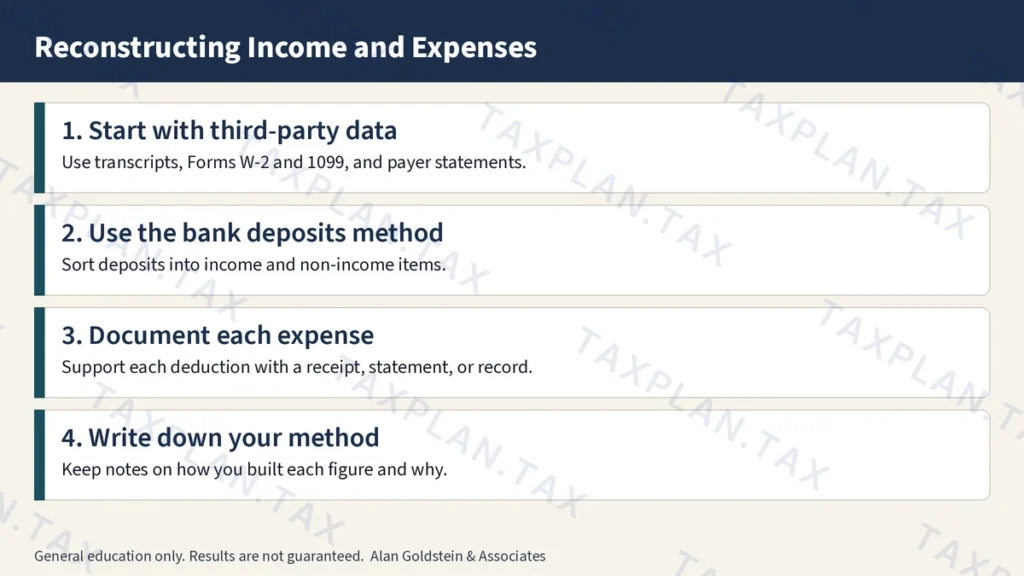


Reconstructing income and expenses for unfiled tax returns means rebuilding each year from IRS data, bank records, and documented estimates. Work on one year at a time. Start with what third parties reported, test it against your bank deposits, and then support your expenses. This guide gives a step-by-step method, shows what the courts and the IRS look for, and explains how to check your work before you file, as of late 2026.
Key Takeaways
- Build income first from IRS transcripts, then test it against bank deposits, because transcripts show only what payers reported.
- The bank deposits method treats deposits as income unless you can show a nontaxable source, such as a transfer between your own accounts or a loan.
- Estimate expenses only when evidence shows you incurred them, and keep stricter proof for travel, gifts, and listed property.
- If your Schedule C receipts are lower than your Forms 1099-NEC, the IRS instructions tell you to attach a statement explaining the difference.
- Write a method note for each year. No outcome is guaranteed.
How do you start reconstructing income and expenses for unfiled tax returns?
Use a fixed order. Gather IRS data, rebuild income, support expenses, and then reconcile the result.
- Pull the IRS data. Order wage and income transcripts and account transcripts for each missing year.
- Rebuild income. Start with the transcript, then add income the payers did not report, using bank and payment records.
- Support expenses. Match each expense to a document, a payment record, or a documented estimate.
- Reconcile and record. Compare your totals to third-party data and write down your method.
This guide goes deeper than our overview of how to file past-due federal tax returns and our guide to unfiled returns for independent contractors. It focuses on the math and evidence behind each figure.
How do you reconstruct income?
Start with third-party data and then test it against your bank records. Income is taxable whether or not a payer reported it.
What do IRS transcripts tell you about income?
They show what payers reported to the IRS, and nothing more. That makes them a floor, not a ceiling.
The IRS says the wage and income transcript shows data from information returns such as Forms W-2, 1098, 1099, and 5498. It displays only documents filed with the IRS, which may not reflect every document issued to you. It is available for the current and nine prior years, and older years need Form 4506-T. If you earned cash or were paid by someone who filed no form, the transcript will not show it.
How does the bank deposits method work?
It treats money deposited in your accounts as income unless you show another source. The IRS uses the same idea when it examines taxpayers with inadequate records.
The Internal Revenue Manual says the method computes income by showing what happened to a taxpayer’s funds. If a taxpayer receives money, it can either be deposited or spent (IRM 4.10.4.5.4). The IRM also notes that case law requires an adequate investigation of deposits to negate the likelihood that they came from nontaxable sources.
The courts agree. In Price v. United States (1964), the Fifth Circuit explained that the bank deposits method assumes all money deposited in a taxpayer’s account during a period is taxable income. The court also said a beginning bank balance must be established. It added that the government must account for any nontaxable source or deductible expense it knows about (335 F.2d at 677). In Gleckman v. United States (1935), the Eighth Circuit observed that a bare deposit does not prove income. However, regular receipts from a lucrative business are “most potent testimony” of income (80 F.2d at 399).
How do you sort your deposits?
Go through every deposit and sort it into taxable, nontaxable, or unknown.
Common nontaxable items include transfers between your own accounts, loan proceeds, and returns of capital. Gleckman describes these as items an auditor eliminated after tracing them. Keep the proof for each exclusion.
| Illustration (hypothetical numbers) | Amount |
|---|---|
| Total deposits for the year | $60,000 |
| Less transfers between your own accounts | ($8,000) |
| Less a documented loan | ($4,000) |
| Deposits treated as income | $48,000 |
| Form 1099-NEC income on the transcript | $30,000 |
| Remaining receipts that no payer reported | $18,000 |
This example is illustrative only. It shows why the transcript alone may understate income. The $18,000 difference would still count as income, subject to your own facts.
What about cash income?
Report it. IRC §61(a) defines gross income as all income from whatever source derived, and the IRS method also looks at cash you spent.
The IRM describes a Bank Deposits and Cash Expenditures Method, which accounts for cash spending as well as deposits (IRM 4.10.4.5.4). To reconstruct cash receipts, use invoices, appointment books, text messages, and customer lists. Then total them by month. Do not leave cash income out because it is hard to prove.
How do you reconstruct business expenses?
Match each expense to evidence, and estimate only what the evidence supports. The expense must also be an ordinary and necessary cost of your business.
Under IRC §162(a), you may deduct ordinary and necessary expenses paid or incurred in carrying on a trade or business. The Instructions for Schedule C list common categories such as advertising, car and truck expenses, contract labor, insurance, legal and professional services, office expense, rent or lease, supplies, utilities, and wages. Use those lines as your checklist.
Evidence usually exists somewhere outside your files:
| Expense type | Where evidence may exist | Proof standard |
|---|---|---|
| Rent or lease | Lease, landlord statements, bank debits | Reasonable estimate with evidence |
| Supplies and inventory | Card statements, vendor account histories | Reasonable estimate with evidence |
| Contract labor | Bank debits, payee confirmations | Reasonable estimate with evidence |
| Travel | Calendars, airline and hotel records, card statements | Strict, under IRC §274(d) |
| Gifts and listed property | Receipts, mileage logs, usage records | Strict, under IRC §274(d) |
For items in the first three rows, a court may accept a reasonable estimate. In Cohan v. Commissioner (1930), the Second Circuit said absolute certainty is usually impossible and not necessary. The court allowed an approximation where the evidence showed money was spent (39 F.2d at 543–44). However, IRC §274(d) bars deductions for travel, gifts, and listed property unless you substantiate the amount, time and place, business purpose, and business relationship. Estimates alone will not satisfy that rule.
What if you cannot prove an expense?
Leave it off, or claim only the part you can support. An unsupported deduction invites questions.
Also remember that a substitute return from the IRS may allow no business expenses at all. The IRM says the IRS has no legal requirement to allow them on an SFR (IRM 4.12.1.25.2). That is why filing your own supported return usually matters.
How do you check your reconstruction before you file?
Reconcile your totals against outside data. Compare receipts to deposits, and compare your income to what the IRS already has.
- Deposits versus receipts. Your reported receipts should explain your taxable deposits.
- Transcript versus return. Every Form 1099 amount should appear somewhere in your income.
- Year over year. Large swings in income or expenses need an explanation.
- Lifestyle. Your reported income should make sense next to your living costs and spending.
The Schedule C instructions point to the first two checks. They say to check any Forms 1099 you received for business income. If your Forms 1099-NEC total more than the receipts you report, you should attach a statement explaining the difference (Instructions for Schedule C). The IRS may send a notice when third-party income information does not match what you reported (IRS: Understanding your CP2000 notice). See our guide to IRS audits and notices, including CP2000.
How should you record your method?
Write a one-page note for each year. List each source, each assumption, and each exclusion, with the math.
That note helps if the IRS asks questions later. It also helps your tax professional prepare the return quickly. Keep copies of every document you used, even partial ones. The IRS also advises keeping records indefinitely if you do not file a return (IRS: How long should I keep records?).
What if you cannot reconstruct a year well?
File with your best supported figures and disclose your method if asked. Do not skip the return because it feels imperfect.
The IRS tells taxpayers to file all returns that are due, whether or not they can pay in full (IRS: Filing past due tax returns). If better records surface, you can amend. Our companion guide on filing multiple years of unfiled returns explains the order of work. A professional can also help you decide which estimates are defensible.
Frequently Asked Questions
Can I use the bank deposits method for my own return?
Yes, as a reconstruction tool. Go through each deposit, remove nontaxable items you can document, and treat the rest as potential income.
Are all bank deposits taxable?
No. Transfers between your own accounts, loan proceeds, and returns of capital generally are not income. Keep proof for each item you exclude.
What if my transcript shows more income than I remember?
Check the source. If the amount is wrong, contact the payer for a corrected form. If it is right, report it, or attach an explanation for any difference.
Can I estimate vehicle or travel expenses?
Not by themselves. IRC §274(d) requires adequate records or sufficient corroborating evidence, such as calendars and receipts.
Do I need receipts for every expense?
Not always. A court may accept a reasonable estimate if evidence shows you incurred the expense, but stricter categories still need proof.
What if the IRS already filed a substitute return?
Your own return generally replaces it. The IRS says it will generally adjust your account to reflect the correct figures.
Should I reconstruct all years before filing any?
Not necessarily. Many people file the recent years first. A qualified professional can advise on order and priorities.
Conclusion
Reconstructing income and expenses takes patience, but a clear method makes it manageable. Start with IRS data, test it against your bank records, support each expense, and document your work. Results depend on your facts, and no outcome is guaranteed.
Alan Goldstein, MBA, IRS Enrolled Agent, at Alan Goldstein & Associates in Coral Gables, Florida, can help you rebuild past-due returns and review your IRS resolution options in a confidential consultation. We do not guarantee any particular result.
Cases Cited
Each case below was checked against the opinion text. Pinpoint pages were confirmed from the star-paginated reporter text on the linked page.
- Price v. United States, 335 F.2d 671, 677 (5th Cir. 1964). Cited for the points that the bank deposits method assumes money deposited in an account is taxable income, that a beginning bank balance must be established, and that the government must account for nontaxable sources or deductible expenses it knows of. Opinion text (OpenJurist).
- Gleckman v. United States, 80 F.2d 394, 399 (8th Cir. 1935). Cited for the points that a bare deposit does not prove taxable income, but regular receipts of money from a lucrative business are strong evidence of income. This is a criminal tax case, and the IRM describes it as the classic bank deposits case. Opinion text (OpenJurist).
- Cohan v. Commissioner, 39 F.2d 540, 543–44 (2d Cir. 1930). Cited for the point that absolute certainty is usually impossible and not necessary, and that an approximation may be made where the evidence shows an expense was incurred. Opinion text (OpenJurist).
Sources
- IRS: Transcript types for individuals and ways to order them
- IRS: About Form 4506-T, Request for Transcript of Tax Return
- IRM 4.10.4, Examination of Income (see 4.10.4.5.4, Bank Deposits and Cash Expenditures Method)
- IRM 4.12.1, Nonfiler Program (see 4.12.1.25.2, SFR Business Expenses)
- IRC §61, Gross income defined
- IRC §162, Trade or business expenses
- IRC §274, Disallowance of certain entertainment, etc., expenses
- IRS: Instructions for Schedule C (Form 1040)
- IRS: Understanding your CP2000 notice
- IRS: How long should I keep records?
- IRS: Filing past due tax returns
- Price v. United States, 335 F.2d 671, 677 (5th Cir. 1964) (OpenJurist)
- Gleckman v. United States, 80 F.2d 394, 399 (8th Cir. 1935) (OpenJurist)
- Cohan v. Commissioner, 39 F.2d 540, 543–44 (2d Cir. 1930) (OpenJurist)
This article is provided for general educational purposes and does not constitute individualized tax, legal, or accounting advice. Tax consequences depend on the taxpayer’s specific facts and applicable law.
