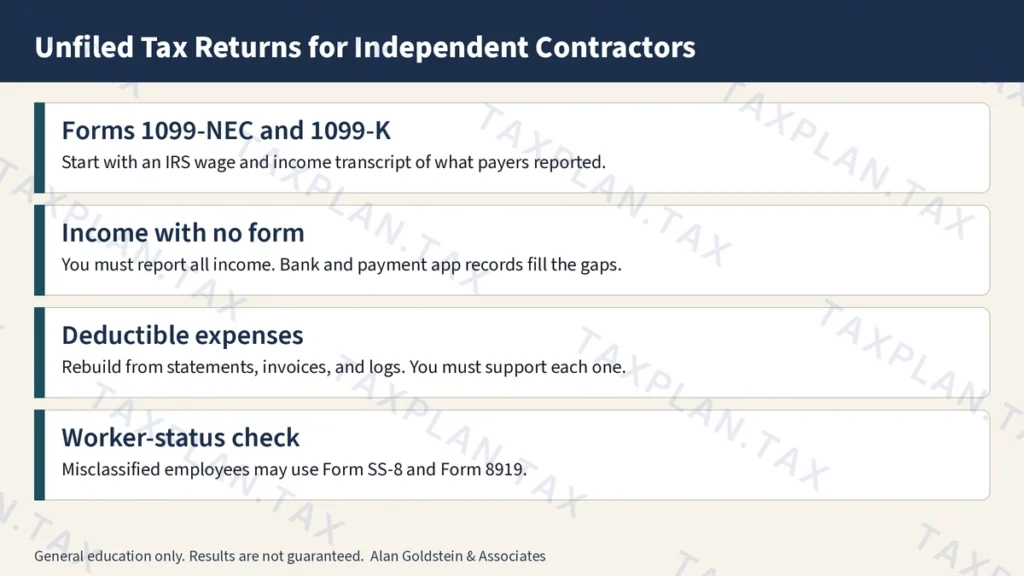


Unfiled tax returns for independent contractors usually start with one problem: rebuilding income that came from many payers. Freelancers may receive Forms 1099-NEC, 1099-K, or no form at all. Yet the IRS says you must report all of that income. This article focuses on how contractors and freelancers can rebuild income and expenses, check worker status, and file accurate past-due returns.
Key Takeaways
- You must report all freelance income, even if a payer sent no Form 1099.
- An IRS wage and income transcript shows only what payers reported, so it may be incomplete.
- Bank, card, and payment app records often reveal income the IRS forms missed.
- If you were really an employee, Form SS-8 and Form 8919 may apply.
- Contractors generally owe self-employment tax and may need quarterly estimated payments going forward.
What makes unfiled tax returns for independent contractors different?
Contractors have no employer withholding and often many payers. As a result, you must piece together both the income and the tax payments from several sources.
An independent contractor is a person who provides services to others but is not their employee. Freelancers and gig workers usually fall into this group. Under the general rule, you are an independent contractor if the payer has the right to control or direct only the result of the work, not what will be done and how (IRS: Independent contractor defined). The IRS weighs all the facts in each case (IRS: Independent contractor or employee).
Contractors generally report income and expenses on Schedule C and figure self-employment tax on Schedule SE. The IRS says you must file if your net earnings from self-employment were $400 or more (IRS: Self-employed individuals tax center).
Do you have to report income that no Form 1099 shows?
Yes. The IRS says you must report income from gig work even if it was not reported on a Form 1099-K, 1099-MISC, 1099-NEC, W-2, or other statement (IRS: Gig economy tax center).
The rule covers income paid in any form, including cash, property, goods, or virtual currency. It also covers part-time, temporary, and side work. So a missing form does not mean the income is not taxable.
Which forms might a freelancer receive?
The two most common are Form 1099-NEC and Form 1099-K. A business that pays you for services may issue Form 1099-NEC. Payment card processors and payment apps or online marketplaces may issue Form 1099-K, which reports payments for goods or services.
Some payments may appear on both kinds of forms. For example, a client may report a payment on Form 1099-NEC that you also received through a card processor. Reconcile the forms to your deposits so you do not report the same dollar twice.
How do you rebuild income for past years?
Start with the IRS transcript, then compare it to your own deposit records. The gap between the two is where most errors hide.
- Get your transcript. First, request a wage and income transcript through IRS Get Transcript. It lists information returns that payers filed under your taxpayer number.
- Collect deposit records. Next, download bank, card, and payment app statements for each year. These often show income that no form reported.
- Match and label. Then match each deposit to a client, a form, or a non-income source, such as a transfer or a loan.
- Total by year. Finally, total gross receipts for each tax year based on your accounting method.
The transcript is a starting point, not a full answer. It shows only what payers reported. Therefore, relying on it alone may understate income, which can create later problems.
How do you rebuild business expenses?
Use any reliable records that show what you spent, when, and why. The IRS expects you to support each deduction you claim.
The IRS says the burden of proof is on you to substantiate entries, deductions, and statements on your return (IRS: Recordkeeping). Card and bank statements, vendor invoices, software subscriptions, and mileage logs can all help. For car, travel, and gift expenses, stricter rules apply, so review IRS Publication 463.
Expenses matter more than many freelancers expect. If you do not file, the IRS may prepare a substitute return. The IRS says such a return might not give you credit for deductions you may be entitled to receive (IRS: Filing past due tax returns). See our article on substitute for return risks for how to respond.
What if you were actually an employee, not a contractor?
Then your tax treatment may change. A worker’s status depends on the facts of the relationship, not on the label or the form the payer used.
The IRS looks at three categories of evidence: behavioral control, financial control, and the relationship of the parties (IRS Topic 762). If the status is unclear, a worker or firm can file Form SS-8 to ask the IRS for a determination.
If you were an employee but were treated as a contractor, Form 8919 may apply. The IRS says you use it to figure and report your share of uncollected Social Security and Medicare taxes on that pay. Because this choice changes the return, decide it before you file the past-due year.
How many past years should a freelancer file?
Many cases focus on the last six years, but the IRS can ask for more. Your notices and facts decide the final list.
Under Policy Statement 5-133, the IRS enforcement period for delinquent returns is generally not more than six years (IRM 4.12.1, Nonfiled Returns). However, the IRM says longer or shorter periods may be used, depending on the facts. Also, when no return exists, IRC §6501(c)(3) lets the IRS assess tax at any time. Our article on how far back the IRS requires unfiled tax returns explains the policy in more detail.
Why does filing matter for a freelancer’s Social Security record?
Because your return is what reports your self-employment earnings. The IRS warns that if you are self-employed and do not file, your self-employment income will not be reported to the Social Security Administration. You will not receive credits toward Social Security retirement or disability benefits (IRS: Filing past due tax returns). For freelancers with no other covered work, those credits can matter later.
What penalties and payments should freelancers expect?
Expect late-filing and late-payment penalties on any balance, plus interest. You may also owe an estimated tax penalty.
The failure-to-file penalty is 5% of the unpaid tax for each month or partial month a return is late, up to 25% (IRS: Failure to file penalty). For returns due after December 31, 2025, a return more than 60 days late has a minimum penalty of $525 or 100% of the unpaid tax, whichever is less. For October through December 2026, the IRS underpayment interest rate is 7% per year, compounded daily (IRS: Quarterly interest rates).
Going forward, quarterly payments help prevent a new balance. The IRS says individuals generally must make estimated payments if they expect to owe $1,000 or more when they file (IRS: Estimated taxes).
Can freelancers get help paying a past-due balance?
Often, yes. Once you file the required returns, the IRS may consider a payment plan or, in some cases, an offer in compromise. Our guide on installment agreements for unfiled returns explains the filing requirement.
Frequently Asked Questions
Do I have to report freelance income if I never got a 1099?
Yes. The IRS says you must report all income, even if no Form 1099 or other statement was issued.
Is the IRS wage and income transcript enough to file my return?
Usually not. It shows only information returns that payers filed. Your own bank and app records may show more income.
What if a client reported the wrong amount on my 1099?
Ask the payer for a corrected form. The IRS suggests contacting the payer for a corrected Form W-2 or 1099 and attaching it to your past-due return.
Can I deduct expenses on old returns?
Yes, if they are allowable and you can support them. Rebuild them from statements, invoices, and logs.
How do I know if I was misclassified?
The IRS weighs behavioral control, financial control, and the relationship of the parties. You can file Form SS-8 to request a determination.
Do freelancers pay Social Security tax?
Yes, through self-employment tax on Schedule SE. The IRS lists the rate as 15.3%, covering Social Security and Medicare.
Should I file all missing years at once?
Often that is efficient, but your notices and deadlines may set the order. IRS policy generally focuses on the last six years.
Conclusion
Unfiled tax returns for independent contractors often turn on records. The IRS transcript shows only part of the income, so deposit records must fill the gaps. Expenses need support, and you should check worker status before filing. With accurate returns in place, payment and penalty options may open up.
Alan Goldstein, MBA, IRS Enrolled Agent, of Alan Goldstein & Associates in Coral Gables, Florida, helps freelancers and contractors rebuild income and file past-due returns. We can also review payment and penalty relief options. Every case depends on its facts, and we cannot guarantee any outcome. To request a confidential review, visit our Tax Resolution Services page.
Sources and Authorities
- IRS: Independent contractor (self-employed) or employee?
- IRS: Independent contractor defined
- IRS: About Schedule C (Form 1040)
- IRS: About Schedule SE (Form 1040)
- IRS: Self-employed individuals tax center
- IRS: Gig economy tax center
- IRS: About Form 1099-NEC
- IRS: Understanding your Form 1099-K
- IRS: Get Transcript
- IRS: Recordkeeping
- IRS Publication 463, Travel, Gift, and Car Expenses
- IRS: Filing past due tax returns
- IRS Topic 762, Independent contractor vs. employee
- IRS: About Form SS-8
- IRS: About Form 8919
- IRM 4.12.1, Nonfiled Returns (Policy Statement 5-133)
- IRC §6501, Limitations on assessment and collection
- IRS: Failure to file penalty
- IRS: Quarterly interest rates
- IRS: Estimated taxes
This article is provided for general educational purposes and does not constitute individualized tax, legal, or accounting advice. Tax consequences depend on the taxpayer’s specific facts and applicable law.
