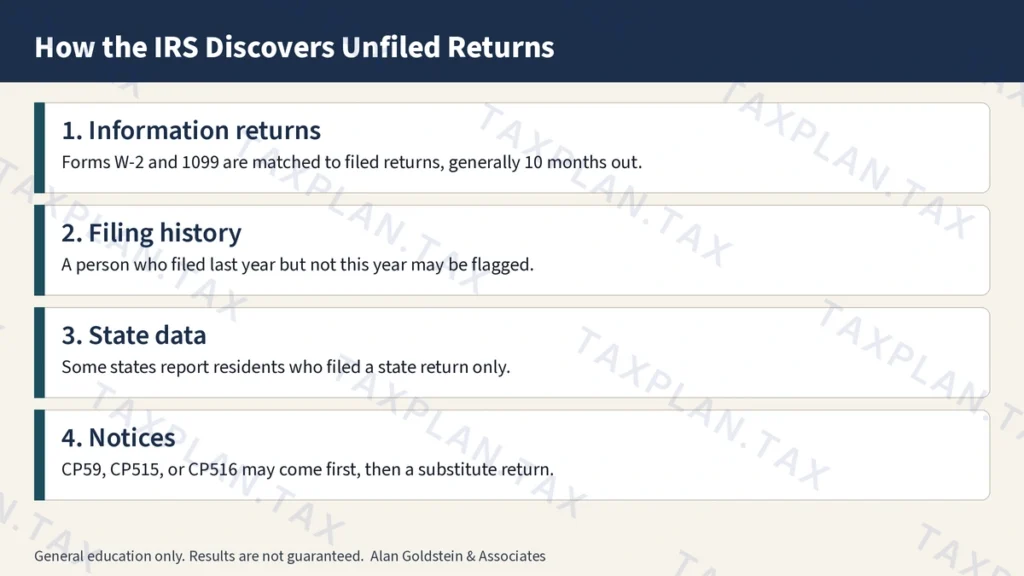


The IRS discovers unfiled tax returns mainly by matching third-party reports and filing history against the returns it receives. It also learns about missing returns from state data, related examinations, and tips. A missing return does not always trigger a notice right away. However, the IRS has several systems that can find it, and no time limit applies to an unfiled year. This guide explains each detection channel and what usually follows, as of late 2026.
Key Takeaways
- The IRS compares Forms W-2 and 1099 and other third-party reports to filed returns, and individual delinquency checks using these reports generally run about 10 months after the due date.
- The IRS also flags people who filed last year but not this year, and states may share data on residents who filed a state return only.
- Notices CP59, CP515, and CP516 tell you the IRS has no record of a return, and a substitute return may follow.
- If you file no return, the IRS may assess tax at any time, so a long gap does not end the risk.
- Filing the missing returns before enforcement starts usually gives you more control. We cannot guarantee any outcome.
How does the IRS discover unfiled tax returns?
It uses several channels. The main ones are information return matching, prior-year filing history, state data, related examinations, and tips.
The Internal Revenue Manual describes the Return Delinquency Program. Its goal is full compliance, including payment of the tax with the delinquent return. Delinquency checks run against the Master File shortly after the processing deadline to identify people who have not filed (IRM 5.1.11.2.1). The sections below explain each channel.
How do Forms W-2 and 1099 expose a missing return?
Payers send the IRS what they paid you, and the IRS looks for a matching return. If it finds income but no return, it may open a case.
According to the IRM, the individual case creation program identifies taxpayers for whom the IRS received third-party reports such as Form W-2 and Form 1099. The IRS generally runs these delinquency checks 10 months after the return due date (IRM 5.1.11.2.1). The IRS says your wage and income transcript shows data from information returns such as Forms W-2, 1098, 1099, and 5498. In other words, you can see much of what the IRS can see. For business returns, the IRM says the IRS runs delinquency checks 16 weeks after the due date, using sources that include payer data.
Does your prior filing history matter?
Yes. A break in your filing pattern is itself a signal.
The same IRM section says the case creation program identifies individuals who filed a return the previous year but failed to file a current return (IRM 5.1.11.2.1). So the IRS may flag a regular filer who stops filing, even if payers reported little income. That is why the IRS can notice a missing return without an information return.
Can state tax data reveal a missing federal return?
It can. Some states share data with the IRS.
The IRM describes the State Reverse File Matching Initiative. It provides data from participating state agencies on taxpayers who filed a state return but not a federal return. It also covers taxpayers who reported higher amounts on a state return than on the federal return (IRM 5.1.11.2.3.1.3). If you filed in your state but not with the IRS, that mismatch can surface.
How do examinations and referrals find unfiled returns?
The IRS sometimes finds a nonfiler while it works another case. Examiners also receive referrals from other IRS functions.
The IRM says examiners encounter nonfilers in several ways, including related-case or spin-off examinations, project cases, and referrals from other functions (IRM 4.12.1.2). For example, an audit of a business partner or client may reveal income paid to someone who filed no return.
Can tips and whistleblowers lead the IRS to a nonfiler?
They can. The IRS says it cannot detect all noncompliance by itself.
The IRS Whistleblower Office accepts claims from people with specific, timely, and credible information about noncompliance. It says awards generally run 15% to 30% of proceeds collected that are attributable to the whistleblower’s information (IRS: Whistleblower Office). Former partners, employees, and business associates are examples of people who may know about unreported income. Eligibility rules apply, and the IRS decides each claim.
What if no one reported your income?
You still must file, and other channels can still apply. Income paid in cash or by someone who filed no form is still taxable.
Self-employed people and cash earners may see fewer information returns, so matching works less well. However, the filing duty does not depend on a Form 1099. IRC §61(a) defines gross income as all income from whatever source derived. The prior-year check, state data, spin-off examinations, and tips can still reach you. Our guide to unfiled tax returns for the self-employed covers the added self-employment tax risk.
Also, the lack of a deadline matters. Under IRC §6501(c)(3), the IRS may assess tax at any time if you filed no return. In Badaracco v. Commissioner (1984), the Supreme Court noted that subsection (c)(3) covers a failure to file a return at all and allows assessment at any time (464 U.S. at 392). Time alone does not clear an unfiled year.
What happens after the IRS identifies a missing return?
You usually get a series of notices, and the IRS may prepare a substitute return if you do not respond. Enforcement then moves to assessment and collection.
- CP59. The IRS says it has no record that you filed your prior year return, and it asks you to file or explain why you do not need to (IRS: CP59).
- CP515 and CP516. These notices repeat that the IRS has no record of your returns. They ask you to file with Form 15103, or to explain why you do not have to file (IRS: CP516).
- Referral. Depending on the case, the IRM lists referral to the Automated Substitute for Return unit for individuals, or to examination or field collection.
- CP3219N. If the IRS prepares a substitute return, it sends this Notice of Deficiency. You have 90 days to petition the Tax Court, or 150 days outside the country (IRS: CP3219N).
Notices may also expand the scope. The IRM tells the investigator to look at all unresolved prior tax periods, meaning the past six, and later periods when a delinquent return case opens (IRM 5.1.11.2.2). Read what a substitute for return is and how to respond to one for details.
Can the IRS summon records or contact third parties?
Yes, within limits. The IRS can summon records to prepare a return when you filed none, but it must follow statutory steps.
IRC §7602(a) authorizes summonses for purposes that include preparing a return when none exists. In United States v. Powell (1964), the Supreme Court said the IRS must show a legitimate purpose, that the inquiry may be relevant, and that it does not already have the information. It must also show that it followed the required administrative steps (379 U.S. at 57–58). In addition, IRC §7602(c)(1) generally requires advance notice to the taxpayer, not later than 45 days before the start of a period in which the IRS intends to contact third parties.
How long before the IRS discovers unfiled tax returns?
No one can predict it. Timing depends on your income reporting, your filing history, and IRS resources.
The IRM says enforcement of filing requirements will normally be pursued for a six-year period. Managerial approval is needed to enforce more or fewer years (IRM 5.1.11.7.1). The IRM also lists factors such as the degree of flagrancy, history of noncompliance, and cost to the IRS. That policy is not a statute of limitations, so older years can still matter. For the background, see how far back the IRS requires unfiled tax returns.
What should you do if you think the IRS may already know?
Get your IRS records, file the missing returns, and respond to every notice. Acting before enforcement starts usually gives you more options.
- Review transcripts. Use Get Transcript to see what the IRS shows for each year.
- Do not ignore notices. The IRS says you cannot request an extension to file once you receive CP3219N.
- File the returns. See our guide to filing past-due federal tax returns.
- Review serious exposure first. The IRS operates a Criminal Investigation Voluntary Disclosure Practice for certain taxpayers with potential criminal exposure.
The IRS notes that if you repeatedly do not file, you could face additional penalties or criminal prosecution (IRS: Filing past due tax returns). A qualified professional can help you choose the right order of steps.
Frequently Asked Questions
Does the IRS automatically know when I don’t file?
Not always, but it has several detection systems. These include information return matching, filing-history checks, and state data.
Will the IRS notice if I had no W-2 or 1099?
It may. The IRS can still flag you through your filing history, state data, related examinations, or tips.
How soon after the due date does the IRS check?
The IRM says individual checks that use third-party reports are generally run 10 months after the return due date. Notices can follow later.
Can the IRS find a return I should have filed years ago?
Yes. If you filed no return, the IRS may assess tax at any time, and the IRM tells investigators to look at the past six periods.
Can the IRS contact my employer or bank?
Possibly, but the law generally requires advance notice to you before it contacts third parties. Summons authority also exists with limits.
What should I do if I receive a CP59?
Read it and respond by the date shown. File the return, or explain why you do not need to file, using the instructions on the notice.
Can someone report me for not filing?
Yes. The IRS has a Whistleblower Office, though eligibility rules apply and the IRS decides each claim.
Conclusion
The IRS has several ways to learn about missing returns, and the absence of a notice does not mean a year is closed. Understanding those channels helps you plan. Get your transcripts, file the missing returns, and respond to any notice promptly. Results depend on your facts, and no outcome is guaranteed.
Alan Goldstein, MBA, IRS Enrolled Agent, at Alan Goldstein & Associates in Coral Gables, Florida, can review your unfiled returns and your IRS resolution options in a confidential consultation. We do not guarantee any particular result.
Cases Cited
Each case below was checked against the page-numbered text of the official U.S. Reports opinion. Pinpoint pages were confirmed on the cited pages.
- Badaracco v. Commissioner, 464 U.S. 386, 392 (1984) (U.S. Supreme Court). Cited for the point that §6501(c)(3) covers a failure to file a return at all and allows assessment “at any time.” Opinion text (GovInfo).
- United States v. Powell, 379 U.S. 48, 57–58 (1964) (U.S. Supreme Court). Cited for the showing the IRS must make to enforce a summons: a legitimate purpose, relevance, information not already in its possession, and compliance with the administrative steps required by the Code. Opinion text (GovInfo).
Sources
- IRM 5.1.11, Delinquent Return Investigations (see 5.1.11.2.1, 5.1.11.2.2, 5.1.11.2.3.1.3, and 5.1.11.7.1)
- IRS: Transcript types for individuals and ways to order them
- IRM 4.12.1, Nonfiler Program (see 4.12.1.2, Source of Cases)
- IRS: Whistleblower Office
- IRC §61, Gross income defined
- IRC §6501, Limitations on assessment and collection
- IRS: Understanding your CP59 notice
- IRS: Understanding your CP515 notice
- IRS: Understanding your CP516 notice
- IRS: Understanding your CP3219N notice
- IRC §7602, Examination of books and witnesses
- IRS: Get Transcript
- IRS: Criminal Investigation Voluntary Disclosure Practice
- IRS: Filing past due tax returns
- Badaracco v. Commissioner, 464 U.S. 386, 392 (1984) (official U.S. Reports, GovInfo)
- United States v. Powell, 379 U.S. 48, 57–58 (1964) (official U.S. Reports, GovInfo)
This article is provided for general educational purposes and does not constitute individualized tax, legal, or accounting advice. Tax consequences depend on the taxpayer’s specific facts and applicable law.
