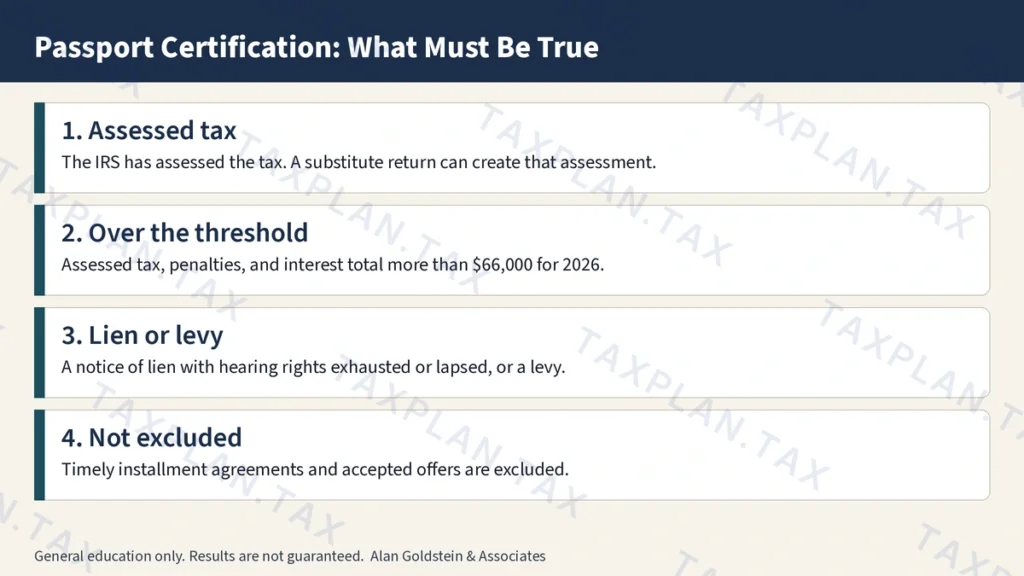


Unfiled tax returns do not, by themselves, lead to passport revocation, but they can set the process in motion. The State Department acts only after the IRS certifies a “seriously delinquent tax debt.” For 2026, that means an assessed, legally enforceable balance above $66,000, plus a filed lien or a levy. This guide explains how unfiled tax returns and passport revocation connect, and what you can do before a certification happens.
Key Takeaways
- Missing a filing deadline alone does not trigger passport action. The IRS must first assess the tax.
- A substitute for return (SFR) assessment can create a large balance, because it often ignores deductions and credits.
- The 2026 threshold is $66,000 in assessed tax, penalties, and interest. The IRS also needs a lien or levy.
- Certain debts do not count, including debts paid on time under an installment agreement.
- Filing accurate returns and arranging payment early may keep a debt from ever being certified.
Can unfiled tax returns cause passport revocation?
Not directly. Passport action depends on a seriously delinquent tax debt, and a debt exists only after the IRS assesses tax. An unfiled return alone is not an assessed debt.
However, the IRS can file a return for you. A substitute for return (SFR) is a return the IRS prepares under IRC §6020(b) when you do not file. If you ignore the follow-up notice, the IRS may assess the proposed tax. That assessment can then grow with penalties and interest into a certifiable debt. Our guide to the substitute for return process explains the steps in more detail.
Also, the Supreme Court has described an assessment as “little more than the calculation or recording of a tax liability,” and noted that the IRS can then use administrative collection tools (United States v. Galletti, 2004, 541 U.S. at 122).
What is a seriously delinquent tax debt?
It is an unpaid, legally enforceable federal tax debt that the IRS has assessed, that exceeds an inflation-adjusted threshold, and that is backed by a lien or levy. The threshold for 2026 is $66,000.
Under IRC §7345(b), three conditions must all be true. First, the liability has been assessed. Second, it exceeds the dollar threshold. Third, the IRS has either filed a notice of federal tax lien and your hearing rights have been exhausted or have lapsed, or it has made a levy under IRC §6331.
The IRS passport page counts assessed penalties and interest toward the threshold. It lists these thresholds: $59,000 for 2023, $62,000 for 2024, $64,000 for 2025, and $66,000 for 2026. The statute adjusts the amount for inflation each year.
How can unfiled returns lead to a certified debt?
The usual path runs from missing returns to an SFR assessment, then to a tax bill, then to a lien or levy. Each step has notice and response rights.
- Notices. The IRS sends reminders about missing returns. Later, it may send a CP3219N, which is a notice of deficiency (a 90-day letter).
- Assessment. If you do not file or petition the Tax Court within 90 days, the IRS may assess the proposed tax. According to the IRS notice page, persons outside the country have 150 days.
- Demand. Under IRC §6303, the IRS gives notice and demands payment within 60 days after assessment.
- Lien or levy. If the balance stays unpaid, the IRS can file a lien or levy. Our articles on liens and levies cover these steps.
Under IRC §6320, a lien notice also warns you about passport certification. It gives you the right to request a hearing within 30 days after a five-business-day period. The pre-levy notice required by IRC §6331(d) must describe passport certification too, and IRC §6330 gives you a hearing right before a levy.
Which debts and taxpayers are protected from certification?
Several categories fall outside the definition or get postponed. The most useful for people with old balances are timely installment agreements, accepted offers, and pending requests.
The statute excludes a debt paid in a timely manner under an installment agreement or an accepted offer in compromise. It also excludes a debt where collection is suspended because you requested a due process hearing, or because you made an innocent spouse election or request. In addition, the IRS passport page says it will not certify taxpayers in these situations:
- Accounts determined to be currently not collectible due to hardship
- Pending requests for an installment agreement or offer in compromise
- Identity theft victims
- Taxpayers in bankruptcy
- Taxpayers in a federally declared disaster area
- Accounts where an accepted adjustment fully satisfies the debt
For more on hardship status, see our guide to currently not collectible status with unfiled returns.
What happens after the IRS certifies the debt?
The IRS sends Notice CP508C, then the State Department may refuse a new passport or revoke an existing one. The IRS explains that the State Department holds sole authority over passports.
Under 22 U.S.C. §2714a(e), the Secretary of State may not issue a passport after receiving certification, except in emergency or humanitarian cases. The Secretary may also revoke a passport. Before revoking, the Secretary may limit it to return travel to the United States.
If you apply or renew, the IRS says the State Department sends a letter and holds your application open for 90 days. During that window, you can pay, enter a payment arrangement, or resolve an erroneous certification. The IRS may also ask the State Department to revoke a passport. Before doing so, it sends Letter 6152, which asks you to call. The CP508C page describes the notice and your options.
How do you get a certification reversed?
The IRS reverses a certification when the debt is fully paid, becomes legally unenforceable, is no longer seriously delinquent, or was certified in error. The IRS must notify the State Department within 30 days of resolving the debt.
A payment arrangement can also help. Under IRC §7345(c), the IRS must notify the State Department within 30 days after it enters an installment agreement or accepts an offer in compromise. However, the IRS page warns that it will not reverse certification when partial payments or collection statute expirations bring the debt below the threshold.
If you have travel within 45 days and an open passport application, you can ask for expedited reversal. The IRS says it can then generally shorten the process from 30 days to 9–16 days. You must provide proof of travel and the State Department’s denial letter. Our guide to an installment agreement for unfiled returns explains the filing requirements for a plan.
Can you challenge a certification in court?
Yes. Under IRC §7345(e), you may sue the United States in a district court or the Commissioner in the Tax Court. The court decides whether the certification was erroneous or the IRS failed to reverse it.
The remedy is limited. If the court finds an error, it may order the IRS to notify the State Department. According to the IRS, the law does not let the court release a lien or levy, or award money damages, in that suit. Also, you need not file an administrative claim first.
Separately, the Supreme Court has recognized the right to travel as part of the “liberty” protected by the Fifth Amendment (Kent v. Dulles, 1958, 357 U.S. at 125). That case did not involve tax debts and did not decide whether §7345 is valid. Therefore, do not assume a constitutional argument will stop certification.
What steps lower your passport risk if you have unfiled returns?
File the missing returns, replace any SFR figures with accurate ones, and arrange payment. These steps can shrink the balance and keep a debt below the threshold or outside the definition.
- Get your records. Request wage and income transcripts for each missing year.
- File accurate returns. The IRS states that filing your own return lets you claim deductions and credits a substitute return may skip. See our past-due returns guide.
- Respond to every deadline. According to the IRS past-due returns page, you cannot request an extension of a CP3219N deadline.
- Pay or arrange payment. Pay in full if you can. Otherwise, ask for an installment plan or review other options.
- Use refunds wisely. The IRS says it applies a current-year refund to a certified debt.
Importantly, a payment plan helps only if you keep it current and file all required returns. The IRS says you must file all required returns on time to avoid default.
Frequently Asked Questions
Do I lose my passport if I have not filed taxes?
Not automatically. The IRS certifies only seriously delinquent tax debt, which requires an assessment above the threshold and a lien or levy. Unfiled returns can still lead to that point through an SFR assessment.
What is the passport tax debt threshold in 2026?
The threshold is $66,000, according to the IRS. It includes assessed tax, penalties, and interest.
Will the IRS warn me before certifying my debt?
The IRS says it sends Notice CP508C when it certifies. Earlier notices, such as lien and levy hearing notices, also describe passport certification. In addition, the IRS says it sends Letter 6152 before asking the State Department to revoke a passport.
Can I still travel while my application is open?
That depends on the State Department. It may issue a limited-validity passport for return travel if you are overseas. For new applications, it generally will not issue a passport after certification.
Does an installment agreement stop certification?
A timely installment agreement removes the debt from the definition while you keep paying. A pending request also blocks certification, according to the IRS. Default can change that result.
How long does reversal take?
The IRS says the standard time is 30 days. For travel within 45 days, it can generally take 9–16 days when you provide the required documents.
Does filing the missing returns remove the passport risk?
Filing alone does not remove an existing certification. However, an accurate return can replace an SFR liability and may lower the balance. You still need to resolve the remaining debt.
Can I fight the underlying tax amount?
You may have options, such as a Tax Court petition after a CP3219N or a due process hearing. Deadlines are strict, so act quickly.
Conclusion
Unfiled tax returns and passport revocation are linked through assessment, not through the missed deadline itself. A substitute return, a balance above $66,000, and a lien or levy can lead to certification. Filing accurate returns and arranging payment early gives you more control.
Alan Goldstein, MBA, IRS Enrolled Agent, of Alan Goldstein & Associates in Coral Gables, Florida, helps taxpayers review unfiled returns and IRS collection options. We can evaluate your notices, transcripts, and payment choices. We cannot guarantee any outcome. To request a confidential review, visit our Tax Resolution Services page.
Cases Cited
- United States v. Galletti, 541 U.S. 114, 122 (2004) (assessment is the calculation or recording of a tax liability; verified against the official U.S. Reports opinion)
- Kent v. Dulles, 357 U.S. 116, 125 (1958) (right to travel is part of the “liberty” protected by the Fifth Amendment; verified against the official U.S. Reports opinion)
Sources
- IRS: Revocation or denial of passport in cases of certain unpaid taxes
- IRS: Understanding your CP508C notice
- IRS: Understanding your CP3219N notice
- 26 U.S.C. §7345, Revocation or denial of passport in case of certain tax delinquencies
- 22 U.S.C. §2714a, Revocation or denial of passport in case of certain unpaid taxes
- 26 U.S.C. §6020, Returns prepared for or executed by Secretary
- 26 U.S.C. §6303, Notice and demand for tax
- 26 U.S.C. §6320, Notice and opportunity for hearing upon filing of notice of lien
- 26 U.S.C. §6331, Levy and distraint
- 26 U.S.C. §6330, Notice and opportunity for hearing before levy
- IRS: Filing past due tax returns
- United States v. Galletti, 541 U.S. 114, 122 (2004) (official U.S. Reports, Library of Congress)
- Kent v. Dulles, 357 U.S. 116, 125 (1958) (official U.S. Reports, Library of Congress)
This article is provided for general educational purposes and does not constitute individualized tax, legal, or accounting advice. Tax consequences depend on the taxpayer’s specific facts and applicable law.
