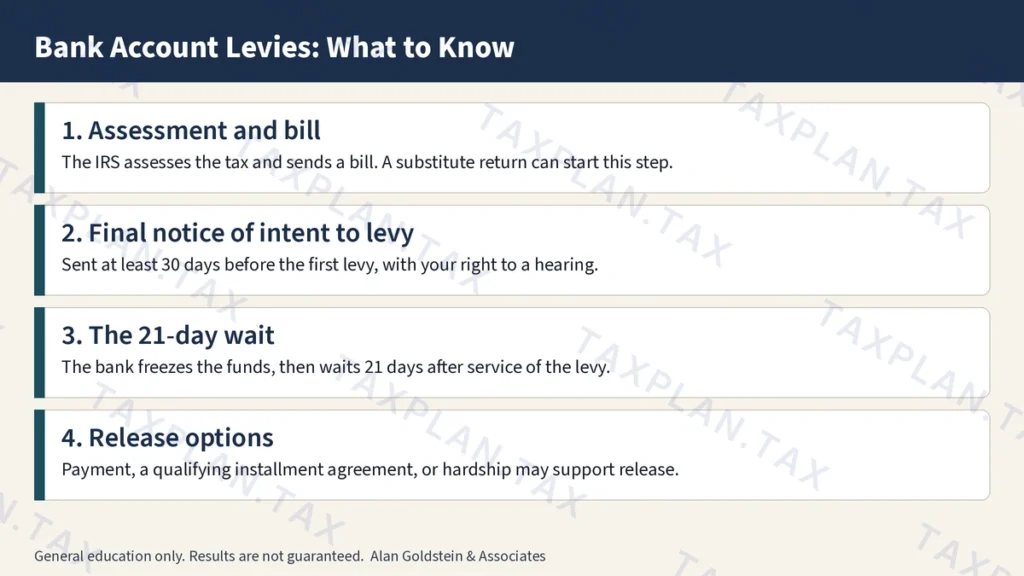


Unfiled federal tax returns can lead to bank account levies, but only after the IRS assesses tax and sends several notices. A bank account levy freezes money in your account and, after a waiting period, sends it to the IRS. This guide explains how bank account levies connect to unfiled returns, what notices come first, and how to respond.
Key Takeaways
- The IRS does not levy a bank account because a return is missing. It levies after it assesses tax and you neglect to pay.
- A substitute for return (SFR) assessment can start that process, often with a larger balance than a filed return would show.
- The IRS must send a Final Notice of Intent to Levy at least 30 days before the first levy. That notice gives hearing rights.
- A bank must wait 21 days after service before it sends your money to the IRS.
- Filing accurate returns and contacting the IRS during that window may open options such as release or a payment plan.
How do unfiled returns lead to bank account levies?
They usually do it through an SFR assessment. The IRS prepares a return for you, assesses the tax, demands payment, and then may levy if the balance stays unpaid.
A levy is a legal seizure of property to satisfy a tax debt. A substitute for return (SFR) is a return the IRS prepares for you under IRC §6020(b) when you do not file. According to the IRS past-due returns page, the return it prepares leads to a tax bill. If you do not pay that bill, the IRS can start collection, including a levy on your wages or bank account.
The Supreme Court has said that a tax “assessment” is “little more than the calculation or recording of a tax liability.” After that recording, the IRS can use administrative collection methods (United States v. Galletti, 2004, 541 U.S. at 122). Our guide to substitute return risks explains how those assessments arise.
What must the IRS do before it levies a bank account?
The IRS usually must assess the tax, send a bill, wait for you to neglect or refuse payment, and send a Final Notice of Intent to Levy. It must give that final notice at least 30 days before the levy.
The IRS lists four requirements on its levy page:
- The IRS assessed the tax and sent a Notice and Demand for Payment.
- You neglected or refused to pay.
- The IRS sent a Final Notice of Intent to Levy and Notice of Your Right to a Hearing at least 30 days before the levy.
- The IRS sent advance notice of third-party contact.
Under IRC §6331(d), the notice may be given in person, left at your home or business, or sent by certified or registered mail. The IRS describes CP504 as a Notice of Intent to Levy under that section in its CP504 notice guide. Letter 1058 and LT11 serve a related purpose, as the IRS LT11 page explains.
Why is the 30-day hearing window so important?
It is your main chance to pause the levy and raise issues. Under IRC §6330, you may request a collection due process (CDP) hearing during the 30-day period stated in the notice.
If you request a timely hearing, the levy actions covered by the hearing and the collection statute of limitations are suspended while the hearing and appeals are pending, under IRC §6330(e). At the hearing, you may raise collection alternatives such as an installment agreement or an offer in compromise. You may also raise spousal defenses.
In addition, you may challenge the underlying tax in limited cases. IRC §6330(c)(2)(B) allows that challenge if you did not receive a notice of deficiency or otherwise have a chance to dispute the liability. This can matter after an SFR. Therefore, review whether you ever received the CP3219N. Use Form 12153 to request the hearing, as the IRS form explains.
How does a bank levy work after the IRS serves it?
The bank freezes the funds in your account when it receives the levy. It then waits 21 days before sending them to the IRS.
The IRS says the 21-day period lets you contact the IRS, arrange payment, or report errors. According to the IRS bank levy page, funds in the account are frozen as of the date and time the bank receives the levy. Normally, the levy does not affect funds you add after that date. The statutory rule appears in IRC §6332(c).
Courts have long treated a bank account as levy-reachable property. In United States v. National Bank of Commerce, the Supreme Court described a bank account as property “subject to levy” under §§6331 and 6332. It also noted that administrative levy is quick and relatively inexpensive (472 U.S. at 721, 1985).
How can you stop or release a bank account levy?
Contact the IRS right away. The IRS says it must release a levy in several situations, including full payment, a qualifying installment agreement, or economic hardship.
The IRS levy-release page says the IRS is required to release a levy if it determines that:
- You paid the amount you owe.
- The collection period ended before the levy was issued.
- Releasing the levy will help you pay your taxes.
- You enter an installment agreement that does not allow the levy to continue.
- The levy creates an economic hardship.
- The property is worth more than the debt, and release will not hinder collection.
See the IRS page on how to get a levy released and IRC §6343(a). However, the IRS also states that a release does not erase the debt. It may reissue a levy if you do not resolve the balance. For a bank account, the IRS says a hardship levy “may be released,” not “must be released,” so documentation matters.
What if the levy hit the wrong account or the wrong person?
You can ask for return of property that was wrongfully levied. You may also ask the IRS to reimburse bank fees that an IRS error caused.
Under IRC §6343(b), the IRS may return money it levied, and it may do so at any time before two years from the levy date. The IRS also explains that you may claim bank charges caused by an erroneous levy on Form 8546. It lists conditions. The IRS must have caused the error, and you must not have compounded it. You must also have responded timely to earlier contacts.
If the account belongs to someone else, for example an elderly parent who added you as a signer, the IRS says the account owner or a power of attorney should call the number on Form 668-A. The IRS may ask for proof of who owns the funds. IRC §6334 also lists categories of property that are exempt from levy.
What should you do if you have unfiled returns and a levy notice?
Act before the 30-day window closes. File accurate returns, review the SFR, and contact the IRS about payment options or a hearing.
- Read the deadline. Find the date on the Final Notice and calendar the 30 days.
- Get transcripts. Pull wage and income data for each missing year.
- File the returns. The IRS says filing your own return may let you claim deductions and credits. Review our guide to filing past-due returns.
- Request a hearing if needed. A timely request can pause levy action.
- Ask about a payment plan. The IRS says you generally must be current on filings. See our article on an installment agreement for unfiled returns.
Also, our overview of unfiled returns and IRS levies covers all levy types. This article focuses on bank accounts.
Frequently Asked Questions
Can the IRS take money from my bank account without a court order?
Yes, after it follows the levy procedures. The IRS uses an administrative levy, which does not require a court order. It must first meet the notice requirements.
Will the bank send my money to the IRS right away?
No. A bank must wait 21 days after service of the levy before it surrenders deposits. The IRS says the funds are frozen during that time.
Does a bank levy take money I deposit later?
Normally not. The IRS says the levy generally does not reach funds you add after the date of the levy. The IRS may serve another levy later.
Can I stop a bank levy if I file my missing returns?
Filing alone may not stop it. However, filing can support a release request, a payment plan, or a hearing. Contact the IRS promptly.
Does an installment agreement end a levy?
The IRS must release a levy if you enter an installment agreement that does not allow the levy to continue. Terms vary, so confirm the release in writing.
What if I never received a notice?
Tell the IRS and keep records. IRS notices go to your last known address, so an address change can matter. You may have hearing or appeal options.
Can I get bank fees back after a mistaken levy?
You may file Form 8546 if the IRS caused the error and you meet the other conditions. The IRS does not guarantee reimbursement.
Is my business account at risk too?
The IRS can levy property belonging to a taxpayer, which may include business accounts. The taxpayer’s legal structure matters. Seek advice on your facts.
Conclusion
Unfiled federal tax returns and bank account levies connect through assessment, not through the missing return alone. An SFR can create a balance, and unpaid balances can lead to a levy after notice. Responding during the 30-day and 21-day windows gives you more options.
Alan Goldstein, MBA, IRS Enrolled Agent, of Alan Goldstein & Associates in Coral Gables, Florida, helps taxpayers review unfiled returns, levy notices, and resolution options. We cannot guarantee any outcome. To request a confidential review, visit our Tax Resolution Services page.
Cases Cited
- United States v. Galletti, 541 U.S. 114, 122 (2004) (assessment is the calculation or recording of a tax liability; verified against the official U.S. Reports opinion)
- United States v. National Bank of Commerce, 472 U.S. 713, 721 (1985) (bank account is property subject to levy under §§6331 and 6332; administrative levy is quick and relatively inexpensive; verified against the official U.S. Reports opinion)
Sources
- IRS: Information about bank levies
- IRS: What is a levy?
- IRS: How do I get a levy released?
- IRS: What if a levy is causing a hardship?
- IRS: Understanding your CP504 notice
- IRS: Understanding your LT11 notice or Letter 1058
- IRS: Filing past due tax returns
- IRS Form 12153, Request for a Collection Due Process or Equivalent Hearing
- IRS Form 8546, Claim for Reimbursement of Bank Charges
- 26 U.S.C. §6020, Returns prepared for or executed by Secretary
- 26 U.S.C. §6330, Notice and opportunity for hearing before levy
- 26 U.S.C. §6331, Levy and distraint
- 26 U.S.C. §6332, Surrender of property subject to levy
- 26 U.S.C. §6334, Property exempt from levy
- 26 U.S.C. §6343, Authority to release levy and return property
- United States v. Galletti, 541 U.S. 114, 122 (2004) (official U.S. Reports, Library of Congress)
- United States v. National Bank of Commerce, 472 U.S. 713, 721 (1985) (official U.S. Reports, Library of Congress)
This article is provided for general educational purposes and does not constitute individualized tax, legal, or accounting advice. Tax consequences depend on the taxpayer’s specific facts and applicable law.
