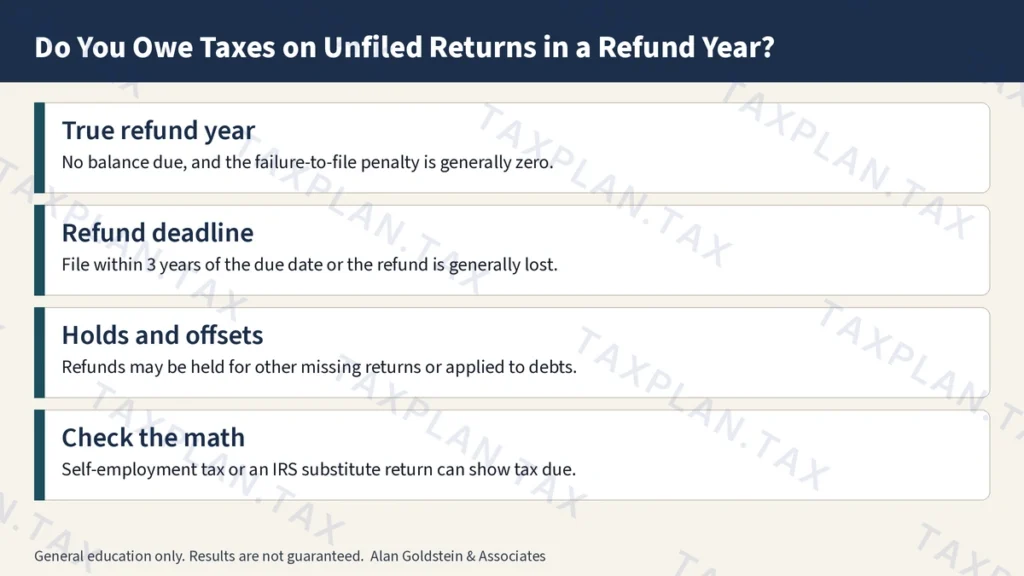


Do you owe taxes on unfiled returns if you are due a refund? Generally, you owe no tax for a year in which you truly overpaid. The failure-to-file penalty is also generally zero, because the IRS figures it on unpaid tax. However, that is not the whole story. You may still have a duty to file, and you can lose the refund after 3 years. In addition, the IRS may hold the refund or apply it to other debts. Many people who expect a refund also turn out to owe. This article explains when you may owe taxes on unfiled returns and when you do not.
Key Takeaways
- If your payments and refundable credits exceed your tax, you generally owe nothing for that year.
- The IRS figures the failure-to-file penalty on unpaid tax, so it is generally zero in a true refund year.
- You may still have a legal filing requirement based on your income and status.
- You generally lose refunds of withholding and estimated tax if you do not file within 3 years of the due date.
- The IRS may hold refunds when other returns are missing, and it may offset refunds against debts.
- Self-employment income or an IRS substitute return can turn an expected refund into a balance due.
Do you owe taxes on unfiled returns if you are due a refund?
Not for that year, if you truly overpaid. A refund means your withholding, estimated payments, and refundable credits are more than the tax you owe. In that case, there is no unpaid tax for the year.
Still, the question has two traps. First, you may owe for other years, and the IRS can apply the refund to those balances. Second, you may not actually be due a refund. We cover both issues below.
What is an overpayment?
An overpayment is the amount you paid, or the law treats you as paying, above your correct tax. IRC §6402(a) lets the IRS credit an overpayment against other tax liabilities, within the applicable limitations period, and refund any balance to you.
For a late return, the return itself is the refund claim. The Treasury regulation says a properly executed original income tax return is a claim for refund for the overpayment it shows (Treas. Reg. §301.6402-3(a)(5)).
Is there a failure-to-file penalty when you are due a refund?
Generally, no. The penalty is a percentage of unpaid tax. If nothing is unpaid, the penalty is generally zero.
The IRS explains the formula (IRS: Failure to file penalty). It starts with the tax the return should show. Then it subtracts tax paid on time, such as withholding and estimated payments, and available refundable credits. Finally, it multiplies the result by 5% per month, up to 25%.
The minimum penalty follows the same logic. For returns more than 60 days late, the minimum is the listed dollar amount or 100% of the underpayment, whichever is less. For returns due after December 31, 2025, the listed amount is $525. So if the underpayment is zero, the minimum is generally zero too. The statute is IRC §6651.
What about the failure-to-pay penalty and interest?
They also depend on unpaid tax. Because a true refund year has no unpaid tax, these charges generally do not apply to that year. For a side-by-side comparison of the two penalties, see our article on the failure-to-file vs failure-to-pay penalty.
Do you still have to file if you are due a refund?
Often, yes. Whether you must file depends on your gross income, filing status, age, and other factors, not on whether you get a refund.
The filing requirement comes from IRC §6012. The IRS offers an online tool to check your situation: Do I need to file a tax return? If you had a filing requirement, the return was due even if it shows a refund.
On the other hand, if your income was below the threshold, you may have had no duty to file. Even so, you must file a return to receive any refund of withholding or refundable credits.
What can you lose by not filing a refund return?
You can lose the refund itself. In addition, you may lose refundable credits, interest, and, if you are self-employed, Social Security credits.
When does the refund expire?
The IRS says you must file within 3 years of the return due date to claim a refund of withholding or estimated taxes. The same rule applies to credits such as the Earned Income Credit (IRS: Filing past due tax returns).
For example, the IRS announced that about $1.2 billion in 2022 refunds remained unclaimed, with an April 15, 2026 deadline. It estimated the median refund at $686 and said unclaimed refunds become the property of the U.S. Treasury after three years (IRS: IR-2026-37). Our companion piece on the statute of limitations on unfiled federal tax returns explains the refund statute in more depth.
Do you lose interest on a late refund?
Partly. Under IRC §6611(b)(3), when a return is filed after its due date, no interest is paid for any day before the return is filed. So waiting does not earn you interest on the refund.
What about Social Security credits?
If you are self-employed and do not file, the IRS says your self-employment income will not be reported to the Social Security Administration. As a result, you may not receive credits toward retirement or disability benefits (IRS).
Can the IRS keep or reduce your refund?
Yes. The IRS may hold a refund when other returns are past due. It may also apply the refund to tax you owe or to certain non-tax debts.
Why would the IRS hold your refund?
The IRS says it holds income tax refunds when its records show one or more returns are past due. It holds them until it gets the past-due return or an acceptable reason for not filing (IRS). The IRS manual describes a Delinquent Return Refund Hold program that delays a refund up to six months while the IRS investigates (IRM 5.1.11).
The 2022 refund release made the same point. It warned that 2022 refunds may be held if the taxpayer has not filed 2023 and 2024 returns.
What debts can reduce your refund?
First, the IRS may apply your refund to federal tax you owe for other years. Second, the Bureau of the Fiscal Service may offset refunds for past-due child support, federal agency non-tax debts, state income tax obligations, and certain state unemployment compensation debts (IRS: Reduced refund).
Are you sure you are due a refund?
Not always. Many people assume a refund because tax was withheld from a paycheck. However, other income, self-employment tax, or an IRS substitute return can change the result.
What can turn a refund into a balance due?
Common causes include:
- Self-employment income. Form 1099 income usually has no withholding, and self-employment tax may apply.
- Several jobs or under-withholding. Withholding at each job may not cover the combined tax.
- Investment or retirement income. Gains, distributions, and other income may carry tax not covered by withholding.
- Lost credits. You may not qualify for a credit you expected.
If any of these apply, prepare the return before assuming anything. A year with a balance due carries penalties and interest.
What if the IRS prepared a substitute return?
Then the IRS may show tax due, even if your own return would show a refund. A substitute for return (SFR) is a return the IRS prepares under IRC §6020(b) from information it already has. The IRS warns it might not give you credit for deductions and exemptions you may be entitled to receive.
In that case, the IRS says it is in your best interest to file your own return. It will generally adjust your account to reflect the correct figures. See our article on what a substitute for return is.
What if the refund deadline has already passed?
You generally cannot receive that refund or have it credited to another year. Still, filing the return may matter for other reasons.
Under IRC §6511, a refund is limited to tax paid within a look-back period. In addition, IRC §6402(a) allows credits against other liabilities only within the applicable limitations period. Therefore, an expired overpayment generally cannot offset a balance from another year.
Even so, the IRS may still ask for that return. Filing can also replace an SFR balance or confirm that no tax is due. For practical next steps, see can you still file federal taxes after years of not filing.
Frequently Asked Questions
Will I be penalized for filing a refund return late?
Generally, no failure-to-file penalty applies when there is no unpaid tax. The IRS figures that penalty on tax due after on-time payments and refundable credits.
Is it illegal not to file if I am due a refund?
If you had a filing requirement, the return was legally due. In practice, the larger risk in a true refund year is losing the refund after 3 years.
How long do I have to claim my refund?
Generally, 3 years from the return due date for withholding and estimated tax. Some exceptions, such as certain disaster extensions, may give more time.
Can the IRS take my refund to pay other debts?
Yes. The IRS can apply it to other federal tax balances. Also, the Treasury Offset Program may take it for child support, certain federal debts, and some state debts.
Why is my refund being held?
One common reason is a missing return for another year. The IRS says it holds refunds until it gets the past-due return or an acceptable explanation.
Do I earn interest if I file a refund return late?
Not for the time before you file. IRC §6611(b)(3) bars interest for days before a late return is filed.
What if I am not sure whether I owe or am due a refund?
Get your wage and income transcript through Get Transcript and prepare the return. The result depends on all your income, payments, and credits.
Conclusion
If you truly overpaid, you generally do not owe taxes on unfiled returns for that year, and the failure-to-file penalty is generally zero. Nevertheless, the refund is not safe forever. It generally expires after 3 years, it may be held while other returns are missing, and it may be applied to other debts. In addition, many expected refunds turn into balances once all income is counted.
Alan Goldstein, MBA, IRS Enrolled Agent, of Alan Goldstein & Associates in Coral Gables, Florida, can review your unfiled years, identify refund deadlines, and prepare the returns that matter most. We also help with any balances that surface. Results depend on your facts, and we cannot guarantee a refund or any IRS outcome. To request a confidential review, visit our Tax Resolution Services page.
Sources and Authorities
- IRC §6402, Authority to make credits or refunds
- Treas. Reg. §301.6402-3, Special rules applicable to income tax
- IRS: Failure to file penalty
- IRC §6651, Failure to file or pay
- IRC §6012, Persons required to make returns of income
- IRS Interactive Tax Assistant: Do I need to file a tax return?
- IRS: Filing past due tax returns
- IRS: IR-2026-37, Unclaimed refunds for tax year 2022
- IRC §6611, Interest on overpayments
- IRM 5.1.11, Delinquent Return Investigations
- IRS: Reduced refund
- IRC §6020, Returns prepared by the Secretary
- IRC §6511, Limitations on credit or refund
- IRS: Get Transcript
This article is provided for general educational purposes and does not constitute individualized tax, legal, or accounting advice. Tax consequences depend on the taxpayer’s specific facts and applicable law.
