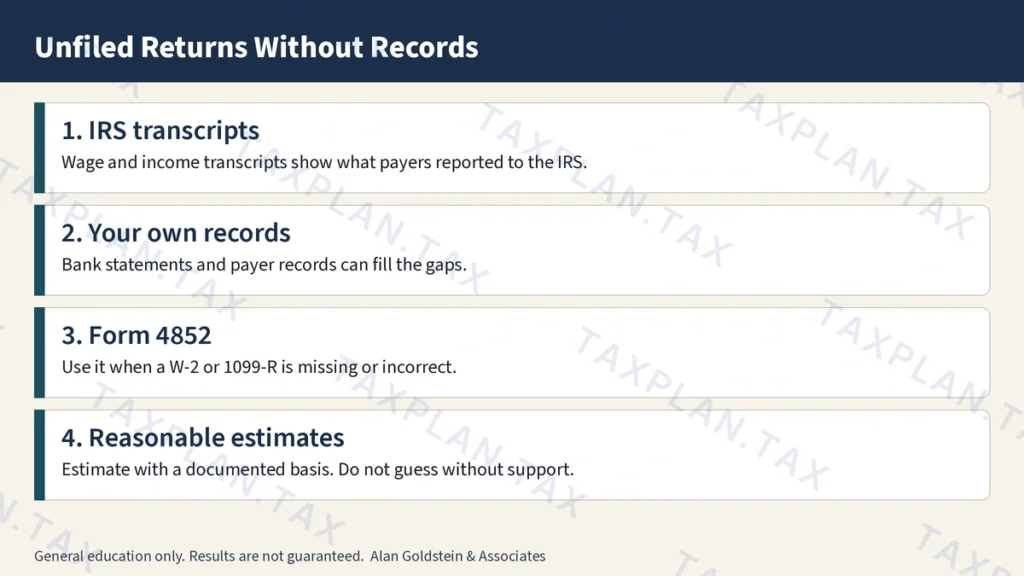


You can prepare unfiled federal tax returns without records by rebuilding your numbers from IRS data, third-party sources, and honest, documented estimates. Lost or missing records do not cancel the duty to file. The IRS holds the information returns it received, and banks and payers hold copies of what they paid you. This guide explains where to start, what you may estimate, what you cannot, and how to document your work as of late 2026.
Key Takeaways
- Missing records do not excuse you from filing, and the IRS may prepare a substitute return that allows no deductions if you do nothing.
- Start with IRS wage and income transcripts, which show many Forms W-2 and 1099 for the current and nine prior tax years.
- Courts may allow a reasonable estimate of an expense, but only if the record shows you actually incurred it.
- Travel, gift, and listed-property expenses need stricter proof under IRC §274(d).
- Write down how you built each estimate, and file the most accurate return you can. No outcome is guaranteed.
Can you file unfiled federal tax returns without records?
Yes. You must file even when records are gone, and you can build a return from IRS data, third-party records, and reasonable estimates.
The IRS tells taxpayers to file all returns that are due, whether or not they can pay in full (IRS: Filing past due tax returns). Missing records can also matter for penalty relief. The IRS lists “inability to get records” among examples that may support reasonable cause. However, you still must show ordinary care and prudence (IRS: Penalty relief for reasonable cause). So make a documented effort to find what you can before you estimate.
Why not wait until you find the records?
Waiting usually costs more. Penalties and interest grow, and the IRS may file a return for you in the meantime.
When you do not file, the IRS may prepare a substitute for return (SFR) under IRC §6020(b). The Internal Revenue Manual says the IRS has no legal requirement to allow business expense deductions on an SFR (IRM 4.12.1.25.2). It also says deductions and credits will not be allowed on an SFR (IRM 4.12.1.25.4). In addition, the IRS holds refunds while returns are past due. If no return is filed, the IRS may also assess tax at any time under IRC §6501(c)(3). For background, read what a substitute for return is.
What does the law expect you to keep and prove?
You must keep records that support your return, and you carry the burden of proving your deductions. That duty explains why missing records make filing harder but not optional.
IRC §6001 requires every person liable for tax to keep records and make returns. The IRS calls the responsibility to substantiate your entries the burden of proof (IRS: Recordkeeping). The IRS also says to keep records indefinitely if you do not file a return (IRS: How long should I keep records?). That is why even partial records are worth saving once you find them.
Where can you get income information first?
Start with IRS transcripts. They show many of the income documents that payers reported to the IRS for each year.
The IRS says the wage and income transcript shows data from information returns such as Forms W-2, 1098, 1099, and 5498. It is available for the current and nine prior tax years. However, it shows only documents filed with the IRS, and it is limited to about 85 income documents online. Older years, and larger transcripts, need Form 4506-T.
You can order transcripts through Get Transcript. A tax professional can also request them for you after you sign Form 8821, which authorizes someone to receive your confidential tax information for the years listed. Account transcripts matter too, because they show whether the IRS already assessed tax for a year.
What if a Form W-2 or 1099 is missing?
Ask the employer or payer first. If that fails, you may estimate your wages and withholding on Form 4852.
The IRS explains the process in Tax Topic 154. It says you may use Form 4852 to complete your return if you do not receive the form in time. You estimate your wages and the taxes withheld. If the real form arrives later and differs from your estimate, you file Form 1040-X to amend. Use your final pay stubs, bank deposits, or your transcript as the basis for the estimate.
What third-party sources can replace lost records?
Banks, payers, and platforms keep records for you. Many will give you copies of old statements and payment histories on request.
These sources are practical starting points, not an IRS checklist:
- Bank and card statements. Ask each institution for statements for the missing years. Retention periods vary, so ask early.
- Payers and clients. Request year-end summaries, invoices, or payment histories from anyone who paid you.
- Employers. Payroll departments can often reissue pay statements and Forms W-2.
- Payment platforms and marketplaces. Online accounts usually keep a transaction history you can download.
- Property and loan documents. Mortgage servicers, landlords, and title companies keep closing statements, interest, and rent records.
- Your Social Security earnings record. Your online Social Security account shows your earnings history and lets you verify reported earnings.
Keep a log of each request, with the date and the response. That log shows ordinary care if you later ask for penalty relief. Our guide on unfiled tax returns for independent contractors covers income sources for freelancers in more detail.
Can you estimate expenses on unfiled returns?
Sometimes. Courts may allow a reasonable estimate of an expense, but only if the evidence shows you actually spent money for a business purpose.
In Cohan v. Commissioner (1930), the Second Circuit held that absolute certainty is usually impossible and not necessary. The court said the tribunal should make as close an approximation as it can, “bearing heavily” on the taxpayer whose inexactitude is of his own making (39 F.2d at 543–44). The court reasoned that there was “obviously some basis for computation” because the evidence showed Cohan had spent money.
The Fifth Circuit drew a clear limit in Williams v. United States (1957). It said a trier of fact is not compelled to estimate, and that “[u]ntil the trier has that assurance from the record, relief to the taxpayer would be unguided largesse” (245 F.2d at 560). In plain terms, you need some evidence that the expense happened. Bank entries, a lease, or a client’s statement can supply that evidence.
Which expenses cannot be estimated?
Travel, gifts, and listed property need stricter proof. IRC §274(d) bars the deduction unless you substantiate the amount, time and place, business purpose, and business relationship by adequate records or by sufficient evidence corroborating your own statement.
That means a rough guess about business mileage or travel will not work on its own. Calendars, emails, toll records, and phone location history may corroborate your statement. If you cannot prove an expense in this group, leave it off rather than invent it. Also remember that the standard deduction is available on your own return without proving individual itemized expenses.
How do you document an estimate?
Write a short method note for each year. It should say what you estimated, how you calculated it, and what evidence supports it.
- Source. Name the document or memory that anchors the figure, such as a transcript line or a bank deposit.
- Method. Show the math, such as monthly rent times months of occupancy.
- Support. List any evidence that corroborates the figure, even if it is partial.
- Consistency. Use the same method across years unless the facts changed.
Accuracy matters on both sides. You sign a return under penalties of perjury, and IRC §7206(1) reaches willfully false statements. The regulations also treat a failure to keep adequate books and records, or to substantiate items properly, as negligence for accuracy-related penalty purposes (Treas. Reg. §1.6662-3(b)(1)). So do not guess low to reduce tax, and do not guess high to increase deductions.
How do you file once you have rebuilt your numbers?
File each year with your best supported figures. Do not hold a return back waiting for perfect records.
The IRS says to file a past due return the same way and in the same place as an on-time return. If you received a notice, send the return to the address on the notice. You can amend later if better records surface, as Tax Topic 154 explains for late-arriving wage forms. Our guide to how to file past-due federal tax returns covers the filing steps, and filing multiple years covers the order of work.
What if the IRS disagrees with your numbers later?
The IRS may ask for support, and you can respond with your method notes and evidence. A well-documented estimate gives you something concrete to discuss.
If the IRS had already prepared an SFR, your filed return generally replaces that estimate. The IRS says it will generally adjust your account to reflect the correct figures. The IRM also lets examiners consider information about past business expenses when you explain credibly why substantiation is unavailable, for example after records were destroyed in a disaster (IRM 4.12.1.25.2). That is discretionary, so do not count on it.
Frequently Asked Questions
Can I file a return if I have no records at all?
Yes. Use IRS transcripts, third-party records, and documented estimates. File the most accurate return you can rather than waiting.
Will the IRS accept estimates?
The IRS may accept a return that shows reasonable, documented estimates, but it can ask for support. It does not promise to accept any figure, so keep your method notes.
What if my employer went out of business?
Check your IRS wage and income transcript first. If it lacks a Form W-2, the IRS process in Tax Topic 154 and Form 4852 may help you report estimated wages and withholding.
Can I deduct expenses I cannot document?
Some expenses may be estimated if the evidence shows you incurred them. Travel, gifts, and listed property need stricter substantiation, and a deduction may be denied without it.
Does the IRS use my past returns?
If you filed in earlier years, your own old returns are useful reference points. The IRM allows examiners to consider past business expenses only in limited situations, so do not rely on that.
How far back should I try to rebuild?
IRS policy normally enforces six years, but facts differ. Ask a qualified professional which years to prioritize.
Should I wait for the IRS to send a notice?
Usually not. Waiting can lead to a substitute return that allows no deductions, plus more interest and penalties.
Conclusion
Missing records make filing harder, but they rarely make it impossible. Pull your IRS transcripts, gather third-party records, estimate only what the evidence supports, and document your method. Results depend on your facts, and no outcome is guaranteed.
Alan Goldstein, MBA, IRS Enrolled Agent, at Alan Goldstein & Associates in Coral Gables, Florida, can help you rebuild income and expenses and review your IRS resolution options in a confidential consultation. We do not guarantee any particular result.
Cases Cited
Each case below was checked against the opinion text. Pinpoint pages were confirmed from the star-paginated reporter text on the linked page.
- Cohan v. Commissioner, 39 F.2d 540, 543–44 (2d Cir. 1930). Cited for the point that absolute certainty is usually impossible and not necessary, and that an approximation may be made where the evidence shows an expense was incurred. Opinion text (OpenJurist).
- Williams v. United States, 245 F.2d 559, 560 (5th Cir. 1957). Cited for the point that a trier of fact is not compelled to estimate, and that the record must give assurance that at least the estimated amount was spent. Opinion text (OpenJurist).
Sources
- IRS: Filing past due tax returns
- IRS: Penalty relief for reasonable cause
- IRM 4.12.1, Nonfiler Program (see 4.12.1.25.2 and 4.12.1.25.4, Substitute for Return)
- IRC §6020, Returns prepared for or executed by Secretary
- IRC §6501, Limitations on assessment and collection
- IRC §6001, Notice or regulations requiring records, statements, and special returns
- IRS: Recordkeeping
- IRS: How long should I keep records?
- IRS: Transcript types for individuals and ways to order them
- IRS: Get Transcript
- IRS: About Form 4506-T, Request for Transcript of Tax Return
- IRS: About Form 8821, Tax Information Authorization
- IRS: Tax Topic 154, Form W-2 and Form 1099-R (what to do if not received or incorrect)
- IRS: About Form 4852, Substitute for Form W-2 or Form 1099-R
- IRC §274, Disallowance of certain entertainment, etc., expenses
- IRC §7206, Fraud and false statements
- Treas. Reg. §1.6662-3, Negligence or disregard of rules or regulations
- Cohan v. Commissioner, 39 F.2d 540, 543–44 (2d Cir. 1930) (OpenJurist)
- Williams v. United States, 245 F.2d 559, 560 (5th Cir. 1957) (OpenJurist)
This article is provided for general educational purposes and does not constitute individualized tax, legal, or accounting advice. Tax consequences depend on the taxpayer’s specific facts and applicable law.
