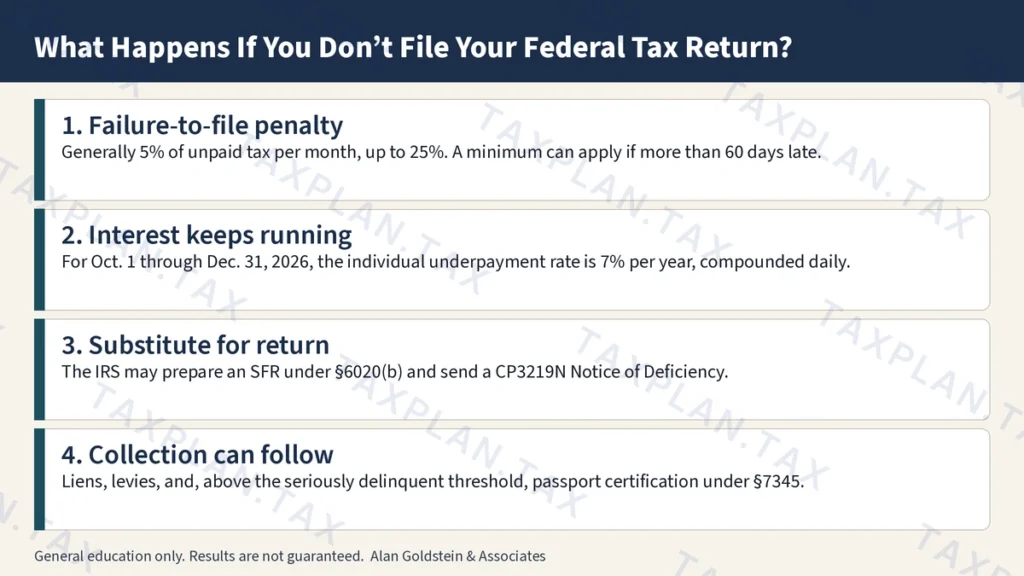


If you do not file a required federal income tax return, the IRS can add penalties and interest, prepare a substitute return, and start collection. The failure-to-file penalty under Internal Revenue Code (IRC) §6651(a)(1) is generally 5% of the unpaid tax for each month, or part of a month, that the return is late, up to 25%. A separate failure-to-pay penalty can accrue at 0.5% per month, also up to 25%, and interest under §§6621 and 6622 compounds daily until the balance is paid. If you never file, the IRS may prepare a substitute for return under §6020(b) that often omits deductions and credits you could have claimed, then assess tax and bill you. Unpaid assessments can lead to a federal tax lien under §6321 and a levy on wages or a bank account under §6331. A refund of withholding or estimated tax can be lost if you do not file in time, and the assessment limitation period in §6501 generally does not start until a valid return is filed. Filing the returns that are due, even if you cannot pay in full, is the first step toward limiting those consequences.
Key Takeaways
- The failure-to-file penalty is generally 5% of the unpaid tax per month, or part of a month, up to 25%. A minimum penalty can apply if an income tax return is more than 60 days late.
- Interest accrues on unpaid tax and on penalties. For October 1 through December 31, 2026, the underpayment rate for individuals is 7% per year, compounded daily; the rate is reset each quarter.
- If you do not file, the IRS may prepare a substitute for return under §6020(b) and send a Notice of Deficiency (CP3219N) that may omit deductions and credits you could have claimed.
- An unfiled year generally keeps the assessment statute of limitations open under §6501, so the IRS can still assess tax after many years.
- Collection can include liens, levies, and, for unpaid federal tax above the inflation-adjusted “seriously delinquent” threshold, passport certification under §7345.
- The IRS advises taxpayers to file all returns that are due, whether or not they can pay in full, and to claim a refund in time under §6511.
Introduction and Background
Federal law requires a return from every person who is liable for a tax and required to file. For most individuals, that return is Form 1040, generally due April 15, with weekend, holiday, and certain overseas-taxpayer adjustments. A timely extension extends the time to file. It does not extend the time to pay.
People fail to file for many reasons: missing records, an unexpected balance due, a life event, or a belief that a refund year can wait. The legal consequences do not depend on the reason, except to the extent the taxpayer later shows reasonable cause and not willful neglect, or otherwise qualifies for penalty relief. The IRS’s guidance is direct: file all returns that are due, whether or not you can pay in full, in the same way and to the same location as an on-time return, or to the address on any notice you have received.
Not every person has a filing requirement for every year. The threshold depends on filing status, age, gross income, and other facts, including self-employment income. If you had no filing requirement, the right response to an IRS inquiry may be to explain that, with supporting facts. If a return is required, leaving it unfiled does not make the year go away.
How It Works
Penalties and interest begin from the due date
The failure-to-file penalty in §6651(a)(1) is computed on the net unpaid tax: the tax required to be shown on the return, reduced by amounts paid on or before the payment due date (such as withholding and timely estimated tax) and by credits that may be claimed on the return. If the net amount is zero because payments covered the tax, the percentage failure-to-file penalty generally does not apply. If an income tax return is more than 60 days late, a dollar minimum can still apply, limited to 100% of the tax required to be shown.
The IRS publishes the inflation-adjusted minimum. For Forms 1040 and 1120 with a return due date (without extension) after December 31, 2025, the minimum is $525, or 100% of the underpayment, whichever is less. For due dates in calendar year 2025, the figure is $510; for 2024, $485. Rev. Proc. 2024-40 confirms the $525 amount for returns required to be filed in 2026.
A failure-to-pay penalty under §6651(a)(2) can run at the same time. When both apply in the same month, the failure-to-file penalty is reduced by the 0.5% failure-to-pay amount, so the combined charge is 5% rather than 5.5%. After five months the failure-to-file penalty reaches its cap (25%, or 22.5% after the offset), but the failure-to-pay penalty can continue, up to 25%. Interest is separate from both penalties and compounds daily.
The IRS can file a substitute for return
If you do not file, the IRS may prepare a substitute for return (SFR) under §6020(b) from information it already has, typically Forms W-2 and 1099. The IRS states that this return might not give you credit for deductions and exemptions you may be entitled to receive. It generally sends a Notice of Deficiency, CP3219N (a 90-day letter), proposing an assessment. You then have 90 days (150 days if the notice is addressed to a person outside the United States) to file your own return or petition the U.S. Tax Court. If you do neither, the IRS may assess the proposed tax and begin collection. The IRS also states that it is still in your interest to file your own return after an SFR, and that it will generally adjust the account to reflect the correct figures.
Collection, liens, levies, and related consequences
Once tax is assessed and remains unpaid, the IRS may file a notice of federal tax lien under §6321 and may levy property under §6331, including wages and bank accounts. It also holds refunds when records show one or more returns are past due, until it receives the past-due return or an acceptable reason for not filing. Unfiled self-employment income may not be reported to the Social Security Administration. Lenders often require copies of filed returns for a mortgage, refinance, business loan, or student aid.
Section 7345 also authorizes the IRS to certify a “seriously delinquent tax debt” to the Department of State. For 2026, the IRS defines that debt as a legally enforceable unpaid federal tax liability, including assessed penalties and interest, totaling more than $66,000, after a notice of federal tax lien (with administrative remedies lapsed or exhausted) or a levy. Certification can prevent issuance of a passport and can lead to denial or revocation. Debts being timely paid under an approved installment agreement or accepted offer in compromise, and accounts determined currently not collectible due to hardship, are among the exclusions.
Benefits and Opportunities
Filing now does not erase tax that is legally due, but it usually improves the path of the case.
- You control the figures. Your signed return can include filing status, dependents, deductions, and credits that an SFR often omits. The IRS says it will generally adjust an SFR account to the correct figures when you file your own return.
- You can stop the failure-to-file penalty from growing. Each month of delay can add 5% (or 4.5% when the failure-to-pay penalty also applies) until the five-month cap is reached. Filing a valid, nonfraudulent return also starts the assessment limitation period under §6501.
- You may preserve a refund. A refund of withholding, estimated tax, or refundable credits generally must be claimed in time under §6511. Waiting too long can forfeit amounts that were already paid in.
- You become eligible for payment options that require current filing. Installment agreements and offers in compromise generally require required returns to be filed. Filing is also the starting point for penalty relief, including reasonable cause and, in some cases, first-time abatement.
- You reduce collection and passport risk. An unfiled year can be assessed later through an SFR. Once assessed and unpaid, liens, levies, and, if the balance is large enough, passport certification become possible.
Legal and Regulatory Considerations
The principal civil penalty for a late or missing income tax return is §6651(a)(1): 5% of the amount required to be shown as tax for the first month, plus 5% for each additional month or fraction thereof, not exceeding 25%, unless the failure is due to reasonable cause and not due to willful neglect. Section 6651(b) reduces the base by timely payments and allowable credits. Section 6651(c)(1) reduces the failure-to-file penalty by the failure-to-pay penalty for the same months. If the failure to file an income tax return is fraudulent, §6651(f) increases the monthly rate and the cap to 15% per month, not exceeding 75%.
Section 6020(b) provides that if a person fails to make a required return, the Secretary shall make a return from the Secretary’s own knowledge and from information that can be obtained, and that a return so made and subscribed is prima facie good and sufficient for all legal purposes. That authority is the legal basis for an SFR assessment after deficiency procedures.
Section 6501 generally allows assessment within three years after a return is filed. If no return is filed, that period does not begin. Section 6501(c) also leaves the period open for a false or fraudulent return filed with intent to evade tax, or a willful attempt to evade tax. Collection after assessment is generally subject to the 10-year period in §6502, measured from assessment, not from the original due date.
Refunds are governed by §6511. A claim generally must be filed within three years from the time the return was filed or two years from the time the tax was paid, whichever is later, and the amount refundable is limited by the lookback rules in §6511(b). Under §6513, withholding and estimated tax are deemed paid on the original due date. The IRS summarizes that a refund of withholding or estimated tax must be claimed by filing within three years of the return due date, and the same timing concern applies to credits such as the earned income credit.
Collection tools rest on §6321 (lien) and §6331 (levy). Passport certification rests on §7345. Willful failure to file a required return is a misdemeanor under §7203. The IRS states that repeated failure to file can lead to additional enforcement, including additional penalties and criminal prosecution. Most non-filer cases are handled civilly, but willfulness depends on the facts.
As a matter of enforcement policy, not statute, Policy Statement 5-133, discussed in IRM 4.12.1 and IRM 5.1.11, provides that the IRS will normally enforce delinquency procedures for not more than six years, with managerial approval required to go shorter or longer. Taxpayers may still file older years, which can still matter for refunds, state compliance, and willful or fraud cases. The six-year figure is a resource guideline, not a discharge of the duty to file.
Practical Examples
The following examples are illustrative. They use statutory percentage rates and IRS-published dollar amounts. Interest is described but not computed to the penny, because the exact factor depends on the days outstanding and on quarterly rate changes.
| Assumption | Example A | Example B |
|---|---|---|
| Tax required to be shown | $10,000 | $2,000 |
| Paid on time (withholding) | $0 | $1,600 |
| Net unpaid tax at the due date | $10,000 | $400 |
| Return filed | 8 months after the due date | More than 60 days late; due date after December 31, 2025 |
| Tax still unpaid when filed | Yes | Paid with the late return |
Example A (illustrative). The failure-to-file penalty runs for five months and, because the failure-to-pay penalty also applies, is reduced from 5% to 4.5% each month, or 22.5% of $10,000, which is $2,250. The failure-to-pay penalty for eight months at 0.5% is 4%, or $400. Combined penalties at filing are $2,650, plus daily compounded interest. If the tax remains unpaid, the failure-to-pay penalty can continue after filing, up to 25%.
Example B (illustrative). The computed failure-to-file percentage on $400 would be modest. Because the income tax return is more than 60 days late, the minimum applies: the lesser of $525 or 100% of the $400 tax required to be shown. The failure-to-file penalty is therefore $400. If that amount is paid with the return, the failure-to-pay penalty stops at payment; interest may still apply for the late-payment period.
Example C (illustrative, refund risk). A taxpayer had $3,000 of withholding, tax of $1,800, and a $1,200 overpayment, but does not file. Withholding is generally deemed paid on the original due date. If the taxpayer waits more than three years after that due date (applying the §6511 lookback, including any extension period that is part of it), the refund can be time-barred.
Common Mistakes and Risks
- Waiting for the IRS to “just figure it out.” An SFR is usually built from third-party reports and often produces a higher tax than a complete Form 1040.
- Assuming that a refund year can sit indefinitely. Refund claims are subject to §6511. Silence can forfeit money already withheld.
- Assuming that old unfiled years have expired. The assessment period generally does not start until a return is filed. The IRS’s normal six-year enforcement policy is not a statute of limitations.
- Not filing because you cannot pay. The IRS tells taxpayers to file even if they cannot pay in full. Filing stops the failure-to-file penalty from continuing and opens payment-plan and other collection alternatives.
- Ignoring notices. CP515, CP59, CP516, and CP3219N notices have response windows. A CP3219N in particular starts a 90-day period to file a return or petition the Tax Court. The IRS states that you cannot request an extension to file after receiving CP3219N.
- Overlooking related returns. Unfiled employment, partnership, or S corporation returns can carry separate penalties, including the per-partner and per-shareholder penalties under §§6698 and 6699.
- Treating interest as if it can be abated like a penalty. Interest generally continues until the tax is paid. The IRS states that, by law, it cannot remove or reduce interest unless the related penalty is removed or reduced, except in narrow statutory situations.
Frequently Asked Questions
Is it a crime not to file a federal tax return?
Willful failure to file a required return can be a misdemeanor under §7203. Many non-filer cases are handled with civil penalties and collection. Anyone concerned about criminal exposure should get professional advice before speaking with the IRS.
What if I do not owe any tax?
If timely withholding and credits cover the tax, the percentage failure-to-file penalty generally has no net-tax base. You may still need to file, and a minimum penalty can apply to a late income tax return if tax was required to be shown and the return is more than 60 days late. If you are due a refund, you generally must file to claim it, and you must do so before the refund limitation period expires.
Can the IRS take my paycheck or bank account if I never filed?
A levy generally follows assessment, notice, and demand. If the IRS assesses tax through an SFR (or after you file and a balance remains), unpaid tax can lead to a levy under §6331, including a wage or bank levy.
How many years will the IRS make me file?
Policy Statement 5-133, as applied in the Internal Revenue Manual, normally limits enforcement of delinquency procedures to six years, with manager approval to do more or less. That is an enforcement guideline, not a repeal of the filing duty, and it does not start the §6501 assessment period.
What happens to my refund if I have other unfiled years?
The IRS states that it holds income tax refunds when records show one or more income tax returns are past due, until it receives the past-due return or an acceptable reason for not filing.
Should I file if I cannot pay the tax?
Yes. The IRS instructs taxpayers to file all returns that are due, whether or not they can pay in full, and then request additional time, an installment agreement, or, if they qualify, an offer in compromise.
Conclusion
Not filing a required federal return leaves the year open, allows penalties and interest to accrue, and gives the IRS a path to assess tax on a substitute return and collect it through liens and levies. Delay also increases refund risk. Filing the returns that are due, even if you cannot pay in full, lets you claim deductions and credits, starts limitation periods, and opens payment and penalty-relief options.
If you have unfiled federal tax returns and want to get current, Alan Goldstein & Associates can help. Alan Goldstein, MBA, IRS Enrolled Agent, works with individuals, business owners, and their tax advisors to prepare delinquent returns and address IRS notices, penalties, and collection issues. Contact Alan Goldstein & Associates in Coral Gables, Florida, for a confidential review.
Sources and Authorities
- 26 U.S.C. §6651 (failure to file tax return or to pay tax): https://www.law.cornell.edu/uscode/text/26/6651
- 26 U.S.C. §6020 (substitute for return): https://www.law.cornell.edu/uscode/text/26/6020
- 26 U.S.C. §6501 (limitations on assessment): https://www.law.cornell.edu/uscode/text/26/6501
- 26 U.S.C. §6511 and §6513 (limitations on credits or refunds; timing of payments): https://www.law.cornell.edu/uscode/text/26/6511
- 26 U.S.C. §§6321, 6331, 7345, 6621, and 7203: lien, levy, passport certification, interest rates, willful failure to file
- IRS, Failure to file penalty (minimum penalty table): https://www.irs.gov/payments/failure-to-file-penalty
- IRS, Failure to pay penalty: https://www.irs.gov/payments/failure-to-pay-penalty
- IRS, Filing past due tax returns: https://www.irs.gov/businesses/small-businesses-self-employed/filing-past-due-tax-returns
- IRS, Quarterly interest rates, and IR-2026-98 / Rev. Rul. 2026-15 (7% underpayment rate for the quarter beginning October 1, 2026): https://www.irs.gov/payments/quarterly-interest-rates
- Rev. Proc. 2024-40, §2.53 (minimum failure-to-file amount for returns required to be filed in 2026): https://www.irs.gov/pub/irs-drop/rp-24-40.pdf
- IRS, Revocation or denial of passport (2026 threshold $66,000): https://www.irs.gov/businesses/small-businesses-self-employed/revocation-or-denial-of-passport-in-cases-of-certain-unpaid-taxes
- IRM 4.12.1, Nonfiled Returns (Policy Statement 5-133 six-year enforcement period): https://www.irs.gov/irm/part4/irm_04-012-001
- IRM 5.1.11, Delinquent Return Investigations: https://www.irs.gov/irm/part5/irm_05-001-011r
This article is provided for general educational purposes and does not constitute individualized tax, legal, or accounting advice. Tax consequences depend on the taxpayer’s specific facts and applicable law.
