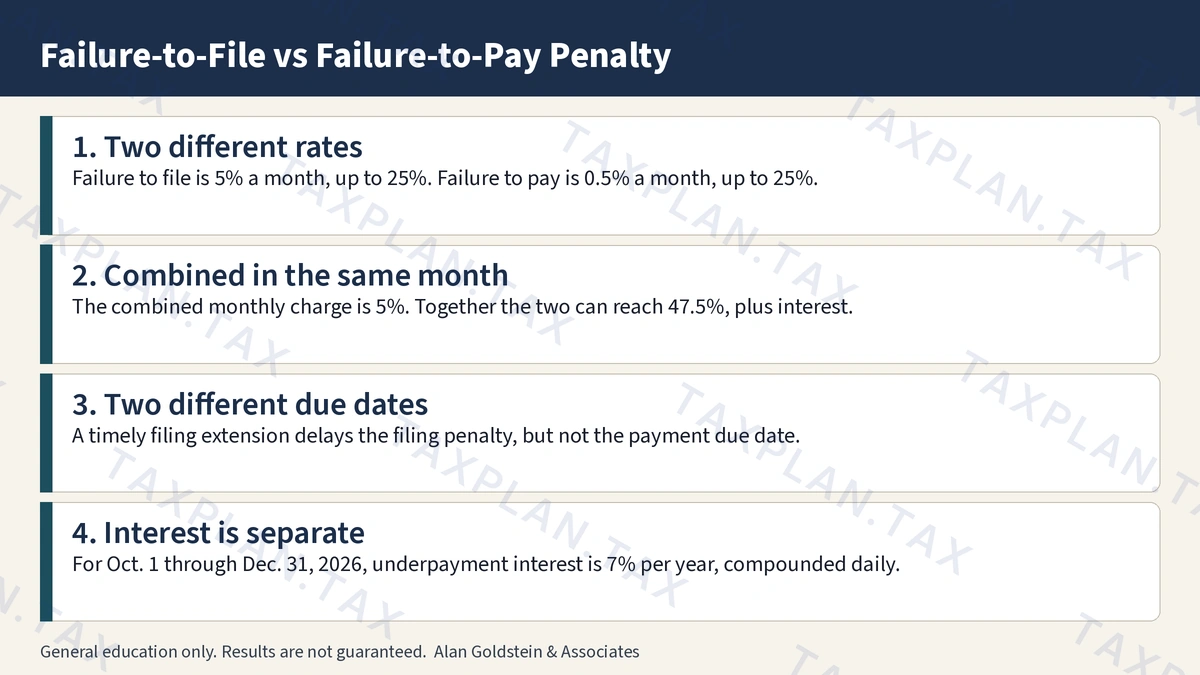

The failure-to-file penalty and the failure-to-pay penalty are separate additions to tax under Internal Revenue Code (IRC) §6651, computed at different rates, from different starting dates, and with different caps, even though they often appear on the same IRS bill. The failure-to-file penalty is generally 5% of the unpaid tax for each month, or part of a month, that the return is late, up to 25%. The failure-to-pay penalty is generally 0.5% of the unpaid tax for each month, or part of a month, that the tax remains unpaid, also up to 25%. When both apply in the same month, the failure-to-file penalty is reduced by the failure-to-pay amount, so the combined charge for that month is 5%, not 5.5%. That difference in rates is why filing on time—even if you cannot pay—avoids the steeper monthly charge. An extension of time to file can postpone the failure-to-file penalty; it does not postpone the failure-to-pay penalty or interest. Interest is a third, separate charge and compounds daily.
Key Takeaways
- Failure to file is a 5% monthly penalty, capped at 25% after five months. Failure to pay is a 0.5% monthly penalty, capped at 25% after 50 months at the ordinary rate, subject to rate changes described below.
- If both apply in the same month, the combined monthly charge is 5% (4.5% late filing plus 0.5% late payment). The IRS states that the maximum of the two penalties together is 47.5% of the unpaid tax, plus interest.
- The failure-to-file penalty uses the filing due date, including a timely extension. The failure-to-pay penalty uses the payment due date, which a filing extension does not extend.
- A minimum failure-to-file penalty can apply to an income tax return that is more than 60 days late. For due dates after December 31, 2025, that minimum is the lesser of $525 or 100% of the tax required to be shown. There is no comparable dollar minimum for the failure-to-pay penalty.
- The failure-to-pay rate can be 0.25% per month during an approved installment agreement if an individual filed on time, and 1% per month after a notice of intent to levy if the tax is not paid within the stated period.
- For October 1 through December 31, 2026, underpayment interest for individuals is 7% per year, compounded daily, in addition to both penalties.
Introduction and Background
Taxpayers often treat “IRS penalties” as a single late charge. The Code splits the idea in two. One penalty is for not filing the return. The other is for not paying the tax. They can run together, they can run separately, and the rules for reducing or removing them are not identical. Reading a notice correctly, and deciding whether to file before you can pay, depends on seeing those differences clearly.
Congress set the late-filing rate much higher than the ordinary late-payment rate. The IRS’s own explanation is practical: file on time even if you cannot pay, because the failure-to-file penalty is much steeper per month, and filing is what allows you to use a payment plan and, in some cases, a reduced failure-to-pay rate.
How It Works
Two statutes, two clocks
Section 6651(a)(1) applies if you do not file a required return by the due date determined with regard to any extension of time for filing, unless the failure is due to reasonable cause and not due to willful neglect. Section 6651(a)(2) applies if you do not pay the amount shown as tax on the return on or before the date prescribed for payment, determined with regard to any extension of time for payment—not a mere filing extension—unless reasonable cause is shown. A third rule, §6651(a)(3), applies a similar 0.5% monthly charge when additional tax that was not shown on the return is not paid within 21 calendar days after notice and demand (10 business days if the amount is $100,000 or more).
The base for the failure-to-file penalty is the tax required to be shown, reduced by timely payments and allowable credits. The base for the failure-to-pay penalty, for any given month, is the unpaid tax reduced by amounts paid before the beginning of that month. Partial payments therefore reduce future failure-to-pay charges even if they do not eliminate the penalty already accrued.
The offset, the caps, and the special rates
Section 6651(c)(1) provides that the failure-to-file penalty is reduced by the amount of the failure-to-pay penalty for the same months. The IRS illustrates this as 4.5% plus 0.5%, rather than 5% plus 0.5%. After five months, the failure-to-file penalty has reached 25% (22.5% if the offset applied throughout). The failure-to-pay penalty can continue until it reaches 25%.
Two special failure-to-pay rates matter in collection cases. If you filed your tax return on time as an individual and you have an approved payment plan, the IRS states that the failure-to-pay penalty is reduced to 0.25% per month during the approved plan. If you do not pay within 10 days after a notice of intent to levy, the rate is 1% per month or partial month. Those adjustments do not change the failure-to-file rate. They also mean that a taxpayer who files late and then enters an installment agreement should not assume the 0.25% rate will apply.
Benefits and Opportunities
- Filing without paying still has a large benefit. It stops the 5% clock and leaves the 0.5% clock, plus interest, as the continuing charges.
- A timely extension helps only the filing penalty. If you need time to finish the return, a timely extension can keep the failure-to-file penalty from starting, but you should still pay as much as you can by the payment due date.
- Payment plans can reduce the failure-to-pay rate, but only on the terms the IRS describes. Filing on time is one of the stated conditions for the 0.25% rate during an approved individual installment agreement.
- Either penalty may be eligible for reasonable-cause relief. The facts that support relief can differ. An inability to pay may be relevant to failure to pay; it does not, standing alone, explain a failure to file. First-time abatement, where it applies, is also administrative and condition-based.
Legal and Regulatory Considerations
The text of §6651 and Treas. Reg. §301.6651-1 controls the computation. The IRS failure-to-file and failure-to-pay pages, Topic 653, and the collection procedural FAQs restate the rates, the offset, the 47.5% combined maximum, and the current minimum failure-to-file amount. Rev. Proc. 2024-40 confirms the $525 minimum for returns required to be filed in 2026. IRM 20.1.2 is the administrative computational guide.
The minimum penalty is unique to the failure-to-file addition on a chapter 1 income tax return that is more than 60 days late. It is the lesser of the inflation-adjusted dollar amount or 100% of the tax required to be shown. The failure-to-pay penalty has no similar dollar floor. That is why a small unpaid tax on a long-late return can produce a failure-to-file penalty equal to the entire tax, while the failure-to-pay penalty on the same tax remains a monthly percentage.
If the failure to file is fraudulent, §6651(f) increases the failure-to-file rate to 15% per month, not exceeding 75%. There is no parallel 15% rule inside §6651(a)(2). Willful failure to file can also be a misdemeanor under §7203, which is a criminal provision, not a substitute for the civil failure-to-pay penalty.
Interest under §§6621 and 6622 runs on unpaid tax regardless of which penalty applies, and the IRS charges interest on penalties as well. For the fourth quarter of 2026, the underpayment rate for individuals is 7% per year, compounded daily (IR-2026-98; Rev. Rul. 2026-15). Interest generally cannot be abated unless a related penalty is abated, except in narrow statutory situations.
Practical Examples
The following examples are illustrative and use statutory rates. Interest is in addition to the penalty amounts and is not computed to the penny.
| Feature | Failure-to-file penalty (§6651(a)(1)) | Failure-to-pay penalty (§6651(a)(2)) |
|---|---|---|
| Ordinary monthly rate | 5% of unpaid tax | 0.5% of unpaid tax |
| Cap | 25% (five months) | 25% |
| Starting date | Filing due date, including a timely filing extension | Payment due date (a filing extension does not extend it) |
| When both apply in the same month | Reduced by the 0.5% failure-to-pay amount (net 4.5%) | Still 0.5% (unless a special rate applies) |
| Dollar minimum | Yes, if an income tax return is more than 60 days late (for example, $525 for due dates after December 31, 2025, limited to 100% of the tax) | No comparable dollar minimum |
| Installment-agreement rate | No 0.25% reduction | 0.25% per month for an individual who filed on time and has an approved plan, during the plan |
| After notice of intent to levy | No 1% special rate | 1% per month if not paid within 10 days of the levy notice |
| Fraudulent failure | 15% per month, up to 75%, under §6651(f) | Not increased by §6651(f) |
Example A (illustrative): $10,000 unpaid, eight months late, still unpaid. Failure to file, after the offset, is 4.5% × 5 months = 22.5%, or $2,250. Failure to pay is 0.5% × 8 months = 4%, or $400. Combined penalties at filing are $2,650, plus interest. If the tax remains unpaid, only the failure-to-pay penalty continues, up to 25%.
Example B (illustrative): same $10,000, return filed on time, tax paid eight months later. There is no failure-to-file penalty. The failure-to-pay penalty is 4%, or $400, plus interest. If the taxpayer is an individual who entered an approved installment agreement and the IRS’s 0.25% condition is met, the rate during the agreement is lower than 0.5%. The difference between Example A and Example B is the $2,250 failure-to-file penalty, which is the cost of not filing.
Example C (illustrative): $400 unpaid tax, return more than 60 days late, due after December 31, 2025. The computed failure-to-file percentage may be modest, but the minimum applies: the lesser of $525 or 100% of $400, so $400. The failure-to-pay penalty remains 0.5% of whatever portion is still unpaid each month. The minimum does not attach to the failure-to-pay penalty.
Common Mistakes and Risks
- Waiting to file until you can pay in full. That decision leaves the 5% monthly penalty running and can trigger the 60-day minimum.
- Assuming a filing extension also extends the time to pay. It does not. Interest and the failure-to-pay penalty can start on the original payment date.
- Adding the penalties as 5.5% a month. The statutory offset makes the combined monthly rate 5% while both apply.
- Expecting an installment agreement to cut the failure-to-file penalty to 0.25%. The reduced rate the IRS describes is a failure-to-pay rate, and only if the individual filed on time and the plan is approved.
- Ignoring a levy notice. The failure-to-pay rate can increase to 1% if the tax is not paid within 10 days after a notice of intent to levy.
- Treating the two penalties as interchangeable for relief. Facts that explain a late payment may not explain a failure to file, and the other way around.
Frequently Asked Questions
Which penalty is more expensive?
On a monthly basis, failure to file is much more expensive: 5% versus 0.5% before the offset. Failure to pay can last longer, because it does not cap at five months, and it can rise to 1% after a levy notice. If both run their full course, the IRS states that the combined total can reach 47.5% of the unpaid tax, plus interest.
If I file late and pay in full with the return, do I still owe the failure-to-pay penalty?
Yes, for each month or part of a month between the payment due date and the payment, unless relief applies. Paying with the late return stops further failure-to-pay accrual. You may still owe the failure-to-file penalty, including the minimum if the return is more than 60 days late.
If I pay on time but file late, do I owe the failure-to-file penalty?
The percentage failure-to-file penalty is computed on unpaid tax. If the tax was paid on time, that percentage generally has no base. The minimum penalty can still apply to an income tax return more than 60 days late if tax was required to be shown on the return. The facts and the IRS computational rules should be checked in a small-balance case.
Does reasonable cause apply to both penalties?
Yes, each of §6651(a)(1) and (a)(2) has a reasonable-cause exception. The explanation has to fit the failure involved. Reliance on an agent to meet a known filing deadline was not reasonable cause in United States v. Boyle, 469 U.S. 241 (1985).
Will an installment agreement stop both penalties?
An agreement does not cancel penalties already accrued. For the failure-to-pay penalty, the IRS states that the monthly rate is reduced to 0.25% during an approved plan if you filed on time as an individual. The failure-to-file penalty does not have that reduced rate, and it will already have stopped accruing once the return is filed, subject to its five-month cap.
Do these rules apply to employment or information returns?
Section 6651 applies to the returns it identifies, including many income, estate, and certain other returns. Employment-tax deposit penalties, information-return penalties, and the partnership and S corporation late-filing penalties under §§6698 and 6699 are different regimes.
Is interest charged in addition to both penalties?
Yes. Interest compounds daily on unpaid tax and is charged on penalties. For the fourth quarter of 2026, the individual underpayment rate is 7% per year.
Can I have the penalties removed after I file?
You may request reasonable-cause relief, and you may qualify for first-time abatement if the administrative conditions are met. File the return, then follow the instructions on the notice or submit a signed written request with supporting documents.
Conclusion
The failure-to-file penalty and the failure-to-pay penalty answer different questions: was the return late, and was the tax unpaid? The first is generally 5% a month for up to five months; the second is generally 0.5% a month for as long as the tax remains unpaid, up to 25%, with special 0.25% and 1% rates in defined collection situations. When both apply, they combine to 5% a month, not 5.5%. Filing even when you cannot pay is the most reliable way to avoid the steeper charge, after which you can address the balance, the remaining failure-to-pay penalty, and interest.
If you need help distinguishing, computing, or requesting relief from failure-to-file and failure-to-pay penalties, Alan Goldstein & Associates can help. Alan Goldstein, MBA, IRS Enrolled Agent, works with individuals, business owners, and their tax advisors to file delinquent returns and sort the penalties that appear on IRS notices. Contact Alan Goldstein & Associates in Coral Gables, Florida, for a confidential review.
Sources and Authorities
- 26 U.S.C. §6651: https://www.law.cornell.edu/uscode/text/26/6651
- Treas. Reg. §301.6651-1: https://www.ecfr.gov/current/title-26/section-301.6651-1
- IRS, Failure to file penalty: https://www.irs.gov/payments/failure-to-file-penalty
- IRS, Failure to pay penalty: https://www.irs.gov/payments/failure-to-pay-penalty
- IRS, Collection procedural questions 3: https://www.irs.gov/faqs/irs-procedures/collection-procedural-questions/collection-procedural-questions-3
- IRS Topic no. 653, IRS notices and bills, penalties and interest charges: https://www.irs.gov/taxtopics/tc653
- Rev. Proc. 2024-40: https://www.irs.gov/pub/irs-drop/rp-24-40.pdf
- IRS, Quarterly interest rates and IR-2026-98 / Rev. Rul. 2026-15: https://www.irs.gov/payments/quarterly-interest-rates
- IRM 20.1.2: https://www.irs.gov/irm/part20/irm_20-001-002r
- United States v. Boyle, 469 U.S. 241 (1985)
This article is provided for general educational purposes and does not constitute individualized tax, legal, or accounting advice. Tax consequences depend on the taxpayer’s specific facts and applicable law.
