

Getting compliant on unfiled federal tax returns means determining which years you were required to file, preparing and filing accurate returns for those years, and then paying the tax or arranging a collection alternative. The IRS tells taxpayers to file all returns that are due, whether or not they can pay in full, and to use the same filing method and address they would use for an on-time return, or the address on any notice they have received. Filing your own returns lets you claim filing status, dependents, deductions, and credits that a substitute for return under Internal Revenue Code (IRC) §6020(b) often omits. It also starts the assessment limitation period under §6501, can preserve a refund under §6511 if you still have time, and is generally a condition for an installment agreement or offer in compromise. This guide walks through how to identify the years at issue, gather records, file, and deal with penalties, interest, and IRS collection after the returns are in.
Key Takeaways
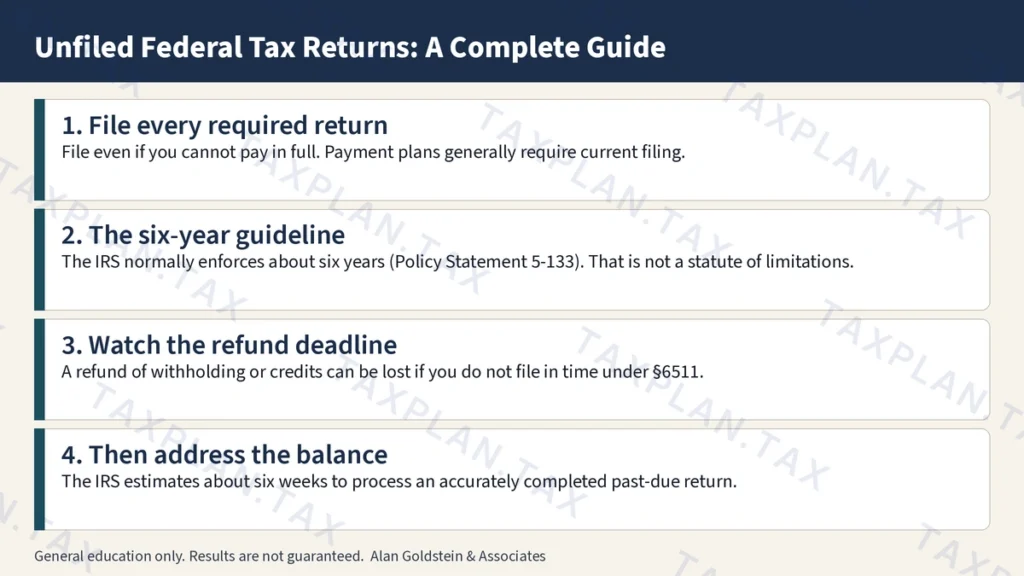
- File every required return that is due, even if you cannot pay the tax in full. Payment plans and other collection alternatives generally require current filing.
- The IRS normally enforces delinquency procedures for six years under Policy Statement 5-133, but that is an enforcement guideline, not a statute of limitations, and older years can still matter.
- A refund of withholding, estimated tax, or refundable credits can be lost if you do not file in time under §6511.
- If the IRS has already prepared a substitute for return, it is still usually in your interest to file your own return. The IRS states it will generally adjust the account to the correct figures.
- The failure-to-file penalty, failure-to-pay penalty, and daily compounded interest are separate. For returns due after December 31, 2025, the minimum failure-to-file penalty can be as high as $525, limited to 100% of the tax required to be shown.
- After you file, expect processing time (the IRS estimates about six weeks for an accurately completed past-due return) and then address the balance, notices, and any penalty-relief request.
Introduction and Background
Unfiled federal returns are a compliance problem and, often, a collection problem. The filing duty comes first. Interest and the failure-to-pay penalty can be addressed after the return is on file; the failure-to-file penalty continues to run, up to its cap, until the return is filed. The assessment statute of limitations generally does not start until a valid return is filed. In short, becoming current starts with the returns themselves.
The IRS may already know a year is missing. It receives Forms W-2, 1099, and other information returns, and it sends delinquency notices such as CP515, CP59, and CP516 when it has reason to believe a return is required. If you do not respond, it may prepare an SFR, issue a Notice of Deficiency (CP3219N), and assess tax without the deductions and credits you could have claimed.
Compliance is not only about the current year. A mortgage lender, a professional license, an immigration filing, a passport application, or a later refund can all surface unfiled years. The practical goal is a complete set of required federal returns, a documented position on any year that was not required, and a plan for any balance due, including related state returns where they apply.
How It Works
Identify the years and the filing requirement
Start with a year-by-year inventory. For each tax year, ask whether you were required to file, not merely whether you think you owed tax. The filing threshold depends on filing status, age, gross income, and other facts, including self-employment net earnings. If you had no filing requirement, keep the facts that support that conclusion. If the IRS has inquired about that year, you may need to explain it, for example on Form 15103 when a delinquency notice includes that form.
The IRS’s normal enforcement period for delinquent returns is six years, under Policy Statement 5-133 as applied in IRM 4.12.1 and IRM 5.1.11. Managers must approve enforcement for a shorter or longer period. You may still file older years, and you should not assume a year is “closed” merely because it is older than six years. The §6501 assessment period remains open if no return has been filed. Refund years, by contrast, can close against you if you wait too long under §6511.
Gather records and official transcripts
Wage and income transcripts show much of what the IRS already has: wages, interest, dividends, broker reports, and many Forms 1099. You can request transcripts through IRS Get Transcript or by filing Form 4506-T and checking the wage and income box (line 8 on the current form). Account transcripts show whether a return posted, whether an SFR posted, and what assessments, penalties, and payments are on the account. Prior-year forms and instructions are available on IRS.gov, or by ordering them at 800-TAX-FORM (800-829-3676).
Where records are incomplete, reconstruct what you can from bank records, payer statements, and the transcripts. Do not omit income that appears on a third-party report without a documented reason. If a report is wrong, the IRS’s past-due returns page says to contact the payer for a correction and to attach the corrected form when you file.
Prepare, file, and then address the balance
Use the correct prior-year Form 1040 (or 1120, 1120-S, 1065, or other form) and the law in effect for that tax year. File electronically if the year is still accepted for e-file. The IRS has stated, on its CP515 notice page, that it accepts returns electronically for the two most recent prior years, and that you must locate an e-file provider who offers that service. Older years are generally paper-filed. If you have a notice, send the return to the address on the notice and include any requested form, such as Form 15103.
Pay what you can with the return. If you cannot pay in full, the IRS says you may request an additional 60 to 120 days to pay through the Online Payment Agreement application or by calling 800-829-1040, with no user fee for that short extension, or you may request an installment agreement or, if you qualify, an offer in compromise. Filing first is what makes those tools available in the ordinary course.
Benefits and Opportunities
- Lower tax than an SFR. Your return can use the correct filing status and claim deductions and credits that a substitute return often omits.
- A chance to keep a refund. If withholding or refundable credits exceed the tax, timely filing under §6511 is how you claim the money.
- A starting point for collection alternatives. Installment agreements, currently not collectible status, and offers in compromise generally require required returns to be filed.
- Penalty relief may be available after the return is filed. Reasonable cause, and in some cases first-time penalty abatement, can reduce or remove the failure-to-file penalty. Interest generally remains until the tax is paid, unless the related penalty is removed.
- Limitation periods start to run. A valid, nonfraudulent return generally starts the assessment period under §6501. That is one of the legal benefits of coming into compliance.
Legal and Regulatory Considerations
Section 6651(a)(1) imposes the failure-to-file penalty: 5% of the net unpaid tax per month or fraction thereof, up to 25%, unless the failure is due to reasonable cause and not willful neglect. When the failure-to-pay penalty also applies, §6651(c) reduces the failure-to-file rate for those months so the combined monthly charge is 5%. If an income tax return is more than 60 days late, a minimum penalty applies: the lesser of the inflation-adjusted amount or 100% of the tax required to be shown. For return due dates after December 31, 2025, that amount is $525 (Rev. Proc. 2024-40; IRS failure-to-file penalty page). Interest on underpayments is set quarterly under §6621 and compounds daily under §6622. For October 1 through December 31, 2026, the underpayment rate for individuals is 7% per year.
Section 6020(b) authorizes a substitute return that is prima facie good and sufficient for all legal purposes once subscribed by the Secretary. The IRS describes the process on its past-due returns page, including the CP3219N 90-day letter. Filing your own return remains important after an SFR; the IRS says it will generally adjust the account to the correct figures. You cannot request an extension to file after receiving CP3219N.
Section 6501 generally gives the IRS three years after a return is filed to assess tax, and no starting date if no return is filed. Section 6502 generally allows collection for 10 years after assessment. Refunds are limited by §6511 and by the deemed-paid rule in §6513 for withholding and estimated tax. Collection, once tax is assessed and unpaid, can include a lien under §6321 and a levy under §6331. A seriously delinquent tax debt can be certified for passport action under §7345 (the 2026 threshold is $66,000, including assessed penalties and interest, after lien or levy conditions are met).
Policy Statement 5-133 does not repeal older filing duties. IRM 5.1.11 instructs employees that the taxpayer may file for all open periods regardless of the age of the delinquency, and that enforcement beyond or short of six years requires managerial approval.
Practical Examples
The following examples are illustrative and use published IRS rates and dollar amounts. Interest is not computed to the penny because quarterly rates change and compounding is daily.
| Situation | Compliance path | What is at stake |
|---|---|---|
| Three unfiled years; mixed balances and one likely refund year | File all required years, and do not delay the refund year | The refund year can be lost under §6511 if it is already approaching the three-year mark |
| Six unfiled years; IRS has sent CP515 notices | File the returns and send them, with Form 15103 if required, to the notice address | Continued silence can lead to an SFR and a CP3219N notice of deficiency |
| SFR already assessed; taxpayer has deductions and credits | File a signed original return with supporting records | The IRS states it will generally adjust the account to the correct figures |
| Balance due after filing; cannot pay in full | Pay what is possible; request a short-term payment or an installment agreement | Filing stops further failure-to-file penalty accrual (once the cap has not already been reached) and opens payment options |
Illustrative numbers. Suppose one late year shows $8,000 of tax, $3,000 of timely withholding, and a $5,000 unpaid balance. The return is filed seven months late and the tax is still unpaid. The failure-to-file penalty, reduced by the failure-to-pay offset, is 4.5% for each of five months, or 22.5% of $5,000, which is $1,125. The failure-to-pay penalty for seven months at 0.5% is 3.5%, or $175. Combined penalties at filing are $1,300, plus daily interest at the applicable quarterly underpayment rates (7% per year, compounded daily, during the fourth quarter of 2026). These figures change if any of the tax was paid earlier, if the return is only a few weeks late, or if the minimum penalty applies to a small balance.
Common Mistakes and Risks
- Filing only the years with a refund and ignoring balance-due years. The IRS may hold a refund when other years remain unfiled.
- Waiting for a perfect set of records. Transcripts and bank records can support a good-faith return. Indefinite delay adds penalties and can forfeit refunds.
- Assuming six years is a legal cutoff. It is an IRS enforcement guideline. The assessment period remains open until a return is filed.
- Ignoring an SFR or a CP3219N. The 90-day period to file a return or petition the Tax Court is short, and the IRS states that you cannot request an extension to file after that notice.
- Omitting income that appears on a wage and income transcript. Information-return matching is how many non-filer cases begin.
- Treating state returns as optional. Many states have their own filing duties, penalties, and collection tools. This series focuses on federal returns, but state compliance is often part of becoming current.
Frequently Asked Questions
Do I have to file years in which I am due a refund?
If a return is required, yes. Even if no return is required, you generally must file to claim a refund of withholding or refundable credits, and you must do so before the §6511 period expires.
What if I cannot find my old W-2s or 1099s?
Request wage and income transcripts through Get Transcript or Form 4506-T, and contact the payer if you need a replacement statement. The IRS also points taxpayers to those tools on its past-due returns page.
Can I e-file old returns?
The IRS has stated that it accepts returns electronically for the two most recent prior years, through an e-file provider that offers the service. Older years are generally filed on paper, using the prior-year form.
How long does the IRS take to process a past-due return?
The IRS states that it takes approximately six weeks to process an accurately completed past-due tax return. If you have a notice, send a copy to the address on the notice.
Should I file before I contact the IRS?
In a typical civil non-filer situation, the IRS’s published advice is to file the returns that are due. If you are concerned about fraud or a criminal investigation, get professional advice before you contact the IRS or file.
Will filing automatically stop a levy or a lien?
Not automatically. Filing is necessary, but a levy or a notice of lien is tied to an assessed, unpaid liability. After the returns are filed and the tax is determined, you may need a payment arrangement or another collection alternative to stop or avoid enforced collection.
What about partnership, S corporation, or employment returns?
Those returns have their own due dates and penalties, including the per-partner and per-shareholder penalties under §§6698 and 6699. A complete compliance plan includes every required federal return, not only Form 1040.
Can penalties be removed?
The IRS may remove or reduce certain penalties for reasonable cause, and it has an administrative first-time abatement procedure in some cases after the return is filed and other conditions are met. Interest generally cannot be removed unless the related penalty is removed, except in narrow statutory situations.
Conclusion
Becoming current with unfiled federal tax returns is a process, not a single phone call. Identify the years, confirm the filing requirement, gather transcripts and records, file accurate prior-year returns, and then pay or arrange to pay. Doing that work yourself, or with a tax professional, is how you replace a substitute return with your own figures, protect refunds that are still timely, and open the collection and penalty-relief options the law provides.
If you have several years of unfiled federal returns and want a structured plan to get compliant, Alan Goldstein & Associates can help. Alan Goldstein, MBA, IRS Enrolled Agent, works with individuals, business owners, and their tax advisors to prepare delinquent returns and resolve the notices, penalties, and balances that follow. Contact Alan Goldstein & Associates in Coral Gables, Florida, for a confidential review.
Sources and Authorities
- IRS, Filing past due tax returns: https://www.irs.gov/businesses/small-businesses-self-employed/filing-past-due-tax-returns
- IRS, Understanding your CP515 notice: https://www.irs.gov/individuals/understanding-your-cp515-notice
- 26 U.S.C. §6651: https://www.law.cornell.edu/uscode/text/26/6651
- 26 U.S.C. §6020: https://www.law.cornell.edu/uscode/text/26/6020
- 26 U.S.C. §§6501, 6511, and 6513: https://www.law.cornell.edu/uscode/text/26/6501
- IRS, Failure to file penalty: https://www.irs.gov/payments/failure-to-file-penalty
- IRS, Quarterly interest rates and IR-2026-98 / Rev. Rul. 2026-15: https://www.irs.gov/payments/quarterly-interest-rates
- Rev. Proc. 2024-40: https://www.irs.gov/pub/irs-drop/rp-24-40.pdf
- IRM 4.12.1, Nonfiled Returns: https://www.irs.gov/irm/part4/irm_04-012-001
- IRM 5.1.11, Delinquent Return Investigations: https://www.irs.gov/irm/part5/irm_05-001-011r
- IRS, Get Transcript: https://www.irs.gov/individuals/get-transcript
- IRS, Passport certification: https://www.irs.gov/businesses/small-businesses-self-employed/revocation-or-denial-of-passport-in-cases-of-certain-unpaid-taxes
This article is provided for general educational purposes and does not constitute individualized tax, legal, or accounting advice. Tax consequences depend on the taxpayer’s specific facts and applicable law.
