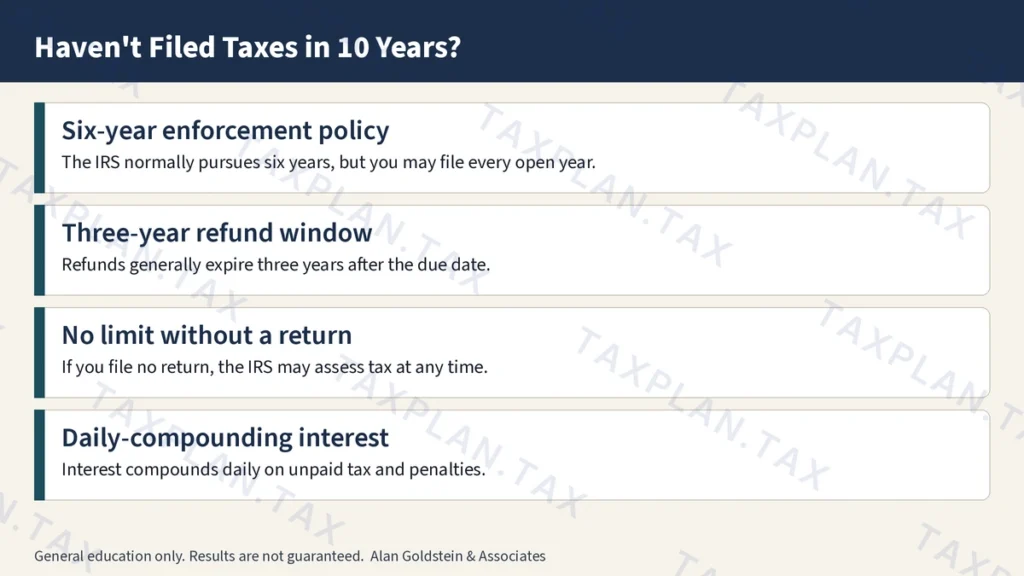


If you haven’t filed taxes in 10 years, the best next step is usually to get your IRS records and then file the missing returns. You do not have to fix everything in one day. Start with transcripts, sort the years by refund and balance risk, and file in an organized way. Penalties and interest may already apply to unpaid tax, but a filed return can stop the failure-to-file penalty from growing. This guide explains how the six-year IRS policy, refund deadlines, and assessment rules work for a ten-year gap as of late 2026.
Key Takeaways
- IRS policy normally enforces six years of filing, but you may file every open year, and the IRS may seek more with managerial approval.
- Refunds generally expire three years after the due date. For a ten-year gap, most older years have usually closed.
- When you file no return, the IRS may assess tax for that year at any time.
- The minimum failure-to-file penalty ranges from $205 to $525 across these ten years, depending on each return’s due date.
- Payment plans, offers in compromise, and penalty relief may be available after you file. We cannot promise any of them.
What should you do first if you haven’t filed taxes in 10 years?
Get your IRS records before you prepare anything. Transcripts show what payers reported and whether the IRS already assessed tax for any year.
Order wage and income transcripts and account transcripts through Get Transcript. The IRS says the wage and income transcript is available for the current and nine prior tax years. Older years need Form 4506-T. The transcript shows only the information returns filed with the IRS, so it may not list everything you earned.
Next, gather your own records. Bank statements, Forms W-2 and 1099, and business records can fill the gaps. Also pause before you contact the IRS or sign anything. A short review with a qualified tax professional can help you avoid avoidable mistakes.
Does the IRS require all 10 years?
Usually the IRS pursues six, but you may file more. The IRS can enforce a longer period when the facts call for it.
The Internal Revenue Manual (IRM 5.1.11.7.1) says the IRS normally pursues enforcement of filing requirements for a six-year period. It also tells employees to request all non-fraudulent unfiled returns. In addition, it says the taxpayer may file for all open periods regardless of the age of the delinquency. Enforcing more or fewer than six years requires managerial approval. IRM 4.12.1.3 repeats the six-year limit and allows longer or shorter periods based on the facts.
The IRM lists the factors behind that decision. They include the degree of flagrancy, your history of noncompliance, whether the delinquency involves trust fund money, and any income from illegal sources. They also include whether little or no tax is due, and the cost to the IRS of securing a return. Because these factors turn on facts, the IRS may treat a ten-year gap differently from a five-year gap. For the policy background, see how far back the IRS requires unfiled tax returns and our comparison of the 3-, 6-, and 10-year rules.
Is there a legal time limit on the older years?
No. If you never filed a return, IRC §6501(c)(3) lets the IRS assess tax at any time.
The Supreme Court described that rule in Badaracco v. Commissioner (1984). It noted that subsection (c)(3) covers a failure to file a return at all and allows assessment at any time (464 U.S. at 392). Once you file a valid return, the usual three-year assessment period generally starts. After assessment, the IRS generally has 10 years to collect under IRC §6502. Our guide to the statute of limitations on unfiled returns covers these clocks in more detail.
Which of the 10 years can still produce a refund?
Only the most recent years, in most cases. You generally must claim a refund within three years of the return due date, and the same rule applies to credits such as the Earned Income Credit.
The IRS says you risk losing a refund if you do not file within that window (IRS: Filing past due tax returns). It also set April 15, 2026 as the deadline for most 2022 refunds (IRS: Tax year 2022 refund deadline). The statutory rules are in IRC §6511 and §6513. The table applies the general rule to tax years 2016 through 2025 as of November 2026.
| Tax years | Refund window (general rule, as of November 2026) |
|---|---|
| 2016 through 2021 | Closed |
| 2022 | Closed April 15, 2026, per the IRS |
| 2023 | Open; generally ends April 15, 2027 (statute-based estimate) |
| 2024 and 2025 | Open |
Courts apply this deadline strictly. In United States v. Brockamp (1997), the Supreme Court held that courts cannot toll the §6511 limits for equitable reasons such as a taxpayer’s disability (519 U.S. at 348, 354). Congress later added a narrow suspension for financial disability in §6511(h). Exceptions can change a date, so confirm yours before you rely on it.
Even for a closed refund year, you may still be required to file. Also, the IRS holds refunds while returns are past due. It says it holds them until it gets the missing return or an acceptable reason for not filing.
What penalties and interest apply after 10 years?
If you owe tax for a year, a failure-to-file penalty, a failure-to-pay penalty, and interest usually apply. If you owe nothing for a year, the failure-to-file penalty is generally zero.
Under IRC §6651, the failure-to-file penalty is 5% of the unpaid tax for each month or part of a month, up to 25%. For a year that is many years late, that penalty has already reached its cap. The failure-to-pay penalty is 0.5% per month, also capped at 25%. When both apply in a month, §6651(c)(1) reduces the filing penalty by the payment penalty. If the failure to file is fraudulent, a higher rate applies under §6651(f), so facts matter.
What is the minimum failure-to-file penalty for each year?
If a return is more than 60 days late, a minimum penalty applies. It is the smaller of the amount below or 100% of the tax required to be shown (IRS: Failure to file penalty). The IRS ties the amount to the return’s original due date, so it changes by year:
| Tax year (return due in) | Minimum failure-to-file penalty |
|---|---|
| 2016 (due in 2017) | $205 |
| 2017 and 2018 (due in 2018 and 2019) | $210 |
| 2019, 2020, and 2021 (due in 2020, 2021, and 2022) | $435 |
| 2022 (due in 2023) | $450 |
| 2023 (due in 2024) | $485 |
| 2024 (due in 2025) | $510 |
| 2025 (due in 2026) | $525 |
Interest also compounds daily on unpaid tax and penalties. The underpayment rate is 7% for October through December 2026 (IRS: Quarterly interest rates). It rises to 8% for the quarter that starts January 1, 2027 (IR-2026-144). Over ten years, interest can add up, so delay usually costs more when a balance exists.
What if the IRS already filed returns for you?
You can usually still file your own returns. The IRS says it will generally adjust your account to reflect the correct figures.
The IRS may prepare a substitute for return (SFR) under IRC §6020(b). An SFR might not give you credit for deductions you may be entitled to. Before assessment, the IRS sends a Notice of Deficiency, CP3219N. You then have 90 days to petition the Tax Court, or 150 days if you are outside the country. Read what a substitute for return is and how to respond to one for more detail.
How do you file ten years of returns?
File each year on its own return, using the forms and instructions for that year. The IRS says to file a past due return the same way and in the same place as an on-time return.
- Use the right forms. Download each year’s form and instructions from IRS Forms and Instructions.
- Expect paper for older years. The IRS says it accepts electronic returns for the two most recent prior years (IRS: CP515).
- Answer any notice. If you got a letter, send the return to the address on it, with Form 15103 when the notice asks for it.
- Be consistent. Income, filing status, and dependents should make sense from year to year.
Because this is a lot of work, many people file the most recent years first and then work backward. That order is a planning choice, not an IRS rule. Our guide to filing multiple years of unfiled returns explains the process step by step.
How can you resolve a balance after filing?
File first, then pick a payment or relief option that fits your finances. Most IRS collection options require that you have filed all required returns.
For example, the IRS lists “filed all required returns” as a condition of its long-term payment plan. Its offer in compromise program also requires that you file all required tax returns.
- Installment agreement. A monthly payment plan. See how to request an installment agreement.
- Offer in compromise. A settlement for less than the full amount, if you qualify. See our offer in compromise guide.
- Currently not collectible status. A temporary pause for hardship. See CNC status with unfiled returns.
Can penalties be removed after ten years?
Possibly, but relief is not automatic. First Time Abate applies to taxpayers with three years of timely compliance, so ten missing years usually rule it out. The IRS is also moving to a similar Automatic Exemption from Penalty (IRS: Administrative penalty relief). Reasonable cause relief may apply if events beyond your control kept you from filing. The IRS lists examples such as serious illness, disasters, and inability to get records (IRS: Penalty relief for reasonable cause). It also says reliance on a tax professional and lack of knowledge generally do not qualify.
Could ten years of unfiled returns lead to criminal charges?
It is possible but uncommon, and it depends on willfulness. Most late filers face civil penalties and collection instead.
Under IRC §7203, willful failure to file is a misdemeanor. The IRS warns that if you repeatedly do not file, you could face additional penalties or criminal prosecution (IRS: Filing past due tax returns). If you have unreported income from illegal sources or other serious issues, speak with a qualified professional before you file anything.
Frequently Asked Questions
Do I have to file all 10 years?
The legal duty applies to each year you were required to file. The IRS normally enforces six years, but it can ask for more, and you may file every open year. Discuss the older years with a qualified professional before you decide.
Can I still get a refund for a year from ten years ago?
Generally no. The refund window closes three years after the due date, and courts cannot extend it for equitable reasons. A narrow financial-disability rule exists under §6511(h).
What if I owe nothing for some of the years?
The failure-to-file penalty is based on unpaid tax, so a year with no balance generally has no penalty. You may still need to file, and a refund year can turn into a balance if income was higher than you recall.
What if I have no records at all?
Start with IRS transcripts. They show many Forms W-2 and 1099 for the current and nine prior years. Then reconstruct what is missing from bank statements and other third-party sources.
Can I e-file all of these years?
Usually not. The IRS says it accepts electronic returns for the two most recent prior years, so older years are typically filed on paper.
Will the IRS take my refund while years are missing?
The IRS says it holds refunds in cases where returns are past due. It holds them until it receives the return or an acceptable reason for not filing.
Does filing late stop the penalties?
Filing ends the monthly buildup of the failure-to-file penalty for that year, because the statute counts the months the failure continues. The failure-to-pay penalty and interest continue until you pay the tax.
Should I contact the IRS before I file?
Not necessarily. Many people gather transcripts and prepare the returns first, then respond to any notice with the filed returns. A professional can advise on timing for your situation.
Conclusion
A ten-year gap feels overwhelming, but it follows a clear path. Get your transcripts, understand the six-year policy and its limits, check which refunds are still open, and file each year accurately. Results vary by facts, and no outcome is guaranteed.
Alan Goldstein, MBA, IRS Enrolled Agent, at Alan Goldstein & Associates in Coral Gables, Florida, can review your unfiled returns and your IRS collection and resolution options in a confidential consultation. Contact us to talk through your situation. We do not guarantee any particular result.
Cases Cited
Each case below was checked against the page-numbered text of the official U.S. Reports opinion. Pinpoint pages were confirmed on the cited pages.
- Badaracco v. Commissioner, 464 U.S. 386, 392 (1984) (U.S. Supreme Court). Cited for the point that §6501(c)(3) covers a failure to file a return at all and allows assessment “at any time.” Opinion text (GovInfo).
- United States v. Brockamp, 519 U.S. 347, 348, 354 (1997) (U.S. Supreme Court). Cited for the holding that courts cannot toll the §6511 refund limits for equitable reasons; the question and holding appear at 348, and the conclusion appears at 354. Opinion text (GovInfo).
Sources
- IRS: Filing past due tax returns
- IRM 5.1.11, Delinquent Return Investigations (see 5.1.11.7.1, Enforcement Determination)
- IRM 4.12.1, Nonfiler Program (see 4.12.1.3, Enforcement Period)
- IRS: Get Transcript
- IRS: Transcript types for individuals and ways to order them
- IRS: About Form 4506-T, Request for Transcript of Tax Return
- IRC §6501, Limitations on assessment and collection
- IRC §6502, Collection after assessment
- IRC §6511, Limitations on credit or refund
- IRC §6513, Time return deemed filed and tax considered paid
- IRC §6651, Failure to file tax return or to pay tax
- IRC §6020, Returns prepared for or executed by Secretary
- IRC §7203, Willful failure to file return, supply information, or pay tax
- IRS: Tax year 2022 refund deadline
- IRS: Failure to file penalty (minimum penalty table)
- IRS: Quarterly interest rates
- IRS: IR-2026-144, Interest rates increase for the first quarter of 2027
- IRS: Understanding your CP3219N notice
- IRS: Understanding your CP515 notice
- IRS: Forms and instructions
- IRS: Payment plans and installment agreements
- IRS: Offer in compromise
- IRS: Penalty relief due to First Time Abate or other administrative waiver
- IRS: Penalty relief for reasonable cause
- Badaracco v. Commissioner, 464 U.S. 386, 392 (1984) (official U.S. Reports, GovInfo)
- United States v. Brockamp, 519 U.S. 347, 348, 354 (1997) (official U.S. Reports, GovInfo)
This article is provided for general educational purposes and does not constitute individualized tax, legal, or accounting advice. Tax consequences depend on the taxpayer’s specific facts and applicable law.
