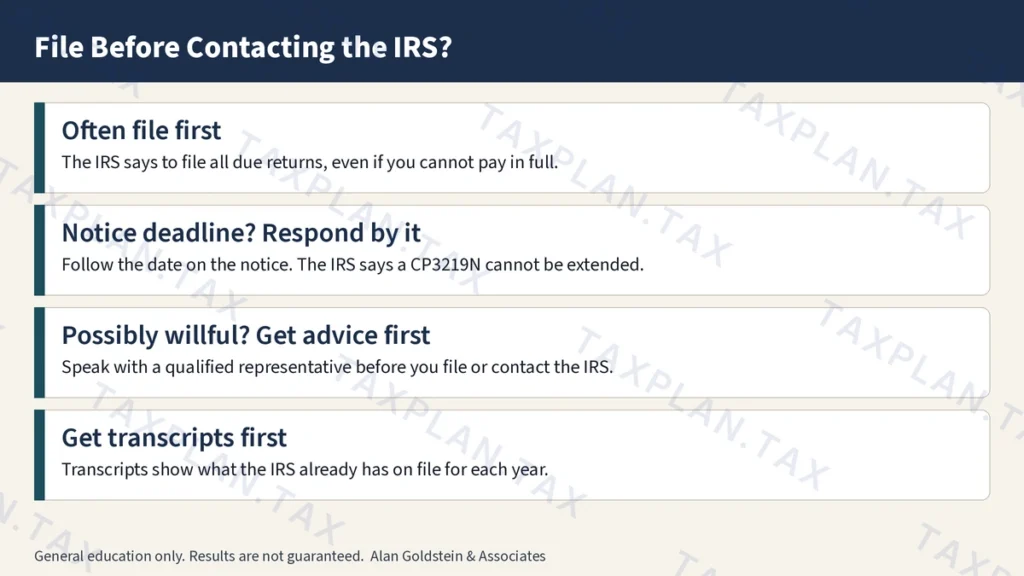


In many ordinary cases, you should file unfiled returns before contacting the IRS. The IRS tells taxpayers to file all returns that are due, whether or not they can pay in full. However, there are exceptions. A notice with a deadline, an assigned IRS agent, or possible willfulness may call for advice first. This guide explains when each approach tends to make sense.
Key Takeaways
- The IRS says to file all due returns even if you cannot pay. It accepts delinquent returns filed on your own initiative.
- Filing first can limit penalty growth, replace a possible substitute return, and open payment options.
- If you received a notice, follow its deadline and send the return where the notice says.
- If your failure to file may have been willful, get qualified advice before you contact the IRS or file.
- Get transcripts first. They show what the IRS already knows, and you can order them without calling anyone.
Should you file unfiled returns before contacting the IRS?
Usually yes, if you have no notice deadline and no willfulness concerns. The IRS asks you to file every past-due return and says you can deal with any balance afterward.
The IRS past-due filing page says to file all returns that are due, regardless of whether you can pay in full. Policy Statement 5-133 says the IRS will accept all delinquent returns a taxpayer submits, on his or her own initiative or at an IRS request. A delinquent return is a required return that arrives after its due date.
Why does filing first usually help?
It gives you control of the numbers and ends the unfiled status. That can matter more than any call to the IRS.
- Penalties. The failure-to-file penalty stops growing once you file. It is 5% of unpaid tax per month, up to 25%, under IRC §6651.
- Substitute returns. If you do not file, the IRS may prepare a return that might not give you credit for deductions and exemptions.
- Refunds. The IRS holds refunds while returns are past due. You generally must claim a refund within three years of the due date.
- Payment options. Installment agreements and offers in compromise require filing compliance.
On that last point, IRM 5.14.1 says taxpayers must establish filing and payment compliance before the IRS grants an installment agreement. The Form 656 booklet says you must file all required returns before an offer can be considered.
What if you cannot pay the tax?
File anyway. The IRS says to file whether or not you can pay in full, and it offers options for any balance.
The IRS says you may request an additional 60 to 120 days to pay, an installment agreement, or an offer in compromise. Penalties and interest continue on unpaid tax, so a payment plan still matters. Our guides cover an installment agreement for unfiled returns and an offer in compromise for unfiled returns.
When should you contact the IRS or a representative first?
Do so when a deadline is running, a case is assigned, or willfulness is a real concern. In those situations, how you proceed can matter as much as what you file.
What if you already received a notice?
Respond by the date on the notice. The IRS says to send your past-due return to the location shown on the notice you received.
Notices such as CP59, CP515, CP516, and CP518 ask you to file or explain on Form 15103 why you do not need to file. A CP3219N is a 90-day letter. You have 90 days from its date to petition the Tax Court, or 150 days if you are outside the country. According to the IRS, you cannot request an extension to file after a CP3219N.
What if a revenue officer or examiner is assigned?
Then contact that person or have a representative do it. A case in the field is already under review, and the IRS may set a filing date.
The Internal Revenue Manual (IRM) says an officer who does not secure a return may set a specific date to file. The IRM treats a failure to file by that date as a refusal to file under IRC §7203, and enforcement may follow (IRM 5.1.11.7). A representative needs a signed Form 2848 to speak for you.
What if your failure to file may have been willful?
Get qualified advice before you contact the IRS or file. Willfulness raises different issues than ordinary late filing.
Willful failure to file is a misdemeanor under §7203. In United States v. Bishop (1973), the Supreme Court said willfulness generally means a voluntary, intentional violation of a known legal duty. The IRM tells collection employees not to solicit returns when a failure to file appears willful or fraud is indicated. Instead, they suspend activity and report the facts. A representative can help you judge your exposure. If criminal exposure is possible, ask whether the IRS Voluntary Disclosure Practice applies. It is only for willful cases, and the IRS says it does not guarantee immunity.
What should you do first, step by step?
Start with information, not with a phone call. The steps below are a general order, not advice for your situation.
- Order your IRS transcripts. Our guide to filing past-due federal tax returns explains what to look for.
- Check whether the IRS already assessed tax for any year through a substitute return.
- Read every notice and note each deadline.
- Decide whether to sign a Form 2848 so a representative can act for you.
- Prepare accurate returns for each required year.
- File them as the IRS directs, then pay or arrange payment of any balance.
The IRS says it accepts e-filed returns for the two most recent prior years if you find a provider. Older years generally go in by paper. See our article on how to file multiple years of unfiled federal tax returns.
Does it matter if you file before the IRS contacts you?
It can. Filing before contact keeps you ahead of a substitute return and may keep a disclosure timely. However, filing late never erases penalties already earned.
After a revenue officer secures a delinquent return, the IRM tells the officer to advise the taxpayer that all tax, penalty, and interest is immediately due (IRM 5.1.11.6). The IRS may also compare income on a filed return with third-party reports. A mismatch can lead to a CP2000-series notice. That is why transcripts matter before you file.
Late-filing penalties generally remain unless the IRS removes them. In United States v. Boyle (1985), the Court held that relying on an agent to meet a filing deadline is not reasonable cause. For the minimum penalty, the IRS lists $525 for Form 1040 and 1120 returns due after December 31, 2025, or 100% of the tax if less (IRS failure to file penalty). Relief such as first-time abatement may help in some cases. It requires timely filing in the prior three years, so it rarely fits a multi-year gap.
What are the risks of filing first?
The main risks are an inaccurate return and a balance you cannot yet pay. Both are manageable with preparation.
A return you sign is a statement under penalties of perjury. If you file without checking transcripts and records, you may omit income the IRS already knows about. A mismatch can lead to a notice or an examination referral. Also, a return that shows tax due creates a bill. Unpaid tax can lead to collection under the IRS process, so plan your payment option when you file. Our guide to substitute returns shows what happens when the IRS files first.
Frequently Asked Questions
Can I call the IRS first to ask what to do?
Yes, but you do not need to. The IRS says to file all due returns, and you can order transcripts online. If a notice came, use the number on it. A representative can also make the call.
Will the IRS accept a return filed before I hear from it?
Yes. Policy Statement 5-133 says the IRS will accept delinquent returns you submit on your own initiative. However, special procedures apply if there are signs of willfulness or fraud.
Should I file all years at once?
Usually you file every required year, and the IRS looks back about six years under policy. The exact set depends on your facts and any notice. See our article on how far back the IRS requires unfiled tax returns.
Do I lose refunds by waiting?
You may. You generally must claim a refund within three years of the return due date. See our guide to the refund deadline for unfiled federal tax returns.
What if I do not have my records?
Start with IRS transcripts, which show wage and income reported to the IRS. Then rebuild other income and expenses from bank records and third-party statements. Do not guess at figures.
Can I file first and ask for penalty relief later?
Often yes. You usually request penalty relief, such as reasonable cause, after you file the return. The IRS may deny relief, so do not assume it will be granted.
Does filing first protect me from criminal charges?
No. Filing does not decide willfulness. If you worry about willful conduct, talk to a qualified representative before taking any step.
What if I owe more than I can pay?
File anyway and ask about payment plans, an offer in compromise, or hardship status. Each has its own rules, and approval is not guaranteed.
Conclusion
For most taxpayers, filing accurate returns first is the sound default. It limits penalty growth, replaces substitute returns, and opens payment options. When a notice deadline is running, an agent is assigned, or willfulness is possible, speak to a qualified representative before you act.
Alan Goldstein, MBA, IRS Enrolled Agent, of Alan Goldstein & Associates in Coral Gables, Florida, helps taxpayers sequence these steps. We can obtain your transcripts, prepare the missing returns, and review IRS collection and resolution options. We cannot guarantee any outcome. To request a confidential review of your unfiled returns, visit our Tax Resolution Services page.
Cases Cited
Sources
- IRS: Filing past due tax returns
- IRS: IRM 1.2.1, Servicewide Policy Statements (Policy Statement 5-133)
- IRS: IRM 5.1.11, Delinquent Return Investigations
- IRS: IRM 5.14.1, Securing Installment Agreements (Payment Plans)
- IRS: Form 656 Booklet, Offer in Compromise
- IRS: Understanding your CP59 notice
- IRS: Understanding your CP515 notice
- IRS: Understanding your CP516 notice
- IRS: Understanding your CP518 notice
- IRS: Understanding your CP3219N notice
- IRS: Understanding your CP2000-series notice
- IRS: About Form 2848, Power of Attorney and Declaration of Representative
- IRS: Criminal Investigation Voluntary Disclosure Practice
- IRS: Failure to file penalty
- IRS: Penalty relief due to First Time Abate or other administrative waiver
- IRC §6651, Failure to file tax return or to pay tax
- IRC §7203, Willful failure to file return, supply information, or pay tax
- United States v. Bishop, 412 U.S. 346, 360 (1973) (official U.S. Reports, Library of Congress)
- United States v. Boyle, 469 U.S. 241, 251 (1985) (official U.S. Reports, Library of Congress)
This article is provided for general educational purposes and does not constitute individualized tax, legal, or accounting advice. Tax consequences depend on the taxpayer’s specific facts and applicable law.
