
Interest on unfiled federal tax returns starts on the original due date of the tax and compounds daily until you pay. The IRS sets the rate each quarter. For the fourth quarter of 2026, the individual underpayment rate is 7%. This guide explains how the rate works, when interest starts, and how to estimate it across several missing years.
Key Takeaways
- Interest runs on unpaid tax from the original due date, even if you never filed and the IRS has not billed you.
- The rate is the federal short-term rate plus 3 percentage points, reset every quarter.
- Interest compounds daily, so you pay interest on past interest.
- Interest also applies to penalties. The start date depends on the penalty.
- The IRS does not remove interest for reasonable cause. It removes interest only when the underlying tax or penalty goes down, or for certain IRS errors or delays.
- Each unfiled year has its own start date, so older years cost more.
What is interest on unfiled federal tax returns?
It is underpayment interest. The IRS charges it on tax, penalties, and earlier interest that remain unpaid after the due date. Its job is to compensate the government for the delay.
The IRS says it charges underpayment interest when you do not pay your tax, penalties, additions to tax, or interest by the due date. Extensions to file do not extend the payment date. See the IRS interest page and IRC §6601.
Interest is not a penalty. The Supreme Court drew that line long ago: “A penalty is a means of punishment; interest a means of compensation” (United States v. Childs, 266 U.S. at 307). Later the Court explained that Congress intended the United States “to have the use of the money lawfully due when it became due” (Manning v. Seeley Tube & Box Co., 338 U.S. at 566). That is why interest runs from the due date and not from the day the IRS finds the problem.
What interest rate does the IRS charge?
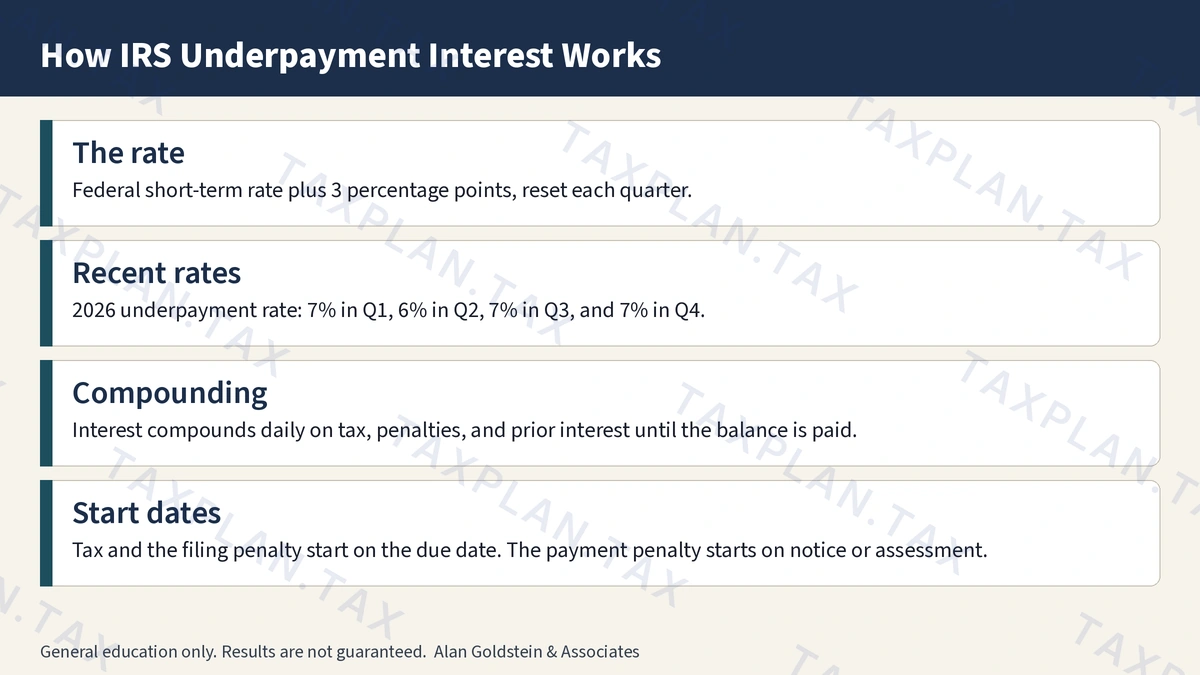
The underpayment rate is the federal short-term rate plus 3 percentage points. The IRS resets it every quarter, so it can change on January 1, April 1, July 1, and October 1.
The statute, IRC §6621(a)(2), sets the formula. The Treasury determines the federal short-term rate for the first month of each quarter. That rate then applies during the next calendar quarter, rounded to the nearest full percent. The IRS posts the results on its quarterly interest rates page.
| Year | Q1 (Jan to Mar) | Q2 (Apr to Jun) | Q3 (Jul to Sep) | Q4 (Oct to Dec) |
|---|---|---|---|---|
| 2024 | 8% | 8% | 8% | 8% |
| 2025 | 7% | 7% | 7% | 7% |
| 2026 | 7% | 6% | 7% | 7% |
These are the IRS underpayment rates for individuals and other non-corporate taxpayers. A rate change does not affect interest already charged for prior quarters. Future quarters will vary, so treat any projection as a rough estimate.
When does interest start and stop?
Interest on the tax starts on the original due date. It stops when you pay in full. For most individuals, that due date is April 15 after the tax year ends.
The start date for penalties differs. According to the IRS, the failure-to-file penalty is due on the return due date, or the extended due date if you filed an extension. Failure-to-pay penalties are due on the date the IRS sends a notice or assesses the penalty. In the statute, interest on the failure-to-file addition runs from the return due date, including extensions (IRC §6601(e)(2)(B)).
There is also a grace period after a notice. If you receive a notice and pay the amount shown by the pay-by date, the IRS does not charge interest on that amount. The statute sets this period at 21 calendar days, or 10 business days if the amount is $100,000 or more (IRC §6601(e)(3)).
How does daily compounding work?
Compounding means interest is added to your balance each day, and the next day’s interest includes it. IRC §6622 requires daily compounding for IRS interest.
The statute says interest “shall be compounded daily.” IRS Topic no. 201 says the same: the unpaid balance is subject to interest that compounds daily. Compounding makes the effective yearly cost a bit higher than the stated rate.
Here is an illustration. It assumes $10,000 of unpaid tax and a constant 7% rate, divided by 365 each day. The rate will not stay constant, and the IRS uses its own daily tables, so treat the figures as approximate.
| Years unpaid | Simple interest at 7% | Daily compounding at 7% |
|---|---|---|
| 1 | $700 | about $725 |
| 2 | $1,400 | about $1,503 |
| 3 | $2,100 | about $2,337 |
| 5 | $3,500 | about $4,190 |
The gap grows each year. This is why a long delay costs more than the rate alone suggests.
Does interest apply to penalties too?
Yes. The IRS says interest increases what you owe until you pay your balance in full, and that includes interest on penalties. Interest keeps accruing on both penalties and prior interest.
In practice, a failure-to-file penalty starts earning interest from the return due date. A failure-to-pay penalty starts earning interest after notice or assessment. If the IRS removes a penalty, it also removes the related interest. For the penalty percentages themselves, see our guide to federal unfiled tax returns penalties.
How is interest calculated when several years are unfiled?
Each year is separate. Interest on each year’s tax starts on that year’s due date and uses the rates in effect for each quarter since then.
Here is an illustrative example. Suppose $5,000 of tax is unpaid for each of three years, and you pay everything on November 30, 2026. The figures below cover tax only. They leave out penalties, and they use the IRS’s published quarterly rates with a simple daily compounding model.
| Tax year | Due date | Days to Nov 30, 2026 | Approximate interest on $5,000 |
|---|---|---|---|
| 2023 | April 15, 2024 | 959 | about $1,038 |
| 2024 | April 15, 2025 | 594 | about $589 |
| 2025 | April 15, 2026 | 229 | about $213 |
Together, that is roughly $1,840 of interest on $15,000 of tax. The oldest year costs the most because it has the most time and the highest rate. However, the IRS’s exact figures can differ from this model. Actual accounts also include penalties and may include payments.
If the IRS prepared a substitute return, interest runs the same way on the assessed tax. Our guide to the substitute for return explains that process.
Can interest be reduced or removed?
Only in limited cases. The IRS says it does not remove or reduce interest for reasonable cause or first-time relief. It reduces interest when the tax or penalty it relates to goes down.
Under IRC §6404(e), the IRS may abate interest caused by an unreasonable error or delay by an IRS employee in a ministerial or managerial act. The delay must not be attributable to you, and the IRS must have contacted you in writing about the matter. The IRS says to use Form 843 for this request.
Interest suspension under §6404(g) is narrower still. It applies to individuals who file by the due date, including extensions, and it excludes any penalty under §6651. Therefore it does not help a taxpayer who never filed on time.
How do you stop interest from growing?
Pay the balance. Interest stops only when the balance is paid in full. Partial payments reduce the base on which later interest is computed.
The IRS says a payment plan does not stop interest. Interest and late payment penalties continue to accrue while you make installment payments (see Topic no. 201). For more on this option, see our guide to installment agreements for unfiled returns. Filing the missing returns also lets the IRS compute the real tax, which may be lower than a substitute return.
If you cannot pay in full, pay what you can and set up a plan. The IRS notes on its reasonable cause page that doing so may reduce future penalties. Keep proof of every payment.
Frequently Asked Questions
Does interest start when I file or when the IRS notices?
Neither. Interest on tax starts on the original due date. That is true even if you file years later and even if the IRS never sent a bill.
Is the interest rate the same for every year I owe?
No. Interest uses the rate in effect for each quarter. One unpaid year can span several rates.
Does an extension stop interest?
No. An extension to file does not extend the time to pay. Interest runs from the original due date.
Can the IRS charge interest on interest?
Yes. IRC §6622 requires daily compounding, so earlier interest becomes part of the balance that later earns interest.
Does interest apply if I am due a refund?
Underpayment interest applies to unpaid tax. If you owe nothing, none builds up. A refund claim has its own deadlines, and the IRS says you generally must file within 3 years of the due date to claim it.
Can I get the interest removed for reasonable cause?
No. The IRS says it does not reduce interest for reasonable cause. It does remove interest related to a penalty if it removes that penalty.
What happens to interest if filing lowers my tax?
The IRS says it automatically reduces the related interest when you reduce the tax or penalties you owe, for example by filing a correct return or qualifying for penalty relief.
Can I estimate interest myself?
You can make a rough estimate with the quarterly rates. The IRS computes the exact amount, and the balance on your IRS notice includes interest accrued to that date.
Conclusion
Interest on unfiled federal tax returns is steady, automatic, and compounding. It starts at the due date, it follows quarterly rates, and the IRS removes it only in narrow cases. Filing and paying sooner is the most reliable way to limit it.
Alan Goldstein, MBA, IRS Enrolled Agent, of Alan Goldstein & Associates in Coral Gables, Florida, helps taxpayers estimate what they owe, prepare past-due returns, and review IRS collection and resolution options. We cannot guarantee any outcome. To request a confidential review of your unfiled returns, visit our Tax Resolution Services page.
Cases Cited
- United States v. Childs, 266 U.S. 304, 307 (1924) (a penalty is a means of punishment; interest is a means of compensation). Supreme Court of the United States. Pinpoint verified against the official U.S. Reports opinion text.
- Manning v. Seeley Tube & Box Co., 338 U.S. 561, 566 (1950) (Congress intended the United States to have the use of the money lawfully due when it became due). Supreme Court of the United States. Pinpoint verified against the official U.S. Reports opinion text.
Sources
- IRS: Interest
- IRS: Quarterly interest rates
- IRS: Topic no. 201, The collection process
- IRC §6601, Interest on underpayment, nonpayment, or extensions of time for payment (Cornell LII)
- IRC §6621, Determination of rate of interest (Cornell LII)
- IRC §6622, Interest compounded daily (Cornell LII)
- IRC §6404, Abatements (Cornell LII)
- United States v. Childs, 266 U.S. 304 (1924) (official U.S. Reports PDF, Library of Congress)
- Manning v. Seeley Tube & Box Co., 338 U.S. 561 (1950) (official U.S. Reports PDF, Library of Congress)
This article is provided for general educational purposes and does not constitute individualized tax, legal, or accounting advice. Tax consequences depend on the taxpayer’s specific facts and applicable law.
