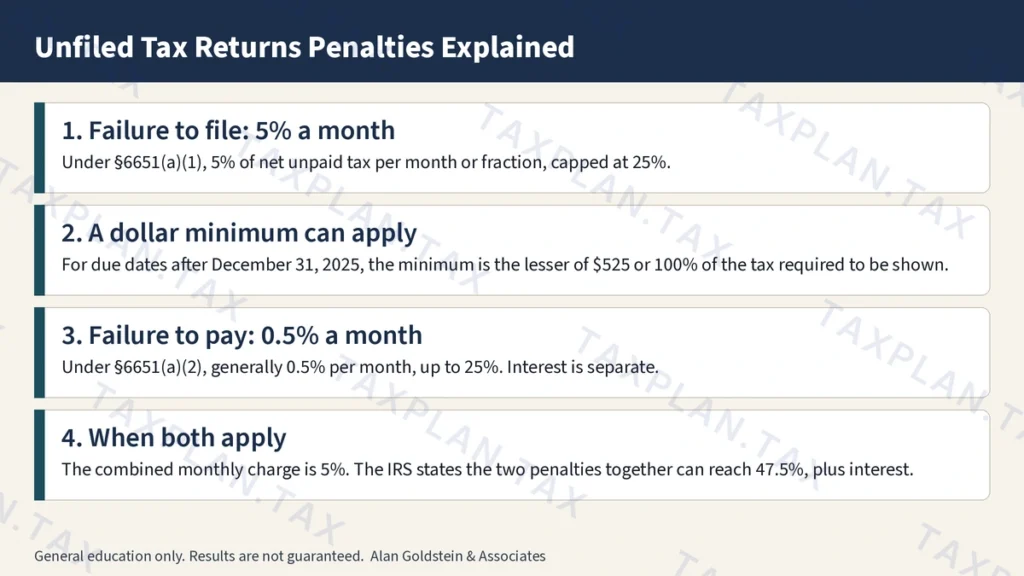


The main civil penalties on unfiled federal income tax returns are the failure-to-file penalty and the failure-to-pay penalty in Internal Revenue Code (IRC) §6651, plus interest that is not itself a penalty. The failure-to-file penalty is generally 5% of the unpaid tax for each month, or part of a month, that the return is late, up to 25%. If an income tax return is more than 60 days late, a minimum penalty can apply: the lesser of an inflation-adjusted amount or 100% of the tax required to be shown. For return due dates after December 31, 2025, that amount is $525. The failure-to-pay penalty is generally 0.5% of the unpaid tax per month, also up to 25%. When both apply in the same month, the failure-to-file rate is reduced so the combined charge is 5% for that month, not 5.5%. Interest compounds daily at the quarterly underpayment rate, which is 7% per year for individuals from October 1 through December 31, 2026. Other penalties can apply as well, including estimated-tax penalties and, in cases of fraudulent failure to file, a much higher §6651(f) rate.
Key Takeaways
- The failure-to-file penalty under §6651(a)(1) is 5% of net unpaid tax per month or fraction thereof, capped at 25%, unless reasonable cause is shown.
- For income tax returns more than 60 days late, the minimum failure-to-file penalty is the lesser of the IRS-published amount or 100% of the tax required to be shown: $525 for due dates after December 31, 2025; $510 for calendar year 2025 due dates; $485 for 2024.
- The failure-to-pay penalty under §6651(a)(2) is generally 0.5% per month, up to 25%. It can drop to 0.25% during an approved installment agreement if an individual filed on time, and it can rise to 1% after a notice of intent to levy.
- When both penalties apply in the same month, the combined monthly charge is 5%. If both run their full course, the IRS states that the total can reach 47.5% of the unpaid tax (22.5% late filing plus 25% late payment), plus interest.
- Interest is separate, compounds daily, and generally is not removed unless a related penalty is removed.
- Penalty relief may be available for reasonable cause, and in some cases through first-time abatement, after the return is filed and other conditions are met.
Introduction and Background
Penalties on unfiled returns exist to encourage timely filing and payment. They are additions to tax, computed on a statutory base, and they are separate from the tax itself. Interest then runs on unpaid tax and, in the manner the Code and regulations provide, on penalties. The practical result is that a year left unfiled can become much more expensive than the original tax, even when the underlying income figures are not in dispute.
The penalty that most often surprises people is not the 0.5% failure-to-pay charge. It is the 5% monthly failure-to-file charge, or the dollar minimum that can apply to a small unpaid tax when the return is more than 60 days late. Understanding the base, the monthly rate, the cap, the minimum, and the interaction with the failure-to-pay penalty is the starting point for reading an IRS notice and for deciding whether to request relief.
How It Works
The failure-to-file penalty
Section 6651(a)(1) adds 5% of the amount required to be shown as tax if the failure to file is for not more than one month, and an additional 5% for each additional month or fraction thereof, not exceeding 25% in the aggregate, unless the failure is due to reasonable cause and not due to willful neglect. The due date is determined with regard to any extension of time to file. Because of the 25% cap, the penalty is not charged for more than five months.
The base is the net unpaid tax: the tax required to be shown, reduced by amounts paid on or before the payment due date and by credits that may be claimed on the return (§6651(b)(1)). If withholding and other timely payments cover the tax, the percentage penalty generally has no base. The minimum penalty, discussed below, is a separate rule for income tax returns that are more than 60 days late.
The minimum penalty and the failure-to-pay interaction
If a chapter 1 income tax return is not filed within 60 days of the due date, determined with regard to extensions, the failure-to-file addition “shall not be less than the lesser of” the inflation-adjusted amount “or 100 percent of the amount required to be shown as tax on such return.” The IRS table of minimums, which matches Rev. Proc. 2024-40 for returns required to be filed in 2026, is:
| Return due date (without extension) | Minimum failure-to-file penalty |
|---|---|
| After December 31, 2025 | $525 |
| January 1, 2025 through December 31, 2025 | $510 |
| January 1, 2024 through December 31, 2024 | $485 |
| January 1, 2023 through December 31, 2023 | $450 |
| January 1, 2020 through December 31, 2022 | $435 |
When both the failure-to-file and failure-to-pay penalties apply in the same month, §6651(c) reduces the failure-to-file penalty by the amount of the failure-to-pay penalty for that month. The IRS describes the result as 4.5% late filing plus 0.5% late payment, or 5% combined, for each of those months. After five months the failure-to-file penalty has reached its cap, and the failure-to-pay penalty can continue, up to 25%. The IRS collection FAQs state that the maximum total of the two penalties is 47.5% (22.5% late filing and 25% late payment).
Other penalties and interest
If the failure to file an income tax return is fraudulent, §6651(f) substitutes 15% per month, not exceeding 75% in the aggregate. Estimated-tax underpayments can produce a separate addition to tax under §6654 (individuals) or §6655 (corporations). Partnership and S corporation late-filing penalties under §§6698 and 6699 are computed on a different base: a per-month, per-partner or per-shareholder amount, up to 12 months. For return due dates after December 31, 2025, the IRS publishes a $255 base rate for those returns.
Interest under §§6621 and 6622 is not a penalty. It compounds daily at a quarterly rate equal to the federal short-term rate plus 3 percentage points for ordinary underpayments. For the fourth quarter of 2026, that underpayment rate is 7% for individuals and for ordinary corporate underpayments. The IRS states that, by law, it cannot remove or reduce interest unless the related penalty is removed or reduced, except in narrow statutory situations.
Benefits and Opportunities
- Filing stops further failure-to-file accrual. Each month or part of a month counts, so filing in the current month, rather than the next, can matter until the five-month cap is reached.
- Paying reduces the failure-to-pay base. Section 6651(b)(2) reduces the unpaid tax, for each month, by amounts paid before the beginning of that month.
- A timely individual return plus an approved installment agreement can reduce the failure-to-pay rate to 0.25% per month while the agreement is in effect. That reduction is not available on the same terms if the return was not filed on time.
- Penalty relief may remove part or all of a failure-to-file charge. Reasonable cause, and in some cases first-time abatement, are the usual administrative paths. Relief is requested after the return is filed, with supporting facts.
- A net-zero year generally avoids the percentage penalty. If timely payments and credits cover the tax, the §6651(a)(1) percentage has no base, which is one reason to file even when you expect a small or zero balance. The minimum penalty can still apply if tax was required to be shown and the return is more than 60 days late.
Legal and Regulatory Considerations
The governing statute is 26 U.S.C. §6651, implemented by Treas. Reg. §301.6651-1. Internal Revenue Manual 20.1.2 is the IRS’s administrative guide for computing and assessing these penalties. The inflation adjustment for the minimum penalty is made under §6651 and published in the annual inflation revenue procedure; Rev. Proc. 2024-40, §2.53, sets the $525 figure for returns required to be filed in 2026. Confirm the figure on the IRS failure-to-file penalty page for the due date at issue, because the table is organized by return due date without extension.
Reasonable cause is a statutory exception, not a courtesy. The taxpayer must show that the failure was due to reasonable cause and not due to willful neglect. In United States v. Boyle, 469 U.S. 241 (1985), the Supreme Court held that a taxpayer’s reliance on an agent to file a return, when the deadline was knowable, was not reasonable cause for a late estate tax return. Illness, a disaster, inability to obtain records despite diligent efforts, and similar facts are the kinds of circumstances the IRS discusses in its penalty-relief materials; each case depends on its facts and on ordinary business care and prudence.
First-time abatement is an administrative waiver described in the Internal Revenue Manual, not a Code section. It generally requires a clean compliance history for the preceding three years, among other conditions, and it applies to certain failure-to-file, failure-to-pay, and failure-to-deposit penalties. It is not a substitute for filing the return, and it does not automatically cover every penalty on a long series of unfiled years.
Criminal liability under §7203 for willful failure to file is separate from these civil additions. A civil penalty assessment is not itself a criminal charge, but willfulness can matter for both §6651(f) and §7203.
Practical Examples
The examples below are illustrative. They use statutory rates and IRS-published dollar amounts. Interest is noted but not computed to the penny.
| Item | Example A: $10,000 unpaid, 8 months late, still unpaid | Example B: $300 tax, more than 60 days late, due after December 31, 2025 |
|---|---|---|
| Failure-to-file (with offset) | 5 months × 4.5% = 22.5% = $2,250 | Computed percentage would be small; minimum applies: lesser of $525 or $300 = $300 |
| Failure-to-pay to date of filing | 8 months × 0.5% = 4% = $400 | Depends on when the $300 is paid; monthly 0.5% of any unpaid portion |
| Combined penalties at filing | $2,650, plus interest | $300 failure-to-file if the minimum is limited by the tax, plus any failure-to-pay and interest |
| If tax remains unpaid after filing | Failure-to-pay can continue, up to 25%, plus interest | Same, on any remaining unpaid tax |
Example C (illustrative): filing on time but paying late, compared with not filing. If the same $10,000 is shown on a timely filed return and is paid eight months later, there is no failure-to-file penalty. The failure-to-pay penalty is 0.5% × 8 = 4%, or $400, plus interest—and the rate can be 0.25% during an approved installment agreement if the other conditions are met. Not filing for those eight months is what adds the $2,250 failure-to-file amount in Example A. That comparison is why the IRS tells taxpayers to file even if they cannot pay in full.
Common Mistakes and Risks
- Confusing the 5% and 0.5% rates. The late-filing penalty is ten times the ordinary late-payment rate, before the offset is applied.
- Ignoring the 60-day minimum. A small unpaid tax can produce a penalty equal to the entire tax if the return is more than 60 days late.
- Assuming an installment agreement always reduces the rate to 0.25%. The IRS describes that reduction for individuals who filed on time and have an approved payment plan.
- Adding the two penalties as 5.5% per month. The Code offsets them so the combined monthly charge is 5% while both apply.
- Expecting interest to be waived as a matter of course. Interest generally follows the tax, and the IRS states that it cannot remove interest unless the related penalty is removed or reduced, except in narrow situations.
- Overlooking entity-level late-filing penalties. Forms 1065 and 1120-S use a per-partner or per-shareholder monthly amount, not the §6651 5% regime.
Frequently Asked Questions
Is there a penalty if I am due a refund and file late?
The percentage failure-to-file penalty is computed on unpaid tax. If timely payments and credits cover the tax, that percentage generally has no base. You can still lose the refund if you file after the §6511 period, and a minimum penalty can apply if tax was required to be shown and the return is more than 60 days late.
Does a filing extension avoid the failure-to-file penalty?
A timely extension extends the filing due date used for that penalty. It does not extend the time to pay, and it does not stop the failure-to-pay penalty or interest on unpaid tax.
What is the maximum combined penalty?
The IRS collection FAQs state that the maximum total for failure to file and failure to pay is 47.5% of the unpaid tax (22.5% late filing and 25% late payment), plus interest.
Can the failure-to-file penalty be removed?
Yes, if you show reasonable cause and not willful neglect, or if you qualify for an administrative waiver such as first-time abatement. You generally need to file the return and submit a written explanation with supporting documents, or follow the instructions on the notice.
Do penalties accrue interest?
The IRS charges interest on penalties. The date from which interest begins varies by the type of penalty. Interest increases the amount you owe until the balance is paid.
What if the IRS already prepared a substitute for return?
Penalties and interest can still apply. Filing your own return can change the tax base on which those amounts are computed if your correct tax is lower than the SFR tax, and it is the first step toward any penalty relief.
Are partnership or S corporation late-filing penalties the same?
No. Sections 6698 and 6699 use a monthly amount multiplied by the number of partners or shareholders, for up to 12 months. For due dates after December 31, 2025, the IRS publishes a $255 base rate. Reasonable-cause relief, and a limited presumption of reasonable cause for certain small partnerships under Rev. Proc. 84-35, may apply.
Is interest currently 7%?
For underpayments during the fourth quarter of 2026 (October 1 through December 31), yes, 7% per year, compounded daily, for individuals and for ordinary corporate underpayments, as announced in IR-2026-98 and Rev. Rul. 2026-15. The rate can change in later quarters.
Conclusion
Penalties on unfiled federal returns are driven by a few statutory rules: a 5% monthly failure-to-file charge capped at 25%, a 0.5% monthly failure-to-pay charge also capped at 25%, an offset when both apply, a minimum penalty for income tax returns more than 60 days late, and interest that compounds daily. The amounts in a particular case depend on the unpaid tax, the due date year, and how long the return and the tax remain outstanding. Filing the return, paying what you can, and then requesting any available relief is how those amounts are limited.
If you need help computing or contesting penalties on unfiled federal returns, Alan Goldstein & Associates can help. Alan Goldstein, MBA, IRS Enrolled Agent, works with individuals, business owners, and their tax advisors to prepare delinquent returns and evaluate reasonable-cause and other penalty-relief options. Contact Alan Goldstein & Associates in Coral Gables, Florida, for a confidential review.
Sources and Authorities
- 26 U.S.C. §6651: https://www.law.cornell.edu/uscode/text/26/6651
- Treas. Reg. §301.6651-1: https://www.ecfr.gov/current/title-26/section-301.6651-1
- IRS, Failure to file penalty: https://www.irs.gov/payments/failure-to-file-penalty
- IRS, Failure to pay penalty: https://www.irs.gov/payments/failure-to-pay-penalty
- IRS, Collection procedural questions (combined 47.5% maximum; $525 minimum for returns required to be filed in 2026): https://www.irs.gov/faqs/irs-procedures/collection-procedural-questions/collection-procedural-questions-3
- Rev. Proc. 2024-40, §2.53: https://www.irs.gov/pub/irs-drop/rp-24-40.pdf
- IRS, Quarterly interest rates and IR-2026-98 / Rev. Rul. 2026-15: https://www.irs.gov/payments/quarterly-interest-rates
- IRM 20.1.2, Failure To File/Failure To Pay Penalties: https://www.irs.gov/irm/part20/irm_20-001-002r
- IRS, Penalty relief: https://www.irs.gov/payments/penalty-relief
- United States v. Boyle, 469 U.S. 241 (1985)
- 26 U.S.C. §§6698 and 6699 (partnership and S corporation late-filing penalties)
This article is provided for general educational purposes and does not constitute individualized tax, legal, or accounting advice. Tax consequences depend on the taxpayer’s specific facts and applicable law.
