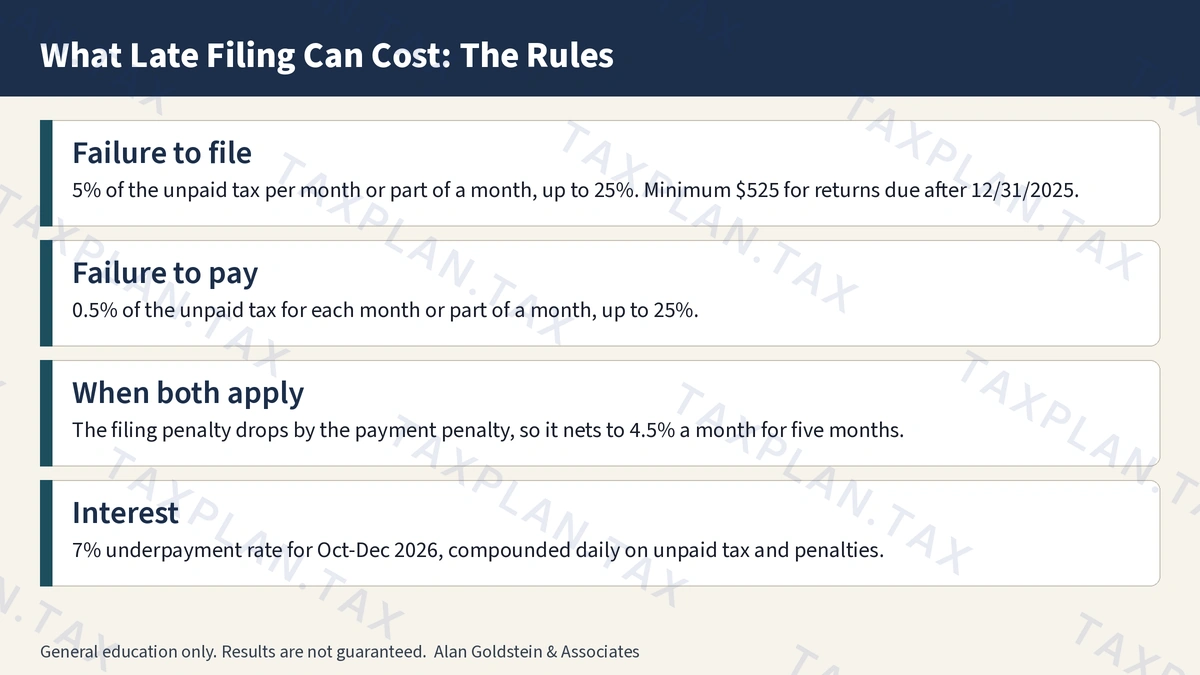

Penalties and interest on unfiled returns can add up to 47.5% of the unpaid tax in penalties alone, plus interest that compounds daily. That 47.5% is the statutory maximum when the failure-to-file and failure-to-pay penalties both apply for long enough. Most people pay less, because they file sooner. This guide shows the rates, a worked example, and what drives the final bill.
Key Takeaways
- The failure-to-file penalty is 5% of the unpaid tax per month, up to 25%.
- The failure-to-pay penalty is 0.5% per month, up to 25%, and it keeps running after the filing penalty stops.
- When both apply, the payment penalty reduces the filing penalty, so the combined rate stays at 5% per month for the first five months.
- For returns due after December 31, 2025, the minimum filing penalty is $525 or 100% of the tax, whichever is less.
- Interest on unpaid tax and penalties compounds daily. The rate is 7% for October through December 2026.
- If withholding and credits cover your tax, the percentage penalties have no unpaid tax to apply to.
What do penalties and interest on unfiled returns cost?
For a late return with tax due, you generally owe three things: a filing penalty, a payment penalty, and interest. The tax itself comes first, and the rest adds on top.
The failure-to-file penalty is 5% of the tax due, less any tax paid on time and available credits, for each month or partial month the return is late. It maxes out at 25%. The IRS failure-to-file page and IRC §6651(a)(1) set this out.
The failure-to-pay penalty is 0.5% of the unpaid tax for each month or partial month, also up to 25% (IRC §6651(a)(2) and (a)(3)). It rises to 1% per month after the IRS gives a notice of intent to levy and 10 more days pass (§6651(d)). Congress aimed these penalties at timely filing. In United States v. Boyle, the Supreme Court said the penalty exists to ensure timely filing so the government can ascertain and collect tax promptly (469 U.S. at 245).
The related guide on failure-to-file and failure-to-pay penalties covers the differences in more detail.
How do the filing and payment penalties combine?
They overlap. When both apply in the same month, the filing penalty drops by the payment penalty, so the total is 5% for that month, not 5.5%.
The IRS says the same thing: the failure-to-pay amount of 0.5% reduces the failure-to-file penalty for each month. After five months the filing penalty maxes out. The payment penalty then continues at 0.5% per month until it reaches 25% or you pay. The table uses the statute’s own arithmetic. It assumes no payments and no penalty relief.
| Months late | Filing penalty before offset | Payment penalty | Combined penalties |
|---|---|---|---|
| 1 | 5% | 0.5% | 5.0% |
| 3 | 15% | 1.5% | 15.0% |
| 5 | 25% | 2.5% | 25.0% |
| 6 | 25% | 3.0% | 25.5% |
| 12 | 25% | 6.0% | 28.5% |
| 50 or more | 25% | 25.0% | 47.5% |
These percentages apply to the tax still unpaid. They do not apply to the whole tax if you paid part on time. Payments, withholding, and credits reduce the base.
How much is the minimum failure-to-file penalty?
For individual and corporate returns due after December 31, 2025, the minimum is $525 or 100% of the tax, whichever is less. It applies if the return is more than 60 days late.
The minimum matters most when the tax is small. For example, 5% of a small balance may be less than the minimum. The statute sets a floor, and the IRS publishes the inflation-adjusted figure by return due date. Here is the IRS table for Forms 1040 and 1120.
| Return due date (without extension) | Minimum penalty |
|---|---|
| After 12/31/2025 | $525 |
| 2025 | $510 |
| 2024 | $485 |
| 2023 | $450 |
| 2020 to 2022 | $435 |
| 2018 to 2019 | $210 |
| 2016 to 2017 | $205 |
| 2009 to 2015 | $135 |
The IRS lists these on its failure-to-file penalty page. The penalty cannot exceed 100% of the tax, so a $100 balance cannot produce a $525 penalty.
How much interest applies to unfiled returns?
Interest runs on unpaid tax, penalties, and prior interest. The individual underpayment rate is 7% for the fourth quarter of 2026, and it compounds daily.
The IRS sets the rate every quarter at the federal short-term rate plus 3 percentage points (IRC §6621(a)(2)). The IRS quarterly interest rates page shows 7% for the first quarter of 2026, 6% for the second, and 7% for the third and fourth. Interest compounds daily under IRC §6622.
The start date depends on the item. Tax is due on the original return date, and extensions to file do not extend the payment date. Interest on the filing penalty starts on the return due date. Interest on the payment penalty starts when the IRS sends a notice or assesses it, per the IRS interest page.
Courts have long treated interest differently from penalties. The Supreme Court described the difference this way: “A penalty is a means of punishment; interest a means of compensation” (United States v. Childs, 266 U.S. at 307).
What does a worked example look like?
Here is an illustrative example. A taxpayer owes $10,000 on a 2025 individual return due April 15, 2026, and files and pays everything on October 15, 2026, six months late. The numbers are approximate and for illustration only.
| Item | Illustrative amount |
|---|---|
| Tax due | $10,000 |
| Failure-to-file penalty (4.5% net for 5 months) | $2,250 |
| Failure-to-pay penalty (0.5% for 6 months) | $300 |
| Interest on the tax (about 183 days, 6% then 7%, compounded daily) | about $335 |
| Interest on the filing penalty from the due date | about $75 |
| Approximate total | about $12,960 |
The IRS’s own computation may differ by a few dollars, because it uses its own daily tables and exact dates. This example shows a late-paid balance only. It leaves out the minimum penalty, payments, state tax, and any relief. In this case, penalties and interest added roughly 30% to the tax.
Waiting longer costs more. The filing penalty stops after five months, but the payment penalty and compounding interest keep growing until you pay. Paying sooner stops that growth.
Do the penalties differ for partnerships and S corporations?
Yes. Partnerships and S corporations pay a per-owner monthly penalty, not a percentage of tax. The base rate is $255 per partner or shareholder per month for returns due after 2025.
The IRS says the penalty runs for each month or partial month the failure continues, up to 12 months. It multiplies the base rate by the number of partners or shareholders and the number of months (IRC §§6698 and 6699). Therefore a 4-owner entity that is 3 months late would face $255 times 4 times 3, or $3,060, before any relief. The IRS also lists a presumed reasonable cause rule for certain small partnerships under Rev. Proc. 84-35.
What if the IRS prepares a substitute return or alleges fraud?
A substitute return does not stop the filing penalty. If the failure to file is fraudulent, the filing penalty increases to 15% per month and the cap to 75%.
Under IRC §6651(g), the IRS disregards a return it makes under §6020(b) when figuring the filing penalty. It treats that return as yours when figuring the payment penalties. Our guide on the substitute for return explains how that process works. Fraud is a separate, serious matter. If it is a concern, speak with a qualified professional before contacting the IRS.
How can you keep the cost down?
File the returns and pay what you can as soon as possible. Every month of delay adds cost, and the IRS offers payment options for balances you cannot pay at once.
- File now. The IRS says to file all due returns even if you cannot pay in full. See filing past due tax returns.
- Pay what you can. Payments reduce the base for the payment penalty and for interest.
- Ask about a payment plan. The IRS says interest and late payment penalties continue to accrue during a plan, so it spreads the cost but does not stop it. Our guide on installment agreements for unfiled returns has more.
- Ask about penalty relief. The IRS may remove penalties for reasonable cause. It does not remove interest on the tax itself.
Frequently Asked Questions
Can penalties and interest exceed the tax I owe?
Yes, over a long period. The two penalties can reach 47.5% of the unpaid tax, and interest compounds daily on top. The minimum filing penalty may also exceed a small balance, but it can never top 100% of the tax.
Do I owe a penalty if I am due a refund?
The percentage penalties apply to unpaid tax. If withholding and credits cover your tax, they generally have no base, because the minimum can never top 100% of the tax required to be shown. However, you can lose a refund if you wait too long. The IRS says you must file within 3 years of the return due date to claim it.
Does the IRS charge interest on penalties?
Yes. The IRS charges interest on penalties. Interest on the filing penalty starts on the return due date. Interest on the payment penalty generally starts at notice or assessment.
Will the penalty stop at some point?
The filing penalty stops growing at 25%. The payment penalty stops at 25% of the unpaid tax. Interest keeps running until you pay the balance in full.
Is the interest rate fixed?
No. The rate is reset every quarter. A change does not affect interest charged for prior quarters, according to the IRS.
Can the IRS remove the penalties?
Possibly. The IRS may remove or reduce some penalties for reasonable cause, and it automatically adjusts the related interest if it removes a penalty. Nothing here is guaranteed.
Which year’s minimum penalty applies if I skipped several years?
The minimum depends on the original due date of each return, not the date you file. A return that was due in 2022 uses the 2020 to 2022 figure of $435, even if you file it in 2026.
Is the example in this article my bill?
No. It is an illustration with round numbers. Your bill depends on your tax, payments, dates, and the IRS’s own calculation.
Conclusion
Penalties and interest on unfiled returns grow with time, but they follow clear rules. Knowing the rates helps you decide how fast to act. Filing and paying sooner usually costs less than waiting.
Alan Goldstein, MBA, IRS Enrolled Agent, of Alan Goldstein & Associates in Coral Gables, Florida, helps taxpayers estimate what they owe, prepare past-due returns, and review IRS collection and resolution options. We cannot guarantee any outcome. To request a confidential review of your unfiled returns, visit our Tax Resolution Services page.
Cases Cited
- United States v. Boyle, 469 U.S. 241, 245 (1985) (purpose of the §6651(a)(1) civil penalty is to ensure timely filing; penalty of 5 percent per month, maximum 25 percent). Supreme Court of the United States. Pinpoint verified against the official U.S. Reports opinion text.
- United States v. Childs, 266 U.S. 304, 307 (1924) (distinguishing penalty, a means of punishment, from interest, a means of compensation). Supreme Court of the United States. Pinpoint verified against the official U.S. Reports opinion text.
Sources
- IRS: Failure to file penalty
- IRC §6651, Failure to file tax return or to pay tax (Cornell LII)
- IRS: Quarterly interest rates
- IRS: Interest
- IRC §6621, Determination of rate of interest (Cornell LII)
- IRC §6622, Interest compounded daily (Cornell LII)
- IRC §6601, Interest on underpayment, nonpayment, or extensions of time for payment (Cornell LII)
- IRS: Filing past due tax returns
- United States v. Boyle, 469 U.S. 241 (1985) (official U.S. Reports PDF, Library of Congress)
- United States v. Childs, 266 U.S. 304 (1924) (official U.S. Reports PDF, Library of Congress)
This article is provided for general educational purposes and does not constitute individualized tax, legal, or accounting advice. Tax consequences depend on the taxpayer’s specific facts and applicable law.
