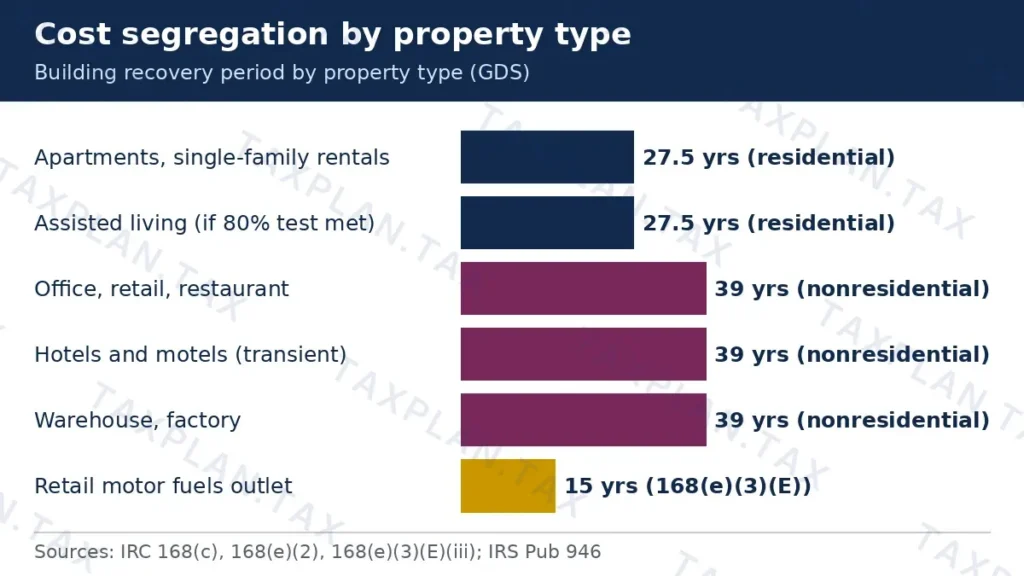


Cost segregation by property type matters because each kind of building has a different mix of personal property, land improvements, and structural components. For example, a restaurant is dense with kitchen equipment and hook-ups. Similarly, an apartment complex has appliances, removable flooring, and large site areas. An office building often has fewer short-lived items, but tenant build-outs may qualify as 15-year property. Therefore, no single result applies to every building. Instead, the property type tells you where to look and which rules control.
In addition, the building’s own life differs by type. Under IRC §168(c), residential rental property uses 27.5 years and nonresidential real property uses 39 years. For property acquired after January 19, 2025, the 5-, 7-, and 15-year parts can generally get 100% bonus depreciation under IRS Notice 2026-11. This guide compares the main property types, explains what each tends to yield in component terms, and shows why dollar results vary.
Key Takeaways
- Cost segregation by property type is about which components a building usually contains, not a fixed percentage.
- The IRS has no official “yield” for any property type. Results depend on the specific building and its records.
- Publication 5653 includes asset matrices for retail, restaurants, biotech and pharmaceutical, casinos, auto dealerships, auto manufacturing, and residential rental property.
- Residential rental buildings use 27.5 years, while most commercial buildings use 39 years.
- Special rules can apply by type, such as QIP for nonresidential interiors, §168(n) for production space, and 15-year treatment for retail motor fuel outlets.
What Does Cost Segregation by Property Type Mean?
Direct answer: Cost segregation by property type means analyzing a building with the classification rules and asset patterns that apply to its specific use. In practice, the use often decides both the building life and the asset class of its personal property.
At the outset, every study follows the same basic law. Buildings and their structural components are §1250 property, as defined in Treas. Reg. §1.48-1(e). In contrast, tangible personal property is §1245 property with a shorter life. However, the asset class for that personal property depends on the business activity. Publication 946, Table B-2 reproduces the Rev. Proc. 87-56 activity classes. For example, class 57.0, Distributive Trades and Services, covers assets used in wholesale and retail trade and in personal and professional services. Moreover, that class has a 5-year life.
Why does the IRS publish industry matrices?
The IRS Cost Segregation Audit Techniques Guide (Publication 5653) includes industry-specific asset matrices in Chapter 7. Specifically, they cover retail, restaurants, biotech and pharmaceutical, casinos and gaming, auto dealerships, auto manufacturing, and residential rental property. The guide says examiners generally should not adjust a return that follows the matrix. Therefore, the matrices are a practical starting point for cost segregation by property type.
How Does Cost Segregation by Property Type Work?
Direct answer: The study team identifies the property’s use, chooses the right building life and asset classes, and then classifies each component with cost records or estimates.
In general, the process itself is the same for every building. First, it includes document collection, a site visit, land allocation, component pricing, and a written report. To see each step, read Cost Segregation Study Process: Step-by-Step Breakdown. What changes by type, then, is where the value tends to sit.
How do the main property types compare?
For quick comparison, the table below summarizes the common drivers for each type. Note that it describes component patterns from IRS guidance, not dollar amounts.
| Property type | Building life | Common shorter-life components | Type-specific rules |
|---|---|---|---|
| Apartments and single-family rentals | 27.5 years | Appliances, furnishings, removable flooring, site work | 80% dwelling unit test; QIP not available |
| Assisted living | 27.5 or 39 years | Furniture, kitchen equipment, courtyards, paving | 80% test applied to care facilities |
| Office buildings | 39 years | Data wiring, decorative finishes, parking | QIP for interior build-outs |
| Retail stores and centers | 39 years | Store fixtures, POS systems, signage, parking | Retail matrix, Pub 5653 Ch. 7.B |
| Restaurants | 39 years | Kitchen hook-ups, food equipment, décor, millwork | Restaurant matrix, Pub 5653 Ch. 7.C |
| Hotels and motels | 39 years | Guest-room furniture, carpet, wallcovering, pools | Transient units are not dwelling units |
| Industrial and warehouse | 39 years | Process electrical, truck courts, special structures | Rev. Proc. 87-56 industry classes; §168(n) |
| Gas stations and car washes | 15 years (if qualifying) | Pumps and other petroleum marketing equipment (class 57.0) | §168(e)(3)(E)(iii); asset class 57.1 |
What Can Each Property Type Yield?
Direct answer: Each type tends to yield a different set of reclassified components. The dollar result still depends on the building’s cost, age, use, and records.
Residential rental property
Apartment and rental buildings use 27.5 years if 80% or more of gross rental income comes from dwelling units, under IRC §168(e)(2)(A). The residential matrix in Publication 5653, Chapter 7.H, states that class 57.0 applies to most §1245 property used with these buildings. That includes appliances, furnishings, and readily removable floor coverings. Meanwhile, paving, fencing, and site lighting are 15-year land improvements. For details, see Cost Segregation for Multifamily Apartment Buildings.
Office and medical buildings
By comparison, office buildings are 39-year property. As a rule, their personal property is often limited to items such as dedicated wiring, decorative lighting, and furniture. However, tenant improvements to an existing building may be qualified improvement property under IRC §168(e)(6), with a 15-year life. Medical offices also add equipment and specialized connections. See Cost Segregation for Office Buildings and Cost Segregation for Medical and Dental Offices.
Retail, restaurant, and hospitality properties
Typically, these types have the most §1245 property. In fact, the retail and restaurant matrices list fixtures, POS systems, kitchen hook-ups, decorative millwork, and theme décor as 5-year property in class 57.0. Likewise, hotels add guest-room furniture and finishes. Hotel units used on a transient basis are not dwelling units under §168(e)(2)(A), so hotels remain 39-year property. See Cost Segregation for Retail Properties and Cost Segregation for Hotels and Motels.
Industrial, warehouse, and self-storage
Warehouses and self-storage facilities tend to yield large land improvements, such as paving and fencing, but fewer interior items. In contrast, manufacturing plants may have process electrical, machinery foundations, and special-purpose structures. Furthermore, manufacturers may also qualify for the new §168(n) production property allowance. See Cost Segregation for Industrial and Warehouse Properties and Cost Segregation for Self-Storage Facilities.
Gas stations and car washes
Finally, this is the clearest example of a type-specific rule. Under IRC §168(e)(3)(E)(iii), a §1250 retail motor fuels outlet is 15-year property, whether or not it also sells food. In addition, asset class 57.1 in Publication 946 gives service station buildings and car wash buildings a 15-year life. So the building itself may qualify for bonus depreciation, if it meets the definition.
What Legal Rules Govern Cost Segregation by Property Type?
Direct answer: The core authorities are IRC §§168 and 1245, Treas. Reg. §1.48-1, Rev. Proc. 87-56, and Publication 5653. Case law sets the tests for personal property.
- IRC §168: recovery periods, residential rental property, QIP, bonus under §168(k), and §168(n).
- IRC §1245(a)(3): defines §1245 property.
- Treas. Reg. §1.48-1: building and structural component definitions.
- Rev. Proc. 87-56: asset classes, reproduced in Publication 946.
- Publication 5653: the audit guide and its industry matrices.
In Hospital Corporation of America v. Commissioner, 109 T.C. 21 (1997), the Tax Court held that the former investment tax credit rules still decide §1245 status. Also, Whiteco Industries, Inc. v. Commissioner, 65 T.C. 664 (1975), set out factors for inherent permanence. Notably, the audit guide discusses both cases.
How does bonus depreciation affect every type?
Public Law 119-21, enacted July 4, 2025, made 100% bonus depreciation permanent for qualified property acquired after January 19, 2025. As a result, it applies to property with a recovery period of 20 years or less. However, property acquired under a written binding contract signed before January 20, 2025, stays under the old phase-down. That rate is 20% for such property placed in service in 2026. Used property can also qualify under Treas. Reg. §1.168(k)-2 if you did not use it before.
What Does Cost Segregation by Property Type Look Like in Practice?
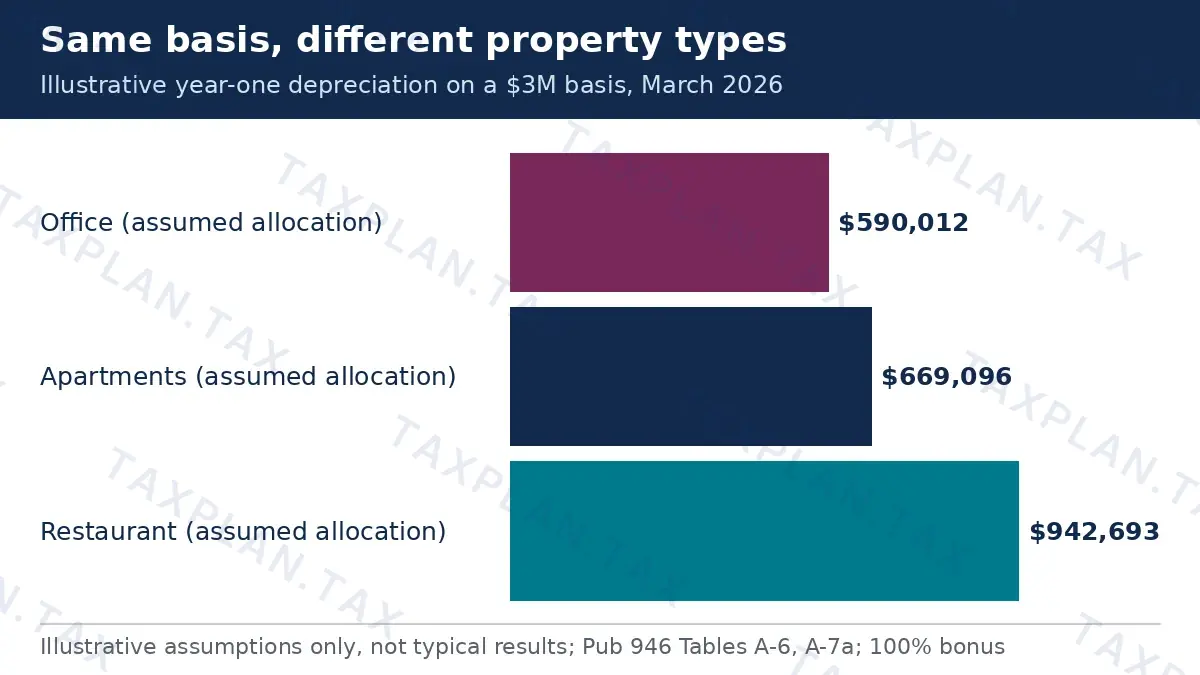
Direct answer: The example below compares three buildings with the same basis. The allocations are illustrative assumptions chosen to show how type changes the result. They are not typical, average, or guaranteed figures.
For this example, assume each building has a $3,000,000 depreciable basis and is placed in service in March 2026. Also, each was acquired under a 2026 contract, so 100% bonus applies to the short-lived parts.
| Illustrative building | 5/7-year (assumed) | 15-year (assumed) | Building portion | Year-one depreciation |
|---|---|---|---|---|
| Office (39-year) | $240,000 | $300,000 | $2,460,000 × 2.033% = $50,012 | $590,012 |
| Apartments (27.5-year) | $360,000 | $240,000 | $2,400,000 × 2.879% = $69,096 | $669,096 |
| Restaurant (39-year) | $600,000 | $300,000 | $2,100,000 × 2.033% = $42,693 | $942,693 |
Here, the building rates come from Publication 946, Tables A-6 and A-7a, for March. Without a study, the office and restaurant would each deduct $60,990, and the apartments would deduct $86,370. So cost segregation by property type changes both the reclassified amount and the building rate. Even so, a real office with heavy build-outs could exceed this restaurant example.
What Are Common Mistakes With Cost Segregation by Property Type?
Direct answer: The biggest mistakes are using generic percentages, applying the wrong matrix, and missing type-specific rules.
- Relying on a “typical” percentage. The audit guide warns examiners about rule-of-thumb studies based on industry averages.
- Using the wrong building life. Hotels are 39-year property, while some care facilities may be 27.5-year property.
- Applying QIP to residential buildings. QIP applies only to nonresidential real property.
- Using one matrix for a mixed-use property. The audit guide directs examiners to the restaurant matrix for a restaurant inside another facility.
- Ignoring activity-based asset classes. Manufacturing equipment lives depend on the industry class, not the building type.
Frequently Asked Questions
Which property type yields the most from cost segregation?
Actually, there is no fixed ranking. Equipment-heavy uses, such as restaurants and retail, often have more 5-year property. However, a specific office or warehouse with large site work can produce more.
Does cost segregation by property type use different IRS rules?
Overall, the law is the same, but the classification depends on use. For instance, the asset class for personal property follows the business activity in Rev. Proc. 87-56.
Is there an IRS table of expected results by property type?
No. The IRS publishes asset classes and audit matrices, not expected percentages. Publication 5653 states that the IRS has not set standards for preparing studies.
Does a mixed-use building need separate analysis?
Yes, because each use may follow different rules. For example, commercial rent can affect the 80% dwelling unit test for a residential building.
Is cost segregation by property type worth it for small buildings?
Sometimes. However, study fees matter more for small properties. Our guide When Is a Cost Segregation Study Worth It? explains how to decide.
Can I apply these rules to a building bought years ago?
Yes. A look-back study claims missed depreciation through Form 3115 and a §481(a) adjustment. The automatic change list appears in Rev. Proc. 2025-23.
Conclusion: How Should You Use Cost Segregation by Property Type?
To sum up, cost segregation by property type tells you where to look, which matrix to use, and which special rules apply. However, it does not give you a guaranteed number. Instead, the result depends on the building’s components, cost records, and placed-in-service date. For property acquired after January 19, 2025, the short-lived parts can generally get 100% bonus depreciation.
Emunah Cost Segregation works with owners of many property types and their CPAs. Alan Goldstein, EA, reviews your building, its use, and its records before any study begins. Then he tells you plainly whether a study makes sense. Contact Emunah Cost Segregation in Coral Gables, Florida, to request a review. For broader context, see Cost Segregation for Commercial Real Estate.
Sources and Authorities
- 26 U.S.C. §168 (including §168(c), §168(e), §168(k), and §168(n)): https://www.law.cornell.edu/uscode/text/26/168
- 26 U.S.C. §1245: https://www.law.cornell.edu/uscode/text/26/1245
- Public Law 119-21 (H.R. 1, 119th Congress), including §70301: https://www.congress.gov/bill/119th-congress/house-bill/1
- IRS Notice 2026-11: https://www.irs.gov/pub/irs-drop/n-26-11.pdf
- Treas. Reg. §1.48-1: https://www.ecfr.gov/current/title-26/section-1.48-1
- Treas. Reg. §1.168(k)-2: https://www.ecfr.gov/current/title-26/section-1.168(k)-2
- IRS Publication 946, including Tables A-6, A-7a, B-1, and B-2: https://www.irs.gov/pub/irs-pdf/p946.pdf
- IRS Publication 5653, Cost Segregation Audit Techniques Guide, including Chapters 4 and 7: https://www.irs.gov/pub/irs-pdf/p5653.pdf
- About Form 3115: https://www.irs.gov/forms-pubs/about-form-3115
- Rev. Proc. 2025-23: https://www.irs.gov/pub/irs-drop/rp-25-23.pdf
- Hospital Corporation of America v. Commissioner, 109 T.C. 21 (1997), and Whiteco Industries, Inc. v. Commissioner, 65 T.C. 664 (1975), as discussed in IRS Publication 5653.
This article is provided for general educational purposes and does not constitute individualized tax, legal, or accounting advice. Tax consequences depend on the taxpayer’s specific facts and applicable law.
