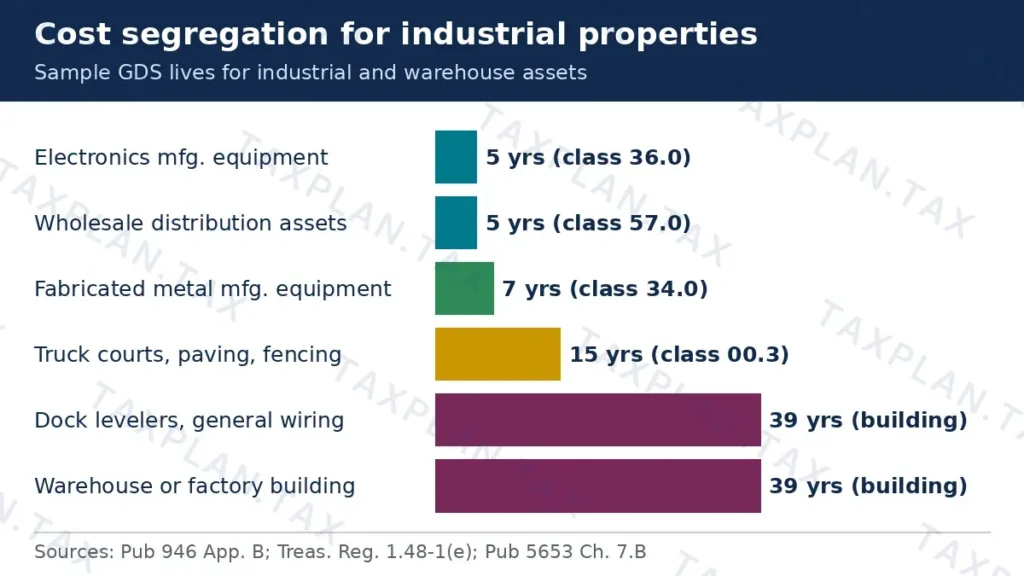


Cost segregation for industrial properties separates a factory, warehouse, or distribution center into building, personal property, and land improvement components, so part of the cost is deducted years sooner. Factory buildings and warehouses are generally 39-year nonresidential real property. In fact, Treas. Reg. §1.48-1(e)(1) names both as examples of buildings. However, industrial sites often include large truck courts, paving, rail spurs, fencing, process wiring, machinery foundations, and special-purpose structures. Many of these items have 5-, 7-, or 15-year lives. In addition, manufacturers may qualify for a new 100% allowance for qualified production property under IRC §168(n), added by Public Law 119-21.
For property acquired after January 19, 2025, shorter-lived parts can generally get 100% bonus depreciation under IRS Notice 2026-11. This guide explains cost segregation for industrial properties, including warehouses, the new production property rules, and two worked examples. It also flags where the rules are still developing, because the IRS has so far issued only interim guidance on §168(n).
Key Takeaways
- Factories and warehouses are generally 39-year nonresidential real property under IRC §168(c).
- Manufacturing equipment lives depend on the industry’s Rev. Proc. 87-56 asset class, as listed in Publication 946.
- Structures that are essentially machinery, such as storage tanks and silos, are not buildings under the regulations.
- Paving, truck courts, fencing, and drainage are usually 15-year land improvements in class 00.3.
- New §168(n) allows a 100% deduction for qualifying production space, with strict dates, an election, and a lessor exclusion.
- Finished-goods storage, offices, and space leased to others do not qualify under §168(n).
What Is Cost Segregation for Industrial Properties?
Direct answer: Cost segregation for industrial properties is an engineering-based study that assigns each part of an industrial property’s cost to its correct depreciation class. It identifies personal property, special-purpose structures, and land improvements that do not belong in the 39-year class.
Industrial property includes manufacturing plants, flex buildings, warehouses, cold storage, and distribution centers. Under IRC §168(e)(2)(B), these are nonresidential real property. Therefore, the building and its structural components use 39-year straight-line depreciation with a mid-month convention.
However, the building definition has two key exceptions. It excludes a structure that is essentially an item of machinery or equipment. It also excludes certain structures that house property used as an integral part of manufacturing or production, if the structure will clearly be replaced when that property is replaced. The regulation lists oil and gas storage tanks, grain bins, silos, and blast furnaces as examples. For a broader view, read What Property Qualifies for a Cost Segregation Study?
How do asset classes work for industrial personal property?
The asset class depends on the activity. Publication 946, Table B-2 reproduces the Rev. Proc. 87-56 classes. For example, class 34.0 covers manufacture of fabricated metal products, with a 7-year life. Class 36.0 covers manufacture of electronic components, with a 5-year life. In contrast, a distribution warehouse used in wholesale trade falls under class 57.0, which also has a 5-year life.
Also note the lessor rule. When a landlord leases an industrial building, the asset class is determined as if the tenant owned the property. The audit guide explains this rule and cites Treas. Reg. §1.167(a)-11(e)(3)(iii).
How Does Cost Segregation for Industrial Properties Work?
Direct answer: A study team gathers cost records and drawings, inspects the site, removes land value, and classifies each component. Then it documents the support for every line.
For new construction, contractor pay applications and invoices are the best support. For an acquisition, the team starts with the purchase price and removes land. Next, it prices each component with cost estimating. The IRS Cost Segregation Audit Techniques Guide explains how examiners review these methods. To see each step, read Cost Segregation Study Process: Step-by-Step Breakdown.
Which industrial components often move to shorter lives?
Every site differs, but studies commonly review these items:
- Process electrical: wiring, panels, and connections that serve production machinery rather than the building.
- Machinery foundations: pads and footings so specially designed that they are in essence part of the equipment. The IRS biotech and pharmaceutical matrix treats these as §1245 property, but says extra thickness alone is not enough.
- Material handling: conveyors, compactors, and hoists, which the retail matrix treats as §1245 property.
- Process climate systems: HVAC installed solely to meet temperature or humidity needs essential to machinery or processing.
- Land improvements: paving, truck courts, sidewalks, fencing, drainage, and landscaping in class 00.3, with a 15-year life.
For cost segregation for industrial properties, the process HVAC point comes from Treas. Reg. §1.48-1(e)(2). It uses an air conditioning and humidification system in a textile plant as an example. In contrast, comfort cooling for workers stays with the building.
What stays in the 39-year class?
Structural components stay with the building. These include walls, floors, roofs, doors, general wiring and lighting, plumbing, central HVAC, and sprinkler systems. The retail matrix also lists permanently installed dock levelers and bumpers as building components. So cost segregation for industrial properties should not treat every loading dock item as equipment. Each dock component needs its own review.
What Are the Benefits of Cost Segregation for Industrial Properties?
Direct answer: The main benefits are larger early deductions, a possible 100% deduction for production space, and better records for future changes.
How does bonus depreciation apply?
Public Law 119-21, enacted July 4, 2025, made 100% bonus depreciation permanent for qualified property acquired after January 19, 2025. Bonus applies to property with a recovery period of 20 years or less. So the 5-, 7-, and 15-year parts found through cost segregation for industrial properties can qualify. However, property acquired under a written binding contract signed before January 20, 2025 stays under the old phase-down, which is 20% for property placed in service in 2026. Used property can also qualify under Treas. Reg. §1.168(k)-2 if you did not use it before.
What is qualified production property under §168(n)?
Section 70307 of Public Law 119-21 added IRC §168(n). If the taxpayer elects, it allows a 100% first-year deduction for qualified production property. This is nonresidential real property used as an integral part of a qualified production activity. The main requirements are:
- Construction begins after January 19, 2025, and before January 1, 2029.
- The property is placed in service in the United States or a U.S. possession before January 1, 2031.
- Original use begins with the taxpayer, subject to a special rule for certain acquired property.
- The taxpayer designates the property in an election.
A qualified production activity means manufacturing, production, or refining of tangible personal property. The activity must result in a substantial transformation of the product. Also, “production” covers only agricultural and chemical production.
IRS Notice 2026-16 provides interim guidance that taxpayers may rely on until proposed regulations are issued. It states that the property must be placed in service after July 4, 2025. It also allows a taxpayer to treat a whole property as qualifying if 95% or more of its space meets the integral part test. Also, the election is made by attaching a statement to the return. The deadline is the due date, including extensions, of the original return for the year the property is placed in service.
What Legal Rules Govern Cost Segregation for Industrial Properties?
Direct answer: The key authorities are IRC §§168 and 1245, the building regulations, Rev. Proc. 87-56 asset classes, Notice 2026-16, and the IRS audit guide.
- IRC §168: recovery periods, bonus under §168(k), and production property under §168(n).
- IRC §1245(a)(3)(B): treats certain tangible property used as an integral part of manufacturing, other than buildings, as §1245 property.
- Treas. Reg. §1.48-1: building and structural component definitions and exceptions.
- Rev. Proc. 87-56: industry asset classes, as reproduced in Publication 946.
- Publication 5653: the audit guide, including the biotech and pharmaceutical matrix in Chapter 7.D and an auto manufacturing matrix in Chapter 7.G.
Two Tax Court cases discussed in the audit guide shape the analysis. In Hospital Corporation of America v. Commissioner, 109 T.C. 21 (1997), the court held that the former investment tax credit rules still decide §1245 status. Also, Whiteco Industries, Inc. v. Commissioner, 65 T.C. 664 (1975), set out factors for inherent permanence.
What does §168(n) exclude?
The statute excludes any portion used for offices, administrative services, lodging, parking, sales, research, software development, engineering, or other functions unrelated to production. Notice 2026-16 adds that receiving and storing raw materials can be essential to the activity. However, storing finished products is not. In addition, property a lessor leases to others is not treated as used by the lessor in a production activity. So most investor-owned warehouses leased to tenants will not qualify.
What about recapture?
Under §168(n)(5), if the property stops being used in a qualified production activity within 10 years and is used in another productive use, §1245 recapture rules apply. In addition, gain on §1245 property is ordinary income up to prior depreciation under IRC §1245. Straight-line building depreciation creates unrecaptured §1250 gain, taxed at up to 25% under IRC §1(h).
What Does Cost Segregation for Industrial Properties Look Like in Practice?
Direct answer: The examples below show a warehouse purchase and a new manufacturing plant. All amounts are illustrative assumptions, not typical or guaranteed results.
Example 1: Buying a distribution warehouse
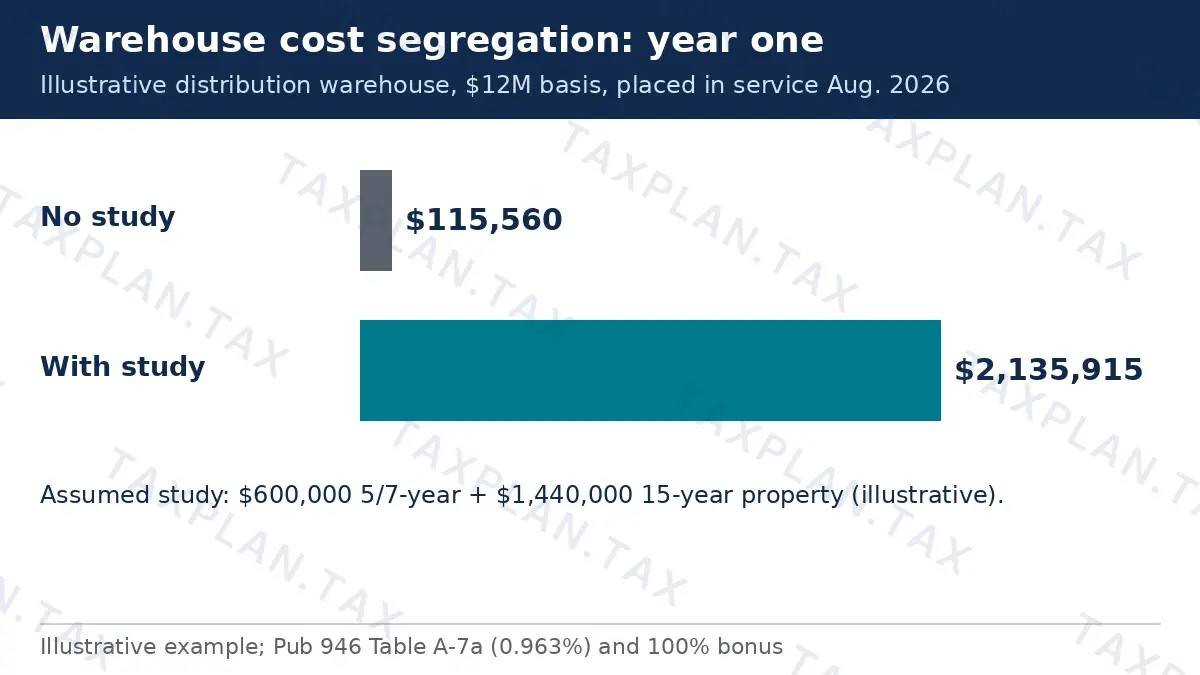
Assume an investor buys a leased distribution warehouse for $15,000,000 under a 2026 contract. The land is worth $3,000,000, so the depreciable basis is $12,000,000. The property is placed in service in August 2026.
| Class (illustrative study) | Basis | Year-one depreciation |
|---|---|---|
| 5- and 7-year personal property | $600,000 | $600,000 (100% bonus) |
| 15-year truck courts, paving, fencing, drainage (class 00.3) | $1,440,000 | $1,440,000 (100% bonus) |
| 39-year building | $9,960,000 | $95,915 |
| Total | $12,000,000 | $2,135,915 |
The 39-year figure uses the August rate of 0.963% from Publication 946, Table A-7a. Without a study, $12,000,000 at 0.963% gives $115,560. So in this example, cost segregation for industrial properties adds about $2,020,355 of first-year depreciation. Because the investor leases the building to others, §168(n) does not apply.
Example 2: A manufacturer builds its own plant
Cost segregation for industrial properties and §168(n) can work together. Next, assume a manufacturer begins building a plant in March 2026 and places it in service in September 2027. The building and site cost $20,000,000, excluding land and production equipment. A study identifies $2,000,000 of personal property and land improvements, which may qualify for 100% bonus.
Of the remaining $18,000,000, assume $15,300,000 relates to production floor and raw-material storage space. If the manufacturer makes a timely §168(n) election, that portion may be deducted in full in 2027. The other $2,700,000 covers offices and finished-goods storage, so it stays 39-year property. At the September rate of 0.749%, that portion yields $20,223 in year one. Therefore, illustrative year-one depreciation totals $17,320,223.
What Are Common Mistakes With Cost Segregation for Industrial Properties?
Direct answer: Most errors involve overreaching on building systems, misreading §168(n), or weak support for process items.
- Treating a warehouse as a special-purpose structure. The regulation names warehouses as buildings.
- Calling comfort HVAC process equipment. Only systems meeting the sole justification test qualify.
- Claiming §168(n) for leased buildings. Lessor-owned property used by a tenant does not qualify for the lessor.
- Including finished-goods storage or offices in production property. Notice 2026-16 and the statute exclude them.
- Missing the election. The §168(n) election is due by the original return’s due date, including extensions.
- Ignoring state law. Some states do not follow federal bonus or §168(n).
Frequently Asked Questions
Is cost segregation for industrial properties worth it for a plain warehouse?
Often, yes, because site work can be large. Cost segregation for industrial properties frequently finds value in truck courts and paving. However, a basic shell warehouse has fewer personal property items than a plant. Our guide When Is a Cost Segregation Study Worth It? explains how to decide.
Can a warehouse qualify for §168(n)?
Only in limited cases. Raw-material storage can be essential to a production activity when it is in the same property or integrated facility. However, finished-goods storage and space leased to others do not qualify.
Are machinery foundations 39-year property?
Not always. In cost segregation for industrial properties, a foundation so specially designed that it is in essence part of the machinery may be §1245 property. General building foundations stay in the 39-year class.
Can I apply cost segregation for industrial properties bought years ago?
Yes. A look-back study claims missed depreciation through Form 3115 and a §481(a) adjustment. The automatic change list appears in Rev. Proc. 2025-23. Note that §168(n) has its own dates and election rules.
Does cold storage change the analysis?
It can, and cost segregation for industrial properties with cold storage needs extra care. Refrigeration equipment is often personal property. However, insulated walls and floors of a building generally remain structural components, so each item needs review.
Do food processing plants qualify for §168(n)?
They may, if the activity results in a substantial transformation. However, food or beverages prepared in the same building as a retail establishment that sells them are excluded.
Conclusion: Is Cost Segregation for Industrial Properties Right for You?
To sum up, cost segregation for industrial properties can move site work, process systems, and special-purpose structures out of the 39-year class. For property acquired after January 19, 2025, those parts can generally get 100% bonus depreciation. In addition, manufacturers that build new production space may elect the §168(n) allowance. However, warehouses and general building systems usually stay in the 39-year class, so careful classification matters.
Emunah Cost Segregation works with industrial owners, manufacturers, and their CPAs. Alan Goldstein, EA, reviews your property, construction records, and use of space before any study begins. Then he tells you plainly whether a study makes sense. Contact Emunah Cost Segregation in Coral Gables, Florida, to request a review. For related reading, see Cost Segregation for Commercial Real Estate.
Sources and Authorities
- 26 U.S.C. §168 (including §168(c), §168(e), §168(k), and §168(n)): https://www.law.cornell.edu/uscode/text/26/168
- 26 U.S.C. §1245 (including §1245(a)(3)): https://www.law.cornell.edu/uscode/text/26/1245
- 26 U.S.C. §1 (including §1(h)): https://www.law.cornell.edu/uscode/text/26/1
- Public Law 119-21 (H.R. 1, 119th Congress), including §§70301 and 70307: https://www.congress.gov/bill/119th-congress/house-bill/1
- IRS Notice 2026-11: https://www.irs.gov/pub/irs-drop/n-26-11.pdf
- IRS Notice 2026-16 (qualified production property): https://www.irs.gov/pub/irs-drop/n-26-16.pdf
- Treas. Reg. §1.48-1: https://www.ecfr.gov/current/title-26/section-1.48-1
- Treas. Reg. §1.167(a)-11: https://www.ecfr.gov/current/title-26/section-1.167(a)-11
- Treas. Reg. §1.168(k)-2: https://www.ecfr.gov/current/title-26/section-1.168(k)-2
- IRS Publication 946, including Table A-7a and Table B-1/B-2: https://www.irs.gov/pub/irs-pdf/p946.pdf
- IRS Publication 5653, Cost Segregation Audit Techniques Guide, including Chapters 7.B, 7.D, and 7.G: https://www.irs.gov/pub/irs-pdf/p5653.pdf
- About Form 3115: https://www.irs.gov/forms-pubs/about-form-3115
- Rev. Proc. 2025-23: https://www.irs.gov/pub/irs-drop/rp-25-23.pdf
- Hospital Corporation of America v. Commissioner, 109 T.C. 21 (1997), and Whiteco Industries, Inc. v. Commissioner, 65 T.C. 664 (1975), as discussed in IRS Publication 5653.
This article is provided for general educational purposes and does not constitute individualized tax, legal, or accounting advice. Tax consequences depend on the taxpayer’s specific facts and applicable law.
