

Filing unfiled returns usually does not, by itself, stop an IRS wage garnishment, but it is often the step that makes a release possible. The IRS calls a wage garnishment a wage levy. A wage levy continues until the IRS releases it, and a late return is not one of the release grounds listed in the Internal Revenue Code. Filing can still correct a substitute-return balance and open the payment options that lead to a release. This guide explains what filing changes and what it does not.
Key Takeaways
- An IRS wage levy is continuous. It lasts until the IRS releases it under IRC §6343.
- Filing a return is not a listed release ground. Release depends on paying, a payment plan, hardship, or another statutory reason.
- Filing can fix an inflated substitute-return balance, because the IRS says it generally adjusts the account to match your return.
- The IRS requires all returns to be filed before it will approve a payment plan or consider an offer in compromise.
- A timely request for a Collection Due Process hearing can suspend levy while the hearing is pending.
- Part of your pay is exempt from levy, and the exempt amount depends on your standard deduction and dependents.
Can filing unfiled returns stop IRS wage garnishment?
Not automatically. Filing the returns does not by itself release a wage levy. It can, however, lower the balance and let you qualify for the options that do stop or release a levy.
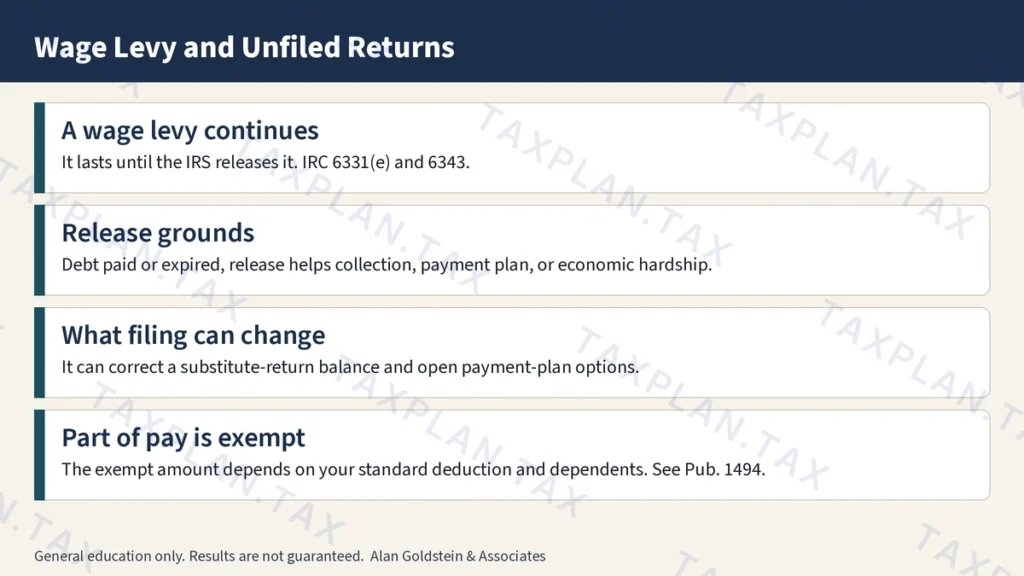
A levy is the legal seizure of property to satisfy a tax debt. According to the IRS levy page, a levy can garnish wages, take money from bank accounts, or seize and sell property. Under IRC §6331(e), a levy on salary or wages is continuous from the date it is first made until the IRS releases it under §6343.
The IRS does not need a court order. In United States v. National Bank of Commerce, the Supreme Court described the levy as a “provisional remedy” that typically “does not require any judicial intervention” (472 U.S. at 720). That is why a wage levy can start without a lawsuit.
Why does the IRS levy wages for years you never filed?
The IRS usually levies only after it assesses tax. For a missing return, that assessment often comes from a substitute for return (SFR), which the IRS builds from third-party income data.
The IRS says it usually levies only after four steps. It assessed the tax and sent a notice and demand. It sent a Final Notice of Intent to Levy and Notice of Your Right to a Hearing at least 30 days before the levy. It sent advance notice of third-party contact. And you did not pay or make arrangements, per the IRS levy explainer.
The IRS past-due returns page warns that the return the IRS prepares “will lead to a tax bill, which, if unpaid, will trigger the collection process,” including a levy on wages. See our guide to the substitute for return for the earlier steps.
What does filing your own returns change?
It can change the amount owed, and it can unlock collection alternatives. It does not erase the levy on its own.
Can filing reduce a substitute-return balance?
Often, yes. A substitute return may not credit deductions and exemptions you could claim. The IRS says it is still in your best interest to file your own return, and the IRS will generally adjust your account to reflect the correct figures.
The IRS says it takes about six weeks to process an accurately completed past-due return. Therefore the levy may continue during that time. A lower balance can still shrink what the IRS seeks later, but it does not guarantee a release.
Does filing open payment plan and offer options?
Yes. The IRS says you must file all required returns to qualify for a payment plan. Before it considers an offer in compromise, you must have filed all returns, and taxpayers in an open bankruptcy case are not eligible.
Those requirements appear in IRS Publication 594 and Topic no. 201. Our guides to installment agreements and offers in compromise cover each route.
How can the IRS release a wage levy?
The Code lists the release grounds. Filing a return is not among them, but several grounds depend on steps that filing makes possible.
IRC §6343(a)(1) says the IRS shall release a levy if any of these apply:
- The liability is satisfied or becomes unenforceable by lapse of time.
- Release will facilitate collection of the liability.
- You entered an installment agreement, unless the agreement provides otherwise.
- The levy is creating an economic hardship due to your financial condition.
- The property’s value exceeds the liability, and a partial release will not hinder collection.
The IRS says a release does not mean you no longer owe the balance. You must still make arrangements, or the IRS may reissue the levy. See the IRS page on how to get a levy released.
What is the economic hardship route?
The IRS says a wage levy that creates an immediate economic hardship must be released. You generally have to show your finances.
The IRS defines economic hardship as the levy preventing you from meeting basic, reasonable living expenses. It usually needs financial information from you to decide. A release does not erase the balance, and the IRS says it will work with you on a payment plan or other steps. Hardship release is a stop-gap, not a resolution. Learn more on the IRS page about a levy causing a hardship.
How much of your pay is exempt from a wage levy?
Part of your wages is exempt. The exempt amount is based on your standard deduction and the dependents you are allowed.
The IRS mails Publication 1494 with the levy so your employer can figure the exempt amount. Your employer gives you a Statement of Dependents and Filing Status, which you must return within three days. If you do not return it, the IRS figures your exempt amount as if you were married filing separately with no dependents. See information about wage levies and IRC §6334(d). The IRS also says a bonus paid separately from your paycheck may go entirely to the IRS.
Can a Collection Due Process hearing pause a wage levy?
Yes, if you request it on time. The IRS says collection is suspended from the date of a timely request until 30 days after the notice of determination, or until Tax Court review ends.
You may request a Collection Due Process hearing after a Final Notice of Intent to Levy. Publication 594 says the request deadline is 30 days from the date of the letter for a proposed levy, and a timely request preserves your right to court review. You can propose a payment plan or offer there, and Appeals may ask for returns or financial information. The statute also lets you petition the Tax Court within 30 days of the determination (IRC §6330(d)(1)). If you miss the deadline, you may request an equivalent hearing within one year, but you cannot go to court afterward. During an equivalent hearing the IRS may levy, although it normally does not, according to Publication 594.
What if the garnishment is not from the IRS?
Different rules apply. Other garnishments come from other legal sources, not from the Internal Revenue Code. Filing a federal return does not directly affect those.
This article covers IRS levies on unfiled returns. For other garnishments, such as a court judgment or child support, check the order and talk with an attorney.
What steps make sense if the IRS is levying your wages?
Move quickly and in order. Read the notice, contact the IRS, file the missing returns, and ask for the right release option.
- Find the notice dates. Look for the response deadline on the Final Notice or levy letter.
- Call the IRS. The IRS says to contact it right away and to request a release. Use the phone number on your notice.
- File every missing return. Prepare accurate returns using records and transcripts, as described in the IRS past-due return guidance.
- Choose an option. A payment plan, offer, hardship request, or hearing request may fit. See our guide to stopping IRS collections on unfiled tax returns for the full list.
- Keep copies. Save proof of every filing and call.
Frequently Asked Questions
Will filing my missing returns release my wage levy?
Not by itself. A levy ends when the IRS releases it. Release grounds include a payment plan, hardship, or payment in full. Filing may make those options available.
How long does a wage levy last?
It is continuous until the IRS releases it. The IRS says part of your wages goes to the IRS each pay period until you make other arrangements to pay or you pay the overdue tax in full.
Can the IRS garnish my wages without going to court?
Yes. A levy is an administrative remedy. The Supreme Court has said it typically does not require judicial intervention, though the IRS must give notice and a right to a hearing first.
Do I get any of my pay during a levy?
Yes. A portion is exempt. Publication 1494 and the IRC §6334(d) formula set the exempt amount based on the standard deduction and dependents.
Can I stop the levy by requesting a hearing?
A timely Collection Due Process request can suspend levy while the hearing is pending, per Publication 594. If you miss the 30-day deadline, you may still request an equivalent hearing within one year, but you lose the right to go to court.
Does a payment plan stop a wage levy?
If you enter an installment agreement, the IRS releases a levy unless the agreement provides otherwise. Interest and penalties continue to accrue under a plan.
Is a wage garnishment the same as a wage levy?
For IRS purposes, yes. The IRS says a levy can garnish wages. Garnishments by private creditors, courts, or states work under different rules.
Can a tax professional contact the IRS for me?
Yes, with a power of attorney such as Form 2848. The IRS says you can authorize someone to contact it on your behalf.
Conclusion
Filing unfiled returns rarely stops a wage garnishment by itself, but it is usually the first step toward getting one released. A wage levy ends only when the IRS releases it, so the goal is to qualify for a ground the Code recognizes.
Alan Goldstein, MBA, IRS Enrolled Agent, of Alan Goldstein & Associates in Coral Gables, Florida, helps taxpayers prepare past-due returns and evaluate IRS collection and resolution options. We cannot guarantee any outcome. To request a confidential review of your unfiled returns and any IRS levy, visit our Tax Resolution Services page.
Cases Cited
Sources
- IRS: Levy
- IRS: What is a levy?
- IRS: How do I get a levy released?
- IRS: What if a levy is causing a hardship?
- IRS: Information about wage levies
- IRS: Publication 594, The IRS Collection Process
- IRS: Topic no. 201, The collection process
- IRS: Filing past due tax returns
- IRC §6331, Levy and distraint (Cornell LII)
- IRC §6334, Property exempt from levy (Cornell LII)
- IRC §6343, Authority to release levy and return property (Cornell LII)
- IRC §6330, Notice and opportunity for hearing before levy (Cornell LII)
- United States v. National Bank of Commerce, 472 U.S. 713 (1985) (official U.S. Reports PDF, Library of Congress)
This article is provided for general educational purposes and does not constitute individualized tax, legal, or accounting advice. Tax consequences depend on the taxpayer’s specific facts and applicable law.
