

Penalty abatement for unfiled returns is sometimes possible, but you generally have to file the returns first and then ask the IRS to remove the penalties. The IRS may remove or reduce failure-to-file and failure-to-pay penalties for reasonable cause, under an administrative waiver, or under a statutory exception. This guide explains each route, what the IRS looks for, and how to ask.
Key Takeaways
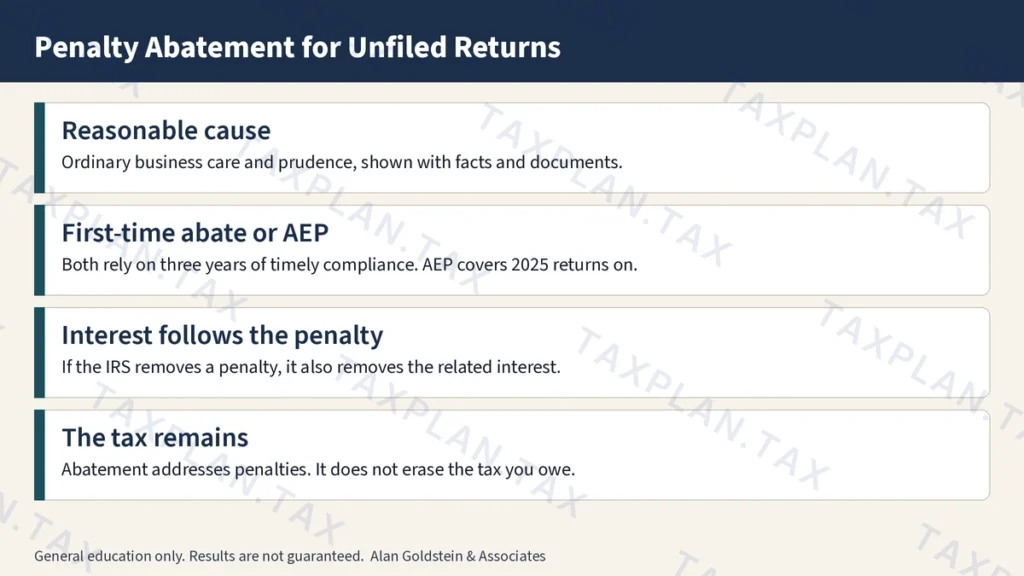
- Penalty abatement means the IRS removes or reduces a penalty. It does not erase the tax itself.
- The main routes are reasonable cause, first-time abate (FTA) or the new automatic exemption, and statutory or disaster relief.
- Reasonable cause requires ordinary business care and prudence. Reliance on an agent to file is not enough.
- If the IRS removes a penalty, it also removes the related interest.
- Long delinquencies are hard cases. Each year needs its own facts, and the IRS looks at how fast you fixed the problem.
Can you get penalty abatement for unfiled returns?
Sometimes. The IRS may remove failure-to-file and failure-to-pay penalties if you show reasonable cause or qualify for an administrative waiver. Approval is not guaranteed.
A penalty abatement is the IRS removing or reducing an assessed penalty. The failure-to-file penalty is 5% of the tax due for each month or part of a month the return is late, up to 25%. According to the IRS failure-to-file page, the penalty does not apply if you show the failure was due to reasonable cause. The statute says the same in IRC §6651(a).
In practice, filing first is the best order. It stops the failure-to-file penalty from growing and gives the IRS the facts it needs. Our guide to filing past-due returns explains how to get current.
Which penalties can you ask the IRS to remove?
You can generally ask for relief from the failure-to-file, failure-to-pay, and, for businesses, failure-to-deposit penalties. The fraud penalty works differently.
The IRS lists these penalties as eligible for administrative relief: failure to file under IRC §6651(a)(1), §6698(a)(1), and §6699(a)(1), and failure to pay under §6651(a)(2) and (a)(3). It also lists failure to deposit under §6656. See the IRS administrative penalty relief page.
Fraud is a separate matter. Under IRC §6651(f), a fraudulent failure to file raises the monthly rate from 5% to 15% and the cap from 25% to 75%. Fraud is a different standard from reasonable cause, so do not expect ordinary relief if fraud is an issue. In that situation, speak with a qualified advisor before contacting the IRS.
Substitute returns also matter. Under IRC §6651(g), a return the IRS makes under §6020(b) is disregarded for the failure-to-file addition. However, it is treated as your return for the failure-to-pay additions. Our article on substitute returns explains how they arise.
What does reasonable cause require?
You must show that you used ordinary business care and prudence and were still unable to file on time. The IRS decides this case by case, based on all the facts.
The regulation says that if the taxpayer “exercised ordinary business care and prudence and was nevertheless unable to file the return within the prescribed time,” the delay is due to reasonable cause (26 CFR §301.6651-1(c)(1)). It also calls for a written statement made under penalties of perjury. The Supreme Court accepted that standard in United States v. Boyle (469 U.S. at 246, 1985).
The IRS gives examples that may qualify. They include fires, natural disasters, inability to get records, death or serious illness of the taxpayer or immediate family, and system problems that delayed a timely electronic filing. The IRS reasonable cause page also lists reasons that generally do not qualify:
- Reliance on a tax professional
- Lack of knowledge of the law
- Mistakes and oversights
- Lack of funds, by itself
In Boyle, the Court held that failing to file on time is not excused by relying on an agent. It held that such reliance is not reasonable cause (469 U.S. at 252).
How do long delinquencies affect a reasonable cause request?
They make the request harder. The IRS looks at the time between the event you cite and the date you finally filed. A good reason for the first missed deadline may not cover years of delay.
IRM 20.1.1.3.5 tells IRS employees to consider the length of time between the event and later compliance. It gives examples where relief may not be appropriate. One involves a death that happened months before the due date, with the return filed a year late. Another involves records that came back well before the deadline, with filing months later (IRM 20.1.1).
Therefore, build the story year by year. Explain what happened, when it ended, and what you did next. If the reason covers only part of the delay, say so. Our guide on common reasons people do not file shows which reasons the law generally excuses.
What are first-time abate and the automatic exemption?
First-time abate (FTA) is an administrative waiver for taxpayers with a clean three-year compliance history. The IRS says FTA is transitioning to the Automatic Exemption from Penalty (AEP), which the IRS says begins in summer 2026.
Under AEP, if you file or pay late but filed timely and paid tax due for the three prior years, the IRS does not assess the penalty. The IRS page says AEP applies to 2025 tax year returns and later. FTA still applies to prior years, but you must ask for it. Both depend on a history of timely filing.
For a long-term non-filer, that history is the obstacle. The IRM FTA criteria (IRM 20.1.1.3.3.2.1) look at whether you filed the same return for the three preceding years and whether those years carry unreversed penalties. If several years are missing, later years generally cannot meet the test. Therefore, FTA or AEP may help, if at all, only with the first late year.
How do you request penalty abatement?
Call the number on your notice, or send a written statement or Form 843. Include what happened, when, and why it kept you from filing, with documents.
The IRS says it may reduce or remove some penalties over the phone. Have the notice, the penalty you want removed, and your reasons ready. If you do not qualify by phone, you can request relief in writing on Form 843. Support your request with records such as:
- Hospital or court records, or a doctor’s letter with start and end dates
- Proof of a natural disaster or other disturbance
- Copies of letters and responses
- Receipts, forms, or other relevant documents
If the IRS denies the request, the denial letter explains next steps, and IRM 20.1.1.4 describes methods of appealing penalties. You can also ask the Taxpayer Advocate Service for help if you cannot resolve the problem on your own, as the Taxpayer Advocate Service explains.
What happens to interest if the IRS abates a penalty?
The IRS automatically reduces or removes the interest tied to the penalty. Interest on the underlying tax is a different matter and continues.
The IRS charges interest on penalties. When it removes a penalty, it also removes the related interest. The tax itself still accrues interest. For the fourth quarter of 2026, the IRS lists a 7% underpayment rate, per its quarterly interest rates page. Therefore, filing and paying sooner still limits the total, even if you plan to request relief.
Frequently Asked Questions
Do I have to file before I can ask for penalty abatement?
In practice, yes. Filing stops the failure-to-file penalty from growing and gives the IRS the facts it needs. The IRS also says to file all returns that are due.
Is not having enough money reasonable cause?
By itself, no. The IRS says lack of funds alone is not reasonable cause for failing to pay. Other facts showing you used reasonable care can still matter.
Can I use my accountant’s mistake as reasonable cause?
Generally not for a late return. The IRS says reliance on a tax professional does not usually qualify, and Boyle reached that result for filing deadlines.
How much is the minimum failure-to-file penalty in 2026?
For Form 1040 returns due after December 31, 2025, the IRS lists a $525 minimum, or 100% of the tax if less. This applies once the return is more than 60 days late.
Does abatement reduce my tax?
No. It addresses penalties, and the related interest. You still owe the tax due.
Can I request abatement over the phone?
Often yes. The IRS says it may reduce or remove some penalties by phone. If not, submit a written request or Form 843.
What if the IRS denies my request?
You may have appeal rights, which the denial letter describes. You can also contact the Taxpayer Advocate Service. Results are never guaranteed.
Does paying the penalty first hurt my chances?
Not necessarily, but time limits can apply to refund claims under IRC §6511. Ask a qualified professional about your deadlines before you pay.
Conclusion
Penalty abatement for unfiled returns depends on your facts, your filing history, and how quickly you came into compliance. File the missing returns, organize your documents, and make a clear, honest request. Acting early may also limit interest and further penalties.
Alan Goldstein, MBA, IRS Enrolled Agent, of Alan Goldstein & Associates in Coral Gables, Florida, helps taxpayers review unfiled returns, penalties, and relief options. We cannot guarantee any outcome. To request a confidential review, visit our Tax Resolution Services page.
Cases Cited
- United States v. Boyle, 469 U.S. 241, 246 (1985) (reasonable cause standard of ordinary business care and prudence; verified against the official U.S. Reports opinion)
- United States v. Boyle, 469 U.S. 241, 252 (1985) (reliance on an agent to file a return on time is not reasonable cause; verified against the official U.S. Reports opinion)
Sources
- IRS: Penalty relief for reasonable cause
- IRS: Administrative penalty relief
- IRS: Failure to file penalty
- IRS: Quarterly interest rates
- IRS: About Form 843, Claim for Refund and Request for Abatement
- IRM 20.1.1, Introduction and Penalty Relief
- IRS: Taxpayer Advocate Service
- 26 U.S.C. §6651, Failure to file tax return or to pay tax
- 26 U.S.C. §6511, Limitations on credit or refund
- 26 CFR §301.6651-1, Failure to file tax return or to pay tax
- United States v. Boyle, 469 U.S. 241, 246, 252 (1985) (official U.S. Reports, Library of Congress)
This article is provided for general educational purposes and does not constitute individualized tax, legal, or accounting advice. Tax consequences depend on the taxpayer’s specific facts and applicable law.
