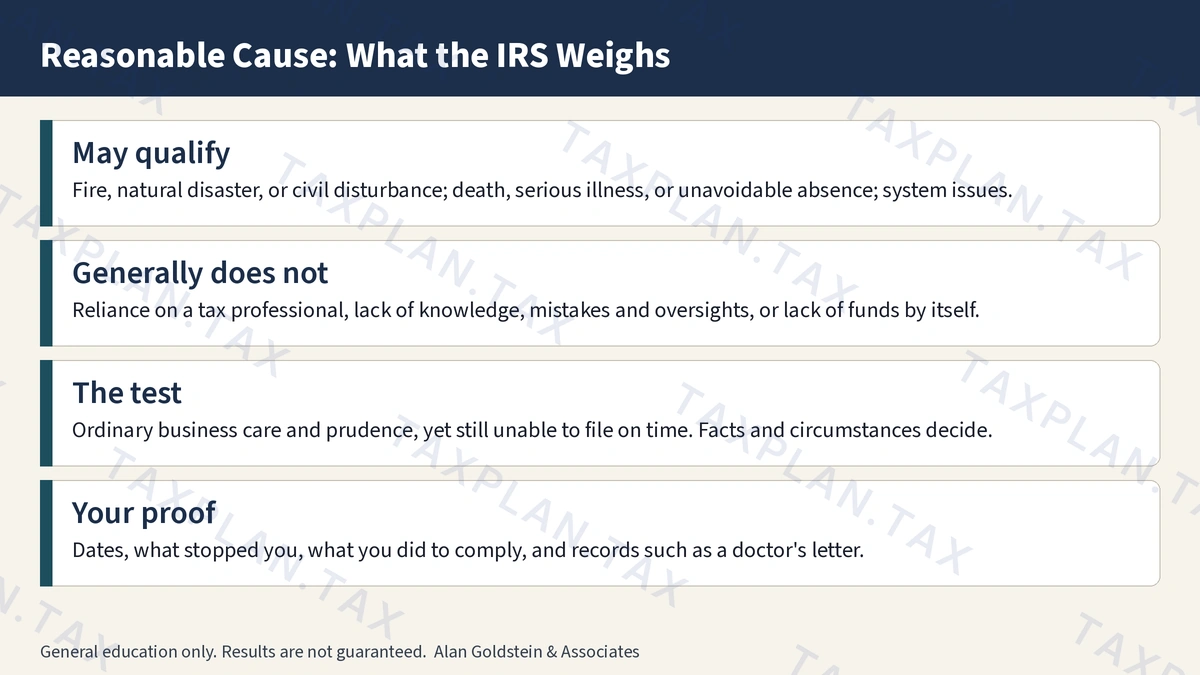

Reasonable cause penalty relief can remove the failure-to-file and failure-to-pay penalties on an unfiled return, but only if you show you used ordinary business care and prudence and still could not comply. The IRS decides each case on its facts. Relief is never automatic, and no one can promise it. This guide explains what counts, what usually fails, and how to ask.
Key Takeaways
- Reasonable cause can reduce or remove penalties. It does not reduce the tax itself.
- The test is ordinary business care and prudence, judged on all the facts and circumstances.
- Serious illness, death in the family, disasters, and lost records may qualify. Lack of knowledge and reliance on a preparer usually do not.
- Your explanation must match the dates and years of each penalty. Missing several years makes this harder.
- If the IRS removes a penalty, it also removes the related interest.
- Filing the missing returns is the first step. Relief requests are decided case by case.
What is reasonable cause penalty relief for unfiled returns?
It is a statutory exception that lets the IRS skip or abate a late-filing or late-payment penalty when the taxpayer shows reasonable cause and no willful neglect. The exception sits in the penalty statute itself.
The failure-to-file penalty is the addition to tax under IRC §6651(a)(1). It applies “unless it is shown that such failure is due to reasonable cause and not due to willful neglect.” The failure-to-pay penalties in §6651(a)(2) and (a)(3) use the same wording. The Supreme Court has read willful neglect as a conscious, intentional failure or reckless indifference (469 U.S. at 245).
The Treasury regulation explains the standard. If the taxpayer “exercised ordinary business care and prudence and was nevertheless unable to file the return within the prescribed time, then the delay is due to a reasonable cause.” See Treas. Reg. §301.6651-1(c)(1).
The Supreme Court has said the taxpayer carries this burden. In United States v. Boyle (1985), the Court called it a “heavy burden” of proving both no willful neglect and reasonable cause (469 U.S. at 245). The IRS repeats the same approach on its penalty relief for reasonable cause page.
Which penalties can reasonable cause remove?
Reasonable cause can apply to the failure-to-file and failure-to-pay penalties. It cannot erase the tax, and it does not apply to every penalty.
The IRS says reasons that qualify depend on the type of penalty and the Internal Revenue Code section behind it. For example, the IRS notes that reasonable cause does not apply to certain penalties, such as the estimated tax penalty.
| Item | Reasonable cause available? | Source |
|---|---|---|
| Failure-to-file penalty | Yes, if shown | IRC §6651(a)(1) |
| Failure-to-pay penalties | Yes, if shown | IRC §6651(a)(2) and (a)(3) |
| The tax itself | No. It is not a penalty. | IRC §6651 |
| Interest | Not on its own. It follows any penalty the IRS removes. | IRS interest page |
| Estimated tax penalty | No, per the IRS | IRS reasonable cause page |
For the broader penalty rules, see our guide to federal unfiled tax returns penalties.
What does the IRS consider reasonable cause?
The IRS looks for circumstances that kept you from filing even though you acted with ordinary care. Its Internal Revenue Manual lists the questions it asks.
The IRM 20.1.1.3.2 frames four questions. What facts prevented you from filing? How did those facts cause the failure? How did you handle the rest of your affairs? Once things changed, what did you do to comply?
The IRS penalty relief page also lists examples that may qualify. They include fires, natural disasters or civil disturbances, death, serious illness or unavoidable absence, and system issues that delayed a timely electronic filing. Each example still turns on the facts.
Do illness or a death in the family qualify?
They can. The IRM says death, serious illness, or unavoidable absence of the taxpayer, or of an immediate family member, may establish reasonable cause.
For this purpose, immediate family means a spouse, sibling, parent, grandparent, or child. The IRS also considers whether you attended to your tax duties promptly once the illness passed. A hospital record or doctor’s letter with start and end dates is the kind of proof the IRS names.
Do disasters or lost records qualify?
Sometimes. A fire or disaster does not by itself provide relief, but it may if you could not comply despite ordinary care.
The IRM separates “affected taxpayers” in an official disaster area from others. It also says that being unable to obtain records may or may not be reasonable cause. The question is whether you used ordinary business care and prudence and were still blocked by events outside your control. You can read the details in IRM 20.1.1.3.2.
Which excuses usually fail?
The IRS says several common reasons do not generally qualify. They are reliance on a tax professional, lack of knowledge, mistakes and oversights, and lack of funds by itself.
Take reliance on a preparer first. The IRS states that you are generally responsible for complying even if someone else handles your taxes. The Supreme Court reached the same result for filing deadlines. In Boyle, the Court held that failing to file on time “is not excused by the taxpayer’s reliance on an agent, and such reliance is not ‘reasonable cause’” (469 U.S. at 252).
The Court drew a line, though. It said a taxpayer may reasonably rely on advice about a question of law, such as whether a return is required. But “one does not have to be a tax expert to know that tax returns have fixed filing dates” (469 U.S. at 251).
Lack of knowledge is also weak by itself. The IRM says ignorance of the law may help only together with other facts, and reasonable cause “should never be presumed.” Lack of funds alone does not excuse failure to pay. The IRS notes that other facts may still show you used reasonable care.
Why is reasonable cause harder with several unfiled years?
Each missed year carries its own penalty, so each needs its own explanation. A single event rarely explains years of silence.
The IRM tells IRS employees that the dates and explanations should correspond with the events on which the penalties are based. It also says reasonable cause does not exist if, after the circumstances end, the taxpayer fails to comply within a reasonable time. Therefore a hospital stay in one year may not cover returns due years later.
The IRS also checks compliance history, at least the three prior years. A first failure to comply does not by itself establish reasonable cause. Likewise, a pattern of late filing weighs against you. The obligation to file is ongoing, and ordinary care means you keep trying to meet it, even if late.
For taxpayers with many years missing, the explanation often works better for some years than others. A candid review of each year is the safer approach. You can also read about the filing side in our guide to filing past-due federal tax returns.
How do you request reasonable cause penalty relief?
File the missing returns first, then ask for relief by phone or in writing. The IRS says to file all returns that are due, whether or not you can pay in full.
- File the returns. Send each past-due return the way you would send an on-time one, or to the address on your notice, per the IRS past-due return page.
- Gather proof. The IRS names hospital or court records, a doctor’s letter with dates, disaster documentation, copies of letters, and receipts.
- Explain the facts. Say how the situation kept you from filing, and what you did to file or pay.
- Ask. Call the number on the notice. If the IRS cannot approve it by phone, request relief in writing on Form 843.
The regulation expects the statement of facts to be in writing and to contain a declaration made under penalties of perjury. Therefore accuracy matters. Never overstate or invent a reason. The IRS may also apply first-time abatement instead if you qualify for it, according to its reasonable cause page. That relief generally needs three years of timely compliance, so it rarely fits a multi-year non-filer.
What if the IRS denies the request?
You may have appeal rights. The IRS says that if you receive a notice denying relief, you should see its penalty appeal page for next steps.
You can also contact the Taxpayer Advocate Service if you cannot resolve the penalty on your own. Keep every notice and its response dates. Deadlines to appeal are strict, so calendar them right away. A professional can review whether a stronger explanation or better documents exist before you appeal.
Does interest go away if a penalty is removed?
Interest on a penalty goes away when the penalty does. The IRS says it automatically reduces or removes the related interest if it reduces or removes a penalty.
However, the IRS does not remove interest on the tax for reasonable cause. Interest on the underlying tax continues until you pay. Under IRC §6601(e)(2)(B), interest on a failure-to-file penalty runs from the return due date, so removing that penalty also removes that interest. Pay what you can while your request is pending to limit further interest.
Frequently Asked Questions
Is reasonable cause the same as first-time abatement?
No. First Time Abate is an administrative waiver for taxpayers with three years of timely compliance. Reasonable cause depends on the facts of your situation. The IRS says FTA is transitioning to a new Automatic Exemption from Penalty starting summer 2026. See the IRS administrative penalty relief page.
Can I get relief if I just did not know I had to file?
Not usually on that alone. The IRS says lack of knowledge is generally not a valid reason. The IRM allows ignorance of the law to count only along with other facts, and never by presumption.
Does being unable to pay count as reasonable cause?
Lack of funds alone does not excuse failure to pay. It also does not excuse failure to file. Other facts showing you used ordinary care and tried to comply may still support relief.
Do I need to file the returns before I ask?
Yes, in practice. The penalty depends on a return. The IRS tells taxpayers to file all past-due returns, whether or not they can pay in full.
Can a tax professional’s mistake qualify?
Generally no for filing deadlines. Boyle held that reliance on an agent to file on time is not reasonable cause. Reliance on advice about a legal question, such as whether you must file, is treated differently.
Will the IRS remove interest too?
Interest on a removed penalty is removed with it. Interest on the unpaid tax stays. The IRS does not remove interest for reasonable cause itself.
How long should I wait for an answer?
The IRS says phone requests can sometimes be decided during the call. Written requests take longer. Check your notice for response dates and keep copies of everything you send.
Can a business get reasonable cause relief?
Yes, the same statute applies to corporations. For businesses, the IRS says the reasons apply to the person with authority to submit the return, deposit, or tax. Partnership and S corporation penalties have their own rules.
Conclusion
Reasonable cause penalty relief can matter when a real event kept you from filing, but it rests on proof and timing. A weak explanation can fail, and a strong one still is not guaranteed.
Alan Goldstein, MBA, IRS Enrolled Agent, of Alan Goldstein & Associates in Coral Gables, Florida, helps taxpayers prepare past-due returns and evaluate penalty relief options. We cannot guarantee any outcome. To request a confidential review of your unfiled returns and IRS resolution options, visit our Tax Resolution Services page.
Cases Cited
Sources
- IRC §6651, Failure to file tax return or to pay tax (Cornell LII)
- Treas. Reg. §301.6651-1, Failure to file tax return or to pay tax (Cornell LII)
- IRS: Penalty relief for reasonable cause
- IRS: Failure to file penalty
- IRM 20.1.1, Introduction and Penalty Relief (reasonable cause, §3.2)
- IRS: Filing past due tax returns
- IRS: About Form 843, Claim for Refund and Request for Abatement
- IRS: Interest
- IRS: Administrative penalty relief
- IRS: Penalty appeal
- IRS: Taxpayer Advocate Service
- IRC §6601, Interest on underpayment, nonpayment, or extensions of time for payment (Cornell LII)
- United States v. Boyle, 469 U.S. 241 (1985) (official U.S. Reports PDF, Library of Congress)
This article is provided for general educational purposes and does not constitute individualized tax, legal, or accounting advice. Tax consequences depend on the taxpayer’s specific facts and applicable law.
