
First-time abatement is an IRS administrative waiver that can remove a failure-to-file penalty if your compliance record is clean. It generally requires three prior years of timely filing without unreversed penalties. This guide explains how first-time abatement works for failure-to-file penalties, who qualifies, why it rarely helps long-term non-filers, and how it is changing in 2026.
Key Takeaways
- First-time abatement (FTA) removes certain penalties for taxpayers with a timely compliance history. It does not cut the tax or the interest on the tax.
- The IRS says you must contact it to request FTA, but you do not need to name FTA or send documents.
- The IRS looks back three years. A late or unfiled return in that window can disqualify you.
- FTA covers one tax period at a time, so multi-year non-filers often cannot use it for every year.
- For 2025 returns and later, the IRS is replacing FTA with an automatic exemption called AEP.
What is first-time abatement for failure-to-file penalties?
It is an administrative waiver. The IRS removes eligible penalties when you have three years of timely compliance. You do not have to prove reasonable cause.
The IRS calls FTA the most common administrative relief for individuals and businesses with a history of timely compliance. According to the IRS administrative penalty relief page, FTA reaches the failure-to-file penalties under IRC §6651(a)(1), §6698(a)(1), and §6699(a)(1). It also reaches the failure-to-pay penalties under §6651(a)(2) and (a)(3), and the failure-to-deposit penalty under §6656. Eligible penalties qualify regardless of amount.
The IRM explains that the waiver began for tax periods ending after December 31, 2000. It applies the first time a taxpayer is subject to one of these penalties for a single return (IRM 20.1.1.3.3.2.1). For background on the penalty itself, see our guide to penalties on unfiled returns.
What are the requirements for first-time abatement?
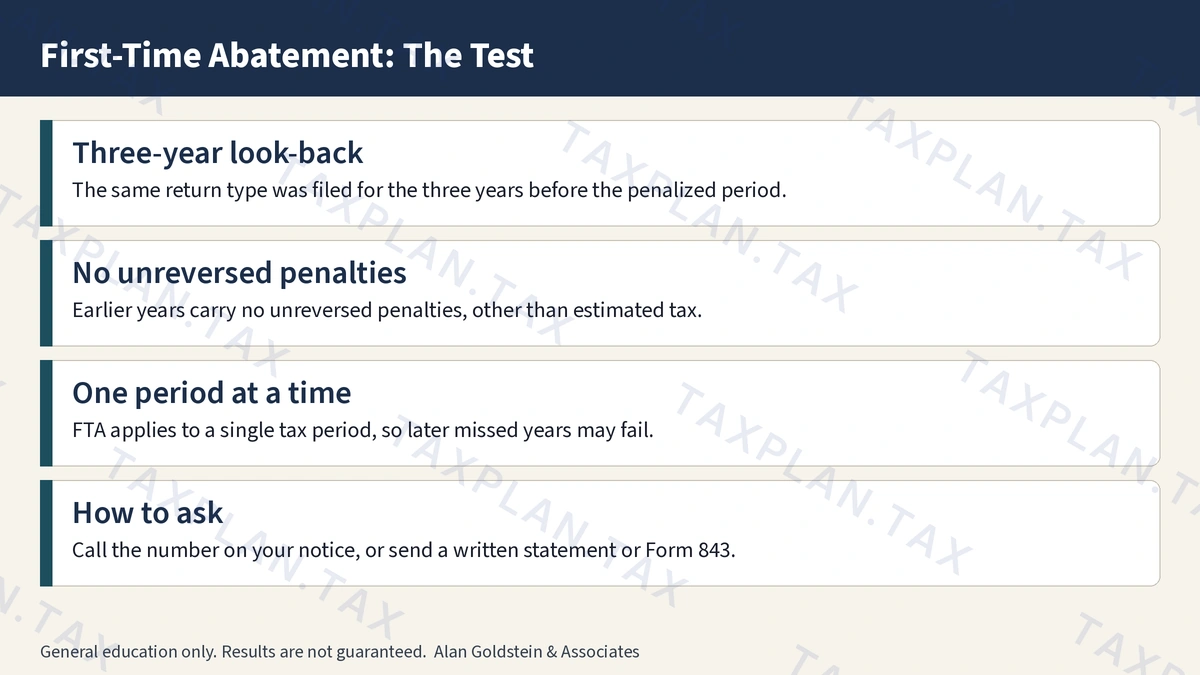
You need a clean three-year history for the same return type. The IRS checks that you filed those returns and that they carry no unreversed penalties.
The IRM sets these criteria for all taxpayers:
- You filed the same return as the penalized return for the three years before the penalized period, unless you had no filing requirement.
- Those returns were processed, and the accounts carry no unreversed penalties, other than an estimated tax penalty.
- No earlier penalty was reversed through FTA or a similar tolerance code.
The IRS administrative relief page frames this as a timely compliance history. It says you must have timely filed the same return type for the prior three years. It adds that you either had no penalty or had one that was later abated for reasonable cause or IRS error. Businesses have an added rule. The IRS must not have waived the failure-to-deposit penalty four or more times in that window.
Also, the IRM states that FTA is not available based solely on a first request. You have to meet the criteria. See our article on the difference between failure to file and failure to pay for how the two penalties interact.
Which penalties and returns are not eligible?
FTA does not cover event-based returns, the daily delinquency penalty, or information reporting that depends on another filing. The fraud penalty is not on the IRS eligibility list either.
The IRM lists examples where FTA does not apply. They include Forms 706, 709, 990, the 1099 series, Form 8300, and Forms 3520 and 5471. The common thread is returns that a taxpayer files once or infrequently. The IRS page lists the eligible penalties, and the fraudulent failure-to-file penalty under IRC §6651(f) does not appear on it. Therefore, do not assume FTA reaches a fraud-based penalty.
How does first-time abatement work for unfiled returns?
It works best when you missed one year and the three prior years were clean. For several missed years, it usually helps only the first one.
The IRM says relief applies only to a single tax period. It also requires that the three preceding returns were filed and carry no unreversed penalties. A late return from a prior year can therefore fail that test for the next year.
Here is an illustrative example. Suppose a taxpayer filed on time for 2020, 2021, and 2022 and missed 2023, 2024, and 2025. The taxpayer files all three late in 2026. The 2023 penalty may qualify for FTA, because the three prior years were clean. The 2024 and 2025 years likely do not, because the 2023 return was late. The numbers and years are illustrative only, and the IRS makes the final determination.
In that case, consider reasonable cause for the other years. The IRS reasonable cause page says that if you ask for reasonable cause but the IRS determines you qualify for first-time abate, it applies FTA. Our guide to filing past-due returns explains how to get current first.
You can check whether First-Time Abate or another relief category may apply with this eligibility checker. The result is only an estimate, not a prediction that the IRS will approve relief.
What happens to unpaid tax after FTA removes the penalty?
The IRS removes the penalty and the interest on that penalty. However, tax and interest on the tax remain, and the failure-to-pay penalty can keep accruing until you pay.
The IRS says it automatically reduces or removes interest tied to a penalty it removes. In its comparison table, the IRS notes that under FTA the failure-to-pay penalty “may continue to accrue until the tax is fully paid.” Under FTA, the IRS assesses the penalty first and removes it later. As a result, a balance may still grow if you leave tax unpaid.
The failure-to-file penalty is 5% per month, up to 25%, and the minimum for a Form 1040 due after December 31, 2025 is $525 or 100% of the tax if less (IRS failure-to-file page). The failure-to-pay rate is 0.5% per month. For payment options, see our article on installment agreements for unfiled returns.
How do you request first-time abatement?
Call the number on your notice, or send a written statement or Form 843. You do not need to specify FTA or attach supporting documents.
The IRS says the agent reviews your account to see whether you meet the requirements. If you owe the penalty on a return you have already filed, call the number on the notice. If the phone request is not approved, send a written request. The Form 843 page explains the written route. Keep a copy of everything you send.
If you did not file at all, file first. Our article on substitute return risks explains why an SFR may leave you with a larger balance than your own return would.
How is the automatic exemption (AEP) changing FTA?
The IRS says FTA is transitioning to the Automatic Exemption from Penalty (AEP) starting summer 2026. AEP applies to 2025 tax year returns and later, and it needs no request.
Under AEP, if you file or pay late but filed timely and paid the tax due for the prior three years, the IRS does not assess the penalty. It sends a letter explaining the relief. FTA still applies to eligible earlier years and you must ask for it. The IRS says AEP covers Forms 1040, 1065, and 1120, along with certain employment tax returns.
Both rely on timely compliance history. As a result, the change helps people who were compliant and slipped once. It does not help those with years of unfiled returns. If you think you should have received AEP but still see a penalty on a notice, the IRS says to contact it.
What if you do not qualify for FTA?
You may still request relief for reasonable cause. The IRS decides that case by case. The standard is ordinary business care and prudence.
The Supreme Court accepted the ordinary business care and prudence standard in United States v. Boyle (469 U.S. at 246, 1985). The IRS lists reasons that may qualify, such as disasters, serious illness, and inability to get records. It also lists reasons that usually do not, such as lack of knowledge. Our article on common reasons people do not file explains how the law treats several of them.
Frequently Asked Questions
Can I use first-time abatement more than once?
The IRM says FTA applies to a single tax period, and your history is reviewed each time. A prior FTA reversal can affect later requests. Ask the IRS to confirm your history.
Does FTA remove interest too?
It removes interest tied to the penalty it removes. Interest on the underlying tax stays.
Do I need to prove why I filed late?
No. FTA depends on your compliance history, not on a reason. The IRS says you do not need to provide supporting documents for FTA.
Does FTA work for a business return?
It can. The IRS lists partnership and S corporation failure-to-file penalties among the eligible penalties. Business filers also face the failure-to-deposit rule noted above.
What if I have not filed for several years?
FTA likely helps only the first late year, if any. Later years may fail the three-year test. Consider reasonable cause for those years.
Can I ask for FTA online?
The IRS says to call the number on your notice or send a written statement or Form 843. Check your notice for current instructions.
Should I still file if I cannot pay?
Yes. The IRS says to file all returns that are due even if you cannot pay in full. Filing stops the failure-to-file penalty from growing.
Is FTA guaranteed if I meet the criteria?
No outcome is guaranteed. The IRS reviews your account and decides. Errors in the IRS record can also change the result.
Conclusion
First-time abatement for failure-to-file penalties can be valuable, but it depends on three clean years. For multi-year non-filers, it usually reaches only the first late year. Filing, checking your history, and asking early gives you the best chance.
Alan Goldstein, MBA, IRS Enrolled Agent, of Alan Goldstein & Associates in Coral Gables, Florida, helps taxpayers review unfiled returns, penalties, and relief options. We cannot guarantee any outcome. To request a confidential review, visit our Tax Resolution Services page.
Cases Cited
- United States v. Boyle, 469 U.S. 241, 246 (1985) (reasonable cause standard of ordinary business care and prudence; verified against the official U.S. Reports opinion)
Sources
- IRS: Administrative penalty relief
- IRS: Penalty relief for reasonable cause
- IRS: Failure to file penalty
- IRS: About Form 843, Claim for Refund and Request for Abatement
- IRM 20.1.1, Introduction and Penalty Relief
- 26 U.S.C. §6651, Failure to file tax return or to pay tax
- United States v. Boyle, 469 U.S. 241, 246 (1985) (official U.S. Reports, Library of Congress)
This article is provided for general educational purposes and does not constitute individualized tax, legal, or accounting advice. Tax consequences depend on the taxpayer’s specific facts and applicable law.
