

IRS wage and income transcripts show the information returns that payers filed about you, so they are a strong starting point for past-due returns. However, they are not a complete record of your income. This guide explains what wage and income transcripts show, how to use them for each unfiled year, and where you still need your own records.
Key Takeaways
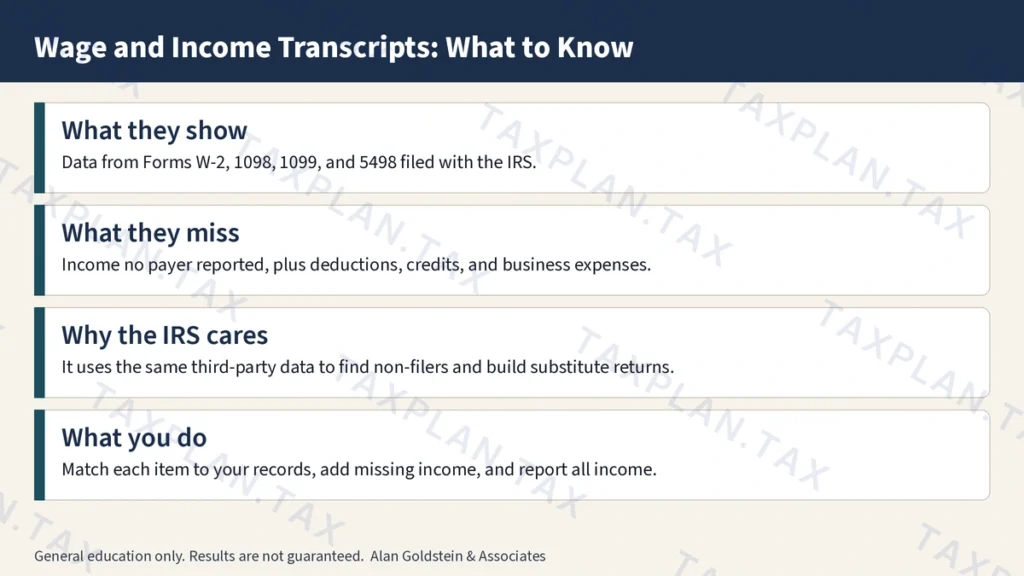
- Wage and income transcripts list data from Forms W-2, 1098, 1099, and 5498 that were filed with the IRS.
- The IRS uses the same third-party data to find non-filers and to build substitute returns.
- The transcript may miss income, such as cash receipts or amounts a payer never reported.
- You must report all income, even if it does not appear on a transcript.
- If a listed item is wrong, ask the payer for a corrected form and keep the proof.
What is a wage and income transcript?
It is an IRS record of information returns filed about you. It shows data such as wages, withholding, interest, and other payments reported by third parties.
According to the IRS transcript types page, the transcript shows data from forms such as W-2, 1098, 1099, and 5498. It is available for the current year and nine prior years. An information return is a form a payer files with the IRS to report a payment to you. The IRS general instructions for information returns cover many of these forms.
What limits does the transcript have?
The IRS says the transcript only displays documents filed with the IRS, and those may not match every document issued to you. It is also limited to about 85 income documents online.
The IRS says the current-year data generally appears in early February. If you have too many documents, the online request will not generate. In that case, you can submit Form 4506-T. For the full ordering steps, see our guide to filing past-due federal tax returns.
Why do wage and income transcripts matter for past-due returns?
They show what the IRS already knows. The IRS matches third-party reports to returns, and it uses them to compute tax when no return is filed.
The Internal Revenue Manual (IRM) says delinquency checks use Information Returns Program documents, such as Forms W-2 and 1099, to identify individuals who have not filed (IRM 5.1.11.2.1). The CP3219N notice says the IRS calculated tax, penalty, and interest from wages and other income reported by employers, financial institutions, and others. If your return omits an item the IRS holds, a mismatch may follow, often as a CP2000-series notice.
The IRS also tells past-due filers to use Form 4506-T, line 8, to get wage and income information. See IRS: Filing past due tax returns.
How do you use wage and income transcripts to prepare a past-due return?
Work year by year. Match each transcript item to your records, add what is missing, and then complete the return.
- Order a transcript for every unfiled year.
- Match each Form W-2 and 1099 to your own records.
- Note any withholding shown. It counts as tax paid.
- Add income that no payer reported.
- Gather records for deductions and credits.
- Prepare and file each required return.
Withholding matters for penalties as well as for tax. The IRS computes the failure-to-file penalty on the tax due after subtracting tax paid on time, such as withholding credits (IRS failure to file penalty). A year with enough withholding may produce little or no penalty.
What does the transcript not show?
It does not show your deductions, credits, basis, or business expenses. It also omits income that was never reported to the IRS.
The transcript does not include state or local information with W-2 data, according to Form 4506-T. It will not reflect cash payments, unreported tips, or payers who failed to file. For those items, you need bank records, invoices, and your own logs. Our guide on filing multiple years of unfiled returns explains how to rebuild records.
Do you have to report income that is not on the transcript?
Yes. A missing item on a transcript does not mean the income is not taxable. In Commissioner v. Glenshaw Glass Co. (1955), the Supreme Court described income as undeniable accessions to wealth, clearly realized, over which the taxpayer has complete dominion.
That is a broad rule. You report income under the tax law, not under what a payer chose to file. Self-employed people should be especially careful, because a Form 1099 may cover only part of their receipts.
What should you do if a transcript item is wrong?
Contact the payer for a corrected form. The IRS also says you can call it about incorrect income and attach corrected forms to your return.
The IRS past-due filing page says to contact the payer to request a corrected Form W-2 or 1099 and to attach corrected forms when you send your return. It also lists 866-681-4271 for incorrect income on a substitute return. Under IRC §6201(d), if you raise a reasonable dispute about an item on an information return and fully cooperate, the IRS has the burden of producing reasonable and probative information in addition to the information return. That rule applies in court proceedings.
Courts have said third-party data needs support. In Portillo v. Commissioner (5th Cir. 1991), the court upheld the IRS’s computer match as a valid determination. However, it held the notice of deficiency arbitrary because the IRS did not substantiate its claim that the taxpayer received additional cash payments. That case turned on its facts, so do not assume the same result for your case.
How do transcripts relate to a substitute return?
The IRS builds a substitute return from the same data. It generally does not include your deductions or credits, so filing your own return can lower the tax.
The IRS says its substitute return might not give you credit for deductions and exemptions. It also says it is in your best interest to file your own return, and that the IRS will generally adjust your account to reflect the correct figures. The IRM describes a process for original returns filed to request reconsideration of a substitute-return assessment. That process includes comparing reported income with the IRS’s information return data (IRM 5.1.11.6.3). See our guide to what a substitute for return is and the article on substitute-return risks and how to respond.
What mistakes should you avoid?
The most common mistakes are treating the transcript as complete and skipping years. Both can lead to later notices.
- Relying only on the transcript. It misses unreported income.
- Ignoring a transcript item. The IRS holds that data and may match it.
- Guessing at missing figures. Rebuild from records or document your method.
- Skipping years. Each required year needs a return. Our article on how far back the IRS requires unfiled tax returns explains the policy.
Frequently Asked Questions
Does the wage and income transcript show my tax due?
No. It lists reported income and withholding. It does not compute your tax. You still need a completed return to determine what you owe or what refund you may be due.
How far back can I get wage and income transcripts?
The IRS says the current year and nine prior years. Form 4506-T says up to 10 years. Check the IRS page for the year you need.
Why is a Form 1099 missing from my transcript?
The payer may not have filed it, or it may not have posted yet. The IRS says the transcript shows only documents filed with the IRS. Ask the payer for a copy.
Can I file using only the transcript?
You can use it as a base, but it is rarely enough alone. You must report all income and support your deductions with records. If you lack records, a preparer can help rebuild them.
What if my transcript shows income I did not earn?
Contact the payer and the IRS. It could be an error or identity theft. The IRS says to call 800-829-1040 if a transcript has unfamiliar information because of possible identity theft.
Does withholding on the transcript reduce my penalty?
It can. The failure-to-file penalty is based on tax due after tax paid on time, including withholding. If withholding covers the tax, the penalty base may be zero.
Can the IRS use the transcript data against me?
Yes. It is the same data the IRS uses for matching and for substitute returns. That is why you should review it before you file.
Do I need a professional to use these transcripts?
No, but it can help. Many unfiled-year cases include missing records, self-employment income, or several states. A representative can also request transcripts through IRS systems with proper authorization.
Conclusion
Wage and income transcripts are one of the best starting points for past-due returns. They show what payers told the IRS, but they do not show everything you earned or can deduct. Review them alongside your own records before filing each year.
Alan Goldstein, MBA, IRS Enrolled Agent, of Alan Goldstein & Associates in Coral Gables, Florida, helps taxpayers use their IRS records to prepare past-due returns. We can review transcripts, rebuild missing income and expense records, and evaluate payment and relief options. We cannot guarantee any outcome. To request a confidential review of your unfiled returns, visit our Tax Resolution Services page.
Cases Cited
- Commissioner v. Glenshaw Glass Co., 348 U.S. 426, 431 (1955)
- Portillo v. Commissioner, 932 F.2d 1128 (5th Cir. 1991) (pinpoint page not confirmed; holding verified in the opinion text)
Sources
- IRS: Transcript types for individuals and ways to order them
- IRS: Form 4506-T, Request for Transcript of Tax Return (Rev. April 2025)
- IRS: Filing past due tax returns
- IRS: General Instructions for Certain Information Returns
- IRS: Understanding your CP3219N notice
- IRS: Understanding your CP2000-series notice
- IRS: Failure to file penalty
- IRS: IRM 5.1.11, Delinquent Return Investigations
- IRC §6201, Assessment authority
- Commissioner v. Glenshaw Glass Co., 348 U.S. 426, 431 (1955) (official U.S. Reports, Library of Congress)
- Portillo v. Commissioner, 932 F.2d 1128 (5th Cir. 1991) (opinion text, Public.Resource.Org; pinpoint page not confirmed)
This article is provided for general educational purposes and does not constitute individualized tax, legal, or accounting advice. Tax consequences depend on the taxpayer’s specific facts and applicable law.
