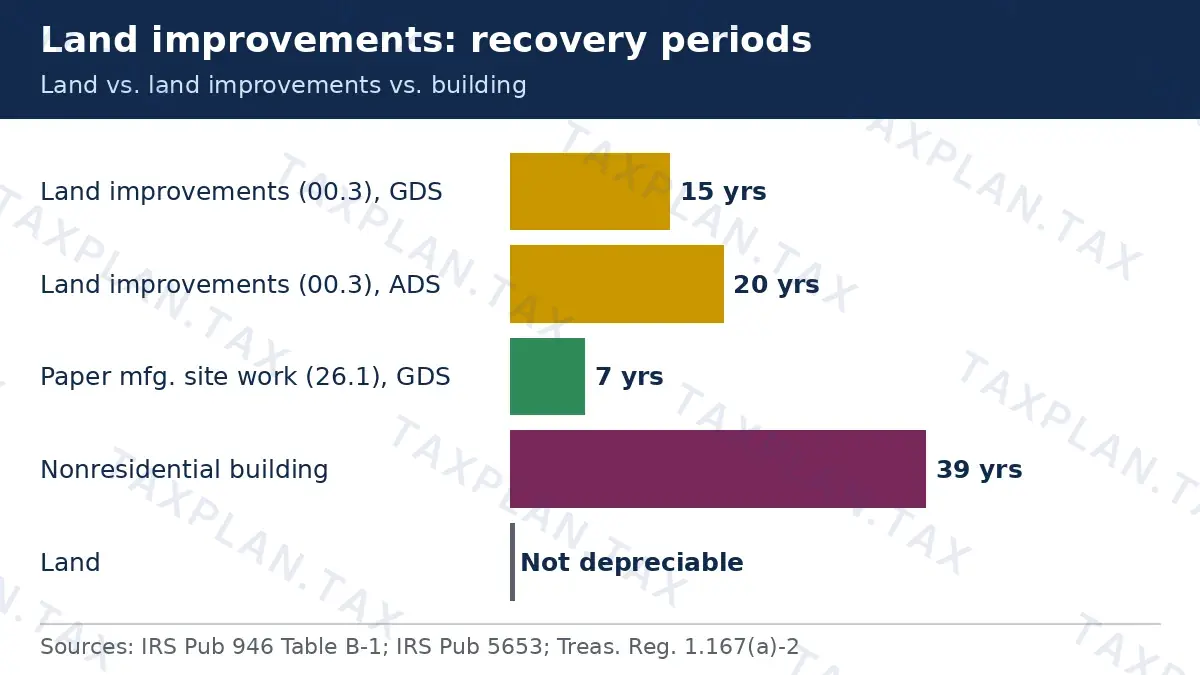

Land improvements are depreciable improvements made directly to or added to land, and most of them are 15-year property in a cost segregation study. Under Rev. Proc. 87-56, asset class 00.3 covers items such as sidewalks, roads, drainage facilities, fences, landscaping, and shrubbery. That class has a 20-year class life, so land improvements get a 15-year GDS recovery period and the 150% declining balance method. By comparison, the building they serve uses 27.5 or 39 years. However, land itself is not depreciable. General clearing and grading that is tied to the land, rather than to a building or paving, is not depreciable either. Because land improvements have a recovery period of 20 years or less, they can also qualify for bonus depreciation, which is 100% for qualified property acquired after January 19, 2025.
This guide explains which land improvements a study can separate, how they are depreciated, what courts have said, and where the risks are.
Key Takeaways
- Land improvements usually fall in asset class 00.3, with a 15-year GDS period and a 20-year ADS period.
- Examples include paving, sidewalks, curbs, fencing, landscaping, site drainage, and some site lighting.
- Buildings and structural components are excluded from class 00.3, even when they sit outside the walls.
- Some activity classes, such as manufacturing classes, include land improvements and override the 15-year default.
- Land and site preparation that is “inextricably associated” with the land are not depreciable.
- Land improvements can qualify for 100% bonus depreciation if acquired after January 19, 2025.
What Are Land Improvements for Tax Purposes?
Direct answer: Land improvements are depreciable assets added to land that are neither the land itself nor part of a building.
IRS Publication 946, Table B-1, reproduces the Rev. Proc. 87-56 description of asset class 00.3. It covers “improvements directly to or added to land, whether such improvements are section 1245 property or section 1250 property, provided such improvements are depreciable.” Its examples include sidewalks, roads, canals, waterways, drainage facilities, sewers (other than municipal sewers in class 51), wharves and docks, bridges, fences, landscaping, shrubbery, and radio and television towers.
What is excluded from land improvements?
Class 00.3 excludes two things. First, it excludes land improvements that are explicitly included in another asset class. Second, it excludes buildings and structural components as defined in Treas. Reg. §1.48-1(e). So an item located outside a building can still be part of that building for tax purposes.
Why does land itself not qualify?
Land does not wear out. Treas. Reg. §1.167(a)-2 states that the depreciation allowance does not apply “to land apart from the improvements or physical development added to it.” Consequently, a study must first remove land value before it allocates any cost to land improvements. For more on this first step, see What Property Qualifies for a Cost Segregation Study?
How Are Land Improvements Depreciated?
Direct answer: Most of these assets use a 15-year recovery period, the 150% declining balance method, and the half-year convention.
Which method and convention apply?
Under IRC §168(b)(2), 15-year property uses the 150% declining balance method, switching to straight line when that yields a larger deduction. The half-year convention usually applies. However, the mid-quarter convention applies under §168(d)(3) if more than 40% of the year’s depreciable basis (excluding real property) is placed in service in the last three months of the year. These assets count toward that 40% test, because they are not residential rental or nonresidential real property.
What are the annual rates?
Publication 946, Table A-1, gives these half-year convention rates for 15-year property: 5.00% in year 1, 9.50% in year 2, 8.55% in year 3, 7.70% in year 4, and 6.93% in year 5. Rates then level off near 5.9% and end with 2.95% in year 16. If the alternative depreciation system applies, class 00.3 uses a 20-year straight-line period instead.
When does an activity class override class 00.3?
Rev. Proc. 87-56 has asset classes (like 00.3) and activity classes (like manufacturing). The IRS Cost Segregation Audit Techniques Guide gives two examples. A paper manufacturer’s production-related land improvements fall in activity class 26.1, which specifically includes land improvements, so they use a 7-year GDS period. However, a rubber manufacturer’s land improvements stay in class 00.3, because class 30.1 does not specifically include them. Also, Pub. 5653 notes that land improvements tied to administrative or retail functions stay in class 00.3.
What Are the Benefits of Identifying Land Improvements?
Direct answer: Identifying this site work moves cost from a 27.5- or 39-year schedule to a 15-year schedule, and it makes that cost eligible for bonus depreciation.
How much faster is 15-year recovery?
The gap is wide. Over the first five years, Table A-1 recovers 37.68% of 15-year property. A 39-year building placed in service in April recovers only 12.075% over the same period under Table A-7a (1.819% plus four years at 2.564%). That is about three times as much in the early years, before bonus.
Do land improvements qualify for bonus depreciation?
Generally, yes. Under §168(k)(2)(A), qualified property includes property with a recovery period of 20 years or less. Public Law 119-21 set the rate at 100% for qualified property acquired after January 19, 2025, and IRS Notice 2026-11 provides interim guidance. Property acquired under a written binding contract signed before January 20, 2025, still follows the prior phase-down, which is 20% for property placed in service in 2026. Taxpayers may also elect out of bonus for the entire 15-year class for a year under §168(k)(7).
What Legal Rules and Court Cases Apply to Land Improvements?
Direct answer: Rev. Proc. 87-56 defines the class, the regulations exclude land and buildings, and court cases decide whether an item is permanent, depreciable, or part of a building.
Which site costs are part of the land?
In Algernon Blair, Inc. v. Commissioner, 29 T.C. 1205, 1221 (1958), the Tax Court upheld the IRS in treating clearing, grading, and landscaping costs as nondepreciable land costs, except for a portion attributable to the buildings. The taxpayer offered no evidence, and the court found those items “inextricably associated” with the land. Similarly, in AmeriSouth XXXII, Ltd. v. Commissioner, T.C. Memo. 2012-67, the court treated a study’s “site preparation and earthwork” as nondepreciable. It noted that site work closely tied to a depreciable asset, such as paving, may be depreciable, but the taxpayer had no evidence to support its allocation.
When is an item a permanent land improvement?
Courts apply the six permanence factors from Whiteco Industries, Inc. v. Commissioner, 65 T.C. 664, 672-673 (1975). For example, in Trentadue v. Commissioner, 128 T.C. 91, 106-108 (2007), the court held that a vineyard’s buried drip irrigation system and well were permanent land improvements. However, its trellising was not a permanent land improvement. By contrast, in PPL Corp. v. Commissioner, 135 T.C. 176, 198-199 (2010), the court held that bolted street light assets were not land improvements. Instead, they fell in the residual 7-year class.
When is an outdoor item part of the building?
Location outside the walls does not settle the question. In AmeriSouth, the taxpayer claimed water lines, sewer lines, gas lines, and site electric as 15-year land improvements. Yet the court held that the water-distribution lines and underground electric lines at issue served the apartment buildings generally. They were structural components, depreciable over 27.5 years. It also said the sewer system would be part of the buildings even if the taxpayer owned it. Class 00.3 itself excludes structural components, so this result follows from the class description. Full citations for all cases appear in the Cases Cited section below.
How are land improvements recaptured on a sale?
Class 00.3 includes both §1245 and §1250 property, so recapture depends on the item. Gain on §1245 property is ordinary income to the extent of depreciation under IRC §1245. For §1250 property, IRC §1250 recaptures depreciation in excess of straight line as ordinary income. Note that 150% declining balance on 15-year property exceeds straight line in the early years. In addition, Treas. Reg. §1.168(k)-2(g)(3) states that bonus depreciation is not a straight-line method for §1250(b) purposes.
What Do Land Improvements Look Like in Practice?
Direct answer: The examples below use Publication 946 table rates on assumed amounts. All dollar figures are illustrative assumptions.
Example 1: A retail center placed in service in April 2026
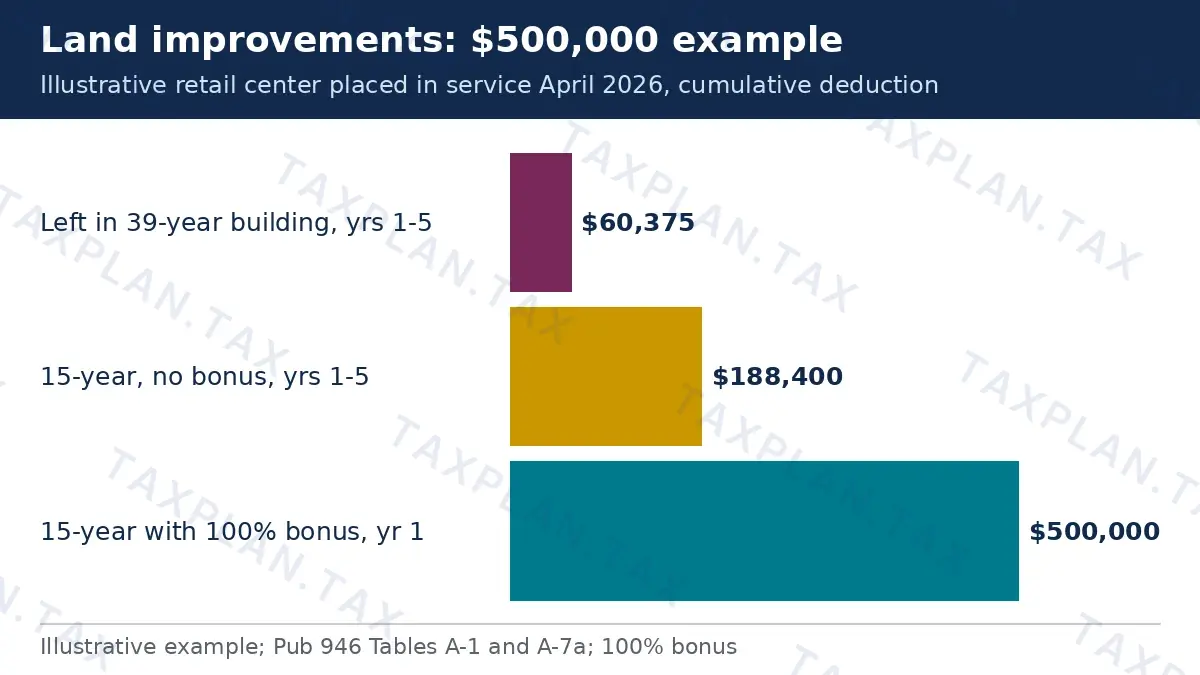
Assume an investor acquires a retail center after January 19, 2025, and places it in service in April 2026. A study identifies $500,000 of land improvements: parking lot paving, curbs, sidewalks, landscaping, fencing, and pole-mounted site lighting. If that $500,000 stayed in the 39-year building, the first-year deduction on it would be $9,095 ($500,000 × 1.819%).
As 15-year property without bonus, it yields $25,000 in year one ($500,000 × 5.00%). With 100% bonus depreciation, the full $500,000 is deductible in 2026.
Example 2: Five-year comparison without bonus
Next, assume the investor elects out of bonus for the 15-year class. Over five years, the $500,000 of land improvements yields $188,400 (37.68%). The same $500,000 left in the 39-year building would yield $60,375 (12.075%) over five years.
| Treatment of $500,000 (illustrative) | Year 1 | Years 1-5 total |
|---|---|---|
| Left in 39-year building (April) | $9,095 | $60,375 |
| 15-year land improvements, no bonus | $25,000 | $188,400 |
| 15-year land improvements, 100% bonus | $500,000 | $500,000 |
Example 3: Site work that stays with the land
Finally, suppose the same study also included $80,000 for clearing trees and rough grading the whole parcel. Under Algernon Blair and AmeriSouth, an examiner could treat that cost as nondepreciable land unless the records tie it to paving, the building, or another depreciable asset. Therefore, contractor records that show where site work occurred are worth keeping. For more examples across classes, see 5-Year, 7-Year, and 15-Year Property in Cost Segregation.
What Are the Common Mistakes and Risks?
Direct answer: Most errors involve claiming land costs, ignoring activity classes, or treating building systems as site work.
- Claiming general clearing and grading. Without records that tie it to a depreciable asset, it is usually land cost.
- Treating building utilities as land improvements. Lines that serve the building generally can be structural components.
- Missing an activity class. Some industries use a different life for land improvements.
- Ignoring the mid-quarter test. Large fourth-quarter site work can change the convention for the year.
- Depreciating assets you do not own. In AmeriSouth, ownership of some utility lines was also disputed.
- Overlooking §1250 recapture. Some class 00.3 assets are §1250 property.
Frequently Asked Questions
Are land improvements 15-year property?
Usually, yes. Asset class 00.3 has a 15-year GDS period. However, an activity class can assign a different period.
Is a parking lot a land improvement?
Generally, yes. Treas. Reg. §1.48-1(c) names paved parking areas as an example of property that is not tangible personal property, and paved areas typically fall in class 00.3.
Is landscaping depreciable?
Landscaping and shrubbery are listed examples in class 00.3, provided they are depreciable. Costs that are inextricably associated with the land are not.
Are land improvements eligible for bonus depreciation?
Generally, yes, because their recovery period is 20 years or less. For property acquired after January 19, 2025, the rate is 100% unless you elect out for the class.
Are exterior lights land improvements?
It depends. Pole-mounted site lighting is often treated as a land improvement. Yet in PPL Corp., a utility’s bolted street lights were held not to be land improvements at all.
Can I claim missed land improvements on a building I already own?
Often, yes. A change in recovery period can usually be made through Form 3115 and a §481(a) adjustment under Rev. Proc. 2025-23.
What is the ADS life of land improvements?
Publication 946 lists a 20-year ADS recovery period for class 00.3.
Conclusion: How Should You Treat Land Improvements?
To sum up, land improvements are one of the most reliable parts of a cost segregation study, because Rev. Proc. 87-56 describes them directly. Still, the line between land, land improvements, and the building requires facts and records. When those are in place, 15-year treatment and bonus eligibility can produce a meaningful benefit.
Emunah Cost Segregation helps owners and CPAs identify site improvements and support each allocation. Alan Goldstein, EA, reviews your property and records before any study begins. Then he tells you plainly whether a study makes sense. Contact Emunah Cost Segregation in Coral Gables, Florida, to request a review. You may also want to read Cost Segregation for Retail Properties.
Cases Cited
- Algernon Blair, Inc. v. Commissioner, 29 T.C. 1205, 1221 (1958) (United States Tax Court). Pinpoint verified against the reporter-paginated opinion text. Opinion
- AmeriSouth XXXII, Ltd. v. Commissioner, T.C. Memo. 2012-67, 103 T.C.M. (CCH) 1324 (2012) (United States Tax Court, memorandum opinion). Pinpoint uncertainty: T.C. Memos have no volume or reporter page of their own, and we could not confirm the T.C.M. (CCH) page numbers for the specific holdings. In the CourtListener text, the site preparation discussion appears at star pages *21-*25 and the utility-line holdings at *44-*46; we believe those star pages track the Lexis version, but we could not confirm that. Opinion
- Whiteco Industries, Inc. v. Commissioner, 65 T.C. 664, 672-673 (1975) (United States Tax Court). Pinpoint verified against the reporter-paginated opinion text. Opinion
- Trentadue v. Commissioner, 128 T.C. 91, 106-108 (2007) (United States Tax Court). Pinpoint verified against the reporter-paginated opinion text. Opinion
- PPL Corp. & Subsidiaries v. Commissioner, 135 T.C. 176, 198-199 (2010) (United States Tax Court). Pinpoint verified against the reporter-paginated opinion text. Opinion
Sources and Authorities
- 26 U.S.C. §168 (including §168(b), (d), (g), and (k)): https://www.law.cornell.edu/uscode/text/26/168
- 26 U.S.C. §1245: https://www.law.cornell.edu/uscode/text/26/1245
- 26 U.S.C. §1250: https://www.law.cornell.edu/uscode/text/26/1250
- Public Law 119-21 (H.R. 1, 119th Congress), §70301: https://www.congress.gov/bill/119th-congress/house-bill/1
- IRS Notice 2026-11: https://www.irs.gov/pub/irs-drop/n-26-11.pdf
- Treas. Reg. §1.48-1: https://www.ecfr.gov/current/title-26/section-1.48-1
- Treas. Reg. §1.167(a)-2: https://www.ecfr.gov/current/title-26/section-1.167(a)-2
- Treas. Reg. §1.168(k)-2 (including §1.168(k)-2(g)(3)): https://www.ecfr.gov/current/title-26/section-1.168(k)-2
- IRS Publication 946, including Tables A-1, A-7a, and B-1: https://www.irs.gov/pub/irs-pdf/p946.pdf
- IRS Publication 5653, Cost Segregation Audit Techniques Guide: https://www.irs.gov/pub/irs-pdf/p5653.pdf
- About Form 3115: https://www.irs.gov/forms-pubs/about-form-3115
- Rev. Proc. 2025-23: https://www.irs.gov/pub/irs-drop/rp-25-23.pdf
- Court opinions: see Cases Cited above.
This article is provided for general educational purposes and does not constitute individualized tax, legal, or accounting advice. Tax consequences depend on the taxpayer’s specific facts and applicable law.
