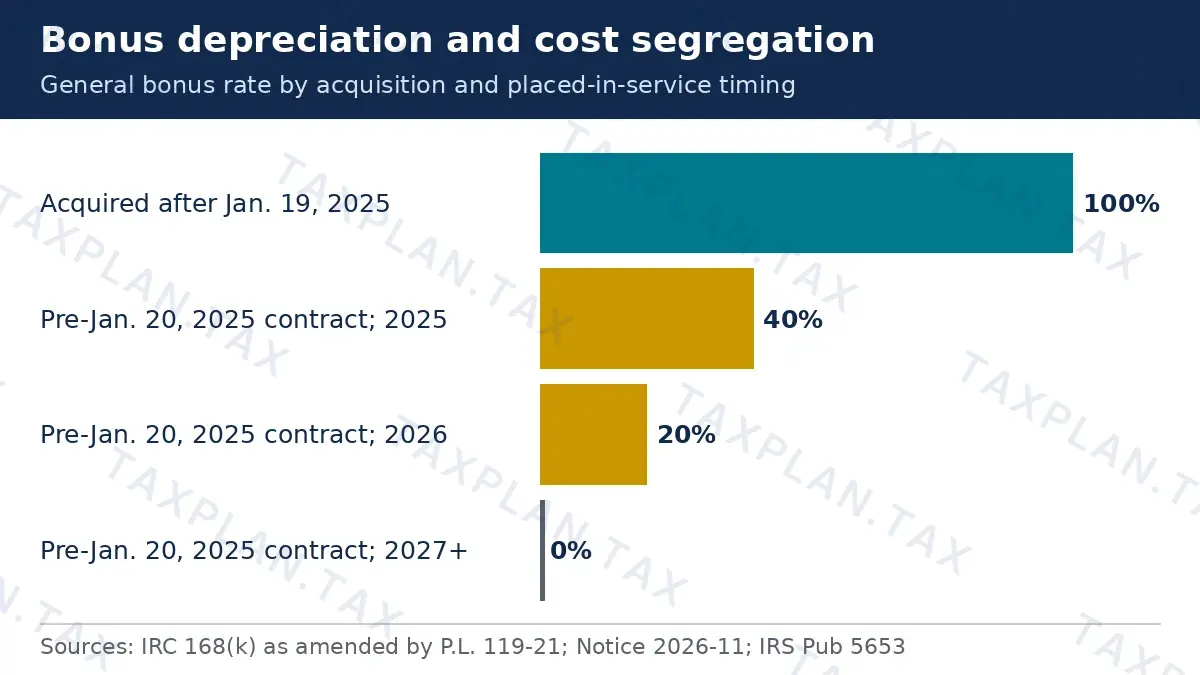

Bonus depreciation and cost segregation work together because a cost segregation study finds the parts of a building that qualify for bonus depreciation. Under IRC §168(k), bonus depreciation generally applies to property with a recovery period of 20 years or less. A 27.5-year or 39-year building does not qualify. However, a study can identify 5-year, 7-year, and 15-year components inside the purchase price, and those components generally do qualify. For qualified property acquired after January 19, 2025, Public Law 119-21 sets the bonus rate at 100%. So the study decides how much cost can be deducted in year one, and bonus decides how fast. Property acquired under a written binding contract signed before January 20, 2025, still follows the older phase-down, which is 20% for property placed in service in 2026.
This guide explains the sequence, the elections, the legal limits, and worked examples of bonus depreciation and cost segregation used together.
Key Takeaways
- Bonus depreciation applies to qualified property with a recovery period of 20 years or less, not to buildings.
- Cost segregation identifies the 5-, 7-, and 15-year property that can receive bonus.
- The rate is 100% for qualified property acquired after January 19, 2025; older contracts follow the phase-down.
- You can elect out of bonus by class of property for a tax year under §168(k)(7).
- Property that must use ADS, such as QIP of an electing real property trade or business, is excluded.
- A study done after the return is filed can still capture missed bonus through Form 3115, unless you elected out.
Why Do Bonus Depreciation and Cost Segregation Belong Together?
Direct answer: Bonus depreciation supplies the rate, and cost segregation supplies the eligible basis.
Bonus depreciation is an additional first-year deduction. Under §168(k)(1), it equals a percentage of the adjusted basis of qualified property in the year the property is placed in service. The remaining basis, if any, is then depreciated under the regular MACRS rules. Qualified property includes MACRS property with a recovery period of 20 years or less, certain computer software, water utility property, and certain productions, if the original use or acquisition requirements are met.
A building alone has little bonus-eligible basis. Residential rental property uses 27.5 years and nonresidential real property uses 39 years, so neither qualifies. Therefore, without a study, bonus depreciation usually reaches only separately purchased equipment. A study, by contrast, carves eligible components out of the building’s cost. For an overview of that process, see What Is a Cost Segregation Study and How Does It Work?
How Do Bonus Depreciation and Cost Segregation Work Step by Step?
Direct answer: You allocate the purchase price, segregate the components, test each class for bonus, and then depreciate what remains.
Step 1: Allocate the purchase price
First, the study removes land, which is never depreciable. If a purchase agreement already allocates the price among asset groups, that allocation may bind you. In Peco Foods, Inc. v. Commissioner, 522 F. App’x 840, 843-844 (11th Cir. 2013), the buyer could not use a later study to override the allocation schedules in its asset purchase agreements.
Step 2: Segregate components into recovery classes
Next, the study assigns components to 5-, 7-, 15-, 27.5-, or 39-year classes. The line between personal property and structural components comes from Treas. Reg. §1.48-1. In Hospital Corp. of America v. Commissioner, 109 T.C. 21, 48-52 (1997), the Tax Court held that the former investment tax credit tests still decide §1245 status for depreciation.
Step 3: Test each class for bonus eligibility
Then each short-life class is tested under §168(k). The key questions are the acquisition date, the original use or used-property rules, and whether ADS applies. Used property can qualify if, among other rules, you did not use it before. Under Treas. Reg. §1.168(k)-2(b)(3)(iii), prior use is tested by looking at whether you had a depreciable interest in the property during the five calendar years before the placed-in-service year.
Step 4: Depreciate the rest
Finally, the bonus reduces basis under §168(k)(1)(B). Any remaining basis in the short-life classes uses the regular MACRS tables, and the building uses its 27.5- or 39-year schedule. Depreciation begins when property is placed in service. In Sears Oil Co. v. Commissioner, 359 F.2d 191, 198 (2d Cir. 1966), the court allowed depreciation once a barge was ready and available for use, even though ice kept it from being used until later.
What Bonus Rate Applies to My Cost Segregation Study?
Direct answer: It depends mainly on when the property was acquired and when it was placed in service.
| Acquisition and placed-in-service timing | General bonus rate | Source |
|---|---|---|
| Acquired after January 19, 2025 (any later placed-in-service year) | 100% | §168(k)(1) as amended; Notice 2026-11 |
| Acquired before January 20, 2025; placed in service in 2025 | 40% | Pub. 5653; Notice 2026-11 |
| Acquired before January 20, 2025; placed in service in 2026 | 20% | Pub. 5653 (TCJA phase-down) |
| Acquired before January 20, 2025; placed in service in 2027 or later | 0% | Pub. 5653 (TCJA phase-down) |
These rates are for property in general. Certain longer production period property and certain aircraft have rates one step higher under the old phase-down, according to the IRS Cost Segregation Audit Techniques Guide. In addition, §168(k)(10) lets a taxpayer elect 40% (60% for that longer-production property) instead of 100% for property placed in service in its first tax year ending after January 19, 2025.
What counts as the acquisition date?
IRS Notice 2026-11 applies the existing rules in §1.168(k)-2(b)(5), with January 19, 2025, substituted for September 27, 2017. Under those rules, property bought under a written binding contract is acquired on the later of the contract date, the date it becomes enforceable, the end of any cancellation period, or the date all contingencies are satisfied. For self-constructed property, the test is when physical work of a significant nature begins.
What Are the Benefits and Trade-Offs?
Direct answer: The benefit is a much larger first-year deduction; the trade-offs are recapture, passive loss limits, and lower deductions later.
- Cash flow now. A larger deduction in year one can reduce tax when the property is acquired.
- Recapture later. Under IRC §1245, gain on §1245 property is generally ordinary income up to the depreciation taken, including bonus. Treas. Reg. §1.168(k)-2(g)(3) also says bonus is not a straight-line method for §1250(b) purposes.
- Passive limits. Under IRC §469, passive losses generally offset only passive income, with suspended losses carried forward.
- Smaller later deductions. Bonus accelerates depreciation; it does not add to the total.
For more on timing, see Cost Segregation ROI: How Quickly Do Studies Pay for Themselves?
What Legal Rules Govern Bonus Depreciation and Cost Segregation?
Direct answer: Section 168(k), its regulations, and Notice 2026-11 set the bonus rules; the classification rules and case law decide which components qualify.
- IRC §168(k): qualified property, the 100% rate, the election out in (k)(7), and the transition election in (k)(10).
- Treas. Reg. §1.168(k)-2: acquisition dates, used property, and elections.
- Notice 2026-11: interim guidance under Public Law 119-21.
- Publication 5653, Chapter 6.H: how examiners treat bonus in cost segregation cases.
Which property is excluded even after a study?
Section 168(k)(2)(D) excludes property that must use ADS. For example, under §168(g)(8), an electing real property trade or business must use ADS for its QIP, so that QIP cannot get bonus. Likewise, an election out under §168(k)(7) covers all property in the class placed in service that year. Pub. 5653 says that if a taxpayer elected out for a class, property a later study adds to that class gets no bonus.
What happens when a study is done after filing?
According to Pub. 5653, a taxpayer that neither elected out nor claimed bonus on qualified property is using an impermissible method. It can generally fix this with an amended return before filing the next year’s return. Otherwise, it files Form 3115 to change methods. The automatic change list is in Rev. Proc. 2025-23. Under Rev. Proc. 2015-13, a negative §481(a) adjustment is generally taken into account in the year of change. Full case citations appear in the Cases Cited section below.
What Do Bonus Depreciation and Cost Segregation Look Like in Practice?
Direct answer: The examples below use Publication 946 table rates on assumed amounts. All dollar figures are illustrative assumptions.
Example 1: Same study, different acquisition dates
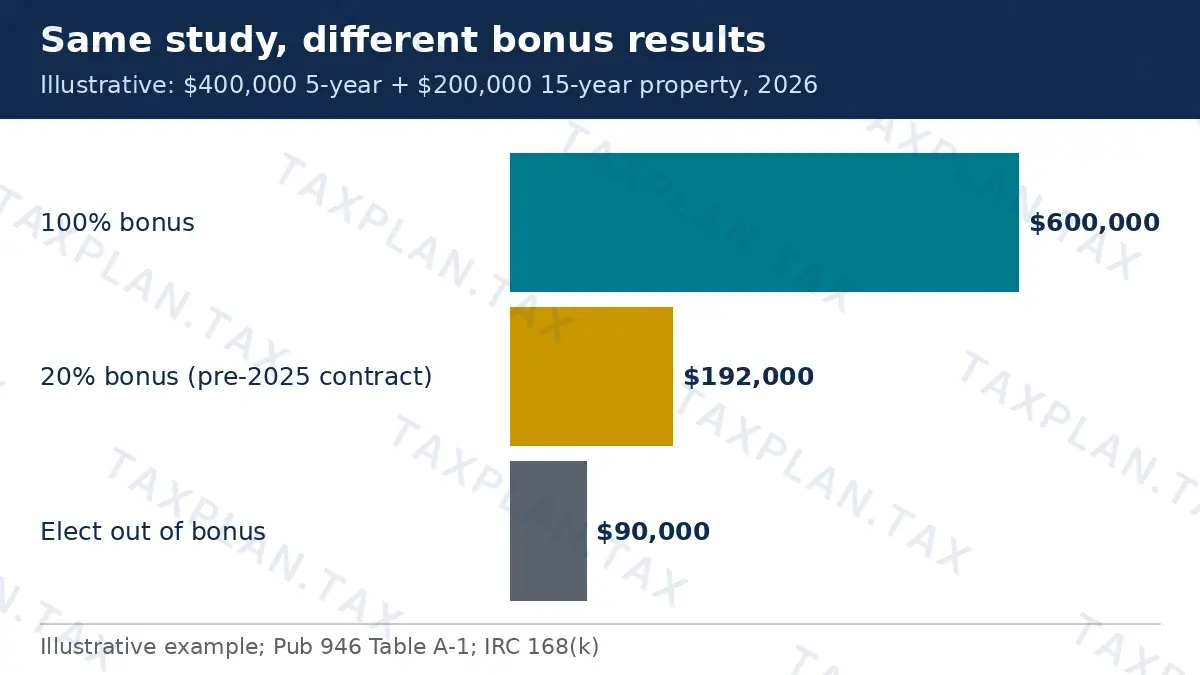
Assume a 2026 study on a commercial building identifies $400,000 of 5-year property and $200,000 of 15-year property. If the building was acquired after January 19, 2025, 100% bonus gives a $600,000 deduction on those components in 2026.
Now assume the buyer signed a binding contract in December 2024 and placed the building in service in 2026. The 20% rate applies. The 5-year property yields $80,000 of bonus plus $64,000 of regular depreciation (20% of the remaining $320,000). The 15-year property yields $40,000 of bonus plus $8,000 (5% of the remaining $160,000). The total is $192,000. If the buyer instead elected out for both classes, the total would be $90,000 ($80,000 plus $10,000).
Example 2: A look-back study with missed bonus
Next, assume an owner bought a building in 2023 and placed it in service that January. It depreciated everything as 39-year property and never elected out of bonus. A 2026 study finds $300,000 of 5-year property. The bonus rate for 2023 was 80%.
The allowable depreciation through 2025 on that $300,000 is $282,720: $240,000 of bonus plus $42,720 on the remaining $60,000 (Table A-1 rates of 20%, 32%, and 19.2%). The owner claimed only $22,767 on that cost as 39-year property (2.461% plus two years at 2.564%). So the negative §481(a) adjustment is about $259,953, generally taken in the 2026 year of change.
| Example 1: $600,000 of components (illustrative) | Year-one deduction |
|---|---|
| Acquired after January 19, 2025: 100% bonus | $600,000 |
| Pre-January 20, 2025 contract, placed in service 2026: 20% bonus | $192,000 |
| Elect out of bonus for both classes | $90,000 |
Example 3: Electing out to match income
Finally, assume a passive investor expects little passive income for several years. Under §469, a large 2026 loss may simply be suspended. So the investor might claim bonus on the 5-year class but elect out for the 15-year class. That choice spreads the 15-year deductions over time. The right answer depends on the investor’s full tax picture.
What Are the Common Mistakes and Risks?
Direct answer: Most problems come from wrong dates, unintended elections, and classes that do not qualify.
- Using the closing date as the acquisition date. A binding contract signed earlier can control.
- Applying bonus to the building. Only property with a 20-year or shorter recovery period qualifies.
- Making an unintended election out. The election covers the whole class for the year.
- Ignoring ADS. Property that must use ADS cannot get bonus.
- Ignoring the purchase agreement. A written allocation can limit the study.
- Forgetting state rules. States may not follow federal bonus depreciation, so check your state’s conformity.
Frequently Asked Questions
Do I need a cost segregation study to claim bonus depreciation?
Not for separately purchased equipment. However, to claim bonus on components inside a building’s purchase price, you need a supportable allocation, which is what a study provides.
Is bonus depreciation 100% in 2026?
For qualified property acquired after January 19, 2025, yes. Property acquired under an earlier written binding contract and placed in service in 2026 generally gets 20%.
Can I use bonus depreciation on a rental house?
Not on the house itself. However, 5-, 7-, and 15-year components identified in a study can qualify.
Can I elect out of bonus for only some assets?
Only by class. The §168(k)(7) election applies to all qualified property in a class placed in service that year.
Does used property qualify for bonus?
It can, if you (or a predecessor) had no depreciable interest in it during the lookback period and the other acquisition rules, such as the related-party rules, are met.
Can I claim missed bonus from prior years?
Often, yes, through Form 3115, unless you elected out for that class in the placed-in-service year.
Does bonus depreciation increase recapture?
Bonus is depreciation for §1245 recapture purposes, so it can increase ordinary income on a sale.
Conclusion: How Should You Combine Bonus Depreciation and Cost Segregation?
In short, bonus depreciation and cost segregation are two halves of one strategy. The study identifies eligible basis, and §168(k) decides how much of it you can deduct now. With 100% bonus available for property acquired after January 19, 2025, the acquisition date and the quality of the study matter more than ever.
Emunah Cost Segregation helps owners and CPAs pair studies with the right bonus elections. Alan Goldstein, EA, reviews your acquisition dates, contracts, and records before any study begins. Then he tells you plainly whether a study makes sense. Contact Emunah Cost Segregation in Coral Gables, Florida, to request a review. You may also find How Cost Segregation Accelerates Depreciation and Boosts Cash Flow useful.
Cases Cited
- Hospital Corp. of America v. Commissioner, 109 T.C. 21, 48-52 (1997) (United States Tax Court). Pinpoint verified against the reporter-paginated opinion text. Opinion
- Peco Foods, Inc. v. Commissioner, 522 F. App’x 840, 843-844 (11th Cir. 2013) (unpublished), aff’g T.C. Memo. 2012-18. Pinpoint verified against the reporter-paginated opinion text. Opinion
- Sears Oil Co. v. Commissioner, 359 F.2d 191, 198 (2d Cir. 1966). Pinpoint verified against the reporter-paginated opinion text. Opinion
Sources and Authorities
- 26 U.S.C. §168 (including §168(k) and (g)): https://www.law.cornell.edu/uscode/text/26/168
- 26 U.S.C. §469: https://www.law.cornell.edu/uscode/text/26/469
- 26 U.S.C. §1245: https://www.law.cornell.edu/uscode/text/26/1245
- 26 U.S.C. §1250: https://www.law.cornell.edu/uscode/text/26/1250
- Public Law 119-21 (H.R. 1, 119th Congress), §70301: https://www.congress.gov/bill/119th-congress/house-bill/1
- IRS Notice 2026-11: https://www.irs.gov/pub/irs-drop/n-26-11.pdf
- Treas. Reg. §1.48-1: https://www.ecfr.gov/current/title-26/section-1.48-1
- Treas. Reg. §1.168(k)-2: https://www.ecfr.gov/current/title-26/section-1.168(k)-2
- IRS Publication 946, including Tables A-1 and A-7a: https://www.irs.gov/pub/irs-pdf/p946.pdf
- IRS Publication 5653, Cost Segregation Audit Techniques Guide, Chapter 6.H: https://www.irs.gov/pub/irs-pdf/p5653.pdf
- About Form 3115: https://www.irs.gov/forms-pubs/about-form-3115
- Rev. Proc. 2025-23: https://www.irs.gov/pub/irs-drop/rp-25-23.pdf
- Rev. Proc. 2015-13, section 7.03: https://www.irs.gov/pub/irs-drop/rp-15-13.pdf
- Court opinions: see Cases Cited above.
This article is provided for general educational purposes and does not constitute individualized tax, legal, or accounting advice. Tax consequences depend on the taxpayer’s specific facts and applicable law.
