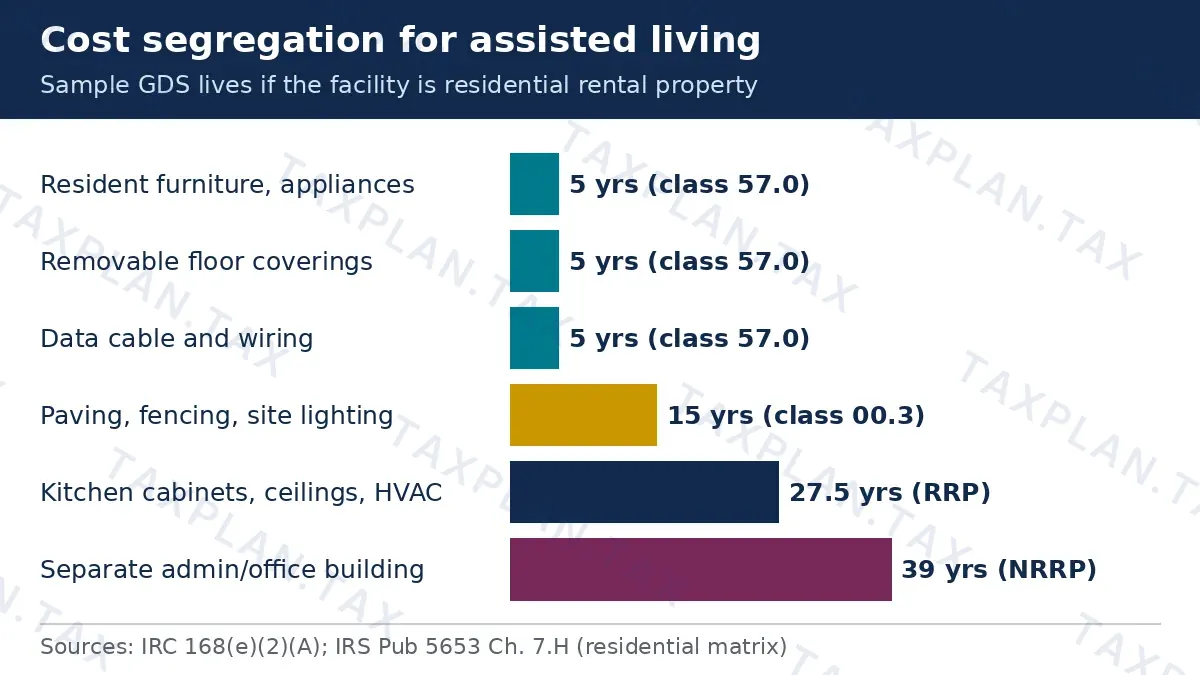

Cost segregation for assisted living facilities separates the building from its personal property and land improvements, so part of the cost is deducted years sooner. The first question, however, is which recovery period the building itself uses. Under IRC §168(e)(2)(A), a building is 27.5-year residential rental property if 80% or more of its gross rental income comes from dwelling units. In two Chief Counsel memoranda, the IRS concluded that care facilities met that test, even though residents also paid for care and meals. Otherwise, the building is 39-year nonresidential real property.
After that, a study identifies furniture, appliances, kitchen equipment, removable flooring, and site work with 5- or 15-year lives. For property acquired after January 19, 2025, those parts can generally get 100% bonus depreciation under IRS Notice 2026-11. This guide explains cost segregation for assisted living, memory care, and similar senior housing, with two worked examples.
Key Takeaways
- An assisted living building may be 27.5-year residential rental property or 39-year nonresidential property, depending on the 80% gross rental income test.
- IRS memoranda 201049026 and 201147025 treated care facilities as residential rental property, but they are not precedent.
- Fees for significant services, such as personal care and meals, are excluded from both sides of the 80% test.
- The IRS residential rental matrix in Publication 5653 puts most §1245 property in asset class 57.0, with a 5-year life.
- Qualified improvement property applies only to nonresidential buildings, so it does not help a 27.5-year facility.
What Is Cost Segregation for Assisted Living Facilities?
Direct answer: Cost segregation for assisted living is an engineering-based study that assigns each part of a senior care property’s cost to its correct depreciation class. It also confirms whether the building is residential or nonresidential.
Assisted living facilities provide housing plus help with daily activities. Many also include memory care wings, dining rooms, commercial kitchens, wellness rooms, and outdoor courtyards. Consequently, they contain both residential features and commercial-style equipment. A study must sort these components by function, not by label. For a general overview, see What Property Qualifies for a Cost Segregation Study?
Is an assisted living facility residential rental property?
Often it can be, but the answer depends on facts. Under §168(e)(2)(A), a dwelling unit is a house or apartment used to provide living accommodations. It excludes units in a hotel, motel, or other establishment where more than half the units are used on a transient basis. Most assisted living residents stay long term, so their units are usually not transient.
In Chief Counsel Advice 201049026 (2010), the IRS considered a house used for an adult home care business. Residents received 24-hour supervision, laundry, and transportation. The memo concluded that the house was residential rental property, except for the portion the owners occupied. Then, in Chief Counsel Advice 201147025 (2011), the IRS reviewed continuing care retirement communities. It concluded that independent living, assisted living, memory care, and skilled nursing units were dwelling units, so the buildings were 27.5-year property.
However, both memos state that they may not be used or cited as precedent, consistent with IRC §6110(k)(3). Still, they show how the IRS applied the statute to similar facts.
How Does Cost Segregation for Assisted Living Work?
Direct answer: The study team first applies the 80% test to each building. Then it gathers cost records, tours the site, removes land value, and classifies each component.
How does the 80% gross rental income test work here?
CCA 201147025 explains that income for services usually provided with a mere rental of rooms counts as gross rental income. In contrast, income for significant services, such as maid service, does not. The memo applies this exclusion to both the numerator and the denominator of the 80% test. As a result, care and meal fees generally do not count either way.
So the test usually turns on non-residential rent. For example, rent from a third-party pharmacy, clinic, or retail tenant in the same building may cause a building to fail. Similarly, a separate administrative building or rental office may be nonresidential. The IRS residential rental matrix notes that a separate rental office or clubhouse building is 39-year property.
What if the owner leases the facility to an operator?
This is a common structure, and it needs care. Both memos involved owners who operated the facilities themselves. Neither memo addresses a triple-net lease of the entire building to an unrelated operator. Therefore, owners using that structure should get a written analysis before choosing a 27.5-year life.
Which components often move to shorter lives?
The IRS Cost Segregation Audit Techniques Guide includes a residential rental property matrix in Chapter 7.H. It states that asset class 57.0 applies to most §1245 property used with residential rental property. Items the matrix lists as 5-year property include:
- Residential furnishings: furniture and similar items in resident units and common areas.
- Kitchen appliances: stoves, ovens, refrigerators, and similar appliances.
- Readily removable floor coverings: flooring installed so that it can be removed without damage.
- Data cable and wiring: telephone and data systems.
- Dedicated electrical: branch circuits that serve specific equipment rather than the building.
In addition, a commercial kitchen in a care facility may be reviewed under the restaurant matrix. Publication 5653 directs examiners to that matrix for restaurant assets located within an apartment building. Meanwhile, the matrix lists paving, fencing, site lighting, and exterior common areas in asset class 00.3, with a 15-year life.
What stays with the building?
The residential matrix keeps kitchen cabinets and counters, ceilings, ceiling fans, elevators, central HVAC, fire protection, and building generators in the 27.5-year class. Accordingly, cost segregation for assisted living should not treat every resident amenity as equipment. Each item needs its own review.
What Are the Benefits of Cost Segregation for Assisted Living?
Direct answer: The main benefits are larger early deductions, an accurate building life, and better records for renovations.
How does bonus depreciation apply?
Public Law 119-21, enacted July 4, 2025, made 100% bonus depreciation permanent for qualified property acquired after January 19, 2025. Bonus applies to property with a recovery period of 20 years or less. So the 5-year and 15-year parts found through cost segregation for assisted living can qualify. However, property acquired under a written binding contract signed before January 20, 2025, stays under the old phase-down. That rate is 20% for such property placed in service in 2026. Used property can also qualify under Treas. Reg. §1.168(k)-2 if you did not use it before.
Why does the building life matter?
A 27.5-year life recovers the building faster than a 39-year life. Moreover, getting the life right from the start avoids a later accounting method change. Cost segregation for assisted living therefore starts with classification, not just component pricing.
What Legal Rules Govern Cost Segregation for Assisted Living?
Direct answer: The key authorities are IRC §§168 and 1245, the structural component regulations, Rev. Proc. 87-56 asset classes, the two IRS memoranda, and Publication 5653.
- IRC §168: residential rental property, recovery periods, QIP, and bonus under §168(k).
- Treas. Reg. §1.48-1: building and structural component definitions.
- Rev. Proc. 87-56: asset classes 57.0 and 00.3, reproduced in Publication 946.
- Publication 5653, Chapter 7.H: the residential rental property matrix.
Two Tax Court cases discussed in the audit guide also apply. In Hospital Corporation of America v. Commissioner, 109 T.C. 21 (1997), the court held that the former investment tax credit rules still decide §1245 status. That case involved hospitals, so it is especially relevant to care settings. Also, Whiteco Industries, Inc. v. Commissioner, 65 T.C. 664 (1975), set out factors for inherent permanence.
Why doesn’t QIP help a residential facility?
Under IRC §168(e)(6), qualified improvement property is an interior improvement to a building that is nonresidential real property. So if a facility is 27.5-year residential rental property, interior renovations are generally 27.5-year property. Only the personal property and land improvements in a renovation get shorter lives.
What about recapture and passive rules?
Gain on §1245 property is ordinary income up to prior depreciation under IRC §1245. In addition, straight-line building depreciation creates unrecaptured §1250 gain, taxed at up to 25% under IRC §1(h). Investors who do not materially participate should also review the passive activity rules in IRC §469.
What Does Cost Segregation for Assisted Living Look Like in Practice?
Direct answer: The examples below show a facility purchase and a later renovation. All amounts are illustrative assumptions, not typical or guaranteed results.
Example 1: An operator buys an assisted living facility
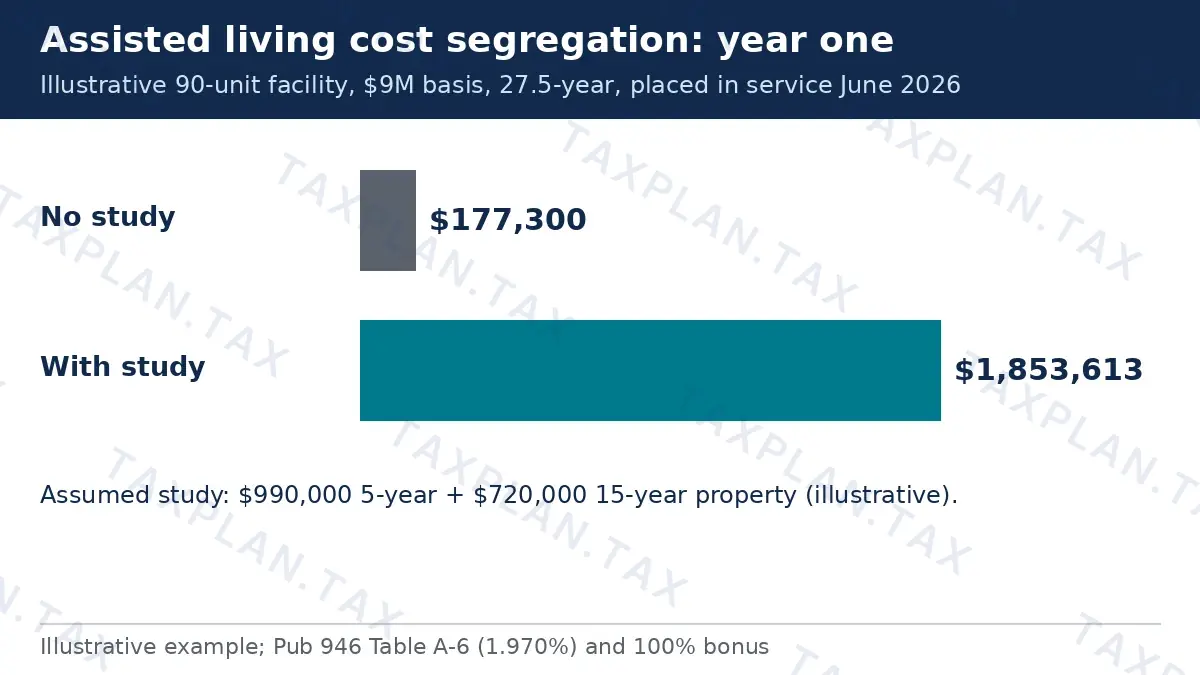
Assume an owner-operator buys a 90-unit assisted living facility under a 2026 contract. The depreciable basis after removing land is $9,000,000. The facility is placed in service in June 2026. Assume also that it meets the 80% test, so the building is 27.5-year property.
| Class (illustrative study) | Basis | Year-one depreciation |
|---|---|---|
| 5-year furniture, appliances, kitchen equipment, removable flooring (class 57.0) | $990,000 | $990,000 (100% bonus) |
| 15-year paving, walkways, fencing, courtyards, site lighting (class 00.3) | $720,000 | $720,000 (100% bonus) |
| 27.5-year building | $7,290,000 | $143,613 |
| Total | $9,000,000 | $1,853,613 |
The 27.5-year figure uses the June rate of 1.970% from Publication 946, Table A-6. Without a study, $9,000,000 at 1.970% gives $177,300. So in this example, cost segregation for assisted living adds about $1,676,313 of first-year depreciation.
Example 2: Renovating resident units
Next, assume the same owner spends $800,000 renovating resident units in September 2026. An illustrative study finds $260,000 of furniture, appliances, and removable flooring. The other $540,000 covers drywall, cabinets, plumbing, and lighting. Because the building is residential, that $540,000 is not QIP. Instead, it is 27.5-year property.
With 100% bonus on the $260,000, plus $540,000 at the September rate of 1.061%, year-one depreciation is about $265,729. In contrast, if the same work were in a nonresidential building, much of the $540,000 might be QIP. For more on residential rules, see Cost Segregation for Residential Rental Properties.
What Are Common Mistakes With Cost Segregation for Assisted Living?
Direct answer: Most errors involve assuming the building life, misapplying QIP, or weak support for allocations.
- Assuming 39 years without testing. Many facilities may qualify for 27.5 years under the 80% test.
- Assuming 27.5 years without testing. Significant third-party commercial rent can cause a building to fail.
- Relying on the memos as precedent. They show IRS reasoning but cannot be cited as precedent.
- Claiming QIP in a residential building. QIP is limited to nonresidential real property.
- Treating cabinets as furniture. The residential matrix keeps kitchen cabinets and counters in the building class.
- Ignoring entrance fee questions. CCA 201147025 cautions that entrance fees are not rent until consumed and taken into income in lieu of monthly fees.
Frequently Asked Questions
Is cost segregation for assisted living worth it for a small care home?
It can be, but study fees matter more for small properties. Our guide When Is a Cost Segregation Study Worth It? explains how to compare fees with expected benefits.
Are memory care units dwelling units?
In CCA 201147025, the IRS treated memory support units as dwelling units on the facts of that case. Still, each facility must be tested on its own facts.
Is a skilled nursing facility treated the same way?
The same memo treated skilled nursing units within a continuing care community as dwelling units. However, a stand-alone nursing facility may have different facts, so it needs its own analysis.
Does cost segregation for assisted living cover medical equipment?
Yes, if the owner buys it. Movable equipment is personal property. For comparison, see Cost Segregation for Medical and Dental Offices.
Can I apply cost segregation for assisted living bought years ago?
Yes. A look-back study claims missed depreciation through Form 3115 and a §481(a) adjustment. The automatic change list appears in Rev. Proc. 2025-23. A change from 39 to 27.5 years may also be possible, but it requires review.
What about the dining room and kitchen?
Kitchen equipment and dedicated hook-ups are often 5-year property. Dining furniture is also personal property. However, general plumbing and ventilation remain building components.
Conclusion: Is Cost Segregation for Assisted Living Right for You?
To sum up, cost segregation for assisted living starts with the building’s life. Many facilities may be 27.5-year residential rental property, but the 80% test must be applied to the facts. After that, a study can move furniture, appliances, kitchen equipment, and site work into 5- and 15-year classes. For property acquired after January 19, 2025, those parts can generally get 100% bonus depreciation.
Emunah Cost Segregation works with senior housing owners, operators, and their CPAs. Alan Goldstein, EA, reviews your property, income streams, and lease structure before any study begins. Then he tells you plainly whether a study makes sense. Contact Emunah Cost Segregation in Coral Gables, Florida, to request a review. For related reading, see Cost Segregation for Multifamily Apartment Buildings.
Sources and Authorities
- 26 U.S.C. §168 (including §168(c), §168(e)(2), §168(e)(6), and §168(k)): https://www.law.cornell.edu/uscode/text/26/168
- 26 U.S.C. §1245: https://www.law.cornell.edu/uscode/text/26/1245
- 26 U.S.C. §1 (including §1(h)): https://www.law.cornell.edu/uscode/text/26/1
- 26 U.S.C. §469: https://www.law.cornell.edu/uscode/text/26/469
- 26 U.S.C. §6110 (including §6110(k)(3)): https://www.law.cornell.edu/uscode/text/26/6110
- Public Law 119-21 (H.R. 1, 119th Congress), including §70301: https://www.congress.gov/bill/119th-congress/house-bill/1
- IRS Notice 2026-11: https://www.irs.gov/pub/irs-drop/n-26-11.pdf
- IRS Chief Counsel Advice 201049026 (Adult Home Care Business as Residential Real Property): https://www.irs.gov/pub/irs-wd/1049026.pdf
- IRS Chief Counsel Advice 201147025 (Continuing Care Retirement Community Facilities as Residential Rental Property): https://www.irs.gov/pub/irs-wd/1147025.pdf
- Treas. Reg. §1.48-1: https://www.ecfr.gov/current/title-26/section-1.48-1
- Treas. Reg. §1.168(k)-2: https://www.ecfr.gov/current/title-26/section-1.168(k)-2
- IRS Publication 946, including Table A-6 and Table B-1: https://www.irs.gov/pub/irs-pdf/p946.pdf
- IRS Publication 5653, Cost Segregation Audit Techniques Guide, including Chapters 7.C and 7.H: https://www.irs.gov/pub/irs-pdf/p5653.pdf
- About Form 3115: https://www.irs.gov/forms-pubs/about-form-3115
- Rev. Proc. 2025-23: https://www.irs.gov/pub/irs-drop/rp-25-23.pdf
- Hospital Corporation of America v. Commissioner, 109 T.C. 21 (1997), and Whiteco Industries, Inc. v. Commissioner, 65 T.C. 664 (1975), as discussed in IRS Publication 5653.
This article is provided for general educational purposes and does not constitute individualized tax, legal, or accounting advice. Tax consequences depend on the taxpayer’s specific facts and applicable law.
