
There is no official IRS table of typical cost segregation reclassification rates by property type. A reclassification rate is the share of a building’s depreciable cost that a study moves out of the 27.5- or 39-year class and into 5-, 7-, or 15-year property. The IRS publishes asset classes and audit matrices, but not expected percentages. In fact, the Cost Segregation Audit Techniques Guide (Publication 5653) tells examiners to view “rule of thumb” studies built on “industry averages” with caution. It also states that the IRS has not set any standards for preparing studies.
So this guide does not offer typical percentages. Instead, it explains what cost segregation reclassification rates measure, why they vary so much by property type, and how to estimate them responsibly. It uses clearly labeled illustrative assumptions, not market data. We editorially adjusted the title of this article for that reason: a “typical” rate is not something the IRS recognizes.
Key Takeaways
- The IRS has no official reclassification rates for any property type.
- Publication 5653 warns examiners about studies that apply a fixed percentage, such as its example of “40% for a manufacturing facility.”
- Rates depend on use, construction records, site work, finishes, and how the rate is calculated.
- Quoted rates may use different denominators, such as total price or depreciable basis, so they are often not comparable.
- A supportable study classifies actual components; the percentage is an output, not an input.
What Are Cost Segregation Reclassification Rates?
Direct answer: Cost segregation reclassification rates express the portion of depreciable building cost assigned to shorter recovery periods. The usual formula divides 5-, 7-, and 15-year property by the total depreciable basis.
The numerator typically includes §1245 personal property, such as equipment connections, and 15-year land improvements, such as paving. Some reports also include qualified improvement property, which is 15-year property under IRC §168(e)(3)(E)(vii). Meanwhile, the denominator should exclude land, because land is not depreciable. However, not every quoted rate uses the same formula. That inconsistency is one reason headline numbers can mislead.
Why does the classification matter so much?
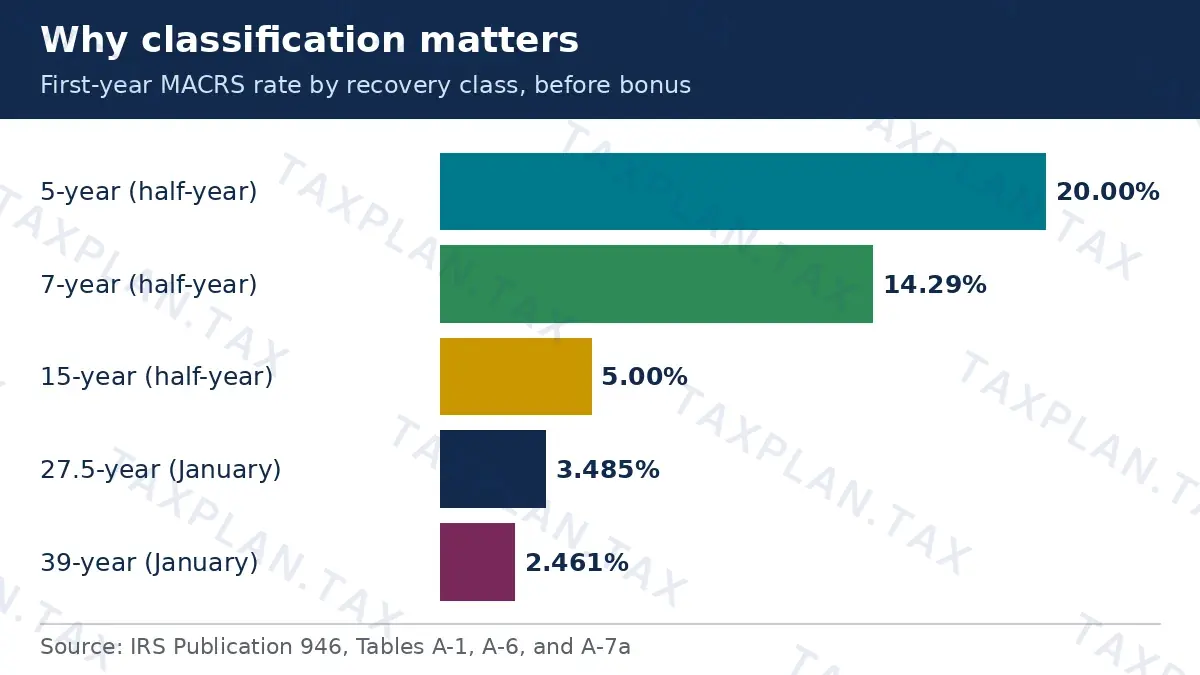
The recovery period sets the pace of deductions. For example, Publication 946, Table A-1 gives a 20% first-year rate for 5-year property under the half-year convention. By contrast, Table A-7a gives 2.461% for 39-year property placed in service in January. In addition, property with a recovery period of 20 years or less can qualify for bonus depreciation under §168(k).
How Do Cost Segregation Reclassification Rates Vary?
Direct answer: Rates vary because each building has a different mix of components. The property type is a major factor, but it is only one of several.
Factor 1: How property use shapes cost segregation reclassification rates
Use decides which components exist and which asset class applies. For instance, the IRS restaurant matrix in Publication 5653 lists kitchen hook-ups, food equipment, and décor as 5-year property. In contrast, a plain shell warehouse may have little interior personal property. Also, Rev. Proc. 87-56 asset classes follow the business activity, so equipment lives differ by industry. For a comparison of types, see What Property Qualifies for a Cost Segregation Study?
Factor 2: Site work and land improvements
Land improvements in asset class 00.3 have a 15-year life. They include sidewalks, roads, drainage, fences, and landscaping. As a result, a suburban property with large parking areas may show a higher rate than an urban building with no site work. Similarly, a property with extensive drainage, fencing, or landscaping can shift the result. On the other hand, a downtown high-rise may have almost no land improvements at all.
Factor 3: Construction records versus estimates
The audit guide calls the detailed engineering approach from actual cost records, in general, the most methodical and accurate approach. However, it notes that this approach generally applies only to new construction. For an acquired building, the study must instead allocate the purchase price and estimate component costs. Therefore, two similar buildings can show different rates simply because of the method and records available.
Factor 4: Finishes, build-outs, and age
Decorative finishes, removable flooring, and specialty lighting can add 5-year property. However, ordinary ceilings, walls, and central HVAC are structural components under Treas. Reg. §1.48-1(e)(2). Moreover, an older building’s components may be worth less relative to the whole, which can change the allocation.
Factor 5: How cost segregation reclassification rates are calculated
Some sources divide by the total purchase price, including land. Others divide by depreciable basis. Some include QIP, and others do not. Consequently, cost segregation reclassification rates quoted without a formula are hard to compare. A quoted rate is only meaningful if you know how it was built.
Why Are There No Official Cost Segregation Reclassification Rates?
Direct answer: The law classifies components by their nature and function, not by property-wide percentages. So a valid rate can only come from the building’s own facts.
Publication 5653 states that the IRS has not established any requirements or standards for preparing cost segregation studies. It adds that the IRS rulings it cites all emphasize that the determination of §1245 property is factually intensive. Its Chapter 4 describes a “rule of thumb” approach that estimates §1245 property as a fixed percentage of project cost. The guide gives “40% for a manufacturing facility” as an example of such an industry average. It then tells examiners to view this approach with caution, because it lacks support. Notably, that 40% figure is an example of a method to scrutinize, not an IRS benchmark.
What do the courts require?
Two Tax Court cases discussed in the audit guide set the framework. In Hospital Corporation of America v. Commissioner, 109 T.C. 21 (1997), the court held that the former investment tax credit rules still decide §1245 status. Also, Whiteco Industries, Inc. v. Commissioner, 65 T.C. 664 (1975), set out factors for whether property is inherently permanent. Both tests look at individual components. Therefore, a percentage cannot replace the analysis.
What Are the Benefits of Understanding Reclassification Rates?
Direct answer: Understanding cost segregation reclassification rates helps you screen projects realistically and avoid overpromised results.
Even so, a rough, clearly labeled estimate can still help with planning. The key is to treat it as a range of possibilities, not a promise. For instance, it can show whether study fees are likely to make sense. Our guide How Much Can You Save with a Cost Segregation Study? walks through that screening. In addition, knowing the drivers helps you gather the right records early, such as pay applications and site plans.
How does bonus depreciation change the stakes?
Public Law 119-21, enacted July 4, 2025, made 100% bonus depreciation permanent for qualified property acquired after January 19, 2025. So every dollar reclassified into a 5-, 7-, or 15-year class can generally be deducted in the first year, per IRS Notice 2026-11. However, property acquired under a written binding contract signed before January 20, 2025, stays under the old phase-down. That rate is 20% for such property placed in service in 2026.
What Legal Rules Govern Cost Segregation Reclassification Rates?
Direct answer: No rule sets a rate. Instead, the rules that classify each component decide the outcome.
- IRC §168: recovery periods, QIP, and bonus depreciation under §168(k).
- IRC §1245(a)(3): the definition of §1245 property.
- Treas. Reg. §1.48-1: building, structural component, and tangible personal property definitions.
- Rev. Proc. 87-56: asset classes, reproduced in Publication 946.
- Publication 5653: study methods, examiner guidance, and industry matrices.
What are the risks of an unsupported rate?
If an examiner rejects an allocation, the IRS can adjust it and assess tax and interest. In addition, an underpayment may trigger accuracy-related penalties under IRC §6662. Later, on a sale, gain on §1245 property is ordinary income up to prior depreciation under IRC §1245. So a higher rate also means more potential recapture.
What Do Cost Segregation Reclassification Rates Look Like in Practice?
Direct answer: The examples below use assumed rates only to show the math. They are illustrative assumptions, not typical, average, or expected results for any property type.
Example 1: How the rate changes year-one depreciation
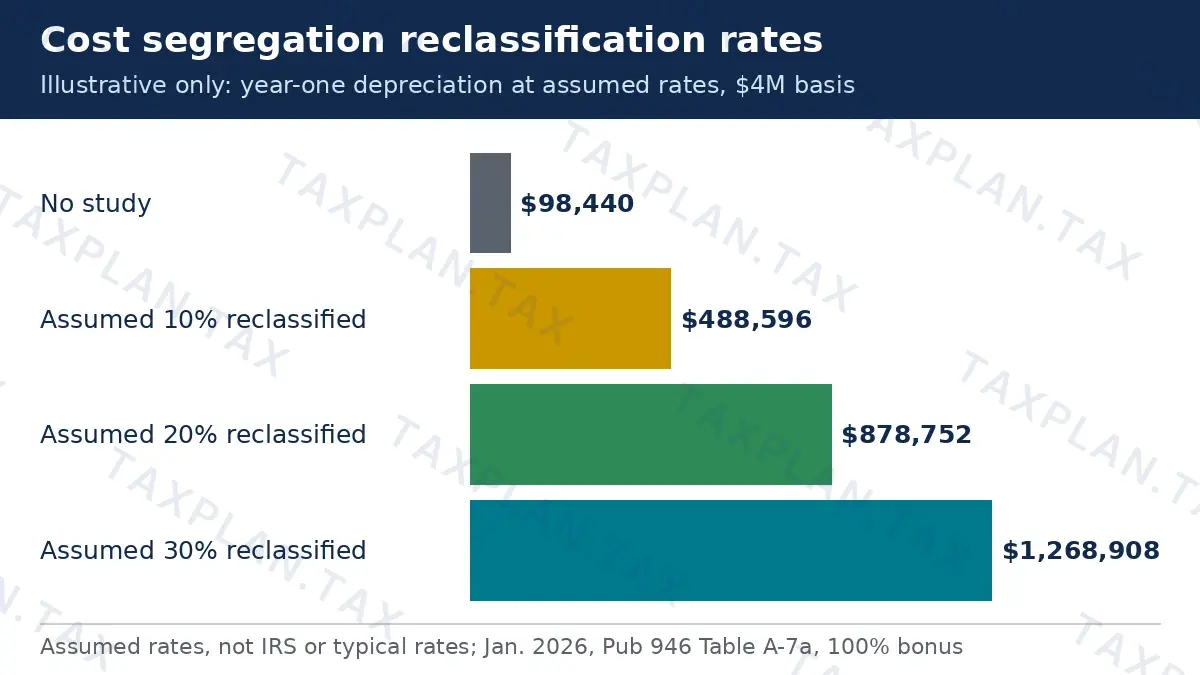
Assume a nonresidential building with a $4,000,000 depreciable basis is placed in service in January 2026. It was acquired under a 2026 contract, so 100% bonus applies. Without a study, the January rate of 2.461% gives $98,440.
| Assumed rate (illustrative) | Reclassified, 100% bonus | 39-year portion × 2.461% | Year-one depreciation |
|---|---|---|---|
| 10% | $400,000 | $88,596 | $488,596 |
| 20% | $800,000 | $78,752 | $878,752 |
| 30% | $1,200,000 | $68,908 | $1,268,908 |
Each 10-point change in the assumed rate moves year-one depreciation by about $390,156. That is why cost segregation reclassification rates must be supported, not assumed.
Example 2: The same study, two different “rates”
Next, assume an investor pays $5,000,000 for a property, including $1,000,000 of land. A study classifies $900,000 as 5- and 15-year property. Measured against the total price, the rate is 18%. However, measured against the $4,000,000 depreciable basis, it is 22.5%. Nothing changed except the formula. So always ask which denominator a quoted rate uses.
What Are Common Mistakes With Cost Segregation Reclassification Rates?
Direct answer: The most common mistakes are treating rates as facts, comparing incompatible numbers, and skipping documentation.
- Using a percentage as the study. The audit guide treats fixed-percentage studies with caution.
- Comparing rates with different formulas. Total price and depreciable basis give different results.
- Ignoring land allocation. A low land value inflates depreciable basis, and it needs its own support.
- Counting structural components as equipment. General HVAC, plumbing, and wiring usually stay in the building class.
- Forgetting recapture. More reclassified property can mean more ordinary income on a sale.
Frequently Asked Questions
What is a typical cost segregation reclassification rate?
There is no official typical rate. The IRS does not publish one, and its audit guide warns against relying on industry averages. A study must classify the actual components.
Why do providers quote ranges?
Providers often share their own experience. However, those figures are not IRS data, and methods differ. In other words, cost segregation reclassification rates from marketing materials describe past projects, not your building. Ask how the range was built and what it includes.
Do residential rentals have lower rates than commercial buildings?
Not necessarily. Apartments often have appliances, removable flooring, and large site areas. Also, the residential building class is 27.5 years, so the comparison is not one to one. Still, results depend on the specific property. For residential details, see Cost Segregation for Residential Rental Properties.
Can I estimate a rate before ordering a study?
Yes, a provider can give a preliminary estimate based on your records. Treat it as a screening tool, not a result. Our guide When Is a Cost Segregation Study Worth It? explains how to use it.
Does a higher rate mean a better study?
No. A better study is one that is accurate and well documented. An inflated rate can lead to adjustments, penalties, and more recapture.
Can I apply a study to a building bought years ago?
Yes. A look-back study claims missed depreciation through Form 3115 and a §481(a) adjustment, under the automatic change list in Rev. Proc. 2025-23.
Conclusion: How Should You Think About Reclassification Rates?
To sum up, cost segregation reclassification rates are an output of a study, not an input. The IRS has no typical rate for any property type, and its audit guide warns against fixed percentages. Instead, rates vary with use, site work, records, finishes, and the formula used. For property acquired after January 19, 2025, every supported dollar reclassified can generally get 100% bonus depreciation.
Emunah Cost Segregation works with property owners and their CPAs to build supportable studies. Alan Goldstein, EA, reviews your property and records before any study begins. Then he gives you a realistic, documented estimate rather than a generic percentage. Contact Emunah Cost Segregation in Coral Gables, Florida, to request a review. For the full process, see Cost Segregation Study Process: Step-by-Step Breakdown.
Sources and Authorities
- 26 U.S.C. §168 (including §168(c), §168(e), and §168(k)): https://www.law.cornell.edu/uscode/text/26/168
- 26 U.S.C. §1245: https://www.law.cornell.edu/uscode/text/26/1245
- 26 U.S.C. §6662: https://www.law.cornell.edu/uscode/text/26/6662
- Public Law 119-21 (H.R. 1, 119th Congress), including §70301: https://www.congress.gov/bill/119th-congress/house-bill/1
- IRS Notice 2026-11: https://www.irs.gov/pub/irs-drop/n-26-11.pdf
- Treas. Reg. §1.48-1: https://www.ecfr.gov/current/title-26/section-1.48-1
- IRS Publication 946, including Tables A-1, A-7a, B-1, and B-2: https://www.irs.gov/pub/irs-pdf/p946.pdf
- IRS Publication 5653, Cost Segregation Audit Techniques Guide, including Chapter 4 (“Rule of Thumb” Approach) and Chapter 7: https://www.irs.gov/pub/irs-pdf/p5653.pdf
- About Form 3115: https://www.irs.gov/forms-pubs/about-form-3115
- Rev. Proc. 2025-23: https://www.irs.gov/pub/irs-drop/rp-25-23.pdf
- Hospital Corporation of America v. Commissioner, 109 T.C. 21 (1997), and Whiteco Industries, Inc. v. Commissioner, 65 T.C. 664 (1975), as discussed in IRS Publication 5653.
This article is provided for general educational purposes and does not constitute individualized tax, legal, or accounting advice. Tax consequences depend on the taxpayer’s specific facts and applicable law.
