

Unfiled federal tax returns for small business owners often involve more than a personal Form 1040. A business may also owe payroll returns, information returns, and an entity income tax return. Each one has its own deadline and penalty. Unpaid payroll taxes can even become a personal liability through the Trust Fund Recovery Penalty. This article maps the business returns that are often missed and explains how to prioritize them.
Key Takeaways
- Small business owners may have four layers of returns: payroll, information, entity, and personal.
- Employers generally file Form 941 each quarter. The due dates are April 30, July 31, October 31, and January 31.
- Unpaid trust fund taxes can lead to a personal Trust Fund Recovery Penalty for responsible persons.
- Late partnership and S corporation returns face a monthly penalty for each partner or shareholder.
- Payroll returns usually deserve first attention, because the personal exposure can be large.
Which unfiled federal tax returns for small business owners are most common?
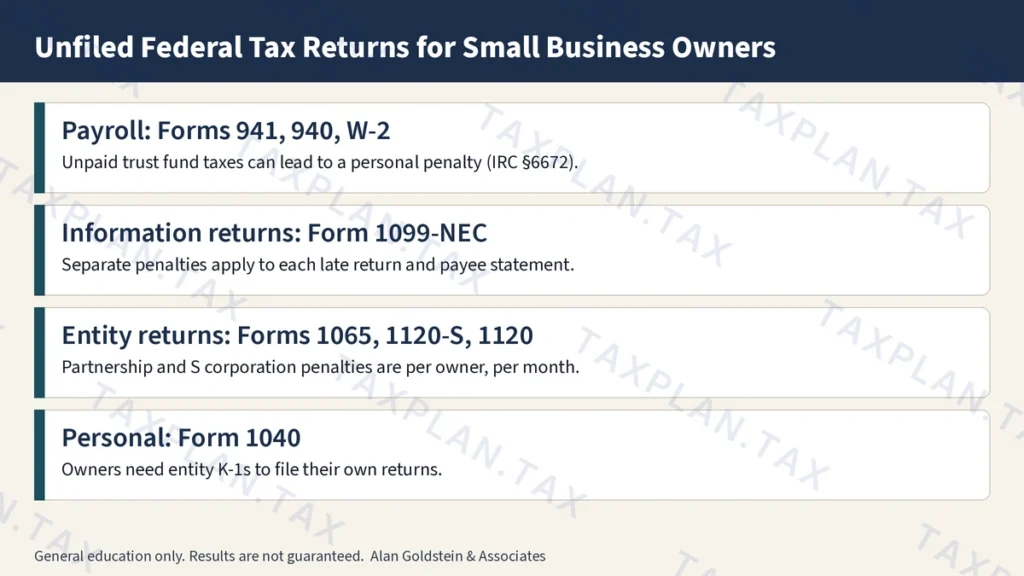
Most small businesses face four kinds of federal returns. The list depends on how the business is organized and whether it has employees.
| Return layer | Common forms | Who files |
|---|---|---|
| Payroll (employment tax) | Forms 941, 940, W-2 | Businesses that pay employees |
| Information returns | Forms 1099-NEC, 1099-MISC | Businesses that make reportable payments |
| Entity income tax | Forms 1065, 1120-S, 1120 | Partnerships, S corporations, C corporations |
| Personal income tax | Form 1040 with Schedules C, E, SE | Owners, including sole proprietors |
An unfiled personal return is only one part of the problem. In addition, a missing payroll or entity return can trigger its own notices, penalties, and collection steps. The IRS handles delinquent business returns under procedures in IRM 5.1.11, Delinquent Return Investigations.
Why are unfiled payroll tax returns the biggest risk?
Because payroll taxes include money withheld from employees, and the law can hold individuals personally liable for it. That makes unfiled and unpaid payroll returns the first priority in many cases.
Employers generally report wages and withholding on Form 941 each quarter. The IRS lists due dates of April 30, July 31, October 31, and January 31 (IRS: Employment tax due dates). Federal unemployment tax is reported on Form 940.
What are trust fund taxes?
Trust fund taxes are the income tax withheld from employees’ wages and the employees’ share of Social Security and Medicare taxes. The IRS says they are called trust fund taxes because the employer holds the employees’ money in trust until it makes a federal tax deposit (IRS: Employment taxes and the TFRP).
What is the Trust Fund Recovery Penalty?
It is a penalty that can make a person personally liable for unpaid trust fund taxes. Under IRC §6672, a person required to collect and pay over the tax who willfully fails to do so is liable for a penalty equal to the unpaid amount.
The IRS says a responsible person has the duty and the power to direct the collecting, accounting, and paying of trust fund taxes. Officers, partners, directors, and others may qualify. Willfulness does not require evil intent. For example, the IRS says using available funds to pay other creditors when the business cannot pay employment taxes is an indication of willfulness. The business does not have to stop operating for the IRS to assess the penalty.
What happens when business entity returns are not filed?
Each entity type has its own penalty rules. Partnerships and S corporations face penalties based on the number of owners, even when no tax is due.
- Partnerships (Form 1065). IRC §6698 imposes a penalty for each month or part of a month the return is late, up to 12 months. The monthly amount starts from a $195 statutory base, adjusted for inflation. Additionally, for 2025 returns due in 2026, it is $255 per partner per month (2025 Form 1065 instructions).
- S corporations (Form 1120-S). IRC §6699 applies a similar per-shareholder, per-month penalty. For 2025 returns due in 2026, that amount is also $255 per shareholder per month (2025 Form 1120-S instructions).
- C corporations (Form 1120). The failure-to-file penalty under IRC §6651 applies to unpaid tax. The IRS lists a minimum penalty for Forms 1040 and 1120 that are more than 60 days late. For returns due after December 31, 2025, it is $525 or 100% of the unpaid tax, whichever is less (IRS: Failure to file penalty).
Pass-through returns also affect owners. A partnership or S corporation issues Schedules K-1 that owners need for their own returns. So a missing entity return often means missing personal returns too.
What about unfiled Forms 1099 and W-2?
They carry separate penalties. The IRS charges penalties for each information return not filed correctly or on time, and for each payee statement not furnished on time (IRS: Information return penalties).
The amount depends on how late the form is. Moreover, the IRS says there is no maximum penalty for intentional disregard. The governing statute is IRC §6721. For contractors paid for services, the common form is Form 1099-NEC.
In what order should a small business catch up?
Many advisers start with payroll returns, then entity returns, then personal returns. The right order depends on your notices, deadlines, and balances.
- Stop new problems. First, make current payroll deposits and file current returns on time. The IRS generally expects current compliance before it agrees to resolve old balances.
- Address payroll periods. Next, file missing Forms 941 and 940. These carry the personal TFRP risk.
- File entity returns. Then file partnership or corporate returns so owners receive their K-1s.
- File personal returns. After that, file each owner’s Form 1040 using the entity figures.
- Resolve balances and penalties. Finally, review payment options and any reasonable-cause penalty relief.
Our step-by-step guide to filing past-due federal tax returns covers the individual side. For payroll matters, see our page on employment and payroll tax issues.
What records do you need to rebuild business returns?
You need records that show income, expenses, payroll, and payments to others. Good records also help you prove deductions if the IRS asks.
The IRS says the burden of proof is on you to support entries, deductions, and statements on your return (IRS: Recordkeeping). For a catch-up project, start with bank and merchant statements, sales records, and invoices. Next, gather payroll registers, quarterly wage reports, and deposit history. Then collect vendor bills and contractor payment records, which also support any missing Forms 1099.
IRS transcripts can fill gaps. For instance, business account transcripts may show which returns the IRS has on file and which deposits it received. A representative with a valid Form 2848 power of attorney can usually request them for you.
How do unfiled returns affect the business itself?
They can disrupt financing, contracts, and cash flow. Beyond penalties, the IRS notes that loan approvals may be delayed if you do not file (IRS: Filing past due tax returns). Lenders often ask for copies of filed returns, including for a business loan.
Collection can also reach business assets. After assessment and notice, the IRS may file a federal tax lien under IRC §6321 or levy under IRC §6331. A levy on business bank accounts or receivables can interrupt operations quickly.
Can the business get on a payment plan?
Possibly, once required returns are filed. The IRS offers payment plans for businesses and individuals. Terms depend on the balance, the type of tax, and current compliance.
Frequently Asked Questions
Can I be personally liable for my company’s unpaid payroll taxes?
Yes, possibly. If you are a responsible person who willfully failed to pay trust fund taxes, the IRS may assess the Trust Fund Recovery Penalty against you personally.
Do I have to file a partnership return if the business lost money?
Generally, yes. The §6698 penalty applies to a late partnership return regardless of whether tax is due, because it is based on the number of partners.
Does a C corporation face the same minimum late-filing penalty as individuals?
The IRS lists the same minimum penalty for Forms 1040 and 1120 that are more than 60 days late. For returns due after December 31, 2025, it is $525 or 100% of the unpaid tax, whichever is less.
Are Forms 1099 really that important?
Yes. Separate penalties apply to each late information return and each late payee statement. There is no maximum for intentional disregard.
Should I file payroll returns before my personal return?
Often, but not always. Payroll returns carry personal TFRP exposure, so many cases start there. Your notices and deadlines may change the order.
Can business penalties be abated?
Possibly. Many penalties do not apply if you can show reasonable cause. The IRS decides each request on its facts, and relief is not guaranteed.
Will the IRS shut down my business?
The IRS has strong collection tools, including levies on business accounts. Responding early and filing missing returns may preserve more options.
Conclusion
Unfiled federal tax returns for small business owners usually span several layers: payroll, information, entity, and personal. Payroll returns often come first because of the personal Trust Fund Recovery Penalty. Entity returns matter because owners need their K-1s. A clear filing order can make the catch-up more manageable.
Alan Goldstein, MBA, IRS Enrolled Agent, of Alan Goldstein & Associates in Coral Gables, Florida, helps business owners identify missing returns and plan a filing order. We can also review payment options and penalty relief. Every case depends on its facts, and we cannot guarantee any outcome. To request a confidential review, visit our Tax Resolution Services page.
Sources and Authorities
- IRM 5.1.11, Delinquent Return Investigations
- IRS: About Form 941
- IRS: Employment tax due dates
- IRS: About Form 940
- IRS: Employment taxes and the Trust Fund Recovery Penalty (TFRP)
- IRC §6672, Failure to collect and pay over tax
- IRC §6698, Failure to file partnership return
- IRS: Instructions for Form 1065 (2025), Late Filing of Return
- IRC §6699, Failure to file S corporation return
- IRS: Instructions for Form 1120-S (2025), Late filing of return
- IRC §6651, Failure to file tax return or to pay tax
- IRS: Failure to file penalty
- IRS: Information return penalties
- IRC §6721, Failure to file correct information returns
- IRS: About Form 1099-NEC
- IRS: Filing past due tax returns
- IRS: Recordkeeping
- IRS: About Form 2848, Power of Attorney
- IRC §6321, Lien for taxes
- IRC §6331, Levy and distraint
- IRS: Payment plans (installment agreements)
This article is provided for general educational purposes and does not constitute individualized tax, legal, or accounting advice. Tax consequences depend on the taxpayer’s specific facts and applicable law.
