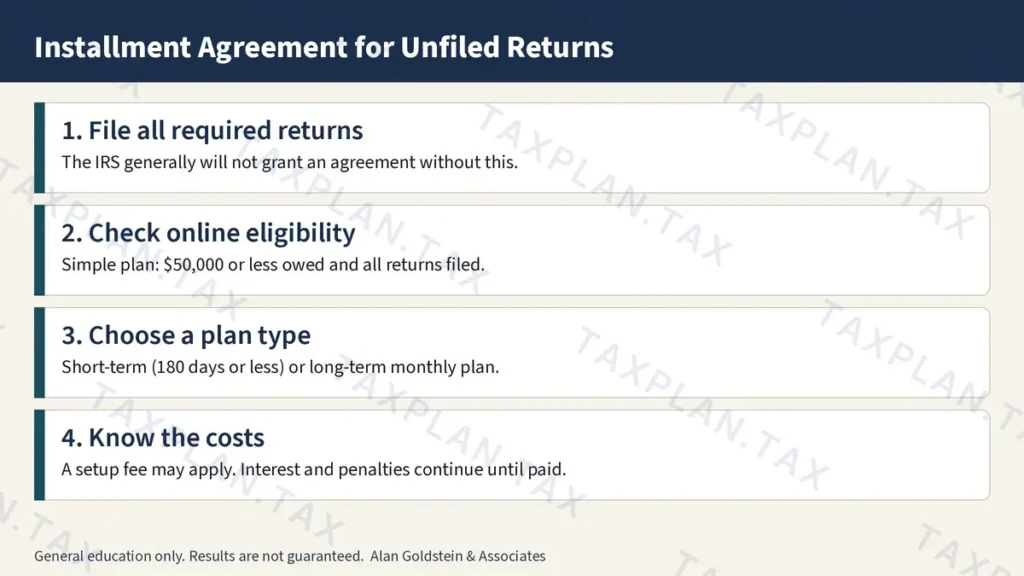


You can request an installment agreement for unfiled returns only after you file them. The IRS generally will not grant a payment plan until you have filed all required returns. So the order is simple: file the missing returns, learn what you owe, then ask for a plan. This article explains how to request an installment agreement for unfiled returns, who qualifies for online approval, what it costs, and what risks remain.
Key Takeaways
- An installment agreement is a payment plan that lets you pay a tax debt over time.
- The IRS requires filing compliance first. That means you have filed all required returns.
- You may apply online for a simple plan if you owe $50,000 or less and have filed all required returns.
- A short-term plan covers up to 180 days. A long-term plan uses monthly payments.
- Interest and penalties continue to accrue until you pay in full.
- While a request is pending, the IRS generally may not levy.
What is an installment agreement?
An installment agreement (IA) is an agreement with the IRS to pay a tax debt over an extended period. The IRS now calls these payment plans. IRC §6159 lets the IRS enter written agreements when it decides the agreement will help it collect the liability in full or in part.
Why does the IRS require filed returns first?
The IRS requires filed returns because it needs to know what you owe and whether you are in compliance. The Internal Revenue Manual says that before granting an agreement, individuals must file all required returns and stay current on estimated tax payments or withholding (IRM 5.14.1).
The manual is direct on this point. It tells employees not to grant an agreement when the taxpayer owes an unfiled balance-due return. It also says a request is not treated as pending until the returns are filed.
How do unfiled returns affect your ability to get a plan?
They block the request. If you ask for a plan while returns are missing, the IRS may tell you to file first. You must then submit a new request after you file (IRM 5.14.1).
The IRS also holds refunds while returns are past due. For help with the filing step, see our guide to how to file past-due federal tax returns.
How do you request an installment agreement for unfiled returns?
You file every required return, confirm your balance, and then apply online, by phone, by mail, or in person. The method depends on how much you owe and what you can document.
Step 1: File every missing return
File each past-due return the same way you would file a timely one. If you received a notice, send the return to the address on that notice (IRS: Filing past due tax returns).
The IRS says processing an accurate past-due return takes about six weeks. Plan for that delay before you expect a balance to appear.
Step 2: Confirm what you owe
Check your balance in your IRS online account or on your notices. Each tax year can have its own balance, including tax, penalties, and interest. You can also use Get Transcript to review your account.
If you filed recently and have not yet received a bill, the IRS says you need the balance due shown on your return to apply online (IRS: Online payment agreement application).
Step 3: Choose how to apply
You may qualify to apply online for a simple payment plan if you owe $50,000 or less in combined tax, penalties, and interest and have filed all required returns. You may qualify for a short-term plan if you owe less than $100,000 in combined tax, penalties, and interest (IRS: Online payment agreement application).
If you do not qualify online, you can apply with Form 9465, Installment Agreement Request. The IRS may also ask for a collection information statement, such as Form 433-F.
Step 4: Consider using a representative
A tax professional can request a plan for you if you authorize them on Form 2848. The IRS says the authorization must cover all tax periods with a balance due, and some authority levels cannot represent you for payment plans.
What types of IRS payment plans are available?
The IRS offers short-term and long-term plans for individuals. Which one fits depends on how fast you can pay and how much you owe.
What is a short-term payment plan?
A short-term plan lets you pay in 180 days or less. The IRS charges no setup fee, but penalties and interest continue to accrue until you pay in full (IRS: Payment plans and installment agreements).
Before you pick a plan, the IRS also notes that you can request an additional 60 to 120 days to pay through the online agreement tool or by phone, with no user fee.
What is a long-term payment plan?
A long-term plan, also called an installment agreement, is a monthly payment plan. The IRS lists the following setup fees for individuals who apply online. Fees are higher if you apply by phone, mail, or in person.
- Direct debit plan: $29 to apply online. Low-income applicants may have the fee waived.
- Non-direct debit plan: $69 to apply online. Low-income applicants may pay $43, which may be reimbursed if conditions are met.
- Revising or reinstating a plan online: $6.
Fees can change, so confirm them on the IRS page before you apply.
What does an installment agreement cost beyond the setup fee?
You also pay interest and penalties until the balance is gone. For late filers, these can be significant, so paying more than the minimum may save money.
What interest rate applies?
The underpayment interest rate is 7% per year, compounded daily, for the quarter that began October 1, 2026 (IRS: Quarterly interest rates). Rates reset each quarter. Because of that, the cost of a long plan can change over time.
Which penalties continue during a plan?
The failure-to-pay penalty is generally 0.5% of unpaid tax per month, up to 25%. The IRS says it drops to 0.25% per month during an approved plan, but only if you filed your return on time (IRS: Failure to pay penalty). Late filers generally do not qualify for that reduction. Authority is in IRC §6651(h).
The failure-to-file penalty is separate. It is 5% of the tax due per month or partial month, up to 25%. For returns due after December 31, 2025, the minimum penalty for a return more than 60 days late is $525 or 100% of the tax due, whichever is less (IRS: Failure to file penalty). See our overview of federal unfiled tax returns penalties for more.
What protections does a pending payment plan request give you?
A pending request generally stops levy, but it does not erase the debt. The protection is limited and ends if the IRS rejects or terminates the plan.
Does a payment plan request stop a levy?
Generally, yes while it is pending. Under IRC §6331(k)(2), the IRS may not levy during a pending request, while an agreement is in effect, or for 30 days after a rejection or termination. An appeal within that window extends the protection.
The IRS adds that the collection period may be suspended or prolonged during these events (IRS). Our article on IRS levies and wage garnishments covers levy basics.
What happens if you default?
If you miss payments, the IRS may propose to terminate the plan. You can often reinstate it, and the IRS lists a $6 online fee for that. To avoid default, keep your filings and payments current.
Frequently Asked Questions
Can I get an installment agreement if I have unfiled returns?
Generally no. The IRS requires you to file all required returns first, then submit the request.
How long does it take to get approved?
Online applicants get an immediate decision on the application. Other methods take longer, and you must also wait for past-due returns to process.
What if I owe more than $50,000?
You may not qualify for the online simple plan, but other options exist. You may need to apply by phone, mail, or in person, and the IRS may request financial information.
Does a payment plan stop the failure-to-file penalty?
No. That penalty has already accrued for the months the return was late. The plan only affects how you pay the balance.
Will the IRS file a lien if I have a payment plan?
It may. The IRS says an unpaid balance can lead to a lien. Some direct debit plans may qualify for lien withdrawal under conditions the IRS lists.
Can I pay off a plan early?
Yes. Paying early can reduce the interest and penalties that keep accruing.
Is an installment agreement better than an offer in compromise?
It depends on your finances. The IRS generally will not accept an offer if you can pay in full through a payment plan or asset equity.
Conclusion
To get an installment agreement, you must first file every required return. Then you can compare short-term and long-term plans, confirm the fees, and apply. A plan may pause levy while it is pending, but it does not stop interest or erase penalties. The IRS decides each request, so no outcome is certain.
If you have unfiled returns and a balance you cannot pay at once, contact Alan Goldstein, MBA, IRS Enrolled Agent, at Alan Goldstein & Associates in Coral Gables, Florida. We offer a confidential review of your unfiled returns and IRS collection and resolution options. We do not guarantee outcomes, because every case depends on its facts.
Sources
- IRM 5.14.1, Securing Installment Agreements (Payment Plans)
- IRS: Online payment agreement application
- IRS: Payment plans and installment agreements
- IRS: Filing past due tax returns
- IRS: Get Transcript
- IRS Form 9465, Installment Agreement Request
- IRS Form 433-F, Collection Information Statement
- IRS: About Form 2848
- IRS: Quarterly interest rates
- IRS: Failure to pay penalty
- IRS: Failure to file penalty
- 26 U.S.C. §6159
- 26 U.S.C. §6331
- 26 U.S.C. §6651
This article is provided for general educational purposes and does not constitute individualized tax, legal, or accounting advice. Tax consequences depend on the taxpayer’s specific facts and applicable law.
