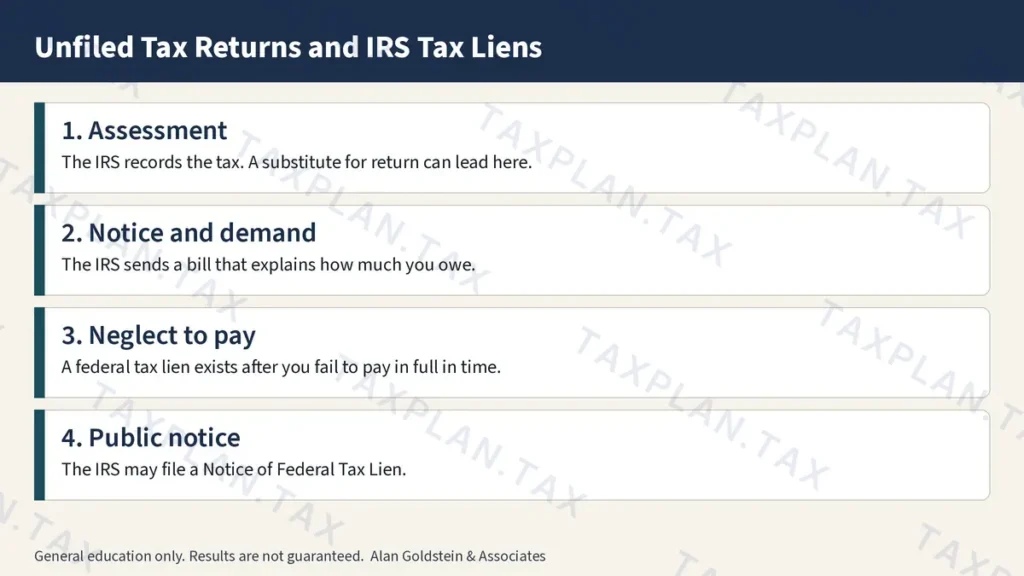


Unfiled tax returns do not create a federal tax lien by themselves. A lien arises after the IRS assesses a balance, sends a bill, and you do not pay it in full. Even so, unfiled tax returns and IRS tax liens are closely linked. A substitute return can produce the assessment, and an unpaid assessment can lead to a lien. This article explains how the process works and what options exist.
Key Takeaways
- A federal tax lien is the government’s legal claim against your property for an unpaid tax debt.
- The lien exists only after an assessment, a notice and demand, and a failure to pay.
- A substitute for return (SFR) can create an assessment if you do not file.
- A Notice of Federal Tax Lien (NFTL) is the public filing that alerts other creditors.
- After an NFTL, the IRS must send notice and offer a lien hearing.
- Paying in full is the main way to release a lien. Withdrawal, discharge, and subordination may help in limited cases.
How do unfiled tax returns and IRS tax liens connect?
They connect through the assessment. The IRS cannot lien your property for tax it has not assessed, and a missing return leaves no assessment until the IRS prepares one or you file.
What is a federal tax lien?
A federal tax lien is the government’s legal claim against your property when you neglect or fail to pay a tax debt. The IRS says it protects the government’s interest in all your property, including real estate, personal property, and financial assets (IRS: Understanding a federal tax lien).
The statute is IRC §6321. It applies when a person liable for tax neglects or refuses to pay after demand.
When does a federal tax lien arise?
A lien arises after three events. First, the IRS assesses the liability. Second, it sends a bill, called a notice and demand for payment. Third, you neglect or refuse to pay in full and on time (IRS).
Under IRC §6322, the lien arises when the assessment is made. It continues until you satisfy the debt or the collection period ends. The usual collection period is 10 years from assessment under IRC §6502.
Can unfiled returns lead to an assessment?
Yes. If you do not file, the IRS may prepare a substitute return under IRC §6020(b). The IRS says the return may omit deductions you could claim, and it sends a notice of deficiency (CP3219N) proposing a tax assessment. You then have 90 days to file your own return or petition the Tax Court (IRS: Filing past due tax returns).
If you do neither, the IRS can assess the proposed tax. An unpaid bill can then trigger collection, including a levy or a Notice of Federal Tax Lien. Our article on the risks of an IRS substitute for return covers this step in detail.
What is a Notice of Federal Tax Lien?
A Notice of Federal Tax Lien (NFTL) is a public document the IRS files to alert creditors that the government has a legal right to your property. The lien itself and the public notice are different things.
Why does the IRS file a Notice of Federal Tax Lien?
The IRS files it to protect its priority. Under IRC §6323(a), the lien is not valid against a purchaser, a holder of a security interest, a mechanic’s lienor, or a judgment lien creditor until the IRS files notice.
In practice, this means a filed NFTL puts other creditors on notice. The IRS also warns that an NFTL may limit your ability to get credit.
Will the IRS tell you before or after it files the notice?
After. Under IRC §6320, the IRS must notify you in writing within five business days after it files the NFTL. That notice must describe your right to request a hearing during the 30-day period that begins the day after the five-day period.
This lien hearing is part of the collection due process (CDP) rules. Publication 1660 explains the appeal rights.
What property does a lien reach?
A lien attaches to all your assets, such as real estate, securities, and vehicles. It also reaches assets you acquire while the lien is in place. For business owners, it attaches to business property and to rights to business property, including accounts receivable (IRS).
Bankruptcy does not always end the problem. The IRS notes that tax debt, the lien, and the NFTL may continue after bankruptcy.
How is a tax lien different from a levy?
A lien secures the government’s claim, while a levy actually takes property. The IRS states that if you do not pay or make arrangements, it can levy, seize, and sell real or personal property you own.
The two actions often follow each other. For levy details, see our overview of IRS levies and wage garnishments. For a broader lien explanation, see our guide to federal tax liens.
How can you avoid or remove a tax lien tied to unfiled returns?
The best way to avoid a lien is to file and pay on time. If that is not possible, you can still limit the damage by filing the missing returns and resolving any balance quickly.
How do you avoid a lien after missing filing deadlines?
File every required return as soon as you can. The IRS says you can avoid a lien by filing and paying all taxes in full and on time. If you cannot pay in full, it says payment options can help you settle the debt over time (IRS).
Filing your own return may also replace an SFR. You may then reduce the proposed tax by claiming deductions and credits you are entitled to. See our guide to filing past-due federal tax returns.
How do you get rid of a federal tax lien?
Paying the debt in full is the best way. The IRS says it releases the lien within 30 days after you pay in full (IRS). Other options reduce the lien’s impact without ending the debt.
- Discharge removes the lien from specific property. Publication 783 gives application instructions.
- Subordination lets other creditors move ahead of the IRS. It does not remove the lien. Publication 784 explains how to apply.
- Withdrawal removes the public NFTL, but you still owe the debt. Authority is in IRC §6323(j), and Form 12277 is the application.
Can you get an NFTL withdrawn after a payment plan?
Possibly. The IRS lists two Fresh Start withdrawal options. One applies after you satisfy the debt and the IRS releases the lien. It requires filing compliance for the past three years and current estimated tax payments or deposits.
The other may apply if you owe $25,000 or less and enter a direct debit installment agreement that pays in full within 60 months or before the collection period ends. You must also make three consecutive direct debit payments and meet other filing and payment rules.
What should you do first if you have unfiled returns and fear a lien?
Start by finding out whether the IRS has assessed anything. Then file the missing returns and compare resolution options. The steps below are general, not advice for your case.
- Review your account. Use Get Transcript to see which years show a balance or no return.
- Read every IRS notice. Look for CP3219N, balance-due notices, and any lien notice.
- File the missing returns. Accurate returns may replace a substitute return.
- Address the balance. Consider a payment plan, an offer in compromise, or hardship status.
- Request a hearing if you receive lien notice. Follow the deadline in the notice.
Frequently Asked Questions
Do unfiled tax returns cause a tax lien?
Not directly. A lien needs an assessment, a notice and demand, and a failure to pay. An SFR assessment can start that chain.
Is a tax lien the same as a levy?
No. A lien is a legal claim on your property. A levy takes property or money to pay the debt.
Does filing my returns remove a lien?
No. Filing may change the amount owed, but a lien stays until you pay or another release rule applies.
How long does a federal tax lien last?
It lasts until you satisfy the liability or it becomes legally unenforceable. The collection period is generally 10 years from assessment, though some events can extend it.
Can I sell my home with a tax lien?
Often it requires coordination with the IRS. A discharge of specific property may be available in some cases, so ask a professional before you sign a sale contract.
Will the IRS file a lien if I am on a payment plan?
It may. The IRS says an unpaid balance can lead to an NFTL. However, a direct debit installment agreement may allow a withdrawal if you meet the conditions above.
Can I appeal a Notice of Federal Tax Lien?
Yes, in some cases. You may request a hearing within the period in your lien notice, and Publication 1660 explains collection appeal rights.
Conclusion
Unfiled returns do not create a lien alone, but they can lead to an assessment that does. Acting early, filing accurately, and responding to notices give you more options. No approach guarantees that a lien will be avoided, withdrawn, or released.
If you have unfiled returns or have received IRS lien or collection notices, contact Alan Goldstein, MBA, IRS Enrolled Agent, at Alan Goldstein & Associates in Coral Gables, Florida. We offer a confidential review of your unfiled returns and IRS collection and resolution options. We do not guarantee outcomes, because every case depends on its facts.
Sources
- IRS: Understanding a federal tax lien
- IRS: Filing past due tax returns
- IRS Publication 1660, Collection Appeal Rights
- IRS Publication 783, Instructions on How to Apply for Certificate of Discharge From Federal Tax Lien
- IRS Publication 784, Instructions on How to Apply for a Certificate of Subordination of Federal Tax Lien
- IRS Form 12277, Application for Withdrawal of Filed Form 668(Y), Notice of Federal Tax Lien
- IRS: Get Transcript
- 26 U.S.C. §6020
- 26 U.S.C. §6320
- 26 U.S.C. §6321
- 26 U.S.C. §6322
- 26 U.S.C. §6323
- 26 U.S.C. §6502
This article is provided for general educational purposes and does not constitute individualized tax, legal, or accounting advice. Tax consequences depend on the taxpayer’s specific facts and applicable law.
