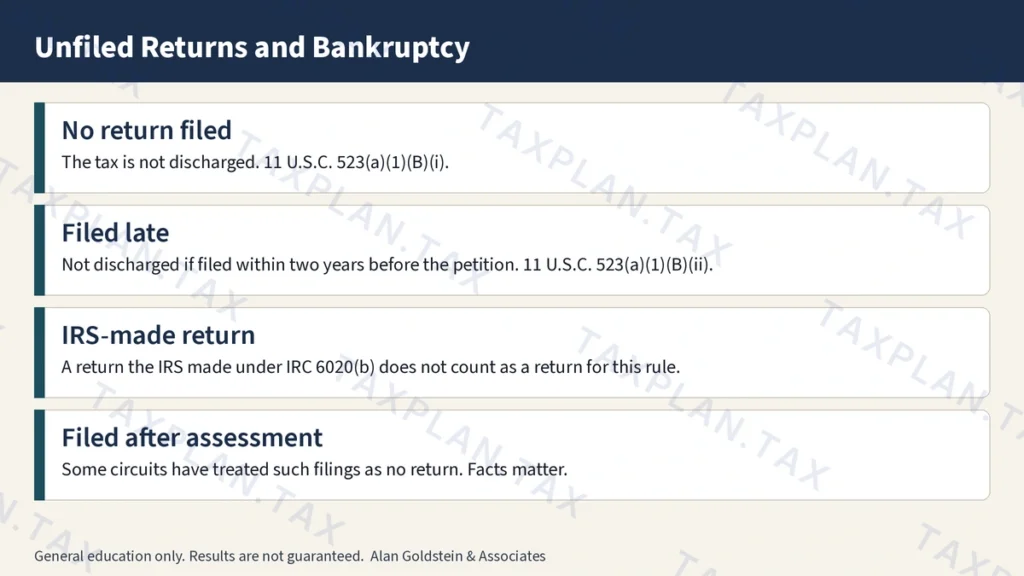


Unfiled tax returns and bankruptcy rarely mix well, because a tax debt for a year with no return filed is not discharged in bankruptcy. The Bankruptcy Code lists that debt among the taxes a discharge does not wipe out. A late-filed return may or may not count, depending on when and how you filed. This guide explains the rules in plain terms. It is not legal advice, and you should speak with a bankruptcy attorney before you act.
Key Takeaways
- Tax for a year with no return filed is not dischargeable under 11 U.S.C. §523(a)(1)(B)(i).
- A return filed late is also not dischargeable if you filed it within two years before the bankruptcy petition.
- A return the IRS prepared for you under IRC §6020(b) does not count as a return for this purpose.
- Some federal appeals courts can treat a late return filed after the IRS assessed the tax as not a return at all. The Eleventh Circuit, which covers Florida, did so in one case.
- Filing a bankruptcy petition triggers an automatic stay that pauses most IRS collection, but it does not erase the unfiled-year tax.
- Chapter 13 requires you to file recent missing returns before the creditors’ meeting.
Can bankruptcy erase tax debt from unfiled tax returns?
Generally no. The Bankruptcy Code does not discharge any tax for which a required return “was not filed or given.” This rule applies in the individual chapters, including chapter 7.
The rule sits in 11 U.S.C. §523(a)(1)(B). It covers two situations. Under clause (i), the return was never filed. Under clause (ii), the taxpayer filed the return late, and “after two years before the date of the filing of the petition.” The IRS Publication 908 states the same two-year rule for chapter 7. A petition is the document that starts a bankruptcy case.
Chapter 13 is slightly different. A chapter 13 debtor generally receives a broad discharge after finishing the plan. Even so, 11 U.S.C. §1328(a)(2) carves out debts described in §523(a)(1)(B), and the plan must pay priority taxes in full, as Publication 908 explains. For general background on collection, see our guide to unfiled tax returns and IRS levies.
What counts as a “return” in bankruptcy?
For §523(a), a return must satisfy “applicable nonbankruptcy law (including applicable filing requirements).” The statute adds that a §6020(a) return counts, but a §6020(b) return does not.
These two IRC sections matter. A §6020(a) return is one the IRS prepares with your cooperation, and you sign it. A §6020(b) return, often called a substitute for return (SFR), is one the IRS prepares on its own when you do not file. The Bankruptcy Code excludes the second kind. So an SFR does not turn “no return” into “a return.” Our article on the substitute for return explains how the IRS builds one.
Courts also ask whether your own filing is an honest attempt. Many apply the four-part Beard test. The document must purport to be a return, carry a signature under penalty of perjury, contain enough data to compute tax, and show an honest and reasonable attempt to satisfy the tax law. The Sixth Circuit stated that test in United States v. Hindenlang (In re Hindenlang), 164 F.3d 1029, 1033 (6th Cir. 1999).
How do the two-year, three-year, and 240-day rules work?
They are timing rules for when a tax may be dischargeable at all. A tax can qualify for discharge only if it clears every rule, and unfiled years usually fail the return rule first.
| Rule | What it says (IRS Publication 908 and the Code) |
|---|---|
| Return rule | No discharge if you never filed the return, or if you filed it late and within two years before the petition. |
| Three-year rule | An income tax is a priority tax if its return was last due, including extensions, within three years before the petition. |
| 240-day rule | An income tax assessed within 240 days before the petition is a priority tax. Offer-in-compromise time can extend this window. |
| Fraud or evasion | No discharge for tax from a fraudulent return, or tax the debtor willfully tried to evade. |
Priority taxes come from 11 U.S.C. §507(a)(8). In a chapter 13 case, the debtor must pay priority taxes in full through the plan, which can run three to five years with court approval, according to Publication 908.
A tax that passes all four rules may be dischargeable in chapter 7. That is a narrow target. Unfiled years often do not reach it, and the facts of each year can differ.
Does filing a late return help in bankruptcy?
It can, but it depends on timing and on whether the IRS had already assessed the tax. A return filed more than two years before the petition may qualify as a late return under the statute. Courts may still reject it if it was not an honest and reasonable effort.
Courts have split on late returns. The Eleventh Circuit noted that the Fourth, Sixth, Seventh, and Ninth Circuits treat delinquency as relevant, while the Eighth Circuit looks at the face of the form (Justice v. United States (In re Justice), 817 F.3d 738, 744 (11th Cir. 2016)). Florida taxpayers fall within the Eleventh Circuit, so its decision matters most here.
What did the Eleventh Circuit decide in Justice?
It held that Forms 1040 filed many years late, after the IRS had issued notices of deficiency and assessed the tax, were not returns under Beard. The tax stayed non-dischargeable.
The debtor in Justice filed returns for 2000 through 2003 well after those years and only after the IRS assessed the taxes. The court held that “the time frame for evaluation of a taxpayer’s apparent effort to comply with the law under the fourth Beard factor includes all of the taxpayer’s conduct with respect to the relevant tax years” (817 F.3d at 746). It also said it was not adopting a per se rule, so other facts might matter (id. at 746 n.8). The court assumed without deciding that “applicable filing requirements” does not include filing deadlines.
What did the Sixth Circuit decide in Hindenlang?
It held that Forms 1040 filed after the IRS prepared substitute returns and assessed the tax were not returns. The debtor could not discharge the tax.
The debtor in Hindenlang did not file for 1985 through 1988, did not respond to IRS deficiency letters, and filed forms only after assessment. The court concluded that “if a document purporting to be a tax return serves no purpose at all under the Internal Revenue Code,” it cannot qualify as an honest and reasonable attempt, and so is not a return (164 F.3d at 1035). The court left open some other late-filing fact patterns.
What happens to IRS collection during bankruptcy?
The automatic stay pauses most collection, but the IRS may still assess tax. The stay generally lasts until the court lifts it, the case ends, or you receive a discharge.
According to Publication 908, the stay bars liens and levies meant to collect pre-bankruptcy debts. It does not prevent the IRS from determining or assessing the tax. The collection statute expiration date (CSED), the date the IRS can no longer collect, usually pauses while the case is pending, plus six months (see IRC §6503(h)). Therefore time in bankruptcy can lengthen the IRS’s window.
A federal tax lien that the IRS filed before the petition generally survives bankruptcy against pre-petition property, even if the court discharges your personal liability. The IRS also may offset refunds in some cases. These rules are technical, so review your account with a professional.
Does chapter 13 require you to file missing returns?
Yes. A chapter 13 debtor must file all required returns for the four years before the petition. The deadline is the day before the first creditors’ meeting.
The rule is in 11 U.S.C. §1308. The trustee may hold the meeting open for a limited time, up to 120 days after the meeting for a return that was already past due, so you can file the missing returns. Returns for older years fall outside that four-year window, but they still affect dischargeability and IRS collection.
Can you make an offer in compromise during bankruptcy?
No. The IRS says taxpayers in an open bankruptcy proceeding are not eligible for an offer in compromise. An offer also requires that you have filed all required returns.
See IRS Topic no. 201 for the eligibility rules. For payment options outside bankruptcy, read our guide to offers in compromise for unfiled returns.
Should you file unfiled tax returns before bankruptcy?
Usually you need the returns filed anyway. The IRS tells taxpayers to file all past-due returns, and the Code treats a return filed late differently from no return at all. Timing can affect the outcome, so get advice first.
Filing a return may start the two-year period in §523(a)(1)(B)(ii). However, a late return filed after an IRS assessment may not count in some circuits, as Justice and Hindenlang show. A bankruptcy attorney can advise on filing for bankruptcy relief. A tax professional can prepare accurate returns and review your IRS account. Both roles matter. See the IRS page on filing past due tax returns.
Frequently Asked Questions
Is tax debt from years I never filed dischargeable?
Generally no. Under §523(a)(1)(B)(i), bankruptcy does not discharge tax when you never filed a required return. Filing later changes the analysis but may not solve it.
Does the IRS substitute for return count as my return?
No, not for discharge. The statute says a return made under §6020(b) does not count as a return for §523(a). Courts may still test your own late filing under Beard.
What is the two-year rule?
It says bankruptcy does not discharge tax if you filed the return late and within two years before the petition. Publication 908 describes it for chapters 7, 11, 12, and 13.
Will bankruptcy stop an IRS levy on my wages?
The automatic stay generally stops levies for pre-bankruptcy tax debts while it is in effect. It ends in time, and the debt may survive. See Publication 908.
Can I discharge penalties on unfiled returns?
Publication 908 says chapter 7 can discharge penalties unless the event behind the penalty occurred within three years of the bankruptcy and relates to a tax that survives. Details vary, so ask counsel.
Does bankruptcy stop the IRS clock to collect?
It generally suspends the collection period while the case is pending, plus six months. That can leave the IRS more time after the case ends.
Do I need a bankruptcy attorney?
Yes, for the bankruptcy filing itself. A tax professional can help with the returns and IRS records, but only a bankruptcy attorney can advise on the case.
Can bankruptcy discharge an unfiled year if the IRS never assessed it?
Not if you never filed the return. The statute excludes tax with no return filed, whether or not the IRS has assessed it.
Conclusion
Unfiled tax returns and bankruptcy follow strict statutory rules, and a missing return usually keeps the tax out of reach of a discharge. Late filing can change the picture, but courts look at timing and effort, and results vary.
Alan Goldstein, MBA, IRS Enrolled Agent, of Alan Goldstein & Associates in Coral Gables, Florida, helps taxpayers prepare past-due returns, review IRS accounts, and evaluate collection and resolution options. This article does not give bankruptcy-law advice, and we cannot guarantee any outcome. To request a confidential review of your unfiled returns, visit our Tax Resolution Services page.
Cases Cited
- Justice v. United States (In re Justice), 817 F.3d 738, 744 (11th Cir. 2016) (summarizing circuit positions on delinquency and the fourth Beard factor); id. at 746 (time frame for evaluating effort to comply includes all of the taxpayer’s conduct; Forms 1040 filed years late after IRS notices and assessment are not returns); id. at 746 n.8 (no per se rule). United States Court of Appeals for the Eleventh Circuit. Pinpoints verified against the star-paginated opinion text on CourtListener; the link is the court’s official slip opinion.
- United States v. Hindenlang (In re Hindenlang), 164 F.3d 1029, 1033 (6th Cir. 1999) (four-part Beard test); id. at 1035 (a document that serves no purpose under the Internal Revenue Code is not an honest and reasonable attempt and is not a return). United States Court of Appeals for the Sixth Circuit. Pinpoints verified against the star-paginated opinion text on CourtListener; the link is Public.Resource.Org’s copy of the opinion.
Sources
- 11 U.S.C. §523, Exceptions to discharge (Cornell LII)
- 11 U.S.C. §507, Priorities (Cornell LII)
- 11 U.S.C. §1308, Filing of prepetition tax returns (Cornell LII)
- 11 U.S.C. §1328, Discharge (Cornell LII)
- IRC §6503, Suspension of running of period of limitation (Cornell LII)
- IRS: Publication 908, Bankruptcy Tax Guide
- IRS: Topic no. 201, The collection process
- IRS: Filing past due tax returns
- Justice v. United States (In re Justice), 817 F.3d 738 (11th Cir. 2016) (slip opinion, Eleventh Circuit)
- United States v. Hindenlang (In re Hindenlang), 164 F.3d 1029 (6th Cir. 1999) (opinion text, Public.Resource.Org)
This article is provided for general educational purposes and does not constitute individualized tax, legal, or accounting advice. Tax consequences depend on the taxpayer’s specific facts and applicable law.
