

A look-back cost segregation study lets you claim depreciation you missed on a building you already own, without amending old returns. First, the study reclassifies building costs into 5-, 7-, and 15-year property as of the original placed-in-service date. You then file Form 3115 as an automatic change in accounting method under Rev. Proc. 2025-23, section 6.01 (designated change number 7). Then the difference between the depreciation you claimed and the allowable amount becomes a §481(a) adjustment. A negative (taxpayer-favorable) adjustment is generally taken in full in the year of change.
That single deduction also captures the catch-up from all prior years, open or closed. In addition, if the reclassified components qualified for bonus depreciation in the year you placed the building in service, and you did not elect out, the allowable amount includes that bonus. So look-back cost segregation can produce a large deduction in one year. However, the rules on adoption, election-outs, and documentation decide whether the catch-up holds up.
So this guide explains how the catch-up works, which rules apply, and what the numbers can look like.
Key Takeaways
- A look-back cost segregation study reclassifies components of a building placed in service in an earlier year.
- After two returns, the reclassification is generally a change in accounting method, made on Form 3115 rather than by amended returns.
- Specifically, the automatic change is DCN 7 under section 6.01 of Rev. Proc. 2025-23.
- A negative §481(a) adjustment is generally deducted in full in the year of change, covering open and closed years.
- Allowable depreciation includes bonus depreciation unless you elected out for that class and year.
- Recapture, passive loss limits, and purchase price allocations still apply.
What Is a Look-Back Cost Segregation Study?
Direct answer: It is a cost segregation study for a building you placed in service in a prior tax year. The study then fixes the classification of its components going back to that date.
Why does missed depreciation happen?
Many owners depreciate the whole building over 39 years (nonresidential) or 27.5 years (residential rental). That is the default when nobody separates the components. Yet many building costs are, in fact, personal property or land improvements. For example, dedicated electrical, certain finishes, site lighting, and paving can have much shorter lives. So a study identifies those costs, and the missed depreciation is the gap between the two approaches.
What does the IRS call it?
“Look-back study” is an industry term rather than a statutory one. Even so, the IRS Cost Segregation Audit Techniques Guide (Publication 5653) uses the phrase “look-back computations.” It describes them as cases where “the study reflects a change in method of accounting, with the return reflecting a deduction for depreciation not deducted in prior years.” The guide also states that a taxpayer may perform a study on used or previously existing property and then re-compute depreciation for prior years.
For a broader overview of how bonus rules interact with these studies, see our guide to bonus depreciation and cost segregation.
How Does Look-Back Cost Segregation Catch Up Missed Depreciation?
Direct answer: You change your accounting method for the reclassified assets and take the cumulative difference as a §481(a) adjustment in the current year.
Step 1: Confirm a method was adopted
Under section 6.01(1)(a) of Rev. Proc. 2025-23, the automatic change applies to property for which you used the impermissible method in at least two taxable years before the year of change. The ATG explains the reason. A taxpayer adopts an impermissible method when it treats an item the same way on two or more consecutively filed returns. However, if you have filed only one return for the building, the options differ. Section 6.01(1)(b) then allows either a Form 3115 or an amended return for the placed-in-service year, filed before the next year’s return.
Step 2: Compute claimed versus allowable
Next, the study and your tax preparer compute two totals for each reclassified asset. The first is the depreciation you actually took. The second, by contrast, is the depreciation allowable under the correct method, as defined in section 6.01(7). According to section 6.01(5), the §481(a) adjustment equals the difference “for open and closed years prior to the year of change.” In other words, the catch-up is not limited to the three-year amended return window.
Step 3: Include bonus depreciation where it applied
Under section 6.01(7)(e)(ii), allowable depreciation for qualified property also takes into account the §168(k) allowance. The only exception is a timely valid election not to deduct it for that class of property. Similarly, Treas. Reg. §1.446-1(e)(2)(ii)(d)(2)(ii) treats a change from not claiming to claiming bonus as a method change, provided you did not elect out. Therefore, the vintage of the building matters. For property acquired after September 27, 2017, and placed in service before 2023, the rate was 100%, according to IRS Notice 2026-11.
Step 4: File Form 3115 and report the adjustment
Finally, you attach the original Form 3115 to your timely filed return for the year of change, including extensions. You also file a signed duplicate copy with the IRS, as the Form 3115 instructions describe. Under section 7.03 of Rev. Proc. 2015-13, a negative §481(a) adjustment generally has a one-year adjustment period. A positive adjustment is generally spread over four years.
What Are the Benefits of Look-Back Cost Segregation?
Direct answer: The main benefit is a single current-year deduction for years of missed depreciation, often with audit protection for the prior years.
- One-year catch-up. You generally take a negative adjustment entirely in the year of change.
- Closed years count. In addition, the adjustment includes depreciation missed in years you can no longer amend.
- No amended returns. Instead, you correct the method prospectively on the current return.
- Audit protection. Under section 8.01 of Rev. Proc. 2015-13, a timely filed Form 3115 generally means the IRS will not require a change for the same item for earlier years. Exceptions apply, for example if you are already under examination.
- Bonus in the catch-up. If bonus applied in the original year and you did not elect out, it flows into the adjustment.
- Higher future deductions. Also, you recover any remaining basis in 5-, 7-, and 15-year property faster from the year of change onward.
What Legal Rules Govern Look-Back Cost Segregation?
Direct answer: The Code’s method-change rules, the 2006 depreciation regulations, and the automatic change revenue procedures govern the process.
Is a reclassification really a change in accounting method?
Yes, under current regulations. IRC §446(e) generally requires IRS consent to change a method of accounting. Treas. Reg. §1.446-1(e)(2)(ii)(d)(2)(i) treats a change in the depreciation method, recovery period, or convention of an asset as a method change. Example 9 of §1.446-1(e)(2)(iii) applies that rule to a cost segregation study on a building placed in service in an earlier year.
However, the law was not always this clear. In Commissioner v. Brookshire Bros. Holding, Inc., 320 F.3d 507, 513 (5th Cir. 2003), the court treated a reclassification as the functional equivalent of a change in useful life. As a result, no Form 3115 was required. Likewise, O’Shaughnessy v. Commissioner, 332 F.3d 1125, 1132 (8th Cir. 2003), held that reallocating assets among MACRS classes fell within the useful life exception. Treasury then responded with temporary regulations, T.D. 9105, and then final regulations, T.D. 9307. Those regulations now control. According to the ATG, they apply to assets placed in service in a tax year ending on or after December 30, 2003.
Why does unclaimed depreciation still reduce basis?
Under IRC §1016(a)(2), basis is reduced for depreciation, but “not less than the amount allowable.” In Virginian Hotel Corp. v. Helvering, 319 U.S. 523, 525-526 (1943), the Supreme Court explained that basis falls by the allowable amount each year, whether or not it is claimed. The Court also said taxpayers cannot accumulate depreciation and hold it for the year of greatest benefit. Consequently, missed depreciation is not simply lost. Instead, the method change recovers it, and section 6.01(6) of Rev. Proc. 2025-23 sets basis to reflect allowable depreciation.
What limits still apply?
- Purchase agreements. In Peco Foods, Inc. v. Commissioner, 522 F. App’x 840, 843-844 (11th Cir. 2013), the taxpayer filed Form 3115 after a study. Even so, the allocation in its purchase agreements bound it.
- Component tests. Hospital Corp. of America v. Commissioner, 109 T.C. 21, 48-52 (1997), held that the former investment tax credit tests decide whether a component is §1245 property.
- Recapture. Reclassified components are generally §1245 property, so gain on sale is ordinary income up to prior depreciation.
- Passive losses. In addition, IRC §469 can limit a large deduction from a rental activity.
- Late elections. Section 6.01(1)(c)(vi) excludes revoking or making a late election, such as a §168(k) election out. Those require a letter ruling instead.
What Does Look-Back Cost Segregation Look Like in Practice?
Direct answer: The examples below apply IRS Publication 946 table rates to assumed facts. All amounts and dates are illustrative.
Example 1: Office building placed in service in 2021, no election out
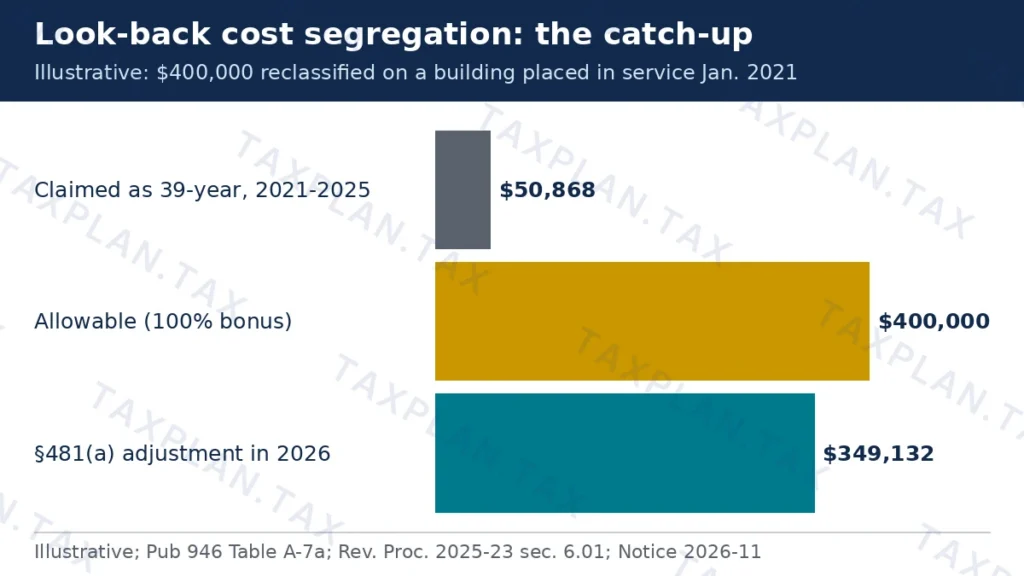
For example, assume a calendar-year investor bought an office building in January 2021 and placed it in service that month. The depreciable basis, excluding land, was $2,000,000. Then, from 2021 through 2025, the investor depreciated everything over 39 years. Later, in 2026, a look-back cost segregation study finds $300,000 of 5-year property and $100,000 of 15-year land improvements.
First, compute the depreciation claimed on the $400,000. Under Publication 946 Table A-7a, the rates were 2.461% for 2021 and 2.564% for each of the next four years. That totals 12.717%, or $50,868. Next, compute the allowable amount. The building was acquired after September 27, 2017, and placed in service in 2021, so the bonus rate was 100%. The investor never elected out. Therefore, the allowable depreciation is $400,000. As a result, the negative §481(a) adjustment is $349,132, deducted in 2026.
Example 2: Same building, but the investor elected out
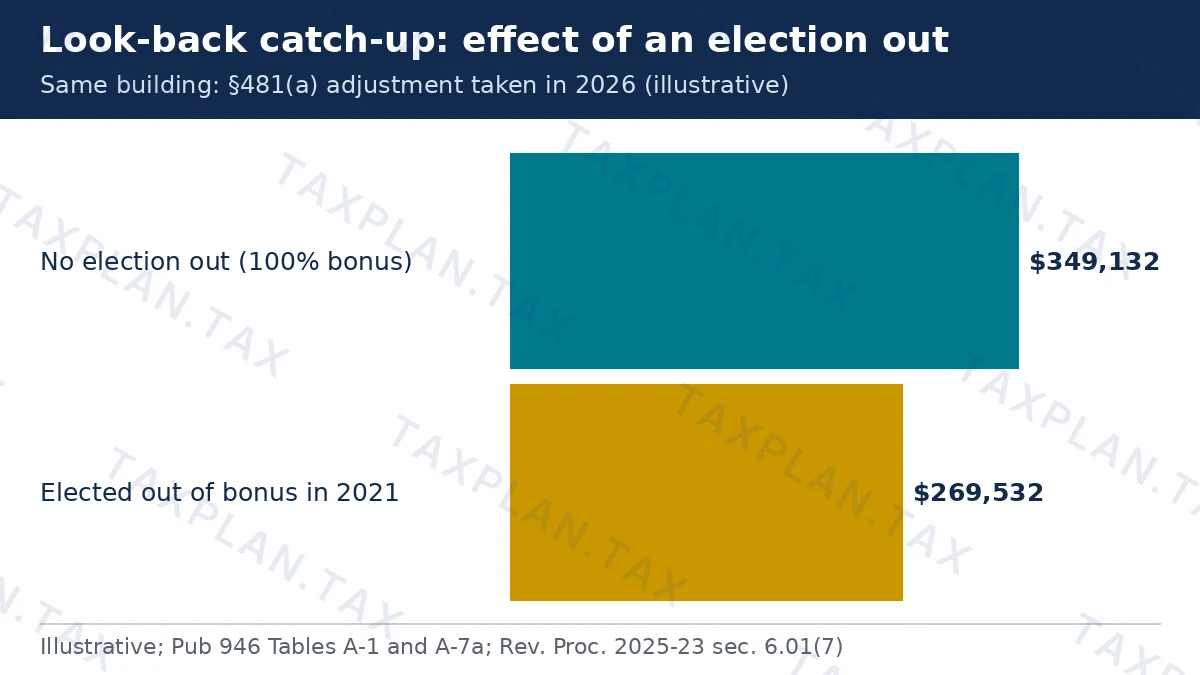
Now assume the investor’s 2021 return included a valid election out of bonus for 5-year and 15-year property. In that case, allowable depreciation follows Table A-1. So for 2021 through 2025, 5-year rates total 94.24%, or $282,720. Meanwhile, 15-year rates total 37.68%, or $37,680. Total allowable is $320,400. So the adjustment is $269,532, which is $79,600 smaller than in Example 1.
| Illustrative example | Depreciation claimed, 2021-2025 | Depreciation allowable | §481(a) adjustment in 2026 |
|---|---|---|---|
| Example 1: 100% bonus, no election out | $50,868 | $400,000 | $349,132 |
| Example 2: elected out of bonus | $50,868 | $320,400 | $269,532 |
In both examples, however, the remaining $1,600,000 stays 39-year property at $41,024 a year. In Example 2, the components also continue to depreciate under Table A-1 from 2026.
What Are the Common Mistakes in Look-Back Cost Segregation?
Direct answer: Most problems come from using the wrong procedure, the wrong allowable amount, or weak support.
- Amending instead of filing Form 3115. After two returns, the ATG says amended returns based on a later study should generally be disallowed.
- Ignoring an election out. Remember that if you elected out of bonus for a class, the catch-up excludes bonus for that class.
- Trying to make a late election. Unfortunately, DCN 7 does not cover late or revoked elections.
- Weak engineering support. Notably, the ATG lists a lack of records to substantiate the adjustment as a common issue.
- Contradicting the purchase contract. An agreed allocation can bind you, as Peco Foods shows.
- Forgetting the duplicate copy. In general, automatic changes require both the attached original and a signed copy filed with the IRS.
- Overlooking state rules. Many states do not follow federal bonus depreciation, so check state conformity.
Frequently Asked Questions
Can I claim missed depreciation without amending my returns?
Yes. Once you have adopted a method, you generally file Form 3115 and take the catch-up as a §481(a) adjustment in the current year.
You can estimate the §481(a) catch-up with this Form 3115 catch-up calculator. Enter the placed-in-service year and review the range before you file.
How far back can a look-back cost segregation study go?
The adjustment covers open and closed years before the year of change. So it can reach back to the original placed-in-service year.
Do I need IRS approval in advance?
Generally, no, because DCN 7 is an automatic change. You file Form 3115 with your return and send the duplicate copy; the IRS does not send acknowledgments.
Is the catch-up deduction taken over four years?
Not usually. You generally take a negative adjustment in the year of change. The four-year spread generally applies to positive adjustments.
Does bonus depreciation apply to look-back cost segregation?
It can. Allowable depreciation includes bonus for qualified property unless you made a timely election out for that class.
What if I placed the building in service last year?
If only one return has been filed, you can usually file an amended return for that year before filing the next return. Alternatively, you can include it on a Form 3115.
Will look-back cost segregation increase recapture when I sell?
Yes, potentially. Depreciation on §1245 components is generally recaptured as ordinary income on a taxable sale.
Conclusion: Is a Look-Back Cost Segregation Study Right for You?
In summary, look-back cost segregation turns years of missed depreciation into one current deduction, without reopening old returns. However, the size of that deduction depends on the building’s vintage, your past elections, and the quality of the study. For that reason, start with your depreciation schedules, purchase documents, and prior returns.
That is where Emunah Cost Segregation can help. It works with owners and CPAs to evaluate look-back cost segregation opportunities and prepare the support a Form 3115 needs. Alan Goldstein, EA, reviews your records first and then tells you plainly whether a study makes sense. Contact Emunah Cost Segregation in Coral Gables, Florida, to request a review. For the steps involved, see our cost segregation study process guide.
Cases Cited
- Commissioner v. Brookshire Bros. Holding, Inc., 320 F.3d 507, 513 (5th Cir. 2003). Pinpoint verified against the reporter-paginated opinion text. Opinion
- O’Shaughnessy v. Commissioner, 332 F.3d 1125, 1132 (8th Cir. 2003). Pinpoint verified against the reporter-paginated opinion text. Opinion
- Virginian Hotel Corp. v. Helvering, 319 U.S. 523, 525-526 (1943) (Supreme Court of the United States). Pinpoint verified against the reporter-paginated opinion text. Opinion
- Peco Foods, Inc. v. Commissioner, 522 F. App’x 840, 843-844 (11th Cir. 2013) (unpublished), aff’g T.C. Memo. 2012-18. Pinpoint verified against the reporter-paginated opinion text. Opinion
- Hospital Corp. of America v. Commissioner, 109 T.C. 21, 48-52 (1997) (United States Tax Court). Pinpoint verified against the reporter-paginated opinion text. Opinion
Sources and Authorities
- 26 U.S.C. §446: https://www.law.cornell.edu/uscode/text/26/446
- 26 U.S.C. §481: https://www.law.cornell.edu/uscode/text/26/481
- 26 U.S.C. §1016: https://www.law.cornell.edu/uscode/text/26/1016
- 26 U.S.C. §1245: https://www.law.cornell.edu/uscode/text/26/1245
- 26 U.S.C. §469: https://www.law.cornell.edu/uscode/text/26/469
- Treas. Reg. §1.446-1 (including (e)(2)(ii)(d) and Example 9 of (e)(2)(iii)): https://www.ecfr.gov/current/title-26/section-1.446-1
- T.D. 9105, Changes in Computing Depreciation, 69 FR 5 (Jan. 2, 2004): https://www.federalregister.gov/documents/2004/01/02/03-31820/changes-in-computing-depreciation
- T.D. 9307, Changes in Computing Depreciation, 71 FR 78066 (Dec. 28, 2006): https://www.federalregister.gov/documents/2006/12/28/06-9892/changes-in-computing-depreciation
- Rev. Proc. 2025-23 (List of Automatic Changes), section 6.01 (DCN 7): https://www.irs.gov/pub/irs-drop/rp-25-23.pdf
- Rev. Proc. 2015-13: https://www.irs.gov/pub/irs-drop/rp-15-13.pdf
- About Form 3115: https://www.irs.gov/forms-pubs/about-form-3115
- Instructions for Form 3115 (Rev. December 2022): https://www.irs.gov/pub/irs-pdf/i3115.pdf
- IRS Notice 2026-11: https://www.irs.gov/pub/irs-drop/n-26-11.pdf
- IRS Publication 946, including Tables A-1, A-6, and A-7a: https://www.irs.gov/pub/irs-pdf/p946.pdf
- IRS Publication 5653 (2-2025), Cost Segregation Audit Techniques Guide: https://www.irs.gov/pub/irs-pdf/p5653.pdf
- Court opinions: see Cases Cited above.
This article is provided for general educational purposes and does not constitute individualized tax, legal, or accounting advice. Tax consequences depend on the taxpayer’s specific facts and applicable law.
