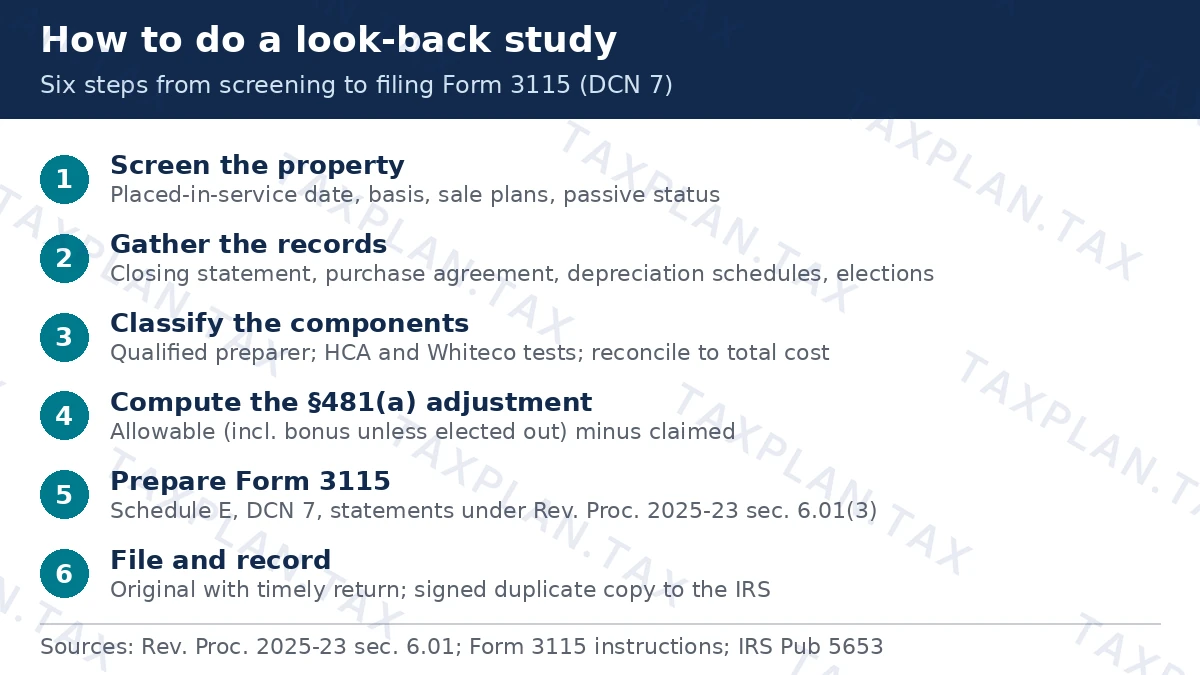

To do a look-back study, you commission a cost segregation study on a building you already own, compute the depreciation you missed, and claim it on Form 3115 as an automatic accounting method change. The process generally has six practical steps. First, screen the property and confirm that a method was adopted. Second, gather the purchase, construction, and tax records as well. Third, have a qualified preparer then classify the components as of the original placed-in-service date. Fourth, compute the §481(a) adjustment: allowable depreciation minus depreciation claimed. Fifth, prepare Form 3115 under designated change number (DCN) 7 in section 6.01 of Rev. Proc. 2025-23.
Finally, attach the original to your timely filed return and also send a signed duplicate copy to the IRS. A negative adjustment is generally deducted in full in the year of change. However, the study must hold up on audit, so the records matter as much as the math.
So this guide walks through each step of a look-back study, with an illustrative worksheet.
Key Takeaways
- A look-back study reclassifies a building placed in service in an earlier year and claims the missed depreciation now.
- Once you adopt a method, you make the correction on Form 3115 under DCN 7, not on amended returns.
- Allowable depreciation includes bonus depreciation for qualified property unless you elected out.
- The original Form 3115 goes with the timely filed return, while a signed duplicate copy goes to the IRS.
- In addition, required statements include a detailed description of the present and proposed methods.
- Good records, such as closing statements, contracts, and depreciation schedules, support the adjustment.
What Is a Look-Back Study and When Does It Apply?
Direct answer: A look-back study is a cost segregation study for property already in service. It applies when you depreciated a building without separating its shorter-life components.
The term, in fact, comes from industry practice. Even so, the IRS Cost Segregation Audit Techniques Guide (Publication 5653) refers to “look-back computations.” It notes that a taxpayer may study used or previously existing property and then re-compute prior depreciation. For the bigger picture on why this catch-up is possible, see our article on bonus depreciation and cost segregation.
Timing matters. Under section 6.01(1)(a) of Rev. Proc. 2025-23, the automatic change covers property for which you used the impermissible method in at least two years before the year of change. If you have filed only one return for the property, section 6.01(1)(b) also allows an amended return for that year. You must file it before you file the next year’s return.
How Do You Do a Look-Back Study Step by Step?
Direct answer: Follow the six steps below in order. Each step also feeds the Form 3115 and the audit file.
Step 1: Screen the property
Start with basic facts. When was the property acquired and placed in service? What is the depreciable basis after removing land? Is it residential rental (27.5 years) or nonresidential (39 years)? Also consider your plans. If you expect to sell soon, recapture may reduce the net benefit. Likewise, if your rental losses are passive, IRC §469 may delay the benefit.
Step 2: Gather the records
Next, collect the documents the preparer needs:
- Closing statement and purchase agreement, including any price allocation
- Prior depreciation schedules and the returns for the placed-in-service year
- Any election statements, especially an election out of bonus depreciation
- Construction costs, drawings, or invoices for later improvements
- Property records such as the appraisal and site plans
In particular, the purchase agreement deserves special attention. In Peco Foods, Inc. v. Commissioner, 522 F. App’x 840, 843-844 (11th Cir. 2013), the taxpayer filed Form 3115 after a study. Even so, the court held that the allocation schedules in its purchase agreements bound it.
Step 3: Classify the components
Then the preparer identifies and values the components. For guidance, the ATG describes the principal elements of a quality study. These include preparation by an individual with expertise, a legal analysis, and a reconciliation of allocated costs to total costs. Classification follows the case law. For example, Hospital Corp. of America v. Commissioner, 109 T.C. 21, 48-52 (1997), applied the former investment tax credit tests to decide §1245 status. Similarly, Whiteco Industries, Inc. v. Commissioner, 65 T.C. 664, 672-673 (1975), set out factors for whether property is inherently permanent.
Step 4: Compute the §481(a) adjustment
After that, compute two figures for each reclassified asset. The first is the depreciation actually claimed. The second, by contrast, is the depreciation allowable under section 6.01(7). Under section 6.01(7)(e)(ii), the allowable amount for qualified property includes the §168(k) bonus, unless you made a timely valid election out for that class. The adjustment equals the difference for open and closed years before the year of change.
Step 5: Prepare Form 3115
Next, complete Form 3115, including Schedule E for depreciation changes, and cite DCN 7. Section 6.01(3)(b) requires several statements. For instance, you need a detailed description of the present and proposed methods. A general description, such as “erroneous method to proper method,” is unacceptable. You also need the facts and law supporting each new classification, as well as the year you placed each item in service. In addition, a change from §1250 to §1245 property requires a specific representation statement. However, a “qualified small taxpayer,” with average annual gross receipts of $10,000,000 or less, may complete fewer lines under section 6.01(4).
Step 6: File and record
Finally, attach the original Form 3115 to your timely filed return, including extensions, for the year of change. The Form 3115 instructions also require a signed duplicate copy filed with the IRS. You file it no earlier than the first day of the year of change and no later than the original. Then update the fixed asset records so future depreciation follows the new method.
What Are the Benefits of Doing a Look-Back Study?
Direct answer: A look-back study converts years of missed depreciation into one current deduction, with no amended returns.
- One-year deduction. Under section 7.03 of Rev. Proc. 2015-13, a negative adjustment generally has a one-year adjustment period.
- Closed years included. Also, the adjustment reaches depreciation missed in years you can no longer amend.
- Automatic consent. DCN 7 is an automatic change, so you do not need an advance ruling.
- Audit protection. Under section 8.01 of Rev. Proc. 2015-13, the IRS generally will not require a change for the same item for prior years. However, exceptions apply, including if you are under examination.
- Single filing for many assets. In addition, under section 6.01(8), one Form 3115 can cover all reclassified assets with a net adjustment.
What Legal Rules Apply to a Look-Back Study?
Direct answer: Method change rules under §446(e), the 2006 depreciation regulations, and the automatic change procedures apply.
Why is Form 3115 required?
IRC §446(e) generally requires consent to change a method of accounting. Under Treas. Reg. §1.446-1(e)(2)(ii)(d)(2)(i), a change in the recovery period, method, or convention of an asset is a method change. Example 9 of §1.446-1(e)(2)(iii) then applies that rule to a cost segregation study. Earlier, two appeals courts had reached a different result. In Commissioner v. Brookshire Bros. Holding, Inc., 320 F.3d 507, 513 (5th Cir. 2003), and O’Shaughnessy v. Commissioner, 332 F.3d 1125, 1132 (8th Cir. 2003), the courts instead treated reclassifications as useful life changes. Treasury then issued T.D. 9105 in 2004 and final T.D. 9307 in 2006.
What does DCN 7 not cover?
Section 6.01(1)(c) lists exclusions. For example, it does not cover making a late election or revoking a timely election, such as a §168(k) election out. Those need a letter ruling. Also, you generally must make a partial disposition election for a replaced component on the timely original return for the year of disposition, under Treas. Reg. §1.168(i)-8(d)(2). So a look-back study usually cannot revive a missed election for an old roof replacement.
What happens to basis and recapture?
First, under section 6.01(6), basis must reflect allowable depreciation as of the beginning of the year of change. Later, a taxable sale generally recaptures depreciation on reclassified §1245 property as ordinary income.
What Does a Look-Back Study Worksheet Look Like?
Direct answer: The worksheet below applies IRS Publication 946 table rates to assumed facts. All numbers and dates are illustrative.
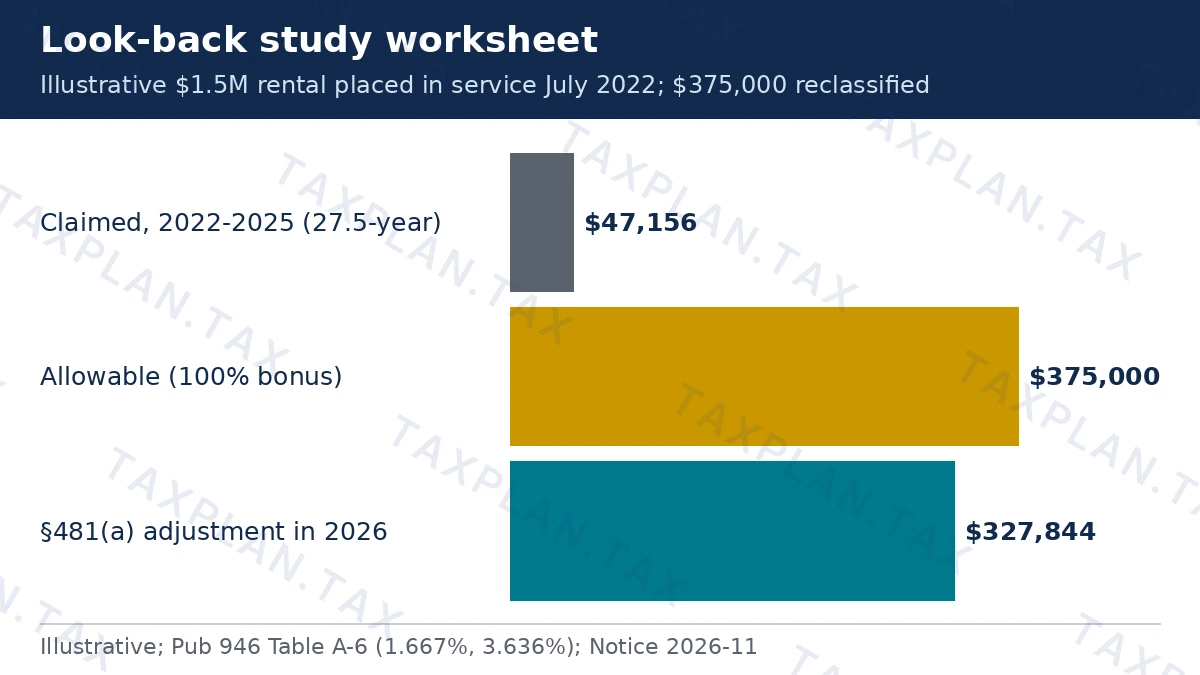
For example, assume an investor acquired a residential rental building and placed it in service in July 2022. The depreciable basis, excluding land, was $1,500,000. The investor then depreciated it all over 27.5 years for 2022 through 2025. Later, in 2026, the investor does a look-back study. It finds $225,000 of 5-year property and $150,000 of 15-year land improvements.
| Worksheet line (illustrative) | Amount |
|---|---|
| Reclassified components ($225,000 + $150,000) | $375,000 |
| Claimed on components, 2022-2025, Table A-6 (1.667% + 3 × 3.636% = 12.575%) | $47,156 |
| Allowable on components (100% bonus; acquired after Sept. 27, 2017; no election out) | $375,000 |
| Negative §481(a) adjustment, deducted in 2026 | $327,844 |
| Remaining building ($1,125,000 × 3.636%), 2026 | $40,905 |
The 100% rate applies because, according to IRS Notice 2026-11, property acquired after September 27, 2017, and placed in service before January 1, 2023, had a 100% bonus rate. By contrast, if the investor had elected out of bonus for these classes in 2022, the allowable amount would follow the regular Publication 946 Table A-1 rates instead.
For a calendar-year individual, 2026 is the year of change. Therefore, you attach the Form 3115 to the 2026 return. That return is generally due April 15, 2027, or October 15, 2027, with a valid extension.
What Mistakes Should You Avoid in a Look-Back Study?
Direct answer: Avoid procedural shortcuts and unsupported numbers.
- Filing amended returns. After two returns, the ATG says the IRS should generally disallow amended returns based on a later study.
- Vague method descriptions. For example, “MACRS to MACRS” does not meet the statement requirement.
- Missing the duplicate copy. You need both the attached original and the signed copy.
- Ignoring an election out. Check prior returns before including bonus in the allowable amount.
- Contradicting the contract. Review any purchase price allocation before the study begins.
- Filing late. The instructions note an automatic 6-month extension may be available under Treas. Reg. §301.9100-2. Otherwise, relief is rare.
- Forgetting state returns. State conformity to federal bonus depreciation varies, so check each state.
Frequently Asked Questions
How long does a look-back study take?
It depends on the property and the records. So start early, and finish the study before the extended due date of the return for the year of change.
Do I need to amend prior returns?
Generally, no. After two returns, you instead correct the method on Form 3115 and take the catch-up in the current year.
Which form and change number do I use?
Form 3115, with Schedule E, under DCN 7 in section 6.01 of Rev. Proc. 2025-23.
Can one Form 3115 cover several assets?
Yes. In fact, section 6.01(8) says a taxpayer changing several assets for the same year should file a single Form 3115.
Is there an IRS acknowledgment for an automatic change?
No. The Form 3115 instructions state that the IRS does not send acknowledgments of receipt for automatic change requests.
What if I am under IRS examination?
You may still be able to file, but audit protection may not apply. For details, Rev. Proc. 2015-13 section 8.02 lists the exceptions and limited windows.
Does a look-back study work for property bought many years ago?
Often, yes, since the adjustment covers open and closed years. However, the benefit is smaller when the components are already mostly depreciated.
Conclusion: How Should You Approach a Look-Back Study?
In summary, a look-back study works best when you treat it as a project with two outputs: a defensible study and a complete Form 3115. First, start with the records. Then confirm your past elections and compute the adjustment carefully. As a result, you can claim the missed depreciation in one year with confidence.
That is where Emunah Cost Segregation can help. It works with owners and their CPAs on look-back studies and the support a Form 3115 needs. Alan Goldstein, EA, reviews your records first and then tells you plainly whether a study makes sense. Contact Emunah Cost Segregation in Coral Gables, Florida, to request a review. For a general overview of a study’s stages, see our cost segregation study process guide.
Cases Cited
- Peco Foods, Inc. v. Commissioner, 522 F. App’x 840, 843-844 (11th Cir. 2013) (unpublished), aff’g T.C. Memo. 2012-18. Pinpoint verified against the reporter-paginated opinion text. Opinion
- Hospital Corp. of America v. Commissioner, 109 T.C. 21, 48-52 (1997) (United States Tax Court). Pinpoint verified against the reporter-paginated opinion text. Opinion
- Whiteco Industries, Inc. v. Commissioner, 65 T.C. 664, 672-673 (1975) (United States Tax Court). Pinpoint verified against the reporter-paginated opinion text. Opinion
- Commissioner v. Brookshire Bros. Holding, Inc., 320 F.3d 507, 513 (5th Cir. 2003). Pinpoint verified against the reporter-paginated opinion text. Opinion
- O’Shaughnessy v. Commissioner, 332 F.3d 1125, 1132 (8th Cir. 2003). Pinpoint verified against the reporter-paginated opinion text. Opinion
Sources and Authorities
- 26 U.S.C. §446: https://www.law.cornell.edu/uscode/text/26/446
- 26 U.S.C. §481: https://www.law.cornell.edu/uscode/text/26/481
- 26 U.S.C. §1245: https://www.law.cornell.edu/uscode/text/26/1245
- 26 U.S.C. §469: https://www.law.cornell.edu/uscode/text/26/469
- Treas. Reg. §1.446-1 (including (e)(2)(ii)(d) and Example 9 of (e)(2)(iii)): https://www.ecfr.gov/current/title-26/section-1.446-1
- Treas. Reg. §1.168(i)-8: https://www.ecfr.gov/current/title-26/section-1.168(i)-8
- T.D. 9105, Changes in Computing Depreciation, 69 FR 5 (Jan. 2, 2004): https://www.federalregister.gov/documents/2004/01/02/03-31820/changes-in-computing-depreciation
- T.D. 9307, Changes in Computing Depreciation, 71 FR 78066 (Dec. 28, 2006): https://www.federalregister.gov/documents/2006/12/28/06-9892/changes-in-computing-depreciation
- Rev. Proc. 2025-23 (List of Automatic Changes), section 6.01 (DCN 7): https://www.irs.gov/pub/irs-drop/rp-25-23.pdf
- Rev. Proc. 2015-13: https://www.irs.gov/pub/irs-drop/rp-15-13.pdf
- About Form 3115: https://www.irs.gov/forms-pubs/about-form-3115
- Instructions for Form 3115 (Rev. December 2022): https://www.irs.gov/pub/irs-pdf/i3115.pdf
- IRS Notice 2026-11: https://www.irs.gov/pub/irs-drop/n-26-11.pdf
- IRS Publication 946, including Tables A-1, A-6, and A-7a: https://www.irs.gov/pub/irs-pdf/p946.pdf
- IRS Publication 5653 (2-2025), Cost Segregation Audit Techniques Guide: https://www.irs.gov/pub/irs-pdf/p5653.pdf
- Court opinions: see Cases Cited above.
This article is provided for general educational purposes and does not constitute individualized tax, legal, or accounting advice. Tax consequences depend on the taxpayer’s specific facts and applicable law.
