
Unfiled tax returns for self-employed individuals carry risks that wage earners do not face. If your net earnings from self-employment were $400 or more, you generally must file, even if you owe no income tax. Self-employment tax may still be due. Your Social Security record may also miss those earnings. This article focuses on the self-employment tax side of unfiled returns: who must file, what the IRS may assess, and how to catch up.
Key Takeaways
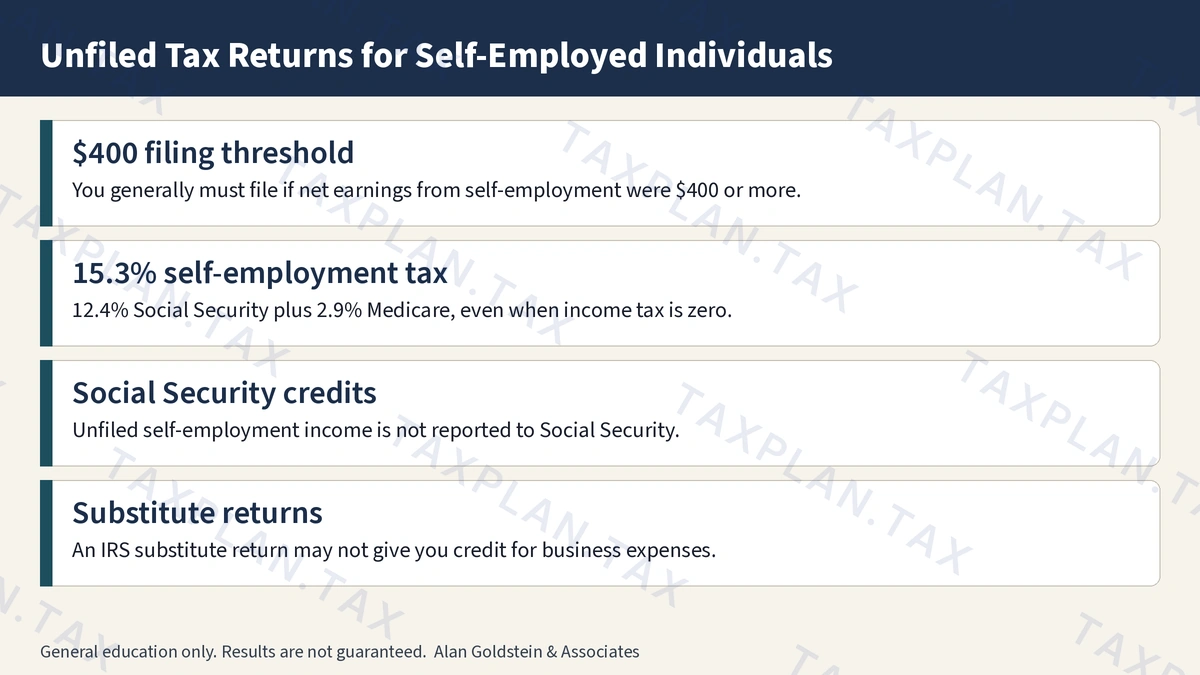
- You generally must file if your net earnings from self-employment were $400 or more.
- Self-employment tax is 15.3%, made up of 12.4% Social Security and 2.9% Medicare, and it applies even when income tax is zero.
- If you do not file, your self-employment income is not reported to Social Security, and you may not earn credits.
- An IRS substitute return may not give you credit for business expenses you could claim.
- Late-filing penalties, estimated tax penalties, and interest can add to the balance.
Do self-employed individuals have to file if they owe little or no income tax?
Often, yes. The IRS says you must file an income tax return if your net earnings from self-employment were $400 or more (IRS: Self-employed individuals tax center).
This threshold is much lower than the general filing thresholds for wage earners. As a result, many people with modest side income have a filing requirement without knowing it. If your net earnings were under $400, you may still have to file under the other rules in the Form 1040 instructions.
What are net earnings from self-employment?
Net earnings from self-employment are, in general, your gross income from a trade or business minus the allowable business deductions. IRC §1402(a) defines the term. Sole proprietors and independent contractors generally report business income and expenses on Schedule C.
How does self-employment tax affect unfiled tax returns for self-employed people?
It often creates a balance even when income tax is small. Self-employment tax is a separate tax that funds Social Security and Medicare for people who work for themselves.
The IRS lists the rate as 15.3%: 12.4% for Social Security and 2.9% for Medicare (IRS: Self-employment tax). You figure it on Schedule SE. For 2026, the IRS says the Social Security part applies to the first $184,500 of combined wages, tips, and net earnings. Older years use the limits shown on that year’s Schedule SE.
There is some relief. You can deduct the employer-equivalent portion of your self-employment tax when you figure adjusted gross income. However, that deduction lowers income tax only. It does not reduce the self-employment tax itself.
Why might an expected refund turn into a balance?
Because self-employment tax is usually not withheld. Wage earners have Social Security and Medicare taxes withheld from each paycheck. In contrast, self-employed people pay through estimated tax or with the return. So a year with refundable credits can still end with tax due once self-employment tax is added.
What happens to your Social Security record if you do not file?
Your earnings may not count toward benefits. The IRS warns that if you are self-employed and do not file, your self-employment income will not be reported to the Social Security Administration. You will not receive credits toward Social Security retirement or disability benefits (IRS: Filing past due tax returns).
This risk is easy to overlook. A wage earner’s employer reports wages through Form W-2 each year. By contrast, the self-employed person’s own return is what reports the earnings. Filing the missing returns is the main way to get those earnings onto your record. Check with the Social Security Administration about how late-reported earnings are credited.
What can the IRS do if a self-employed person does not file?
The IRS may prepare a substitute for return (SFR), which is a return the IRS prepares from its own records under IRC §6020(b). The IRS says such a return might not give you credit for deductions and exemptions you may be entitled to receive.
For self-employed people, that gap can be large. The IRS sees gross payments reported on information returns, such as Forms 1099. However, it usually does not know your business expenses. As a result, an SFR may tax gross receipts with few or no offsetting deductions. The IRS then sends a Notice CP3219N, a statutory notice of deficiency that gives you 90 days to file your own return or petition the Tax Court.
If the IRS files an SFR, the IRS says it is still in your best interest to file your own return. It will generally adjust your account to reflect the correct figures. For more, see our guide to the substitute for return (SFR).
Which penalties and interest apply to self-employed late filers?
Three charges are common: the failure-to-file penalty, the failure-to-pay penalty, and the estimated tax penalty. Interest also runs on unpaid tax.
- Failure-to-file penalty. The IRS charges 5% of the unpaid tax for each month or partial month a return is late, up to 25% (IRS: Failure to file penalty). For returns due after December 31, 2025, the minimum penalty for a return more than 60 days late is $525 or 100% of the unpaid tax, whichever is less.
- Failure-to-pay penalty. This penalty applies to tax not paid by the due date. When both apply in the same month, IRC §6651(c) reduces the failure-to-file penalty by the failure-to-pay amount.
- Estimated tax penalty. The IRS says individuals, including sole proprietors, generally must make estimated payments if they expect to owe $1,000 or more (IRS: Estimated taxes). IRC §6654 imposes an addition to tax for underpayment.
- Interest. For October through December 2026, the IRS underpayment rate for individuals is 7% per year, compounded daily (IRS: Quarterly interest rates).
The IRS may remove some penalties for reasonable cause. However, relief depends on the facts, and it is not automatic.
How can self-employed people rebuild missing records?
Start with what the IRS already has, then fill the gaps from your own sources. The goal is a return that reports all income and supports each deduction.
First, request a wage and income transcript through IRS Get Transcript. It lists information returns, such as Forms 1099-NEC and 1099-K, that payers filed under your number. Next, use bank and card statements, invoices, and payment app records to find income that no form reported. Then rebuild expenses from receipts, statements, mileage logs, and vendor records.
The burden of proof is on you. The IRS says you must be able to support the income, deductions, and statements on your return (IRS: Recordkeeping). Therefore, keep copies of everything you use to rebuild each year.
How many years should a self-employed person file?
Many cases center on six years, but your facts decide. IRS policy generally asks for the last six years of returns in delinquency cases (IRM 4.12.1, Policy Statement 5-133). Even so, the IRS may ask for more years in some cases. Our article on how far back the IRS requires unfiled tax returns explains the rule.
How do you stay compliant after catching up?
Make estimated payments and keep records each year. Most repeat problems start when no tax is set aside during the year.
Use Form 1040-ES to figure quarterly payments. Keep a separate business account so income and expenses are easier to track. In addition, review your numbers each quarter, not only at filing time. Staying current also matters for collection options. In general, the IRS expects all required returns to be filed before it approves a payment plan or offer in compromise.
Frequently Asked Questions
Do I have to file if my self-employment income was small?
If your net earnings from self-employment were $400 or more, you generally must file. Below that amount, other filing rules may still apply.
Is self-employment tax due even if I owe no income tax?
Yes, it can be. Self-employment tax is separate from income tax. It applies to net earnings of $400 or more even if deductions and credits eliminate income tax.
Will the IRS allow my business expenses on a substitute return?
Possibly not. The IRS says an SFR might not give you credit for deductions you may be entitled to. Filing your own return is the usual way to claim them.
Does not filing affect my Social Security benefits?
It can. The IRS says unfiled self-employment income is not reported to the Social Security Administration. As a result, you may not receive credits toward retirement or disability benefits.
Can I deduct expenses if I lost my receipts?
You must be able to support deductions. Bank records, statements, and other evidence may help rebuild them. A tax professional can help judge what is supportable.
Can I get penalties removed?
Possibly. The failure-to-file penalty does not apply if you show reasonable cause. The IRS decides each request on its facts.
Can I set up a payment plan for the tax I owe?
Often, yes, once your required returns are filed. The IRS offers payment plans and, in some cases, an offer in compromise.
Conclusion
Unfiled tax returns for self-employed individuals involve more than income tax. The $400 threshold, self-employment tax, and Social Security reporting make filing important even in low-income years. An IRS substitute return may overstate the tax because it may omit expenses. Filing your own accurate returns is usually the first step toward a resolution.
Alan Goldstein, MBA, IRS Enrolled Agent, of Alan Goldstein & Associates in Coral Gables, Florida, works with self-employed clients to rebuild records and file past-due returns. We can also review penalty relief and payment options. Every case depends on its facts, and we cannot guarantee any outcome. To request a confidential review, visit our Tax Resolution Services page.
Sources and Authorities
- IRS: Self-employed individuals tax center
- IRC §1402, Definitions (net earnings from self-employment)
- IRS: About Schedule C (Form 1040)
- IRS: Self-employment tax (Social Security and Medicare taxes)
- IRS: About Schedule SE (Form 1040)
- IRS: Filing past due tax returns
- IRC §6020, Returns prepared for or executed by Secretary
- IRS: Failure to file penalty
- IRC §6651, Failure to file tax return or to pay tax
- IRS: Estimated taxes
- IRC §6654, Failure by individual to pay estimated income tax
- IRS: Quarterly interest rates
- IRS: Get Transcript
- IRS: Recordkeeping
- IRM 4.12.1, Nonfiled Returns (Policy Statement 5-133)
This article is provided for general educational purposes and does not constitute individualized tax, legal, or accounting advice. Tax consequences depend on the taxpayer’s specific facts and applicable law.
